
On quantifying the benefits of bike share
I’m sharing another article that presents a quantification of Such articles and studies are gaining interest as cycling or biking becomes a popular choice for many seeking an alternative to their usual or former modes of transport. It helps that there are many initiatives promoting active transport in general and cycling/biking in particular.
Wilson, K. (July 23, 2021) “Study: Bike Share Saves the U.S. $36 Million Public Health Dollars Every Year,” StreetsBlog USA, https://usa.streetsblog.org/2021/07/23/study-bike-share-saves-the-u-s-36-million-public-health-dollars-every-year/ [Last accessed: 8/6/2021]
While the article is about bike share, the conclusions can be extended to cycling/biking in general. The article points to at least 3 major areas where benefits can be derived: safety, air pollution (reduction) and physical activity. To quote:
“I think the message to cities is that bike share — and biking in general, though that’s harder to quantify in the way we do in this study — can contribute a lot to their long term goals,… Most cities want to improve quality of life, the economy, the climate, and their public health outcomes. Bike share does all those things.”
–
On the other benefits of cycling – pavements
Here is a very interesting article that tackles a not so obvious benefit of switching to cycling:
Dion, R. (July 12, 2021) “Biking’s Billion-Dollar Value, Right Under Our Wheels,” Planetizen, https://www.planetizen.com/features/113986-bikings-billion-dollar-value-right-under-our-wheels?utm_source=newswire&utm_medium=email&utm_campaign=news-07262021&mc_cid=51555c9a39&mc_eid=9ccfe464b1 [Last accessed: 8/4/2021]
To quote: “A strategic switch to biking would dramatically reduce the depth of roads, saving untold billions over the next generation.”
This is relevant from the perspective of highway engineering particularly concerning pavement design, construction and maintenance. It is intriguing, too, since pavement design (and consequently pavement thickness) is not necessarily correspondent to light vehicle traffic volumes. In the Philippines, for example, only heavy vehicles are considered for the pavement load estimation. It is assumed that light vehicle traffic, which compose most of the traffic along roads contribute mainly to pavement weathering rather than structural aspects.
–
Tinkering with decentralization of public transportation planning, franchising and regulations
I recall an informal discussion my colleagues and I had about the then Department of Transportation and Communications (DOTC) more than a decade ago. We were comparing the Department of Public Works and Highways (DPWH)’s and DOTC’s structures. DPWH has regional offices but also District Engineering Offices (DEO). These DEOs were practically mini me’s of the DPWH with the District Engineer calling the shots. Under him were a Design Engineer, Planning Engineer, Maintenance Engineer, etc. who were the equivalent at that level of the Bureaus. DOTC didn’t have the equivalent even though there were Land Transportation Office (LTO) and Land Transportation Franchising and Regulatory Board (LTFRB) regional offices. So if there were regional development council (RDC) meetings, the DOTC’s representatives are usually from the regional offices of LTO and LTFRB plus other offices of agencies under DOTC – Maritime Industry Authority (MARINA), Air Transportation Office (ATO now CAAP) and the Philippine Ports Authority (PPA).
I mention these because perhaps one vision for the future is to have something like Metropolitan, City or Municipal Transit Authorities similar to those you’ll find in other countries. And these should have the capacities for route planning and assessment that are currently centralized in DOTr (i.e., Road Transport Division). But perhaps these transit authorities should not only have road based public transport under them but also rail, too. This is especially applicable to metros like MM, the loosely defined Metro Cebu and Metro Davao and other HUCs that maybe ripe for some form of urban rail transport. In some cases, I would even dare include maritime transport as well since modes like the Pasig River Ferry should also be included.
This idea of decentralization is something worth considering as local government units build capacity and capability for public transportation planning, operations and management. Some are already capable though mainly concern themselves with tricycles and pedicabs. These two modes are not under the LTFRB but are arguable the most in number around the country. There are already best practices about their management including those that have been documented in past studies on sustainable transport (e.g., San Fernando, La Union, Quezon City, Olongapo City, Davao City, etc.). Many of these cities are highly urbanized and would need to deal with all public transport and might just be the most knowledgeable and experienced in their jurisdictions. National government should at least identify pilot cities where bus, jeepney and van transport planning, franchising and management (including operations and enforcement) can be devolved or delegated. That is so we can already have an idea how these local transit authorities can be operationalized. Many already have their Local Public Transport Route Plans (LPTRP) so that is a good starting point for LGUs to establish their transit units around.
–
Sharing an article on the benefits of cycling exercise
Here is another quick share of an article on the benefits of cycling. The article is more about the health benefits that are highlighted here with a study on diabetics:
Putka, S. (July 26, 2021) “One type of exercise reliably lowers your risk of death, says scientists,” Inverse, https://www.inverse.com/mind-body/benefits-of-cycling-exercise [Last accessed: 7/28/2021]
The article is clear about the impacts not being limited to diabetics or those with other illnesses. Also, while intensity and duration of exercise are mentioned and appear to have the most significant positive effects, the findings extend to relatively healthy people as well as those into lower intensity, less duration exercise. The key is still to be active. Of course, a healthy diet should also be a constant across these cases.
On riders’ perception of safety
The Federal Highway Administration (FHWA) of the US Department of Transportation released some infographics recently to highlight road safety. One very timely and relevant graphic image asks about which facilities make bicycle riders feel safer:

There were some initial reactions when I shared this on social media with one immediately criticizing share-use paths and citing the one along Marcos Highway (stretch under Pasig, Marikina, Cainta and Antipolo) as an example. I quickly explained that the graphic assumes good designs instead of the flawed one along Marcos Highway. In fact, the shared use path is also quite popular in Europe and particularly in the Netherlands where they have many examples of these paths stretching for kilometers that are exclusive to active transport (pedestrians and cyclists). The good designs need to be shared and circulated so people will know about what they look like and learn about their features. These can be adopted and adapted to local situations.
Did you notice the images of cyclists/riders at the top of the graphic? These are important, too, because they provide context in terms of the type of riders who are the targets for infrastructure and campaigns that support and promote cycling across different types of people. Cycling shouldn’t just be for the most fit or the weekend warriors but rather for everyone who could take it up and not just for recreation but for everyday, utilitarian use (e.g., commuting, shopping, etc.).
On phantom congestion
I’ve talked about phantom congestion in my class lectures and training modules but have always explained it through figures and diagrams I usually draw on the board as I discuss the topic with my students or trainees. Here is a very informative, very visual explanation of what typically happens along many roads and how there is congestion when there seems to be no reason at all for these traffic jams:
Have you experienced these phantom traffic jams yourself?
–
Another look at the ‘avoid, shift and improve’ framework
The transport and traffic situation during this pandemic has revealed a lot about what can be done and what needs to be done about transportation. Discussions about what and how people visualize their ideal or acceptable transportation system reminded me of the backcasting concepts and the tools. The following diagram is sourced from the SLoCaT homepage: https://tcc-gsr.com/global-overview/global-transport-and-climate-change/
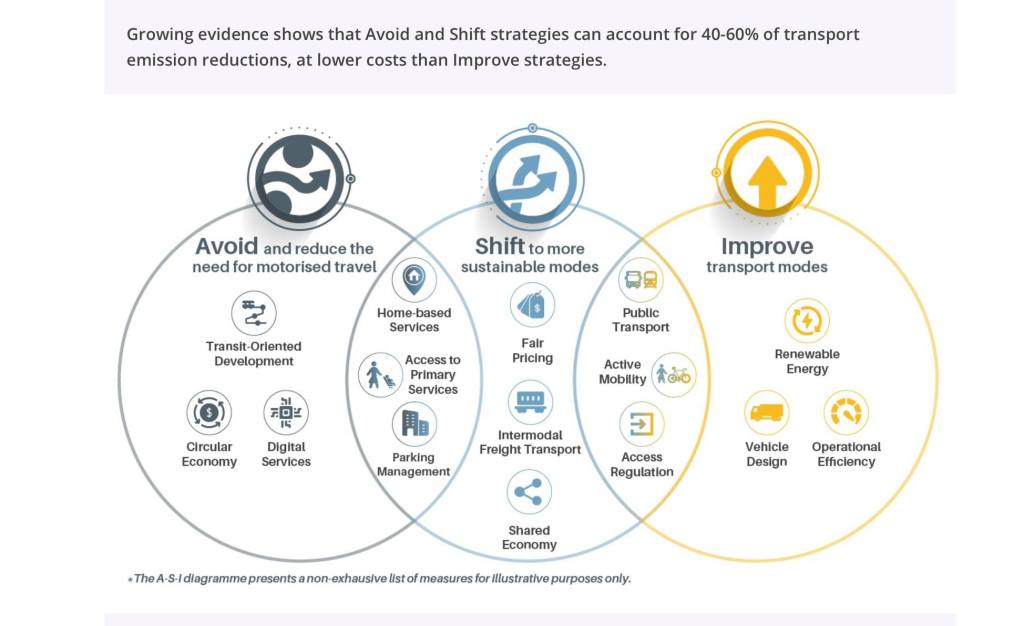
Note the overlaps among the three? Do you think its possible to have a measure that’s avoid, shift and improve at the same time?
Note, too, that if we contextualize this according to the Covid-19 pandemic, these measures even make more sense rather than appear like typical, ordinary measures we have about transportation. The pandemic revealed many weaknesses or vulnerabilities of our transportation system. We are presented with the opportunity to address these and implement certain measures that would have met with a lot of opposition before but can probably be rolled out now such as public transport priority schemes and protected bike lanes. “Work from home” is not really new since the concept has been proposed and implemented before but not as widely as was required by the pandemic situation. So perhaps we should take advantage of this forced reboot of sorts for our transportation system to be able to implement this A-S-I framework.
–
On step counts
Here’s a nice read about whether we need to reach 10,000 steps/day. We often hear or read about people asking how many steps you’re taking on average each day or lamenting or bragging about how many they’re taking each day. Perhaps we don’t really have to take so many? And maybe the key is really about our diets.
Apparently, there is really no need to reach that so-called magic number that is 10,000 steps.
Here is another article:
Landsverk, G. (July 9, 2021) “Forget 10,000 steps — here’s how much you should actually walk per day, according to science,” Insider, https://medium.com/insider/forget-10-000-steps-heres-how-much-you-should-actually-walk-every-day-db6699848f9c [Last accessed: 7/14/2021]
–
On car ownership and car use vs. public transport use
Here is another quick share of an article regarding car ownership and car use vs. public transport use. It is written in the first person as a the author relates her experience and what contradictory feelings she’s had with the decision to acquire and use a car.
Noor, D (June 21, 2021) “Buying a Car Improved My Life. It Shouldn’t Have.” Gizmodo, https://gizmodo.com/buying-a-car-improved-my-life-it-shouldnt-have-1847106068 [Last accessed: 7/10/2021]
I think many people in the Philippines (not just Metro Manila or other highly urbanized cities in the country) have similar experiences. They really don’t want to get a car or a motorcycle but their circumstances and the conveniences have outweighed their initial stand. Why do we need to have our own private vehicle anyway? Is it because its difficult to get a ride using public transport? Is it because of the quality of the ride? Is it due to health or safety-related reasons? In that last question, perhaps the fears of getting infected by Covid-19 present a overwhelming justification for car use and not just car ownership.
We also have to distinguish between vehicle ownership, car ownership and car use. ‘Vehicle ownership’ is a more general term that should include both motorized and non-motorized vehicles. Thus, if you have don’t have a car but instead have a bicycle, you are still a vehicle owner. Of course the term is more widely applied to motor vehicle owners but we need to expand this and distinguish between motor and non-motor vehicle ownership. Otherwise, let’s just be specific about the vehicle. ‘Car ownership’ is not equal to or does not correspond with car use. It is possible that one owns one or more cars or vehicles but does not use them at least for his/her regular commute. People in Singapore, for example, have cars. The same for people in Japan. However, most of these car owners choose to take public transportation most days. In their case, owning a car may not have improved their lives considering the excellent public transport services they have and requirements for people wanting to own cars in those places. Elsewhere, such as the Philippines, owning and using a car may provide better transport options depending not the circumstances of the person(s), even considering the costs of ownership and operations.
–
A night’s catch
I like going out early and taking a walk along the beach. Aside from the glorious sunrises and the views and sound of the waves, there are always other scenes and experiences that you only get to observe seaside. Among those is witnessing the arrival of fishing boats laden with the night’s catch. The boats are met by the families of the fishermen who help bring in and sort the fish. Here are a few photos from Laiya, Batangas.




–
 Caught (up) in traffic