
Not so fast…caution on data collection and reporting
I’ve seen posts where people have offered data on bicycle counts based on short period measurements (e.g., 5 to 15 minutes). They are quick to expand the counts to hourly values. So counting 10 bikes in 5 minutes (10 bicycles/5-minutes) is reported as 120 bikes/hour. I have seen some posts even stating that this was evidence of just how many people choose cycling for their commutes. While there is a significant increase in cycling volumes since last year (probably mainly due to the lack of public transport during this pandemic), their numbers still are quite low compared to both public and private transport users. It would be nice to know just how many people are cycling compared to pre-Covid levels. Here are some data I posted 5 years ago about traffic along the Iloilo Diversion Road where they have a wide bike lane along the northbound side of the highway. One wonders about the current numbers.
 Figure 1. AM Peak hour traffic along the Iloilo City Diversion Road (ca. 2016)
 Figure 2. PM Peak hour traffic along Iloilo City Diversion Road (ca. 2016)
It’s one thing to report and another to use the expanded value for modeling or analytical work. One basic reason why traffic scientists and engineers use the expanded value is because traffic volume is generally expressed in “vehicles/hour” as a standard unit. For certain purposes, this unit is converted to “pcu/hour” or “passenger car units per hour”. Flow rates may vary and are useful to describe the flow at specific times but the variation of flow is actually more important as this describes the behavior of traffic. I know, it reads or sounds like a car-centric unit of measurement, and it is. But that same comment can be made about currency and how the US dollar is being used rather than the Euro, the Yen, or the Yuan/Renminbi…if you get my point.
Perhaps a better argument is to use persons/hour/direction as the unit of measure if people cannot agree about using a specific vehicle type? That should be more acceptable to most people. But you need to have information about vehicle occupancies. Past studies in Metro Manila have established, for example, that on average the private vehicle occupancy is between 1.2 to 1.6 persons per car. This and other vehicle occupancies are multiplied to the various vehicle to estimate the number of persons in persons/hour/direction traveling along roads. This can be for the entire day or for peak periods. Note though that occupancy values will also vary according to time of day. The same calculations can be applied to rail and other modes as well.
The classic and popular graphic comparing the road space occupied by cars vs. spaces occupied by buses, motorbikes or bicycles, respectively is also inaccurate as these show capacity or the potential high value if certain modes are used. There will never be a 100% single mode choice especially for major roads like say the urban street network. Most people will choose their mode of transportation based on many factors including travel distance, time and cost. Those are the measurable factors. Others like comfort and convenience are also important and perhaps may have other factors substituting for them.
While I support cycling and the provision of bike lanes, there should always be a fair treatment of how data or information are gathered and presented. Otherwise, we are just misinforming people and generating hostility where cooperation or collaboration should be pursued instead. More work or effort towards convincing the general public and especially decision makers and movers in government and the private sector to effect changes in policies and infrastructure requires being collaborative rather than combative. That includes formulating ang communicating solutions rather than playing a blame game.
–
In defense of expressways
Expressways have been on the receiving end of criticisms and bad press lately mainly due to the recent much publicized proposal of a Pasig River Expressway (PAREX) by a private corporation. While I also do not agree with the alignment of this proposed tollway, I take exception to the generalization of expressways as sort of a manifestation of evil.
There seem to a lot of information being posted about and vs. expressways. However, it is important to sort through the hype as well as the misinformation that people tend to post about expressways. Yes, there are expressways being demolished or that have been demolished in other countries. These were probably so because they were ill-planned in the first place as are many other elevated pathways (e.g., poorly planned and designed footbridges), and many of the cities removing them have also developed their transport systems to be more efficient in terms of their people’s mobility. That is the case with Seoul and that certainly is the case for Tokyo. In fact, Tokyo had been moving their surface railways underground for the past decades. And now it seems they will be doing so for certain expressways. Does Tokyo have an efficient transport system? It does and perhaps is among the densest if not the most extensive rail and road system in the world.
It is important to have context to the matter. NLEX and SLEX, for example, were developed as relatively free-flowing, high capacity, high-speed roads that were the alternative to the national highways that directly connected many municipalities and cities. The latter had many intersections or junctions with other national roads as well as carry mainly local traffic including public transport such as tricycles and jeepneys. Expressways are built to be part of the primary arterial network and not as local roads. They are built for access rather than mobility.
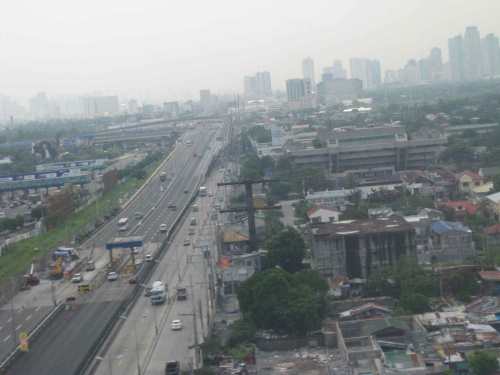 From L-R: SLEX, Skyway, and the East Service Road. The Skyway connects the NAIA-X to the left and the NLEX connector section onwards through. SLEX eventually becomes the South Super Highway, which is an urban street.
So, are expressways anti-pedestrian? Basically, no. Though they clearly were not developed or constructed with walking in mind. In fact, expressways are generally built along secured right-of-way and are limited access facilities. In the Philippines, all expressways are tolled; meaning you have to pay to use them. Expressways are built more for long distance travel and not for the shorter ones where walking is most appropriate.
Are they car-centric? Not necessarily so because they provide a less congested alternative for long distance transport of people (buses and vans) and goods (trucks). Would you rather take the Manila North Road (McArthur Highway) to Baguio City and endure over 7 hours travel time? Or would you take the 4-hour trip via 3 expressways (NLEX, SCTEX and TPLEX)?
Are expressways supposed to reduce traffic on local roads? Yes and no. Yes, because they actually do reduce traffic at the local level when you divert long distance travel to expressways. The math tells us there is subtraction there. However, it is a no in terms of local traffic increasing over time, which should not be charged to expressways, as they are a function of other elements coming into play including population increase and economic growth. This includes a contribution to induced traffic or new trips generated by the perception of infrastructure being adequate and having the capacity to cater to more trips that are not necessarily borne by cars.
Do we need more expressways? Probably, but not in the locations or alignments like the one proposed for PAREX. Incidentally, there is another expressway being planned that seems to have escaped the attention of those against PAREX. I am talking about the Laguna Lakeshore Expressway that will be a combination of at-grade (over reclaimed land) and elevated (viaduct over the Laguna de Bai) sections leading to heart of Laguna and towards Quezon province. But that’s another story…
–
Article on sustainable mobility
Here is a quick share of an article from Cities Development Initiative for Asia or CDIA. The title may already be quite cliche by now (i.e., along the lines of the slogan “move people, not cars”) but the message is clear and cannot be emphasized enough especially as people grapple with the impacts of the pandemic on transportation. For the reader, take note of the avoid-shift-improve framework, which is quite useful in describing what needs to be done in order to address the climate impacts of transportation systems.
Cities Development Initiative for Asia (April 22, 2021) “Sustainable Mobility is About Moving People, Not Vehicles,” cdia.asia, https://cdia.asia/2021/04/22/sustainable-mobility-is-about-moving-people-not-vehicles/ [Last accessed: 5/2/2021]
–
On building the ideal city from a transportation perspective
There’s a not so old article that popped in my timeline of articles I’ve read the past years. I thought I would make a quick share of it here. It is a good read and something that will never be irrelevant for as long as we have not redeveloped our cities and municipalities for transport equity and sustainability. Here’s a takeaway from the article:
“The ideal city is a place where lots of different kinds of people with lots of different amounts of money can live and work. It has to be easy to get around without a car, even for people whose bodies can’t ride bikes or hop over potholes, and for people who have kids to drop off on the way to work and groceries to buy on the way home, and maybe flowers to buy next door to the dry cleaner’s. These are places where people want to live, because it’s nice there. The fact that those places also adapt to and mitigate climate change instead of causing it is a bonus.”
Here’s the article from last year:
Rogers, A. (April 1, 2020) “Build Cities for Bikes, Buses, and Feet—Not Cars,” Wired, https://www.wired.com/story/cities-without-cars-san-francisco-jeff-tumlin/?bxid=5bd6761b3f92a41245dde413&cndid=37243643&esrc=AUTO_OTHER&source=EDT_WIR_NEWSLETTER_0_ENGAGEMENT_ZZ&utm_brand=wired&utm_campaign=aud-dev&utm_mailing=WIR_Classics_042921&utm_medium=email&utm_source=nl&utm_term=WIR_Daily_TopClickers [Last accessed: 4/30/2021]
–
On when to use masks when outdoors
Here is a useful graphic from the US Centers for Disease Control and Prevention. The graphic described situations for when masks are required. I don’t want to use preferred because it means people may opt out of using masks. It is a useful reference even for those in other countries that do not have enough clear information from their governments about wearing masks and how it helps protect vs. getting infected by Covid-19. It is applicable to people searching for a legit reference to mask-wearing in outdoor situations.
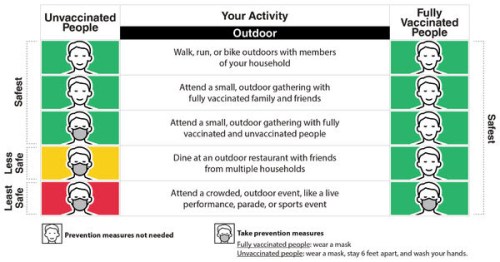
This information becomes more relevant as people start getting vaccinated and at the same time look forward to getting together with family and friends in social events such as eating out or having picnics. Of course, this also applies to exercise as well as commuting via active transport modes (i.e., walking or cycling).
–
Inter-island bridges in the Philippines – Nice to have but not necessary at this time?
A news article came out yesterday, reporting on the shelving of several inter-island bridge projects as well as the progress of only 3 projects include the Panguil Bay Bridge. Many of these projects have been conceptualized a long time ago but were being fleshed out through various feasibility studies.
https://www.bworldonline.com/bridges-fall-down-the-bbb-priority-list/
I’ve written before about these bridges, and had a healthy discussion among friends about the merits and demerits of such infrastructure when there are other, more urgent projects that would probably have higher impacts. One friend was involved in studying the connection between Panay and Negros islands, and had concluded that the cost can be justified by the economic benefits brought about by the bridge. I disagreed, stating the costs could cover modern urban transit systems at least in the major cities of Iloilo and Bacolod.
With limited resources and the likelihood of these projects being funded from various foreign loans make them unpalatable since these will mean more debt for the country. Also, these projects will benefit fewer people compared to other transport projects including modernizing public transportation and building bike lane networks. The latter kinds of projects are for daily commuters whereas the bridges are more for occasional travelers. What do you think?
–
Is there a supply problem with public transport in NCR plus?
I initially wanted to use “Philippines” or “Metro Manila” instead of “NCR Plus” for the title of this post. I dropped “Philippines” in order to be more specific and also because I am not so aware of the situation in other cities outside Mega Manila. I also decided vs. “Metro Manila” because transport for the metropolis is tightly woven with the surrounding areas where many people working or studying in MM actually reside. These include the towns of Bulacan, Rizal, Laguna and Cavite.
So, is there a supply problem with public transport in what is dubbed as NCR+? The photos in social media appear to describe a lack of public transport vehicles with many people lined up along major roads, queued at terminals or train stations. These photos do not lie where they were taken. Indeed there is a big problem about supply along certain corridors due to certain factors such as limited number of public utility vehicles (mainly jitneys and buses) allowed operation and health protocols that limit the passenger capacities of vehicles. The latter also applies to rail services where despite rolling stocks being back to pre-pandemic operations, are limited to the number of people they can carry. Crush loads are a no-no during these times.
Traffic congestion and its effects on PUV turnaround times, however, is another major factor for what may seem like a lack of supply. Most road-based public transport operate in mixed traffic. As such, their operations are susceptible to traffic conditions along their routes. So it is very likely that during the peak periods, PUVs get stuck along the peak direction and take much time to return despite the lighter traffic along the return trip. The problem for some routes though is that during peak periods both directions are congested. This further exacerbates the situation for public transport as vehicles would have to go through a two-way gauntlet of sorts, resulting in a lot of people taking longer to get their rides. And so for those who have access to private transport do go back to using private vehicles.
Definitely and obviously, there is a mode choice issue here because many people appear to have taken private transport as their mode of choice instead of public or active transport modes. This is mainly attributed to the perception that public transport is unsafe or less safe compared to your own vehicle in the context of the current pandemic. We qualify the current health situation here since that seems to be the main driver for people choosing to take their cars apart from that other perception of the poor quality of service provided by public transport in general. For active transport, the reality is not everyone or not a lot of people will choose to walk or cycle along roads that are generally regarded as unsafe despite efforts to put up bike lanes. Those who are having problems commuting are those dependent on public transport also because of their long commutes between the residential outside or in the outskirts of Metro Manila and the CBDs in the metropolis.
The dilemma here is determining which routes would actually require additional vehicles. While the general perception and temptation is to add vehicles everywhere, it’s the actual numbers that need to be estimated based on the information that needs to be collected (as against available data, which can be unreliable). The situation and the data for different routes varies much.
Case in point is the experience along the Antipolo-Cubao route that used to be served by jeepneys. Buses now serve that route after the government rationalized the service. Initially, there were fewer buses operating along the route that had a large catchment area for passengers. Additional buses were deployed in order to address supply issues (again many passengers were not able to get their rides for the same reasons we mentioned earlier). Now, there seems to be enough buses for the peak periods but a surplus during the off-peak. Passengers along other routes are not as lucky as those served by the Antipolo-Cubao buses.
Public transport operations will not survive such variations in demand if they continue to operate under the old “boundary” or rental scheme. So, there has to be a subsidy somewhere for them to operate under these conditions. And that’s where service contracting comes in. While I agree that this is essential for transport reform, we still have limited resources, and it will not be sustainable in the long run if we cannot make people take public transport over private vehicle options.
–
On how communities should be?
This post is related to my recent post about Philippine cities and municipalities already somehow being 15-minute units. I am sharing another article I’ve read and reread for its current relevance.
Litman, T. (March 15, 2021) “A Complete Community is All Mixed-up,” Planetizen, https://www.planetizen.com/node/112565?utm_source=newswire&utm_medium=email&utm_campaign=news-03222021&mc_cid=628c8ee4b1&mc_eid=9ccfe464b1 [Last accessed:
The article is loaded with references that you can download and use in research or practice. And there are these two tables – Walk Score Ratings and Public Amenities – that are quick guides or references to what is desired to be achieved in communities.
Enjoy!
–
On what local governments can do to improve road safety
Here is a very interesting article on how a small city in the US was able to reduce traffic deaths by investing in people-oriented transport programs and projects:
Kessler, E. (April 6, 2021) “EYES ON THE STREET: How Hoboken Has Eliminated Traffic Deaths,” StreetsBlog NYC, https://nyc.streetsblog.org/2021/04/06/eyes-on-the-street-how-hoboken-has-eliminated-traffic-deaths/ [Last accessed: 4/14/2021]
The article is pretty much self-explanatory. I won’t be commenting more about this except that many of the items mentioned can be taken on by many cities and municipalities in the Philippines. You don’t have to be a highly urbanized city with a big population and so much resources to come up with a plan and perhaps improvise in order to reduce costs of implementation. The most important thing is leadership since leaders like the mayor will be responsible for and making the critical decisions for the town. That is why he was elected in the first place, and the same goes for the other elected officials who are supposed to represent the interests of all their constituents and not just those who own cars.
–
If you build the bike lanes, will people use them?
The obvious answer to this question is yes. It is not so clear, however, how many will really be using these bike lanes over time. That needs data. That requires counting. And such data will be useful in order to understand, among other things, why people choose to bike or why they don’t. The latter is important to determine what factors are being considered by people who can switch to cycling particularly for commuting. Of course, there are many references for this from other cities and countries but these still need to be contextualized from our (Philippine) perspective. Case in point is Marikina, which has the most comprehensive network of bike lanes in the country. What are the numbers and what are the constraints and misconceptions? Did the city do its part to promote and sustain cycling?
Here is an article discussing the experience in the US:
Penney, V. (April 1, 2021) “If You Build It, They Will Bike: Pop-Up Lanes Increased Cycling During Pandemic,” The New York Times, https://www.nytimes.com/2021/04/01/climate/bikes-climate-change.html?smid=url-share [Last accessed: 4/9/2021]
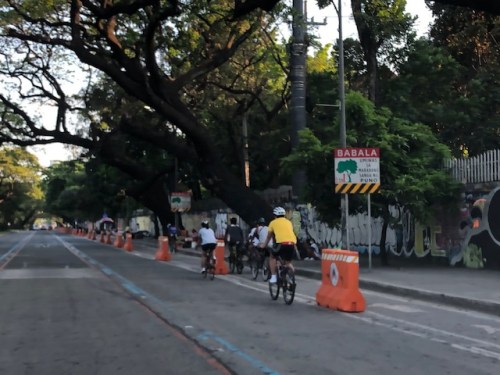 Bike lane along Katipunan Avenue (C5) in Quezon City
Here is the link to the paper mentioned in the article:
https://www.pnas.org/content/118/15/e2024399118
–
 Caught (up) in traffic