
NAIA Terminal 3 revisited
I was back at NAIA Terminal 3 to fetch someone who was flying in from Bacolod last Palm Sunday. Going around while waiting for the plane to arrive, I took some photos of the newer shops and restaurants in the terminal. Here they are with a few photos at the waiting area and outside the terminal.
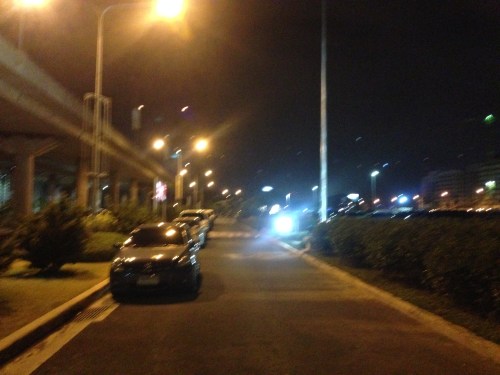 The overnight parking spaces were not yet full. It was a Palm Sunday so I guess many people haven’t taken their vacations yet. I remember fetching the wife one Maundy Thursday morning and the parking lot was just full of vehicles. I had to park at a slot that required some walking to get to the terminal building.
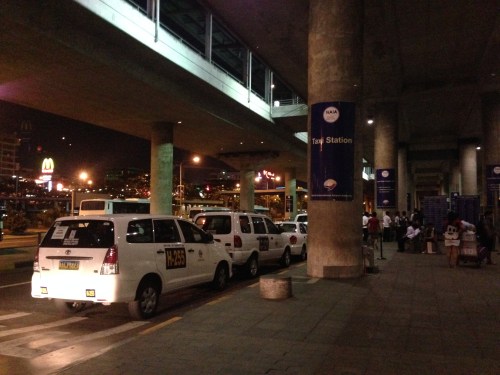 Taxi station at the arrival level of NAIA – only airport accredited taxis are allowed at this station and many, if not most, are not metered (i.e., do not have or use taxi meters). There is a dispatcher at the station and rates are basically higher than regular metered taxis.
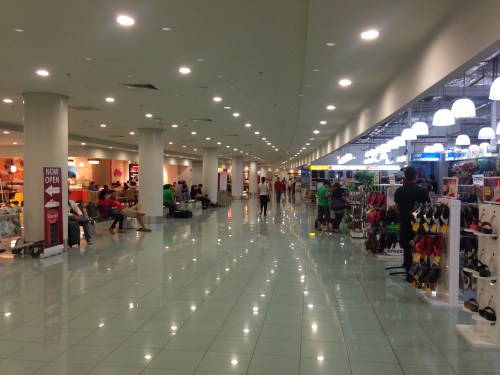 There are more shops, restaurants and cafes at Terminal 3. The old ones are still there but noticeable are the newer shops and restaurants when you explore the 3rd level of the terminal.
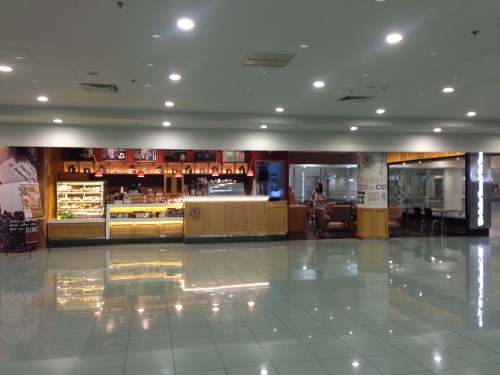 The Coffee Bean & Tea Leaf branch at Terminal 3.
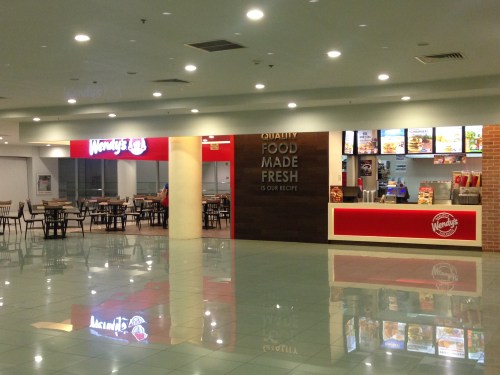 Wendy’s fastfood restaurant.
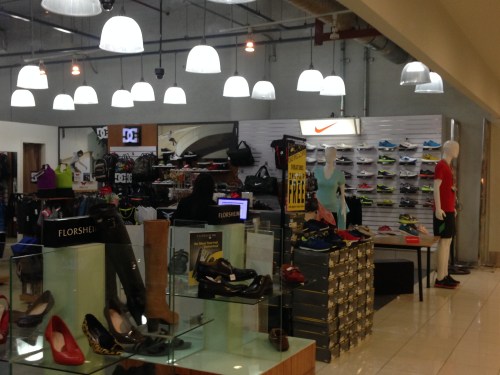 Shoes on display at one of the older shops at the terminal that offers a lot of different merchandise like luggage and apparel and accessories.
 Victoria’s Secret shop opening soon and likely before other international airlines move to Terminal 3 when renovations for Terminal 1 move to full gear.
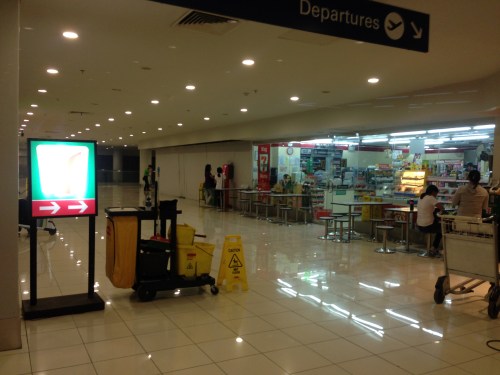 This Seven Eleven store is relatively new. There’s a Mini Stop store near the escalator to the 3rd level of the terminal.
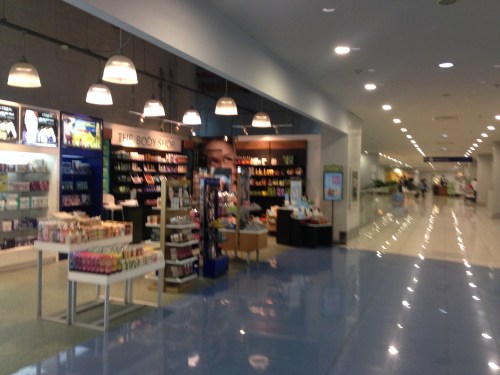 The Body Shop store.
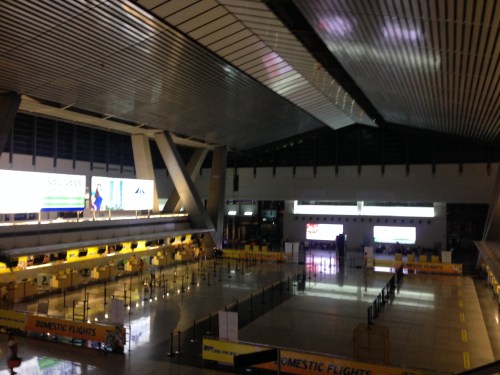 Not so many people at the Cebu Pacific domestic check-in counters around 8 PM. At this time, most domestic airports in the country are already closed as they are not equipped for night time operations. Thus, there are few flights at this time likely from the handful of modern airports – Cebu, Davao, Iloilo and Bacolod.
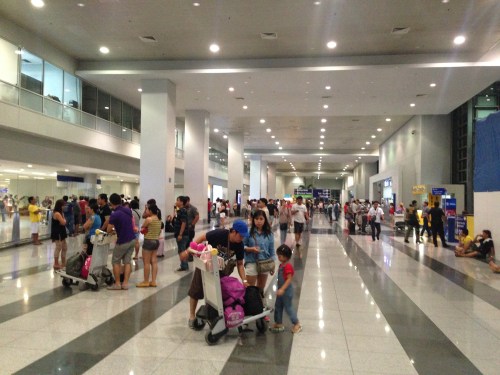 Well-wishers meeting arriving passengers at the spacious arrival area concourse.
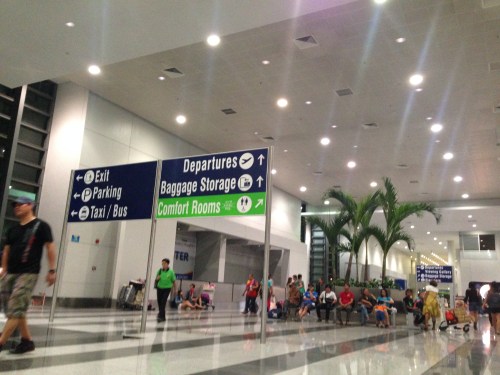 Signs provide directions to passengers and well-wishers.
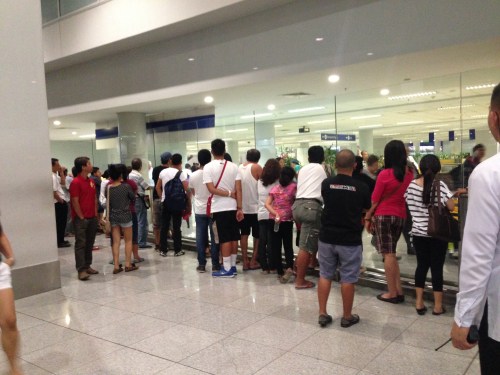 Crowds form at the exits to check passengers filing out of the arrival area. International passengers come out from the left while domestic passengers from the right.
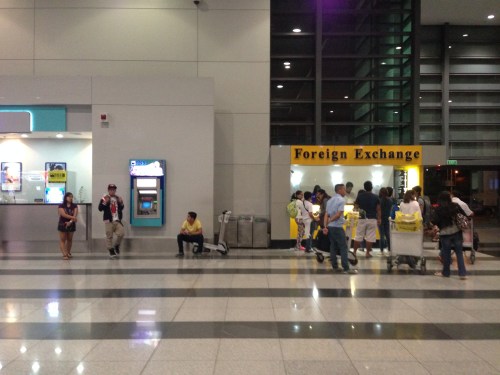 There are more foreign exchange counters now at Terminal 3 and this is likely due to the increased number of international flights served by the terminal.
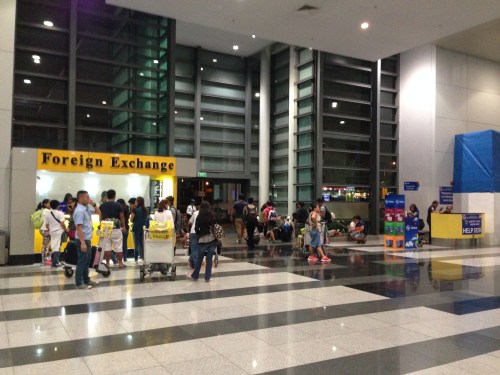 People go out of the terminal at one of the many exits at ground level. However, there are only two entrances to the terminal at the arrival level where security checks are made.
–
Daang Bakal
The right of way for the old railroad line going up to Antipolo is still there and is now a regular road. Daang Bakal rises from what is now Valley Golf Subdivision (Celso Tuazon Ave. and Taktak Drive) in Cainta, Rizal through Victoria Valley Subdivision (Taktak Drive), Fairmount Hills Subdivision and Hinulugang Taktak (Daang Bakal though often referred to as Taktak Road, which is actually a different road and on the other side of the river), and until part of the Sumulong Memorial Circle in the vicinity of the Antipolo Church (Shrine of Our Lady of Peace and Good Voyage). I took a few photos of Daang Bakal on our way to the Parish of the Immaculate Heart of Mary for Palm Sunday Mass. The photos have been modified as I took it at dusk. The originals were quite dark so I adjusted the brightness. Still, I can only imagine now how this route could have looked like back in the day when the Manila Rail Road line passed through this area. It could have been one of the most scenic rides as it is still a scenic route today.
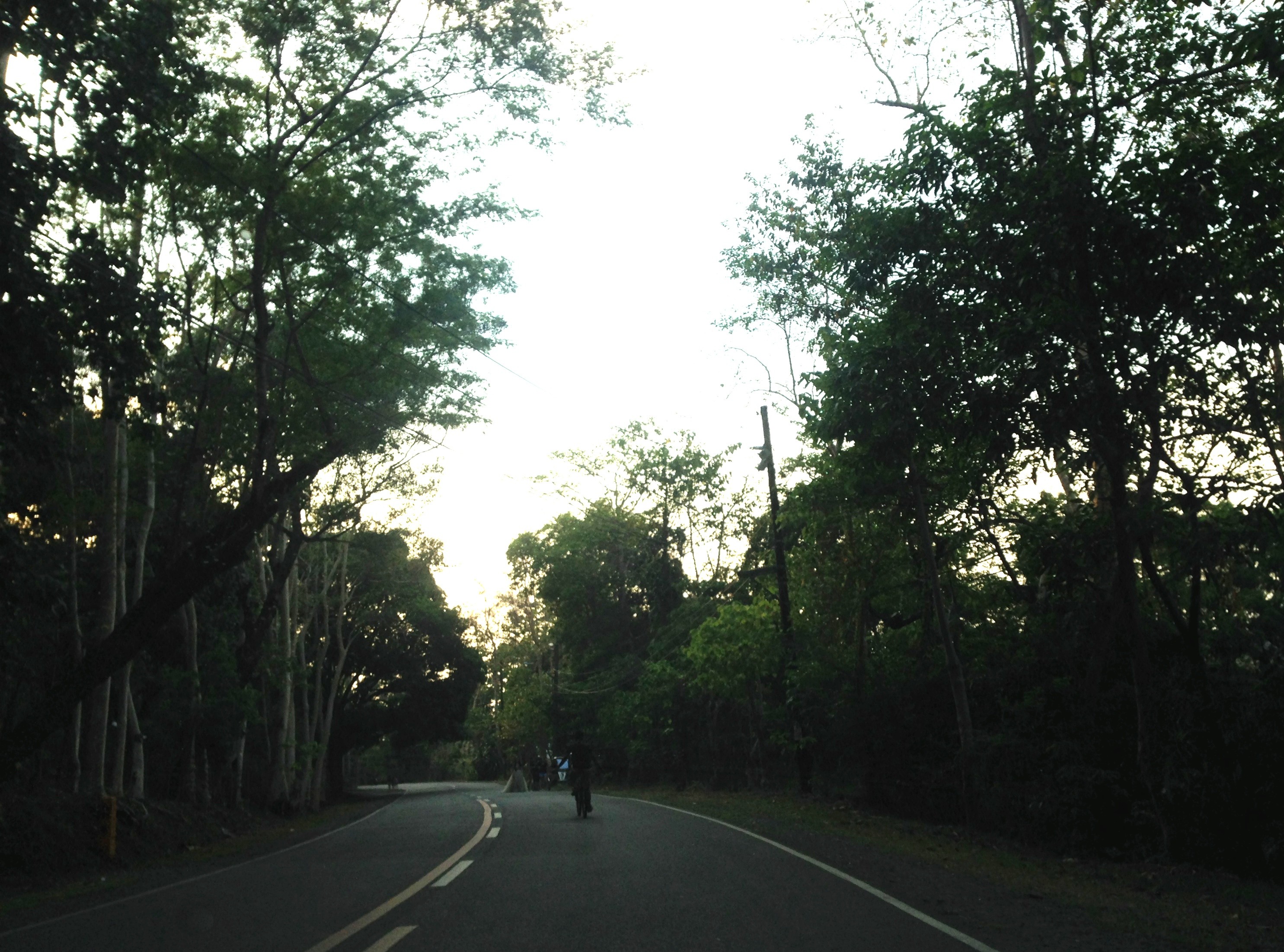


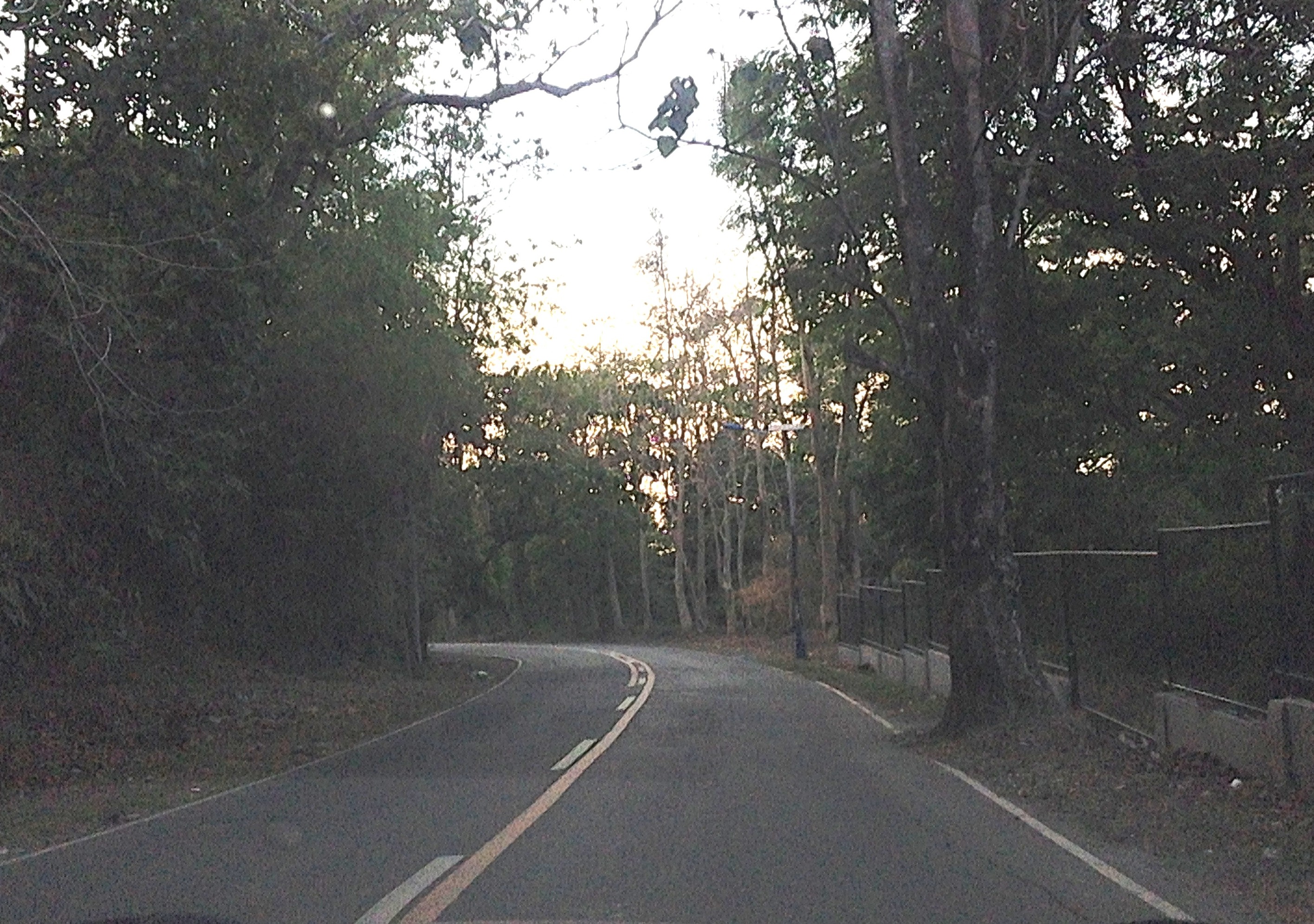
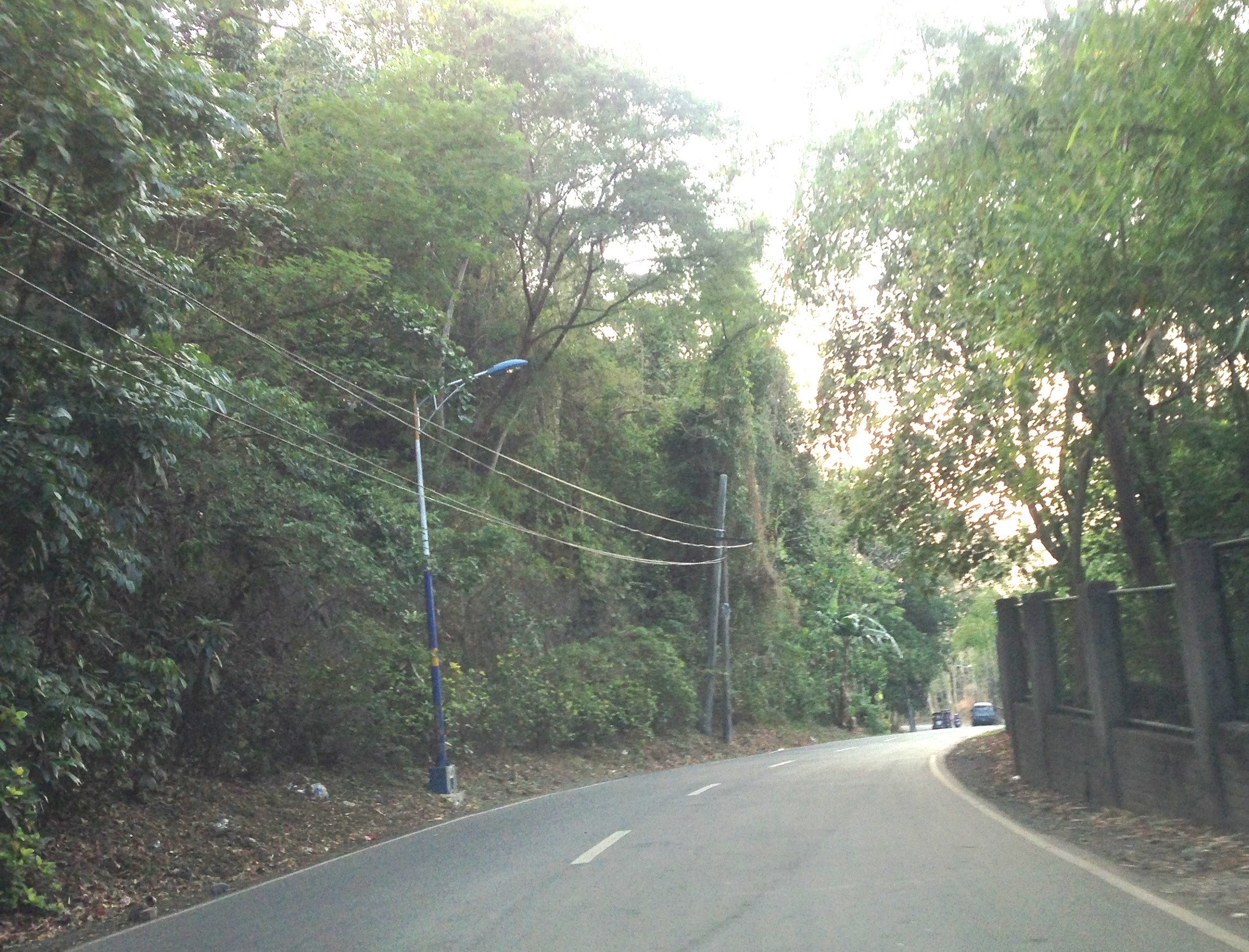
At right in the photos is a fenced property designating the Hinulugang Taktak National Park. Hinulugang Taktak refers to the water falls that used to be one of the more popular destinations in Antipolo. There is actually a popular folk song inviting people to come to Antipolo (“Tayo na sa Antipolo at doon maligo tayo…”) to enjoy the falls. The falls have deteriorated through the years as it has been affected mainly by the settlements around it. There seems to be an effort to rehabilitate the area but it is still closed to the public. The road though is in excellent condition and has low motor traffic volumes. It is popular among cyclists as well as joggers. This Holy Week, the area should have a lot of visitors because of the Parish church in the area, which has an impressive architecture and gardens. The church is perfect for those doing Visita Iglesia or perhaps people just wanting to go to a quiet place for some meditation and prayer.
–
Traffic consultants for Philippine cities?
I was driving to the office one morning, and as I was slowing down to stop at the Masinag junction I spotted a familiar face giving instructions to Antipolo traffic personnel. Robert Nacianceno was formerly the General Manager (Undersecretary level position) with the Metropolitan Manila Development Authority (MMDA) when it was chaired by Bayani Fernando, the first MMDA Chair to gain a cabinet level post (previously the MMDA Chair was not a Secretary level position). He was in an office barong while leading Antipolo staff in positioning orange traffic cones to mark the lanes for turning traffic along the Sumulong Highway approach from Antipolo.
Nacianceno is a cyclist so I would like to think that he can take that perspective in transport planning and traffic management for Antipolo. Unfortunately, his track record at the MMDA does not provide strong evidence as to his competence in transport planning or traffic management. Insiders say most policies and schemes during BF’s time was the latter’s ideas (e.g., U-turns, bike lanes, etc.) and he had his own consultant (and reportedly an inner circle) for various matters including traffic. In fairness to the man, Nacianceno probably has tremendous experience on the job but one has to note that there were other people with the MMDA who also dabbled in transport and traffic. Also, as GM he had other things to attend to during his stint including waste management and flood control.
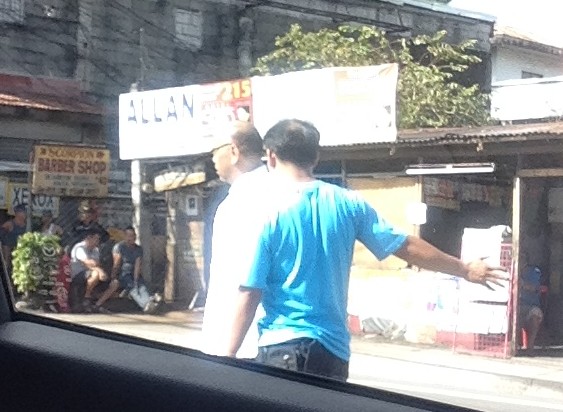 Remember this guy? He used to be the MMDA GM during BF’s stint at the agency.
I recall that the previous traffic consultant of Antipolo City was also a former MMDA official, Ernesto Camarillo. Unfortunately, I couldn’t say that Antipolo traffic improved during the last few years. Based on what I have seen in my daily commute, transport and traffic conditions have degenerated. Antipolo is overrun by tricycles and people generally do not follow rules and regulations. Informal terminals dot the city and you don’t have to go far to find inappropriate terminals as these are in plain view and across from the Rizal Provincial Capitol. Antipolo has a new mayor in the former Rizal Governor and his mother now sits as governor of the province. I’m crossing my fingers as to how they will improve transport and traffic in Antipolo if there is really a desire to do so. For starters, is there a transport and traffic plan for this Highly Urbanized City (HUC)? There should be one as the city needs it badly together with a land use plan to bring some order in development.
Antipolo is rapidly developing but at the same time conditions (including traffic) are also rapidly deteriorating. Hopefully, the LGU will address these issues and eventually make this city a modern one and fit for its being an HUC as well as a popular pilgrimage site for decades if not centuries due to the Shrine of Our Lady of Peace and Good Voyage (Is there some irony here?). Nacianceno’s work has just started and I hope he is up to the challenge of bringing order to Antipolo’s chaotic transport and traffic situation. I hope, too, that he will take note of good practices in other cities (Philippine or foreign) and won’t be relying purely on his experiences in Metro Manila. And hopefully, whatever improvements from the traffic schemes he will be introducing and implementing will be felt immediately by travellers. Good luck!
–
Quiapo traffic
Fridays in Manila are associated with Quiapo and the devotion to the Black Nazarene. People flock to Quiapo Church to hear Mass or pray at the Basilica, which is arguably among the most popular for Roman Catholics. Fridays are regarded as feast days dedicated to the Black Nazarene and since many people go to Quiapo Church throughout the day, there is almost always traffic congestion in the area. These days, however, any weekday is a congested day in that area what with more vehicles and more people coming to this area or just passing through.
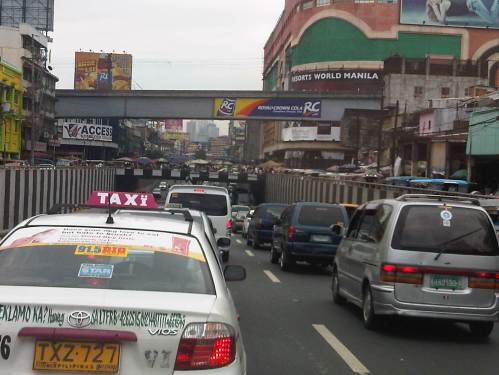 Espana Avenue ends at its junction with Quezon Boulevard and turning left leads the traveler to the Quiapo District. The photo shows heavy traffic along the underpass and the elevated LRT Line 2.
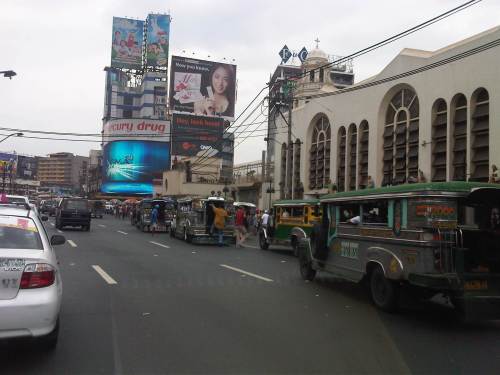 Quiapo Church is just beside Quezon Boulevard and jeepneys loading and unloading passengers occupy up to 3 lanes nearest to the church.
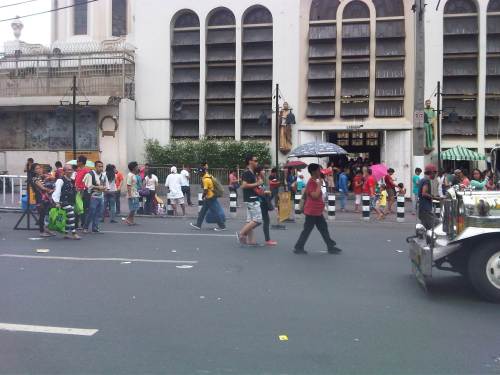 There is a door at the side of the church along Quezon Boulevard and people seem to be everywhere even the middle of the road as they walk or wait to ride a jeepney.
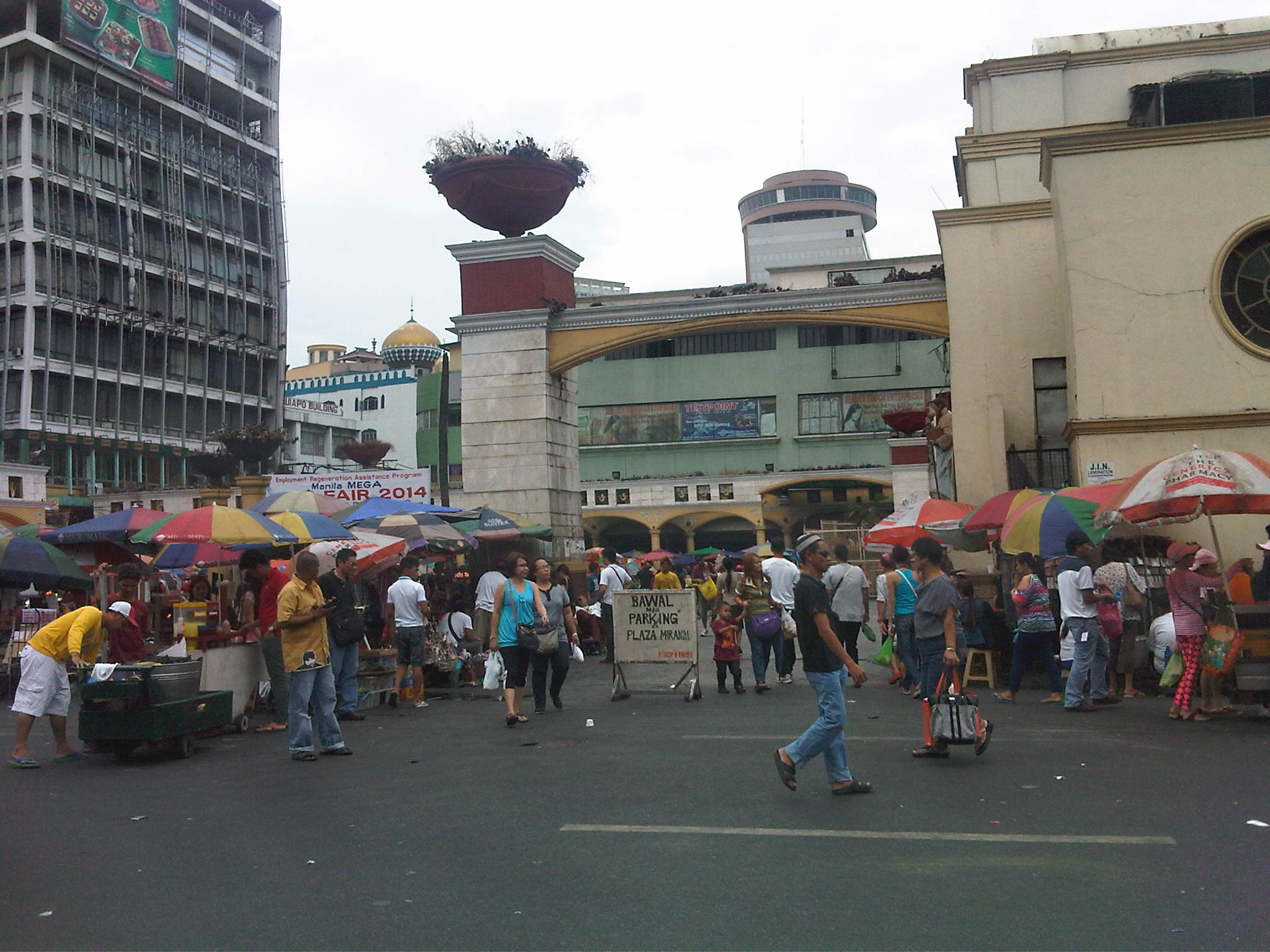 Historic Plaza Miranda in front of the church is witness not only to a lot of the frenzied processions during the feast day of the Black Nazarene every January. Plaza Miranda has also been a venue for many political rallies including the infamous one in the early 1970s that was among the triggers for Martial Law. On “normal” days, the plaza is home to vendors, fortune tellers and other denizens of this area.
There are other popular churches around Metro Manila that attract a lot of people throughout the year and not just during feast days. Among these are Baclaran in Pasay City (Our Lady of Perpetual Help), St. Jude in Manila, Sto. Domingo in Quezon City, San Agustin and the Manila Cathedral in Intramuros, Manila. Nearby in Antipolo is the Shrine to Our Lady of Peace and Good Voyage. These churches are among the busiest especially on certain days of the week (e.g., Wednesdays are for Baclaran, etc.) and with the coming Holy Week, a lot of people are again expected to flock to these churches for the Visita Iglesia tradition. Hopefully, these devotions are really a manifestation of faith rather than the pretentious kind where the road trip is more touristy than religious or prayerful.
–
Future fare collection for jeepneys and other modes?
In the last Electric Vehicle Summit held in late February this year, I noticed a conspicuous device installed in the electric jeepney unit that was on display at the venue. The device is for electronic payment of fares; using a card much like the ones being used in other countries like Singapore and Japan, and soon, hopefully, for the LRT and MRT in Metro Manila. Such a capability has a lot of potential including a very convenient way to pay fares for public transport in Metro Manila. Other potential uses would be for payments of items bought at stores or shops (or vending machines) like Japan’s Suica card. Users would just have to “top up” or load their cards for these to be used in their commutes or purchases.
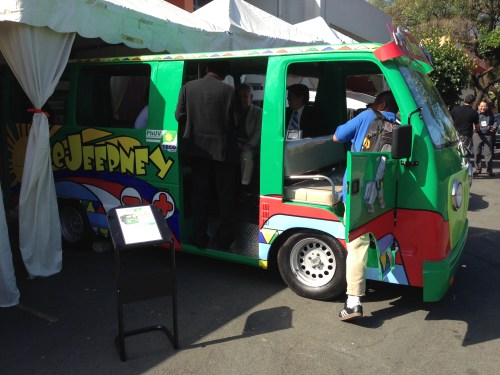 The latest e-jeepney model features a side door instead of one at the rear.
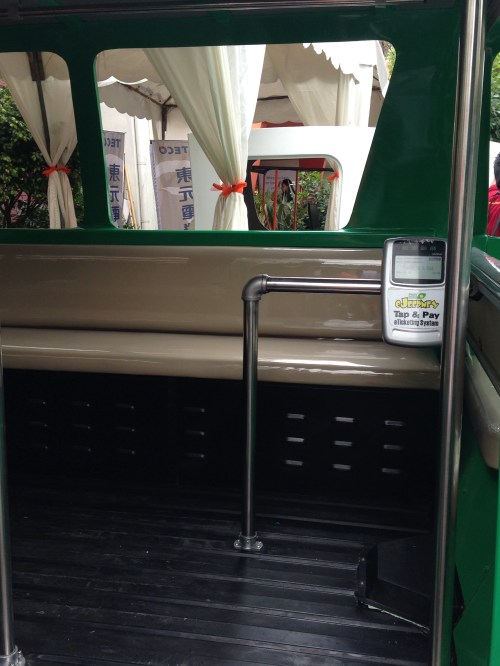 Boarding passengers will encounter device upon entering the vehicle. The current technology available should soon enable passengers to use “tap” cards to pay for their fares.
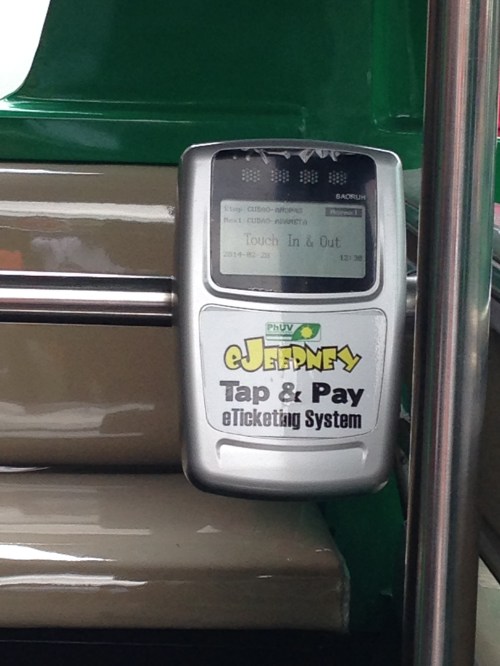 Such a device will leas to a more efficient fare collection and eliminate the need for “conductors” or persons assisting the driver in taking passengers’ fares. These should also allow the driver to focus on driving rather than be distracted by fare collection including trying to keep track of who has paid and who has change due. This would likely translate into safer travel for most people.
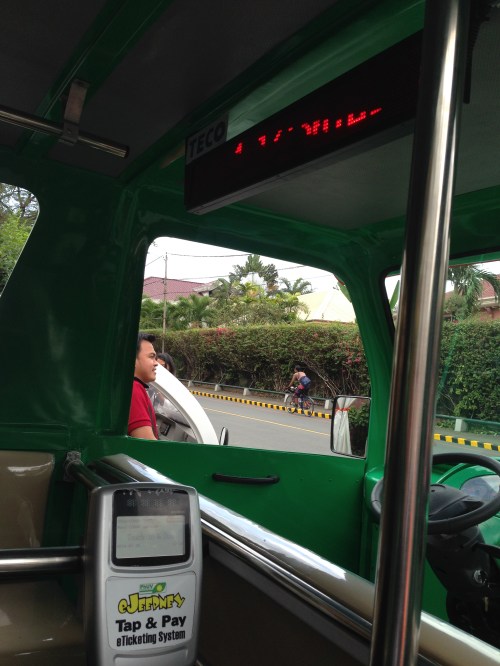 Electronic boards at the top behind the driver can provide travel information such as the next stop or traffic conditions along the transit route. Such information can be derived from various sources including the MMDA or local governments as well as from crowd-sourcing.
–
Driver’s personal insurance?
A friend of my father-in-law approached me to ask if there have been studies on requiring Philippine drivers to get personal insurance before being issued a driver’s license. I replied that I am unaware of any study or studies on this topic. I told him, though, that there have been discussions to require bus and trucks drivers to get certification from the Technical Education and Skills Development Authority (TESDA) to drive these large vehicles. The certification is the same required in other countries for foreign drivers seeking working in those countries. And so, prospective OFW drivers would have to take up the certification course at TESDA in order to qualify as drivers in other countries. These discussions were made at DOTC together with the LTO and the TESDA prior to 2010. Since then, I have no knowledge if such discussions were continued or if someone or some group pursued this. Based on what we see now on our roads where buses and trucks have been involved in many road crashes, I can only conclude that the certification initiative was not pursued for one reason or another.
The reason I was asked whether there were studies on the topic of driver insurance is that the person is part of a group (he didn’t reveal it to me and I didn’t ask him about the name) seeking for a bill to be filed for this insurance to be required prior to being given a license to drive. He told me that this is based on the system in the US, where prospective drivers are required to get insurance as a prerequisite to being issued a license to drive. The premium for the insurance is dependent on the record of the driver and increases significantly with the person’s involvement in a road crash where he or she is proven as the guilty party. The premium also increases when drivers are found to have violated traffic rules and regulations, and the data based on citations or tickets issued by apprehending officers are transmitted to the Department of Motor Vehicles (DMV), which is the equivalent of our Land Transportation Office (LTO). The idea is for drivers involved in crashes or frequently violated traffic rules and regulations to be charged a higher premium until a point when there will be no legitimate companies willing to insure the driver because of his record. Alternatively, the driver might be forced to give up on driving because he or she could no longer afford the steep premium resulting from his/her own actions on the road.
This is actually a good idea and one that probably is worth looking into in more detail by our LTO if it is to use this as a way to reduce errant drivers on the road. I would propose that higher premiums should be required of public transport drivers who would be responsible for a lot of lives. Truck drivers can have their premiums dependent on what kind of trucks they drive. Perhaps higher premiums are for those driving tankers or lorries carrying sensitive or high value freight. The bottom line, of course, is how such a system can be operationalised or implemented. There is also that thing about enforcement and the sharing of information between apprehending entities (e.g., PNP, local police or local government staff) and the LTO for the data required to assess a driver’s record whenever he or she renews his or her license. There will always be loopholes and/or fixers somewhere but these should not deter the authorities from seeking a better system than what we have now where drivers can “get away with murder” sometimes quite literally.
–
120-passenger capacity AGT prototype
The DOST-MIRDC has built another prototype vehicle for its Automated Guideway Transit (AGT) project. The vehicle is larger than the one at the University of the Philippines Diliman as each vehicle would have a capacity of 120 passengers (seated and standing). They are also building another elevated test track at the MIRDC compound across from the main DOST compound in Bicutan, Taguig City, and along Gen. Santos Avenue. This is a significant upgrade from the 30-passenger capacity vehicles at UP Diliman (60 for a 2-car train) as a 2-car train with 240 passengers means much more capacity for a real line using such vehicles. To compare, 5-minute headways along one direction could carry 720 passengers per hour for the UP Diliman prototype while the Bicutan model can carry 2,880 passengers per hour.
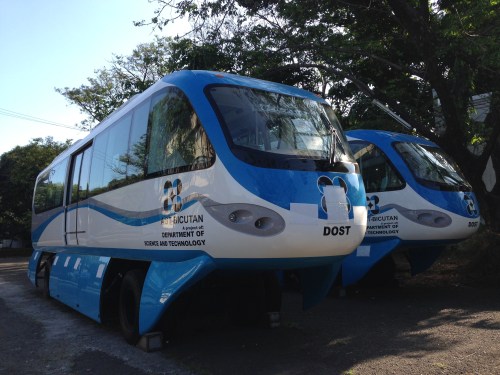 Two prototype AGT vehicles with maximum capacity of 120 passengers at the MIRDC compound in Bicutan, Taguig City.
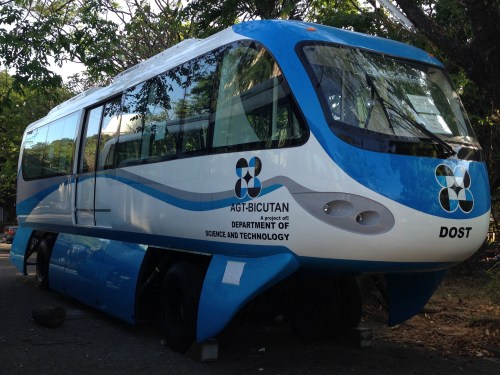 The design is very much the same as the first prototype vehicle, with its distinctive look including the snout, headlights and skirt.
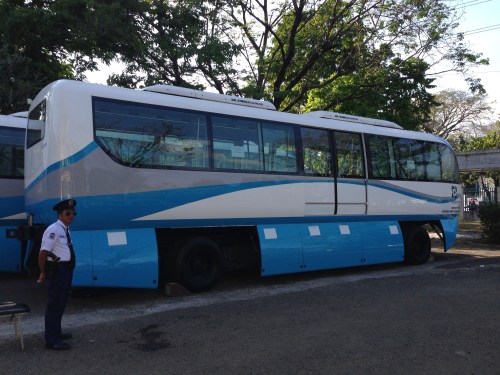 The vehicle looks like it was inspired by the large provincial buses that, if seats are configured as benches and the body is stretched to be longer, can accommodate more passengers.
 The MIRDC is also building a test track in Bicutan within their compound and parallel to Gen. Santos Avenue.
I don’t know how long this elevated test track will be but to be able to have substantial tests for the new vehicles this should be longer and would need to be extended beyond the MIRDC compound. That means the tracks would pass through land occupied by the Polytechnical University of the Philippines (PUP), which is a state university, and Camp Bagong Diwa, which is under the Philippine National Police. Can this line serve the areas along Gen. Santos Avenue? I think so but it will be competing with tricycles and jeepneys. Tricycles are the dominant public transport mode here despite Gen. Santos being a national road. Taguig City would have to find a way to address issues pertaining to a reduction or phase-out of tricycles as the communities in the area might be dependent (unfortunately) on these for their livelihood.
–
DPWH and DOTC merger
I had posted on one of my social media accounts about the idea of a merger of the Department of Public Works and Highways (DPWH), Department of Transportation and Communication (DOTC) and Housing and Land Use Regulatory Board (HLURB) to become the Department of Land Use, Public Works, Transportation and Communication or DLUPWTC (that’s definintely a mouthful). While it was April Fool’s, I got a lot of comments agreeing with the idea. One friend even gave a short history review noting that DOTC used to be DPWTC and what is now DPWH used to be DPH.
The idea of a merger of agencies is not a new idea nor is it a novel one if you look at the potential more closely. In fact, the Japanese already did such mergers many years ago when they created “super ministries” in the Ministry of Economy, Trade and Industry (METI) and the Ministry of Land, Infrastructure, Transport and Tourism (MLIT) and the Ministry of Education, Culture, Sports, Science and Technology. These would be like merging the NEDA, DTI into one agency, the DPWH, DOTC, HUDCC, HLURB into another agency, the DepEd, CHED and DOST into a single entity. Such was undertaken in order to promote efficiency in government services in Japan by streamlining the bureaucracy among agencies that are supposed to have strong linkages if not overlapping responsibilities.
This idea makes sense for the DPWH and DOTC, and more so now that there seems to be a dearth in leadership over at the transport department while the public works and highways department is enjoying a resurgence, revitalized by a strong secretary. While these two agencies have cooperated for the longest time, much is still desired for a seamless collaboration where DOTC might serve as The Planning Agency while DPWH might be The Implementing Agency. They would probably work best under the guidance of a single strong leadership who would have a vision for a much improved future transport for the country and a knack for how to realize this vision.
Think about it and suddenly its not a joke worthy of April Fool’s Day.
–
“Sharing the road” – bandwagons and fads? Let’s hope not!
There seems to be a lot of talk about “sharing the road” and the initiatives to have more bikeways. I hope I am proven wrong but it seems to me as if these current programs and projects are more of a fad. A lot of people (and local governments) join the bandwagon with little understanding of what needs to be done. It’s usually because of the good PR they get out of these that they agree to coming up with the token carless street or the haphazardly implemented bicycle lanes. More than PR, some cities are aware of the opportunities that come with such initiatives as international agencies and groups are willing to spend money to support such programs and projects. The question really is on sustainability and doing the right thing not only on initiating things or coming up with programs but on the substance itself. And by substance I mean that programs should also go into the details of designs. Too often, the “pwede na yan” approach is taken and this just won’t do.
 The MMDA painted the sidewalks in White Plains and designated them as bikeways, in a way alienating pedestrians.
A vision for what people want to have is there but it is ultimately how the achieve the vision that needs a lot of work. For example, bills are being filed in congress to force the creation of bicycle lanes along major highways. (And mind you there are a lot of similar bills filed in congress that upon closer inspection actually have little substance.) The premise here seems to be that if you build them then people will start cycling. That was not the experience in Marikina, which boasts of the country’s only bikeways network that includes many off-street sections. These bikeways were built at a time when the perception and analysis pointed to a critical mass of cyclists in that city that was thought to be surely the tipping point in terms of non-motorised transport. Nowadays, the same bikeways are used by motorcycles and tricycles and most cyclists we see are not commuters (e.g., cycling between home and work/school) but recreational cyclists. It would take Marikina some effort to promote commuting by bicycles and much effort in enforcement to correct the misuse of the bikeways. The “new” bikeways in Quezon City appear to be poorly conceptualised as the MMDA decided to paint the sidewalks along EDSA northbound without addressing the obstacles like electric posts. Still, it is an effort to put NMT in the consciousness or awareness of the general public (thanks in part to media’s making these news worthy items).
Cities like Pasig and Taguig like to show-off Ortigas Center and Bonifacio Global City, respectively, as their faces when in fact the cities have not done much in their original cores. The running joke is that the real Taguig is not the areas to the west of C-5 but the old Taguig, which is to the east. This Taguig is the one plagued by narrow streets and the proliferation of tricycles. It was not so long ago that a former mayor imposed e-tricycles on BGC (where they were not suitable) while not doing much to lift a finger in the mayhem of tricycles in old Taguig (e.g., along Gen. Luna). As for Pasig, you just have go along the Pasig River and the Manggahan Floodway to see what it has accomplished so far in those areas.
There are no quick fixes to the transport and traffic problems our cities are facing. In the case of Metro Manila, much is at stake for the long-delayed mass transit projects. And the DOTC’s announcements of projects being formulated or proposed are no longer taken seriously as they have not delivered on any of these despite 4 years of this current administration. For other cities, it is important to learn the hard lessons from the experience of Metro Manila. There is also a need for a drastic change in transport and traffic policies in our cities. Iloilo, for example, has built an expensive bike lane along Ninoy Aquino Avenue (Diversion Road) and has marketed its Esplanade as a haven for pedestrians and cyclists. Yet the city has not acted on the clamour to revisit the overpasses along Gen. Luna (Infante and Jalandoni flyovers). The latest information I got from the city is that there are issues in the design of the bikeway along the Diversion Road as the surface (they used pavers) is not suitable for cycling. It seems, also, that the city and cyclists were not consulted by the DPWH when the bikeway was designed and constructed resulting in many cyclists using the Diversion Road itself for traveling. This last example is a lesson for our local governments and national agencies that they need to cooperate with each other and turfing has no place in transport and traffic if we are really serious about bringing solutions to problems we encounter everyday.
–
Public transport fare hikes
Bus and jeepney groups often demand for an increase in the fares every time there is an increase in the prices of fuel. The latest one is mentioned in this article via Rappler, where a jeepney group is to hold a protest caravan as they seek a discount on diesel for all public utility vehicles. The reaction from readers is an overwhelming “Annoyed.” And rightly so because while these protests appear to be noble and are often linked by jeepney groups to petitions for fare hike increases (i.e., asking for fare increases if they cannot be given fuel or petroleum product discounts), closer scrutiny of operating costs will reveal flaws in their arguments for fare hikes and discounts. These same flaws also reveal why government agencies charged with public transport franchising and regulation (i.e., DOTC and LTFRB) should have the data and tools for a fair assessment of fares (pun intended).
Data from field surveys conducted quite recently (NCTS, 2012) show us that jeepneys typically average around 3 to 4 km/L on diesel fuel. This is a very low value that is comparable to the income from passengers for one trip over a distance of say 4 km. A fully-loaded jeepney with an average of 20 passengers (9 on each bench plus 2 beside the driver) operating a 4-km route will 160 pesos. However, there are limited reliable information or data on other costs such as maintenance costs and other items including “boundary” and “dispatching.” The boundary is basically a rental fee for the use of the vehicle while jeepney groups charge a fee for dispatching vehicles from the terminal or stop. In a day’s operation, such costs could easily accumulate into a significant total that would eat up a day’s income, usually leaving the driver with just enough to bring home to his family.
This brings us back to the argument against transport being treated as livelihood rather than a service. Many operators or owners of public utility vehicles, whether they have one or more units, tend to scrimp on the maintenance of their vehicles. Poor maintenance manifests in the form of smoke-belching and frequent breakdowns. While smoke-belching contributes to the deterioration of the environment and health costs, breakdowns often lead to road crashes (e.g., tires flying off, problems with brakes, etc.) like the recent bus crash in the Mountain Province where faulty breaks were blamed for the crash.
Jeepney groups often raise issues on the plight of small operators who are usually the drivers of the jeepneys themselves. Many of these people should not even be operating or driving jeepneys in the first place because safe and efficient service is not their priority. Service is second only to the desire to generate income, to earn a living, which makes them drive the way they currently do (i.e., recklessly) and improperly and haphazardly maintain their vehicles. There is seldom serious talk and little done to protect the interests of people who take public transport. These are the same people who are often shortchanged with the poor quality of public transport in our cities and have long suffered for this. Let us hope that the LTFRB will be guided as they decide on this matter of fares and furthermore for the agency to study the state of road public transport franchising in order to weed out people and groups who do not deserve to be operators. I believe there is more than enough data or evidence against such operators if the LTFRB truly wants to reform the system.
–
 Caught (up) in traffic