
Transport in the State of the Nation Address 2013
The President of the Republic of the Philippines delivered the State of the Nation Address (SONA) last July 22, 2013. The SONA is for the mid-term as 3 years have passed since the current president was elected into office. The address was most awaited by a lot of groups. These include allies of the administration and those who have been critical of the administration. For the latter group, they would have been interested to see/hear what the SONA will report on for what seemed to them was a slow pace in the introduction and execution of reforms as well as the slow implementation of programs and projects including those regarding transport infrastructure. Of course, there is not a short supply of sycophants in Congress as in the past administrations, who would easily clap their hands at the slightest hint of accomplishment that is mentioned in the SONA. I pity their constituents who are responsible for voting them into office.
While the speech mentions a lot of gains in all fronts of the so-called war against corruption following the administration’s policy for “matuwid na daan” (straight path), the details or information most useful for people dealing with policy and technical assessments are found in the SONA Technical Report. This report is supposed to have been written based on the inputs provided by government agencies and is a more comprehensive, if not the most comprehensive, material documenting what has been accomplished so far. More importantly, it is supposed to contain material on what the administration looks forward to seeing through until the end of its term in 2016. There is the opinion that it would have been better if the report and the speech followed an outline similar to the Medium Term Philippine Development Plan (MTPDP 2011-2016) so that the reported accomplishments can be placed side by side with what the administration set out to do at the start of its term. Then, it would be possible to gauge clearly where we are and if indeed we are heading towards achieving our targets by 2016.
The transcript and video of the 2013 State of the Nation Address may be found in the Official Gazette of the Republic of the Philippines. That link is for the speech delivered in Filipino and a translation in English may be found through a link right after the end of the transcript. Similarly, there is a link SONA 2013 Technical Report found after the link to the translation.
Streets of Intramuros: Solana Street
I’m posting more photos of the streets around Mapua and Lyceum. Solana Street is behind Mapua and practically runs parallel to Muralla Street. The southeast end of the street is at its junction with Victoria Street at the Manila Science High School while the northwest end is at the junction with Muralla St. and Andres Soriano, Jr. Ave. at Plaza Espana, where located are the ruins of the Maestranza and the Intendencia.
 Intersection of Solana Street with Beaterio Street with an informal pedicab terminal at the corner.
 Real Street (view towards the southwest) as seen from Solana Street
 A newly built or renovated building is at right across from Mapua. There are many buildings hosting dormitories or rental rooms for students in the area. This is similar to buildings near institutions in the University Belt area where now stands many high-rise condominiums also catering to students.
 Intersection of Solana Street with San Francisco Street (left), which leads back to Muralla Street and the Lyceum.
 Intersection with Sta. Potencia Street – we caught an amusing sight of these two people who appear to be compacting the asphalt concrete transition between Solana’s lower pavement surface elevation with the Sta. Potencia’s new PCCP.
 Vehicles parked along Solana Street and behind the Mapua Institute of Technology
 Approaching the intersection with Victoria Street, one sees many signs of businesses geared towards the academic nature of institutions in the area (e.g., photocopying, bookbinding, computer rentals, etc.). The building on the left is Mapua’s while the ones on the right include dormitories or rental apartments on the upper floors.
–
Swapang! or the perils of walking
Walking to the jeepney terminal for a ride to the university, I was irritated by the constant honking behind me as motorcycles rode up the sidewalk to avoid the weaving into congested traffic along Aurora Boulevard. And so I tried to stand my ground allowing only half the space of the sidewalk for these motorcycles to pass through. As far as I’m concerned, I was already too generous giving part of the space that is for pedestrians and not for motorized traffic. Still, there were a few motorcyclists who seem to think they had the right of way as they attempted to convince me give up more space so they could practically take over the sidewalk. I didn’t give way and assumed they were cursing me inside their helmets. Manigas sila! I thought that in the end, sila ang asar at talo in this situation, not me.
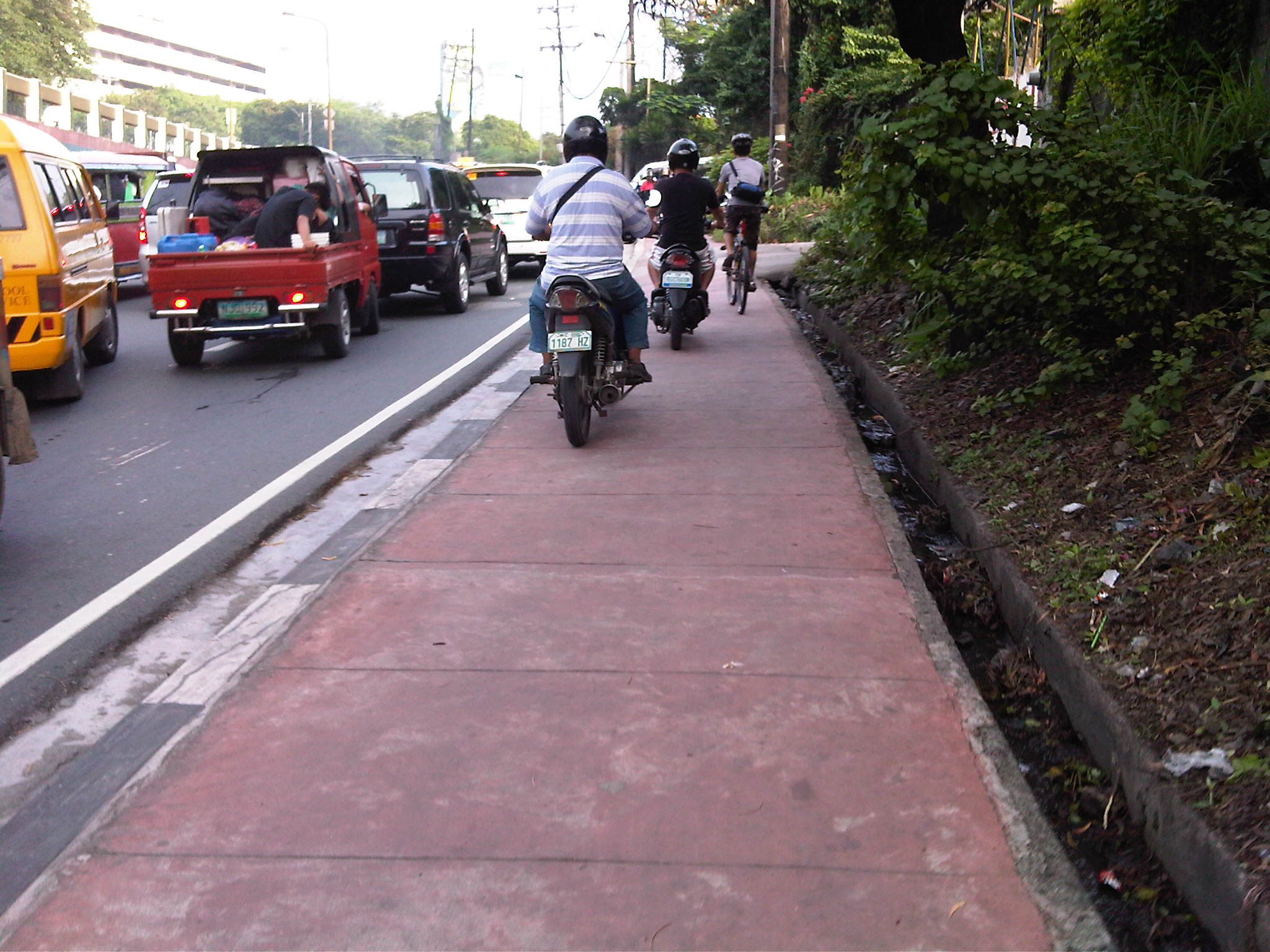 Motorcycles dominating space for pedestrians
At one point, I held my ground and didn’t give way to the motorcycles behind me [Advisory: This is not for everyone especially those who are “pikon” or who are looking for a fight.]. I knew my rights and I was walking on the pedestrian sidewalk. Unfortunately, a bicycle came along and I gave way only because I also appreciated cycling and understood that pedestrians and cyclists are sort of “kindred spirits” in a world dominated by motorized transport. The bicycle was immediately followed by two motorcycles including one that almost sideswiped the cyclist. I took the photo above to better show the situation.
The other day, I chanced upon a similar situation as I was driving in heavy traffic along Amang Rodriguez in Pasig City. What little space was available for pedestrians along a narrow sidewalk along this road connecting Marikina and Pasig cities.
 Motorcycles using a narrow pedestrian sidewalk to avoid traffic congestion along Amang Rodriguez
These cases are clear examples of swapang attitude or behavior that is prevalent among many road users. Unfortunately, these are not apprehended or accosted by traffic enforcers. The latter seem to be more engrossed with number coding and swerving violations, anyway, that they seem to have forgotten all the other traffic violations that included this brazen behavior of motorcyclists. Perhaps enforcers should go back to the basics and take more notice of all those other violations (e.g., speeding, counter flowing, beating the red light, beating the green light, etc.) to improve and promote discipline on our roads.
–
Another look at traffic along Morayta, Recto and Legarda
Heading to another appointment one morning, our driver avoided Quezon Boulevard and the Quiapo area, which we learned later had serious flooding at the underpass. Our driver said we were actually waved off by a traffic enforcer from heading into Quezon Blvd. to head instead towards Morayta and Recto. And so I decided to take some new photos along our way, which took us to Morayta, Recto, Legarda, P. Casals and Ayala Blvd.
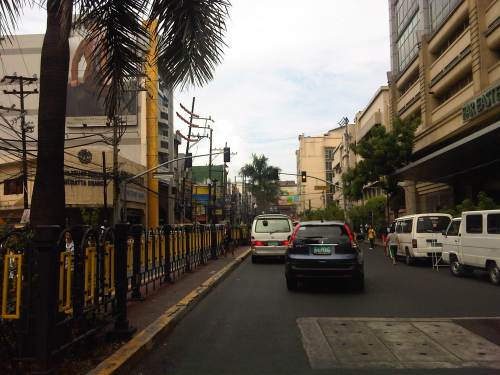 Morayta Street with the Far Eastern University (FEU) at right is part of an area that is called the University Belt because of the academic institutions located in the area including several major universities like FEU, the University of the East (UE), the University of Sto. Tomas (UST), San Sebastian College, San Beda College, Centro Escolar University and College of the Holy Spirit.
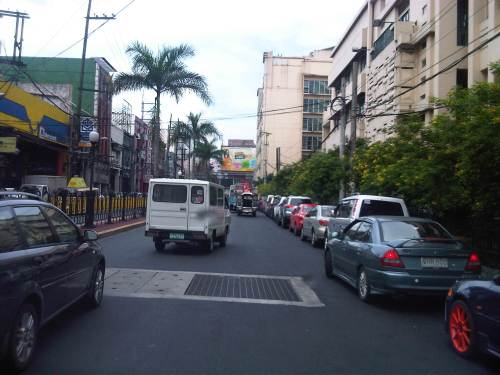 On-street parking along Morayta Street – there should be parking fees for such spaces in Manila since vehicles significantly reduce road capacities and cause congestion. These streets are public spaces and should benefit the general public and not just a few people who happen to have cars but no parking space in an area where space is very limited and therefore valuable.
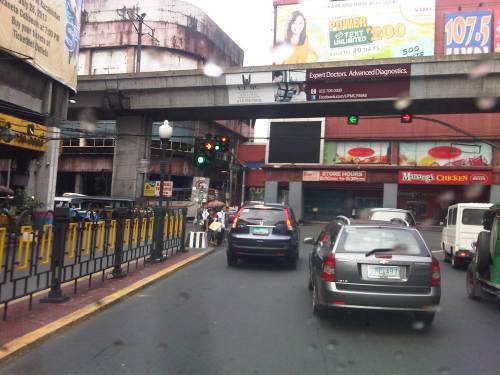 Approach to intersection of Morayta with Recto Avenue.
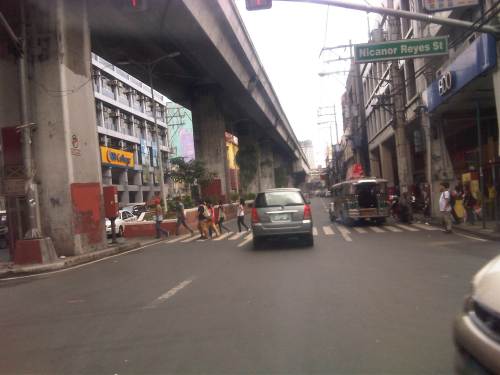 Recto Avenue eastbound with the elevated tracks of the LRT Line 2.
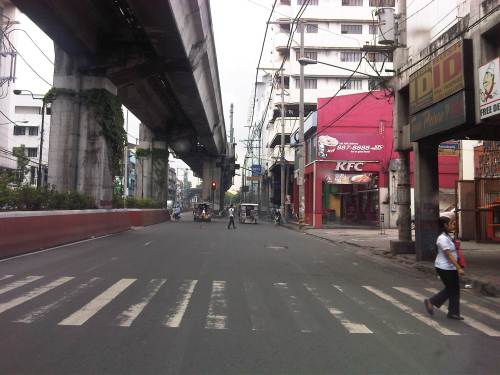 Approach to the intersection of Recto with Loyola Street. San Sebastian College is just after the signalized intersection. The pedestrian crossing is for people crossing to or from the University of the East, which is on the other side of the road.
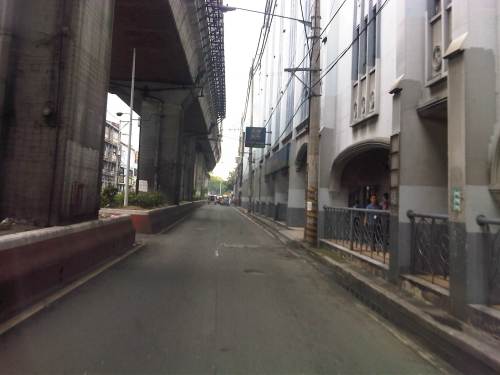 The alignment of the LRT Line 2 led to its posts dividing the eastbound lanes of Recto for the section between Loyola Street and Legarda. San Sebastian College is at right with its arcade walkways.
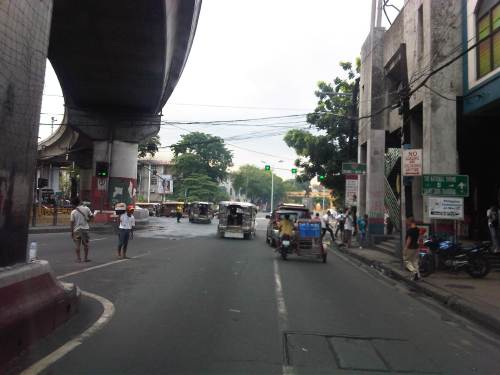 The divided eastbound lanes of Recto merge at the approach to the intersection with Legarda and Mendiola.
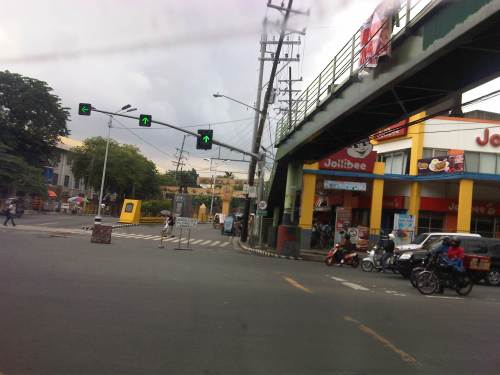 That’s Mendiola from across our turning vehicle with San Beda College on the left and a branch of Jollibee obscuring a view of Centro Escolar University at right.
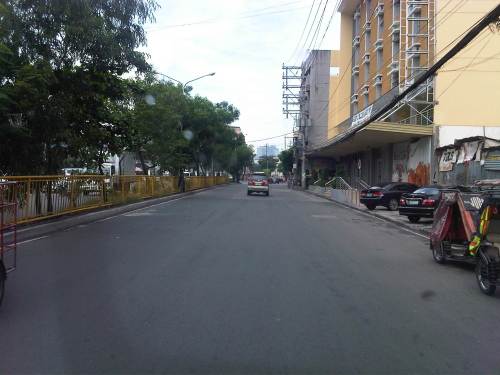 Southbound lanes of Legarda in the general direction towards Arlegui Street. There are many new buildings along the street including the one on the right, which replaced what were already decrepit buildings and houses. Some of these houses probably had historical value but were demolished nonetheless after the property was sold to more enterprising people.
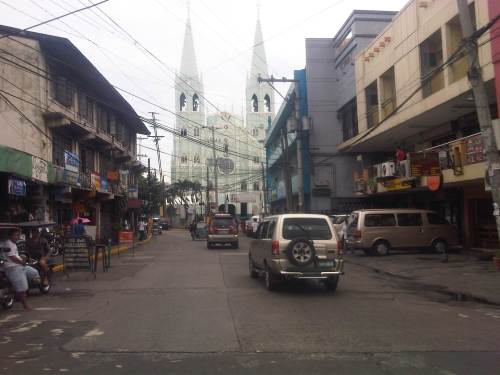 A peak at San Sebastian Church from Legarda and downstream along Bilibid Viejo Street. This image has been captured in many photos and drawings from the time it was completed during the last years of the Spanish period, to the American period until the present.
 Legarda ends at its intersection with Nepomuceno and Concepcion Aguila Streets where the most prominent landmark is the National Teachers College. Here, Legarda becomes Nepomuceno and proceeds towards Arlegui and P. Casals.
–
Pedicabs at your service
Pedicabs are among the most common modes of public transport around the country. These are usually found in residential areas including subdivisions or villages where they provide services to people who find it far to walk between their homes and the village gate. However, in many other places, particularly in the rural areas, pedicabs along with tricycles represent the main public transport mode for short trips. And because the main roads connecting barangays or barrios may be national roads, one will find these non-motorized transport traveling along national roads and clearly violating a law prohibiting such transport from using the national highways.
Pedicabs serving rural areas are often tolerated because of a lack of convenient public transport services in barangays. Many communities that happen to be located along national highways are often served by pedicabs (and/or motor tricycles) since jeepneys or buses come along quite sporadically, especially during the off-peak hours. Their drivers and passengers though are often at risk from motor vehicles, especially buses and trucks, that travel at higher speeds and with which crashes are highly likely to result in fatalities.
 This guy earns 10 pesos for a special (single passenger only) ride from the national highway to the Leyte Landings monument in Palo. Normal fare is 6 pesos per passenger if you share the ride with others. It’s a decent job and the man earns an honest living pedaling his pedicab to ferry people to and from government offices around the area.
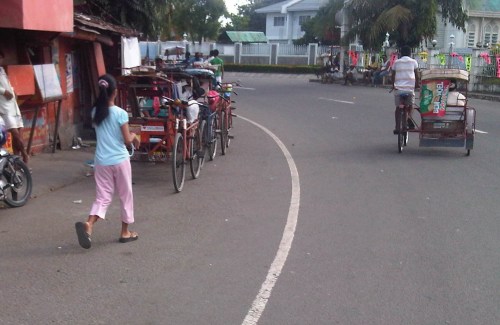 Pedicab queue at the junction of national roads are quite common in the rural areas.
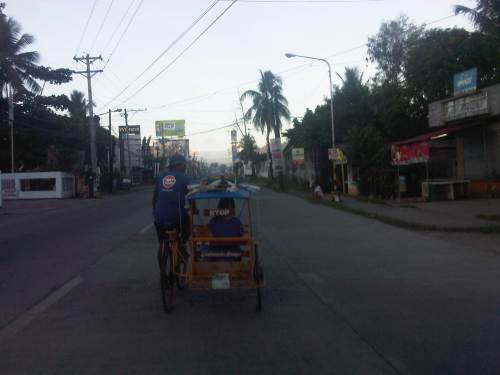 Pedicab traveling along a national highway in Leyte.
In the urban setting, pedicabs operate in many streets and in many cases travel along major roads. Many are considered nuisances in traffic as they are slow moving and do risky maneuvers. In certain cases, like Intramuros and Pasay, they are just too many and may cause congestion simply by their numbers in general traffic. One can also wonder why they are necessary in many places if the walking environment can be improved for pedestrians so that they would not need to take short rides via pedicabs. While we are aware of the social dimensions of pedicab services (i.e., mainly their being the source of income or livelihood for a lot of people), there is the view that many of these same people are misguided in their being allowed to operate so many pedicabs and thereby making many believe it is the “only” livelihood they can depend on. The local governments should be made answerable to these questions regarding pedicab proliferation where they are not suitable.
 Pedicabs along a Manila street near Tutuban and the PNR station.
 Pedicabs in Intramuros, Manila near Mapua Institute of Technology.
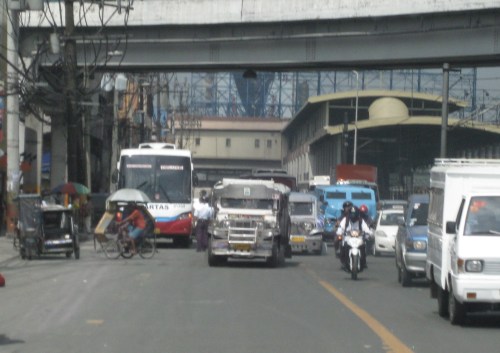 Pedicabs operating along a section of EDSA in Pasay City near the provincial bus terminals.
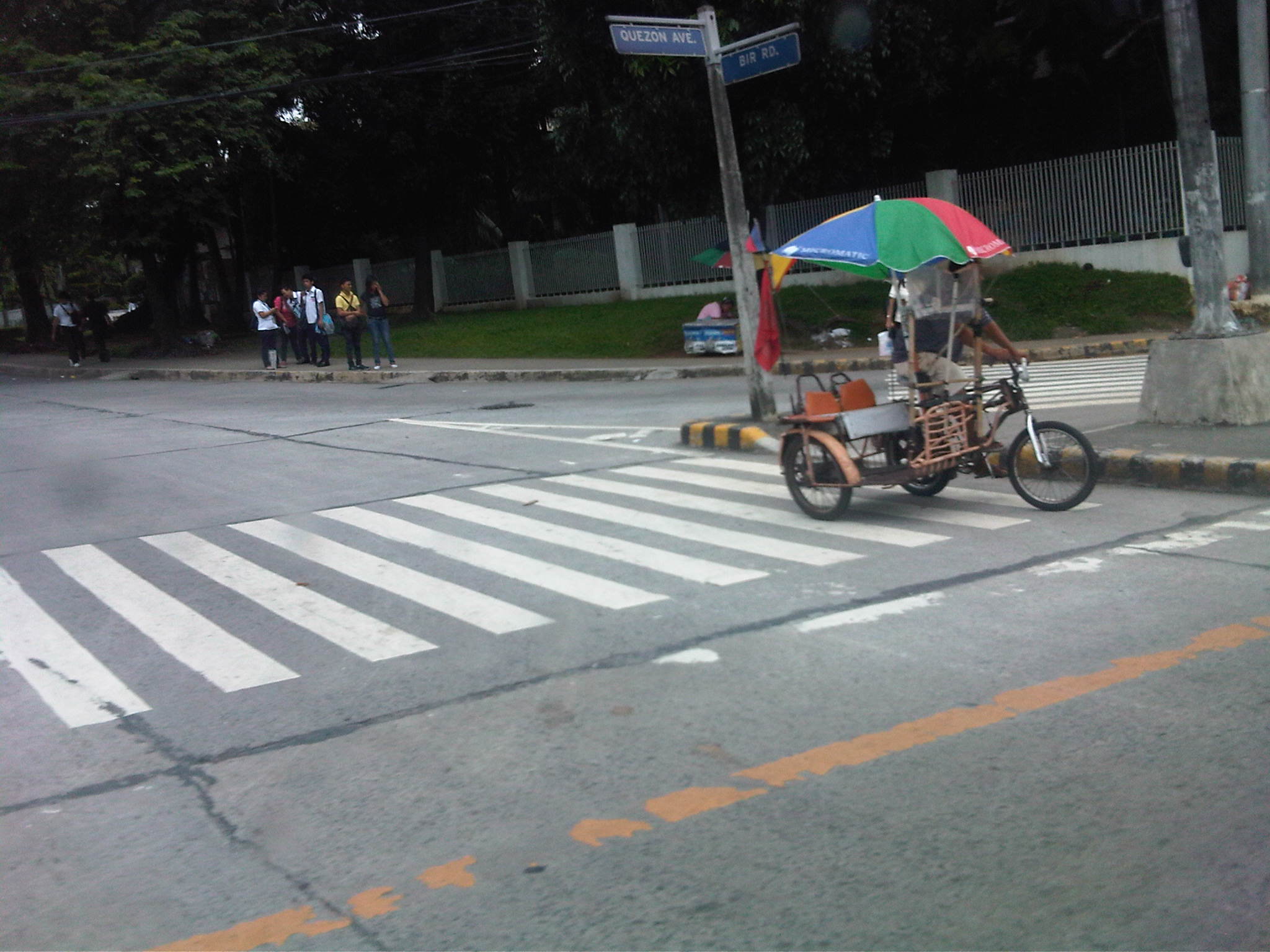 Pedicab along Quezon Avenue in Quezon City near the BIR Road and Agham Road, ferrying people from the EDSA MRT station to offices along the said roads.
Then, of course, there are the pedicabs serving the private or gated residential subdivisions. While tricycles have been the ones to first establish services for these villages, pedicabs have become the choice for many where noise and emissions from tricycles have become irritants and serious issues to residents. The slower-moving pedicabs pose less risks to children playing on the streets or pedestrians walking on village carriageways.
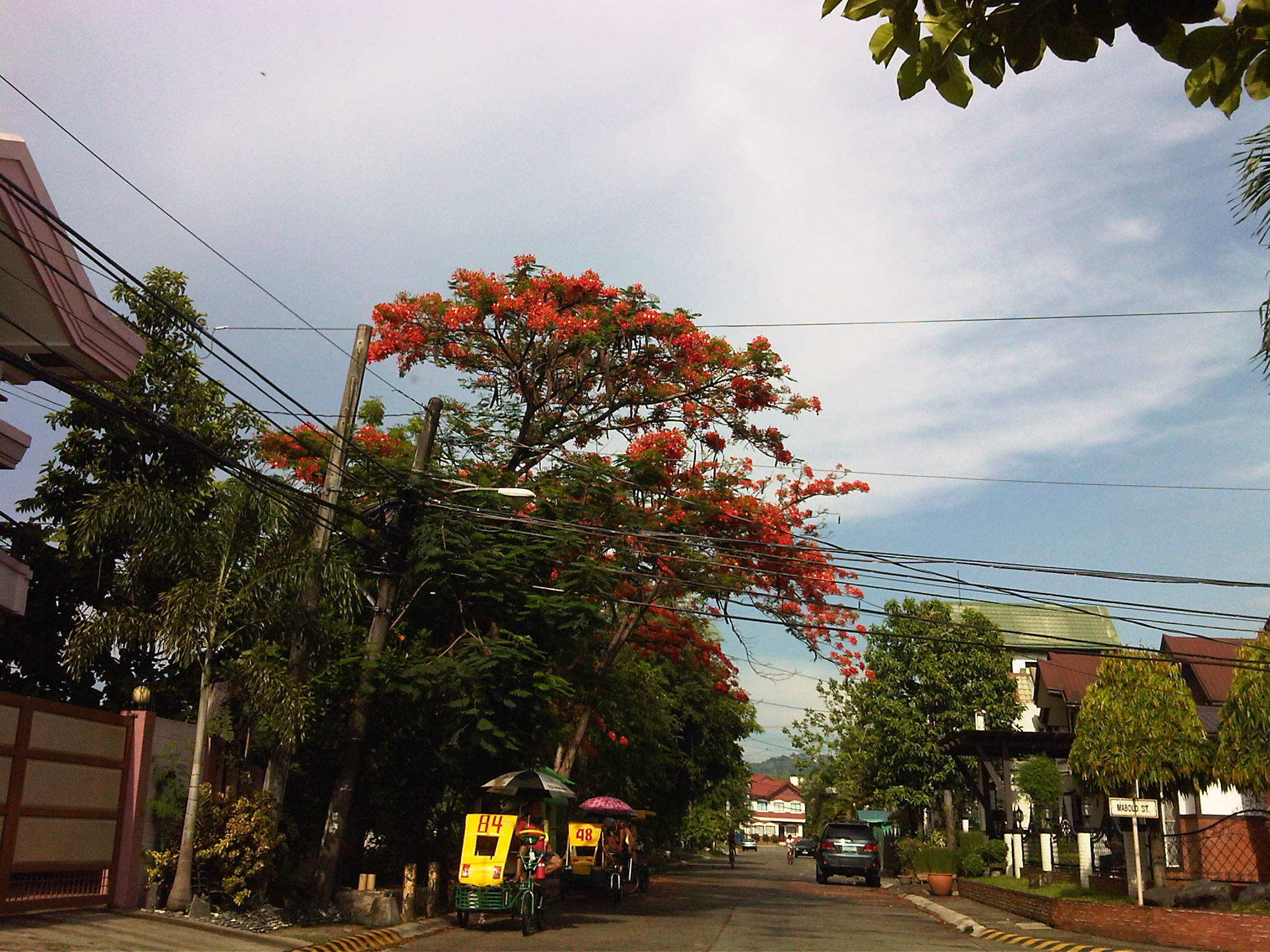 Pedicabs at an exclusive residential subdivision – depending on the fare policies set by local governments, barangays or village associations, pedicabs may charge somewhere between 5 to 10 pesos per passenger depending on the distance traveled, and in some cases the weather conditions (i.e., in many areas, pedicabs charge more when its rainy and especially when streets are flooded).
–
Old style intersection traffic management
Heading to the DOST complex for a meeting, I took a few photos of the enforcers managing the traffic at the intersections at the Bicutan interchange from on top a traffic box. The intersections are formed by the on and off ramps of the South Luzon Expressway, the service roads and Gen. Santos Ave./Dona Soledad Ave. It was a welcome scene considering the enforcers seemed to be doing very well (i.e., traffic was flowing quite smoothly at the intersections) while also evoking times when traffic signals weren’t the norm in major intersections. Of course, it helped that pedestrian movements on the ground were eliminated by the pedestrian overpass set-up at the interchange, a legacy of the BF era at the MMDA.
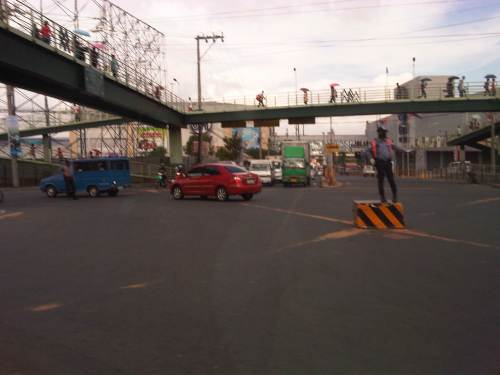 Traffic enforcer on a box directing traffic at the intersection of the SLEX soutbound ramps, the West Service Road and Dona Soledad Ave. That’s SM Bicutan in the background with its two buildings on either side of Dona Soledad and connected by an elevate walkway. Pedestrians have been eliminated from the equation thanks to the elevated walkway at the SLEX Bicutan interchange.
 Traffic enforcer at the intersection of the the SLEX northbound ramps, the East Service Road and Gen. Santos Ave. The PNR tracks run along just after the intersection.
–
The positive impacts of direct EU flights from the Philippines
It’s all over the news since evening yesterday – the European Union’s lifting a ban on direct flights from/to the Philippines to/from its member countries. While the decision is limited to legacy carrier Philippine Airlines (PAL), it is quite symbolic of gates (and not just windows) of opportunity opening up for the country particularly in terms of tourism and other businesses. It is no secret that the Philippines has been pushing for more tourism from abroad, knowing that there is vast market out there who would be willing to spend money on vacations to attractions in many parts of the country.
These attractions include currently popular destinations like Boracay, Palawan (including Coron), Mindoro, Batangas, Cebu (Mactan, Bantayan, Moalboal, Camotes), Bohol (Panglao), Surigao (Siargao) and Davao (also Samal). There are also many emerging destinations for international tourists like those in Ilocos (Pagudpud, Saud, etc.), Cagayan (Sta. Ana, Palaui Island, etc.), Aurora, Bicol (Caramoan, Misibis, Bagasbas, Calaguas, etc.), Guimaras, Siquijor, Negros, Mindanao and so many other attractions in the other provinces. Obviously, that was not an exhaustive list and one would eventually get tired Googling so many places to see around the country. I purposely mentioned “international” here as I would like to believe that local tourists (i.e., Filipinos) have already discovered many of these emerging destinations that are only being developed now judging by the photos being posted on social media, the amount of info now available about so many destinations when you use the search engines, and the continuing aggressiveness of local airlines in offering promotional fares while also maintaining high frequencies to many cities.
Increased tourism arrivals would definitely have wider impact on a lot of businesses and not just those directly dealing with the visitors (i.e., hotels, airlines, etc.). The required logistics will tell us, for example, that agriculture and fisheries sectors will also benefit as they will supply the food required by tourists. Retail will also benefit as it is inevitable for people to make purchases like souvenirs and other items (need or want) during their stays. I had written before about the benefits of a healthy competition among local airlines in the Philippines and the winners are practically everyone and not just the tourists. It should be noted here that the number of Filipino Overseas Foreign Workers (OFWs) and their families along would make direct flights worthwhile for PAL.
Offhand though, this development regarding direct flights to Europe for PAL should increase the already tremendous pressure on government to provide the transport infrastructure to handle tourist arrivals. These would be airports, ports and roads that are necessary for smooth travel across the country and not just for our international gateways in Manila, Cebu, Clark and Davao. These gateways, after all, provide a first impression of the country, and I would like to see NAIA Terminal 1, for example, finally getting the upgrade that should have been done so many years ago. Perhaps, the demand translating to more passengers to be handled by our gateways will increase further should approval be granted for Philippine carriers to serve more US destinations. That is not far-fetched given the proverbial green light from the EU for PAL.
–
Near miss
The crash by an Asiana Airlines B777 in San Francisco reminded me of an experience I had in 2011 aboard an Asiana flight from Busan to Manila. Here is the account I posted elsewhere after that experience in 2011:
Lost in the past days’ heavy rains and the resulting floods that threatened to enter our home last Friday night was the close call I had last Thursday night as I returned from Korea. I had just attended the 9th International Conference of the Eastern Asia Society for Transportation Studies (EASTS) held in Jeju, Korea. From Jeju, I took the Air Busan domestic flight that was codeshared with Asiana Airlines to Busan, where I was to connect to Asiana Airlines flight OZ 705.
I had a long layover at Busan and asked for information about the city and what I could do for the 7 hours available to me prior to my flight back to Manila. I had already checked-in my baggage so I was practically unencumbered to move about. Unfortunately, the transit system from the airport to downtown Busan was not operational (surprise!) and I decided that the trip downtown where I would just probably walk around a mall was not worth it. I thought I would just end up spending on unnecessary shopping or dining.
As I entered the departure area after the routine immigration process, I proceeded for some Duty Free shopping for pasalubong. Afterwards, I took advantage of the free internet services at the airport, replying to emails received that day. There was no free WiFi at the airport so I had to make do with the terminals made available to departing passengers near the airline lounges. Afterwards, I proceeded to the gate assigned to our flight. This was about 4 hours prior to the tentative boarding time indicated on the electronic signboard near the gate.
As I had quite some time before my flight, I tried to catch up on the latest issue of Wired magazine that I had brought along specifically for the long lay-over. It was while I was reading that I noted an announcement for an Asiana flight to another Southeast Asian city being delayed due to technical problems with the their aircraft. I also noticed upon looking around outside the terminal that quite a few planes were sitting out from the terminal where passengers were brought to the aircraft by bus. I had experienced this before when our aircraft arrived in Jeju the Monday before, and at NAIA Terminal 2 in past domestic and international flights that couldn’t be accommodated at the terminal due to congestion. It was then that I noticed the Asiana Airlines Airbus A320 sitting across the terminal, and it looked like it was being serviced based on the vehicles parked beside it and the activity I could see from where I sat. I assumed that this was the aircraft that was supposed to be used by the delayed flight announced on the airport PA system.
A few minutes later, however, the airport PA announced that the delayed flight was now boarding. A while later, I saw an Asiana aircraft taking off, about 45 minutes delayed from its original flight departure time. The other aircraft still sat where it was, and still apparently being serviced. I noticed later that there were no other Asiana aircraft arriving or departing prior to our flight though there were many Korean Air, Air Busan and Jeju Air planes arriving and taking off. I also saw that a PAL flight left for Manila ahead of us and a Cebu Pacific flight left for Cebu one hour before ours. That was when I suspected that the plane sitting from across the terminal would be our aircraft for the trip to Manila.
Upon boarding the aircraft, we already noticed that the airconditioning was off along with the plane’s engine. This was already unusual for me considering a plane that was supposed to take off within the next 20 minutes normally had its engines running already. The Koreans on that same flight apparently were not pleased with the conditions as the cabin became warmer as more passengers settled in their seats for the flight to Manila. Not a few were already voicing their displeasure and were doing so in a way we usually see on TV. It seemed to me that they were already berating the crew. When the pilot started the plane’s engines, the cabin suddenly became dark and a weird sound was heard from outside the plane. Minutes later, the pilot announced that the plane was having problems with its electrical system and we had to wait out for it to be repaired. What followed were more complaints and possible offensive words from the Korean passengers who didn’t like the idea of being delayed. We were, after all, originally scheduled to arrive in Manila at 12:00 midnight. Any delay meant we were arriving early morning of Friday.
Abotu 30 minutes later, the pilot again attempted to start the plane and for the second time, the electrical system failed. This resulted in what I thought were insults and other offensive words from the Korean passengers. I could see that the flight attendants were already quite embarrassed and they could do nothing but try to assuage passengers on the situation. I was already thinking about whether we will be asked to deplane and wait our for our plane to be fixed or another aircraft to take its place. No such announcement was made and we had to wait it out for another 20 minutes. I thought that it was good though that there were cooler heads among the Korean passengers who were able to calm down others who were already threatening the pilot and the crew due to the displeasure about the situation.
The third time around, the plane finally responded and we were able to taxi and take-off without any hitch. The pilot continued to apologize even after take-off and assured everyone that the electrical system was repaired. Nevertheless, I could not sleep in the plane no matter how hard I tried to as each shake and rumble due to turbulence made me think about the possibility that the plane’s electrical system will fail, resulting in a crash. It was no light matter considering that we were traveling 3.25 hours between Busan and Manila, and we will be flying between two typhoons including one whose path was to cross ours. Such assured us of much turbulence throughout the flight including a couple that made me quite nervous as I could not even see the plane’s wings from my window seat due to the thick clouds around us. The only thing I could do was to pray silently that we don’t have a breakdown in midflight.
I was only able to relax when we finally landed in Manila. In fairness to the pilot, it was one of the smoothest landings I ever experienced even despite my being too conscious of the turbulence throughout the flight. Yet, my worries were renewed when the the cabin blacked out momentarily after we stopped at NAIA Terminal 1. I could not help but think about what could have happened if this occurred earlier while we were still in the air. Moments later, my suspicion was confirmed by an airport supervisor who was going around the conveyor belt telling Filipino passengers that our bags will be delayed due to the difficulties experienced by ground staff in opening our plane’s baggage compartment. I could not help but feel relieved that I “survived” that flight. Perhaps it was my prayers? My faith? No matter. I am truly thankful and grateful to the One Who watches over us and did so formally while in Church this morning to celebrate the feast of Corpus Christi.
–
Dream plan for the Greater Capital Region?
A report came out last Saturday on a major daily about a JICA study estimating losses of as much as 2.4 Billion pesos per day due to traffic jams experienced in Metro Manila. Not mentioned was the 1.0 Billion pesos per day estimated losses for the Bulacan, Rizal, Laguna and Cavite areas that are at present considered part of what has been loosely defined as Mega Manila or the Greater Capital Region (GCR). That’s 3.4 Billion pesos per day of lost productivity and potential income that if reduced, could generate resources that could be distributed to the rest of the country. The JICA estimate, as reported by NEDA, is the product of a study that is in its concluding phase that looked into transport for an area comprised of Metro Manila, Region 3 (Central Luzon) and Region 4A (Southern Tagalog or Calabarzon). The main objective of the study was to come up with a Transport Infrastructure Framework and Roadmap for the GCR that would guide planners and engineers, and most importantly decision-makers (i.e., our leaders) in identifying and prioritizing transport infra projects that would ultimately improve the way we travel in the GCR.
While I am not at liberty at present to divulge the details of this study as the entirety has not been made public yet, I can say that the study was comprehensive and the conclusion an urgent reminder to what needs to be done for transport in the GCR. The latter is necessary because we have failed to deliver on the transport infrastructure required by Metro Manila and its surrounding areas since the late 1970s adn early 1980s when some decisions were made that were detrimental to public transport development and, to my view, inhibited and limited us from implementing a much more efficient transport system than what we have now. In my own conversations with the person who led the study, I can understand his own frustrations as he was himself a witness to the deterioration of transport in this country. Much of this deterioration have been attributed to a lack of political will to make the hard decisions in relation to transport. These decisions include those pertaining to the rationalization of transport services like phasing out jeepneys and tricycles where they are no longer suitable and committing to the implementation of mass transit projects that have been delayed for decades now.
 Network of recommended rail rapid transit (RRT) lines for the Manila Metropolitan area in 1973 (UTSMMA, 1973)
Perhaps we are at a crossroads in terms of transport in this country. Perhaps our leaders should listen to the clamor of their constituents for better transport systems in our cities, for more efficient ways to move about. Perhaps, too, we could finally see what’s really at the end of the tunnel rather than the proverbial light that we have always seen, frustratingly, for the past few decades. Perhaps the current administration will prove itself the catalyst for transforming transport in this country towards what it has preached as a “straight path.” Will we have a champion or champions who would push for the realization of a dream plan for transport? Whoever should step forward would definitely get my vote in 2016!
–
Some issues on pedestrian crossings at signalized intersections at BGC
I had heard from friends working at Bonifacio Global City in Taguig that it is difficult for pedestrians to cross at intersections at BGC. For one, the cycle settings (i.e., movements allowed for every green signal) for the intersections, at least those I’ve seen, often had turning traffic in direct conflict with pedestrian crossings. This meant that while given the green light to cross the street, for example, pedestrians had to contend with left turning as well as right turning vehicles who are also allowed movement for particular green phases. The phasing and the cycle settings are definitely more favorable to motor vehicles and assume that motorists will give way to pedestrians already on the carriageway and crossing the street. This is not the case and motorists tend to assert their way against pedestrians. These pedestrians are not jaywalkers but actually have the right of way by virtue of them getting the green light to cross. There is also that frequently violated rule of vehicles having to give way to legitimate crossings when people are already on the road. This is practiced in many other countries including the US, Japan and Singapore but is lost upon our motorists who seem to believe they own the road.
Another situation I’ve observed and personally experienced is the insufficient amount of time allocated for pedestrians to cross streets. This is particularly true for the wider streets of the Fort where it seems the people who set the signal cycles failed to estimate how much time it requires for people to cover the distance from one side of the roa to the other. What’s more is that the pedestrian settings allow only one or two people to cross at a comfortable pace. That is, other people will have to rush or run to be able to cross. Of course, the pedestrians would have to contend with the
 Intersection of 26th Street and 5th Avenue (view along 26th and towards 4th) – notice the green light given to through and left turning traffic as well as the signals for pedestrians, which include countdown timers.
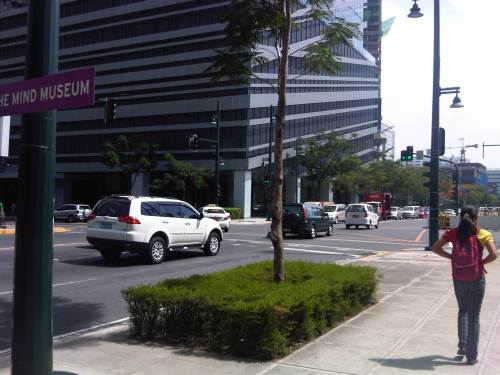 26th and 5th (view at the corner facing the Net Lima building)
 26th and 7th (view from the corner towards The Fort)
The solution to this issue about pedestrian crossings is a little bit more tricky that what seems like something that can be addressed by a simple adjustment of signal settings to provide more time for pedestrians. There is a need to revisit the phasing scheme for vehicle movements allowed at the intersections. Then there is also a need to find the optimum cycle and green time allocations considering the requirements for pedestrians and not just for vehicles. I believe whoever is in charge of the signal settings at BGC should look into this and if they are not capable of adjusting the settings then they should require the provider of the signals to make the necessary adjustments if not show them how to do this considering that traffic is quite dynamic and settings would need to be programmed to be responsive to demand not just for vehicles but pedestrians as well. BGC has great potential to be a pedestrian friendly CBD but whoever is in charge of transport planning and development should step up and level up, so to speak, in providing an environment that will encourage people to walk rather than take their cars. High Street is already there and is an important element in that mix of development but then the cluster of offices and residential condos aren’t exactly designed for efficient walking, and the settings for the intersection signals, as we pointed out, need to be adjusted for pedestrians.
–

