
Final presentations of undergraduate researches and proposals – March 2012
Undergraduate students under the Transportation Engineering Group of the Institute of Civil Engineering of the University of the Philippines Diliman presented last March 26, 2012. A total of 17 presentation were made including 12 for completed studies and 5 research proposals. One presentation was deferred as the group was still analyzing their data and could not make the deadline for draft manuscripts.
The final presentations of completed undergraduate researches were as follows:
- Travel Time Estimation of Jeepneys: The Case of UP Diliman, Quezon City (Arlish M. Carpio and Joseph Rei Mark Co)
- Assessment of the Philippine National Railway Commuter Line Services (Lara Kriselle B. Paragas and Ma. Katrina Q. Rañeses)
- Applicability of Unconventional Transit Systems in Selected Metropolitan Areas in the Philippines (Joselle Patricia E. Civil and Maiko G. Tenorio)
- Estimation of Traffic Signal Setting for the University Avenue-Commonwealth Avenue Intersection (Aimah C. Busok and Chrislene D. Calivo)
- A Road Safety Assessment Toolkit for Metro Manila (Neil Kendrick L. Sy)
- Analysis of Operation of Electric Tricycles (Demi Anne C. Obediencia and Ruth Noemi F. Sloot)
- Accident Risk by Mode of Public Road-Based Passenger Transport in Metro Manila (Walter T. Crisologo)
- Measuring Delay Caused by U-turn as a Traffic Control Facility (Neil Angelo G. Luzano and Mark Anthony G.Tolentino)
- Comparative Analysis of Male and Female Public Transport Bus Drivers in Metro Manila (Benilda M. Fonseca)
- Effects of Road Features in the Vulnerability of Child Pedestrians (Jordan A. Villanueva)
- Investigation of Factors Affecting PUV-related Accidents Involving Pedestrians along Commonwealth Avenue (Mark Alain C. Norombaba)
- Assessment on Parking Management System in Shopping Malls (Denryl Caesar S. Cortuna)
Deferred final presentation:
- Estimating Ridership for a Proposed Transit System for UP Diliman (Jessica Mae J. Anaque and Kylie Dianne Erika M. Landingin)
The final presentations of research proposals for implementation in the next semester were as follows:
- Perception of Traffic Noise Inside UP Campus (Michelle Monelle S. Quilatan and John Carlo D. Villar)
- Traffic Characteristics and Level of Service of Pedestrian Routes along Velasquez – Roces Street of UP Diliman (Angel U. Gacutan and Maria Jenna M. Tan)
- Determining the Effectiveness of Imposed Speed Reduction Programs Along Commonwealth Avenue (Hessen Noreen Z. Castillo and Hazel E. Maata)
- Analysis of the Presence of Urban Air Pollutants from Road Vehicles Within UP Diliman (Joshua Carlo S. Padilla and Tsuyoshi A. Sakurai)
- Determination of the Walkability Index of UP Diliman (Niki Jon Tolentino)
Following are a few photos taken during the final presentations:
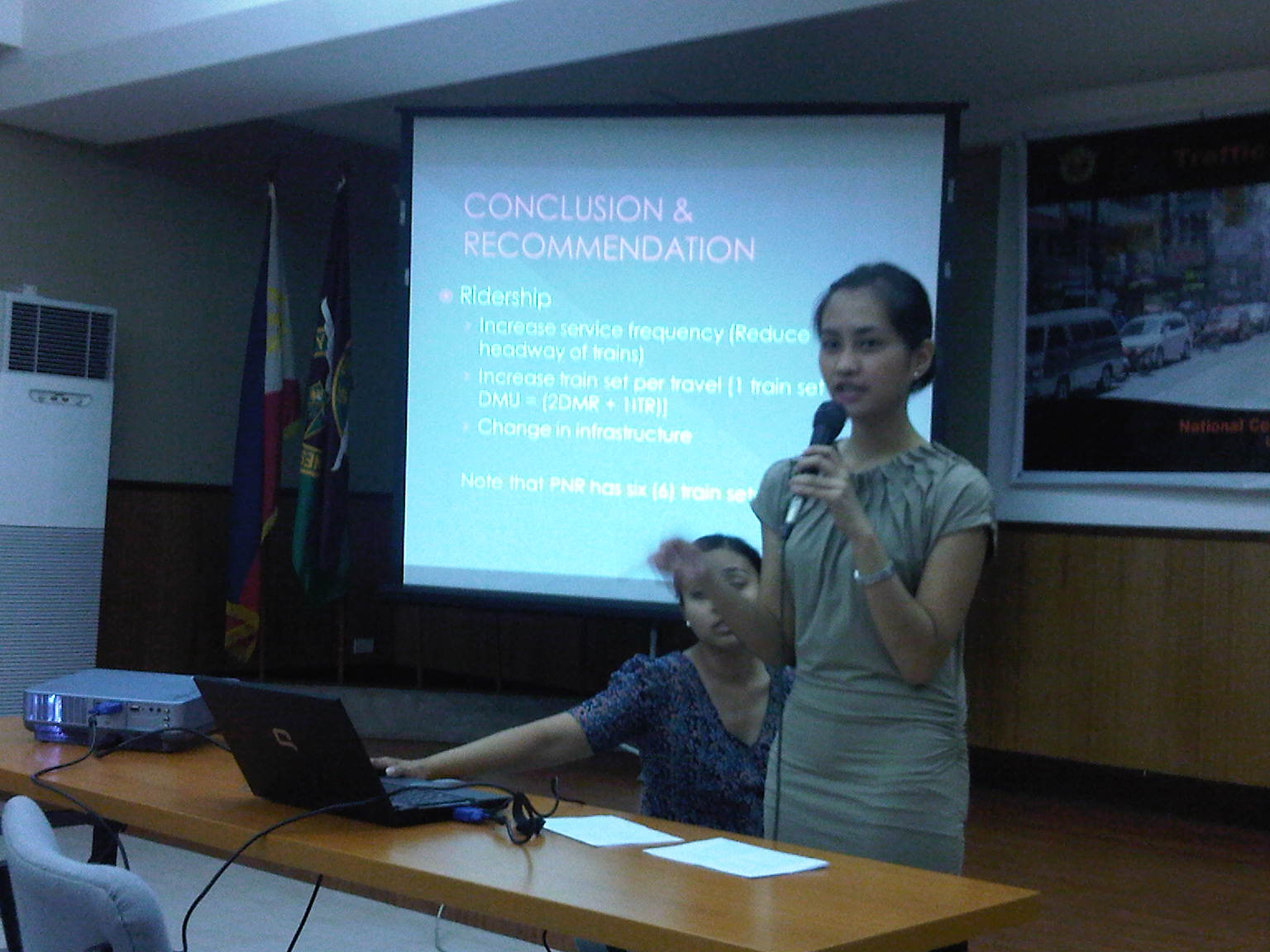 Paragas and Raneses presenting on their study on the PNR operations
 Civil and Tenorio presenting on their study on unconventional transit systems
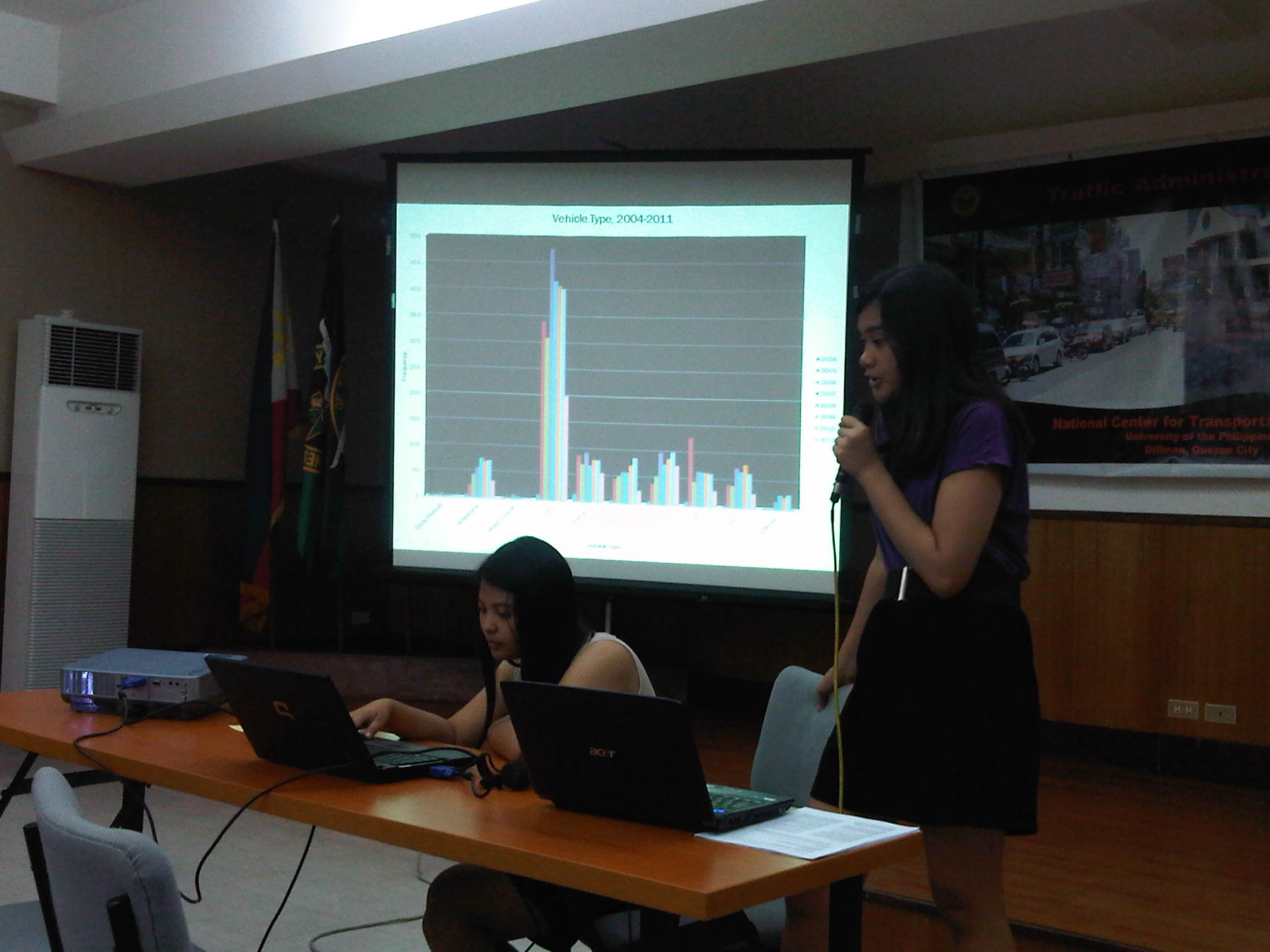 Busok and Calivo presenting on their study on the Commonwealth Ave.-University Ave. intersection
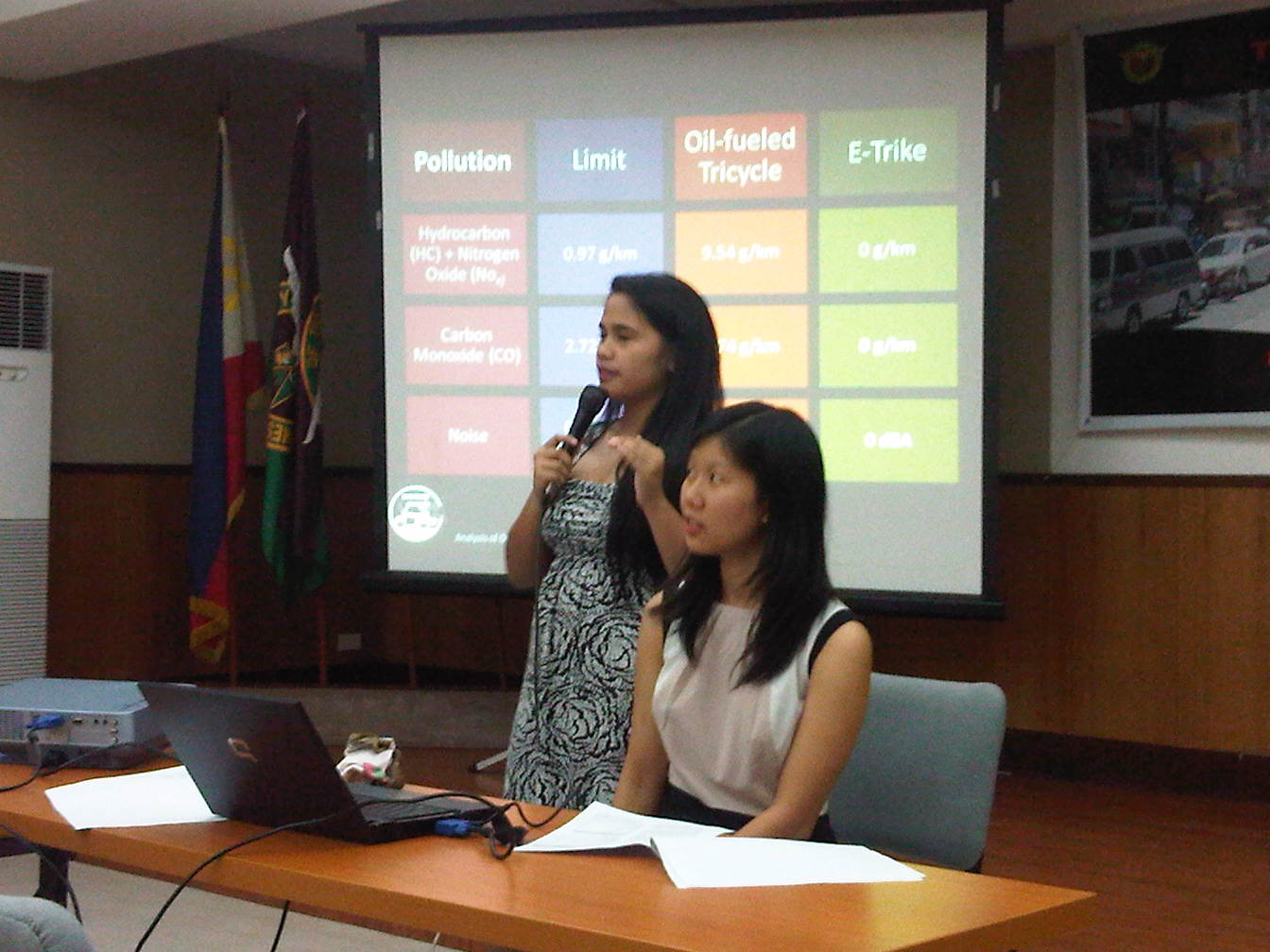 Obediencia and Sloot presenting on their study on electric tricycles
We are already looking forward to the implementation of the researches proposed this semester and those that will be proposed in the next semester of a new academic year (starting June 2012). This academic year has been a very fruitful one with many excellent students taking a renewed interest in Transportation Engineering and Planning. I hope there will be more in the next batch of students.
–
NAIA T3 Departures
This is one of the peak periods for air travel in the Philippines so the airports are pretty full with people departing and arriving from different places here and abroad. It was early morning yesterday and as I approached at the airport, I could see lots of vehicles driving off from the departure level of the terminal including taxis that have ferried passengers mainly for morning flights. It was about 4:30 AM when I arrived so the terminal was not as busy as it would be a few hours later.
I had some time to burn yesterday as I waited for the arrival of my wife at NAIA’s Terminal 3. And so I decided to take a walk around the terminal to check out the restaurants and coffee shops on the 3rd level. It turned out my favorite place was still closed and I didn’t think pizza, burgers or fried chicken would be a good idea at the time. I ended up walking around the terminal to get some exercise early in the morning and taking a few photos here and there of the queues at the check-in counters.
 Cebu Pacific handles a lot of flights nowadays as the top airline in the Philippines though it is a budget airline. At 4:30 AM, there were a lot of people lined up in front of their counters assigned to domestic flights. There were a lot more outside the cordoned off area and also outside the airport queued before the first security check for the terminal.
 There were even more people on the other side as Ceb Pac handled quite a number of flights to favorite destinations such as Caticlan (gateway to Boracay), Tagbilaran (gateway to Panglao) and Puerto Princesa (Palawan). Of course, there were the frequent flights to hubs like Cebu, Davao and Iloilo.
 AirPhil Express (formerly Air Philippines) also operates out of Terminal 3 but has less flights compared to CebPac. Its mother company, Philippine Airlines (PAL), is a full service airline with domestic and international flights to and from Terminal 2, which is also called the Centennial Terminal after being opened during the Philippines’ Independence Centennial in 1998. PAL Express, another one of PAL’s budget spin-offs, used to operate out of T3 but ceased operations in 2010 and was integrated into AirPhil Express.
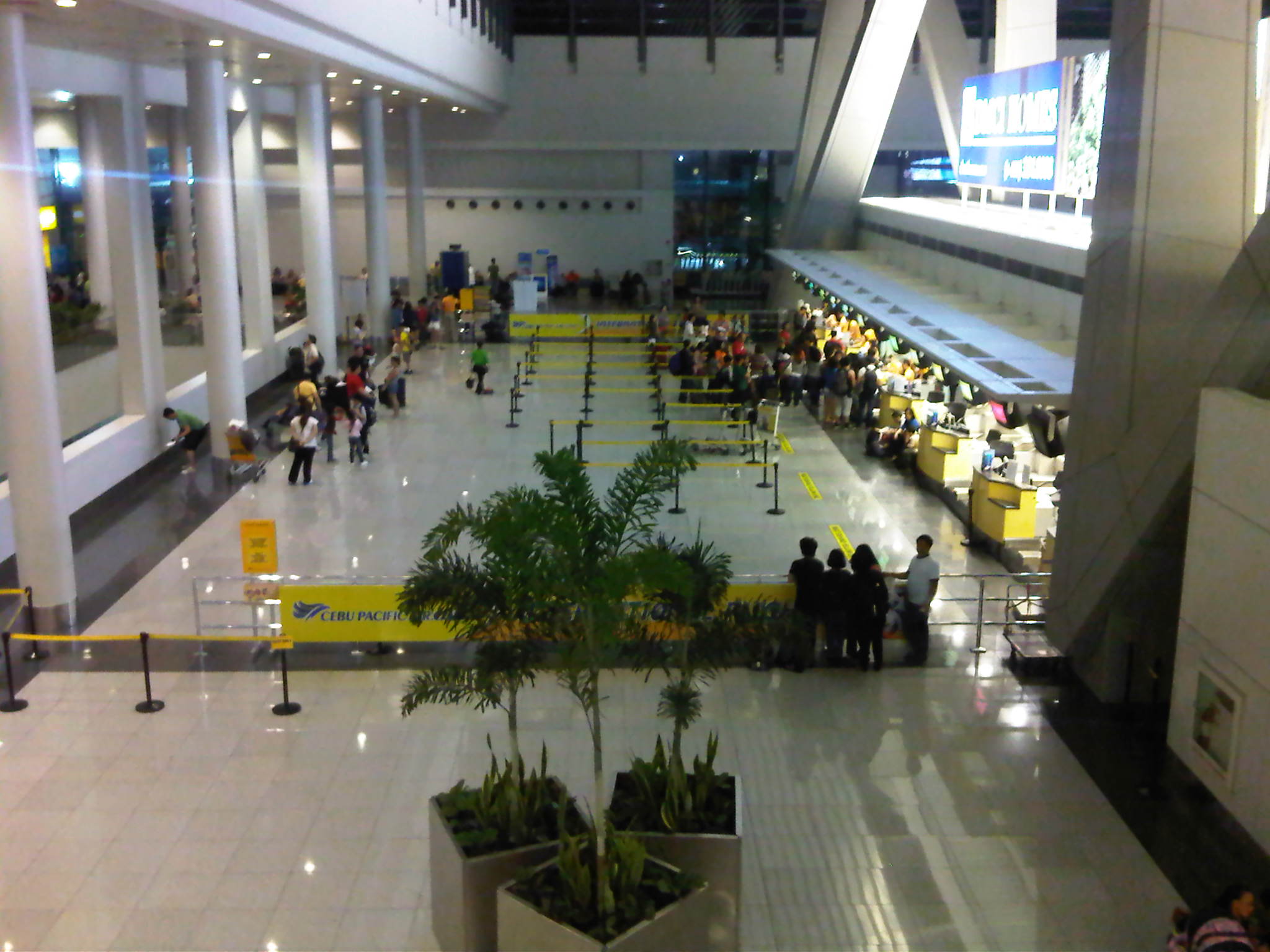 The queues for CebPac’s international flights were still short. I think they have few flights during the late night to early morning periods. These counters, however, will be busy later in the day considering the frequencies of service to destinations like Singapore, Hongkong and Bangkok. CebPac also flies to Korea, China and Japan and has recently opened direct flights to Cambodia (Siem Reap) and Vietnam (Hanoi and Ho Chi Minh).
I was not able to take a photo of the counters assigned to All Nippon Airways (ANA). I guess there might be no people there yet as ANA operates only two flights daily between Manila and Narita (from where it connects with a lot of flights to many other destinations including major cities in the US and Europe). Terminal 3 will be busier in the coming months and years as international flights increase and the Philippines tries to have its status upgraded in order for airlines such as CebPac to expand operations. Already in the sights of the airline are destinations in the Middle East, Australia and the US where there is a demand for a low cost Philippine carrier even counting only Filipinos living abroad. And with the country pitching its tourist destinations abroad, T3 will be expected to handle much of the traffic in this gateway in Manila.
–
Noise Standards in the Philippines
Caught a show on television featuring noise pollution in the Philippines. The feature on noise included the reporter accompanied by a person who measured ambient noise using a portable noise meter.The results were quite interesting if not surprising, including the alarming measurements inside a high school classroom at a building beside EDSA. There was also the segment where hearing damage was covered, particularly those derived from workplaces (e.g., factories).
Of course there are many sources of noise, but it seems that much of it nowadays is associated to vehicular traffic (e.g., tricycles, trucks, etc.). Nevertheless, we often disregard a lot of the other sounds around us because they are part of what we hear everyday and we have gotten used to them. To be able to appreciate the totality of the sounds (noise) that we often disregard, much is actually eliminated when we have blackouts. That means no TV, no stereos, no electronics that produce sounds that we take for granted.
I reproduce below the three pages of what was the National Pollution Control Commission’s Memorandum Circular No. 002, Series of 1980, as published in the Official Gazette of the Republic of the Philippines, which until now serves as the basis for noise standards in the country. Recent initiatives led by the DENR’s Environmental Management Bureau seeks to update/revise these standards and a draft has been circulated to members of an inter-agency committee and industry. Perhaps our local governments could take a look at laws that are often set aside in part because of a lack of instruments to be able to quantify noise. I think curbing noise pollution should significantly improve our quality of life and would have positive impacts to our health.
 Page 1 of the NPCC Memorandum Circular No. 002, Series of 1980
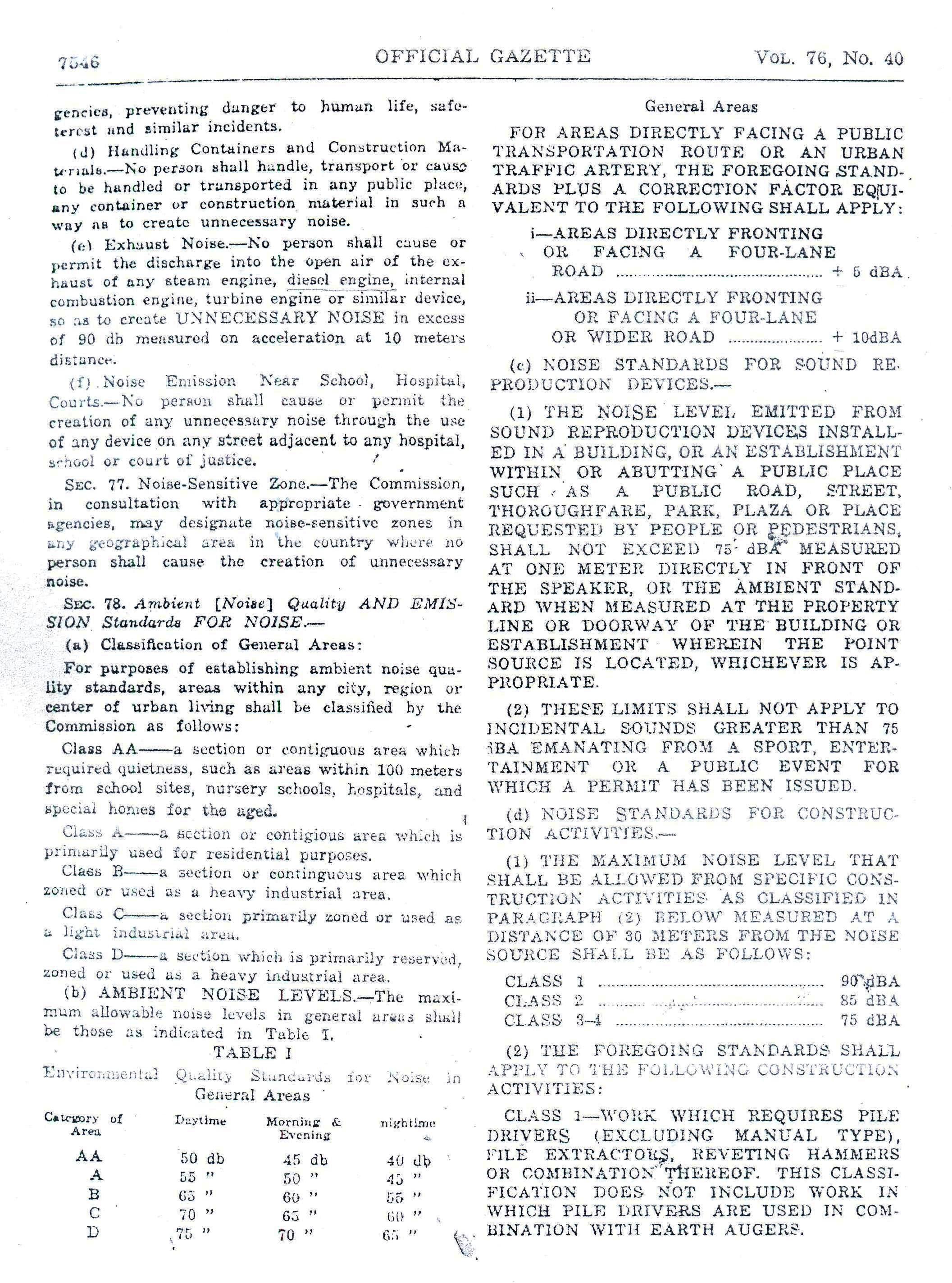 Page 2 of the NPCC Memorandum Circular No. 002, Series of 1980
 Page 3 of the NPCC Memorandum Circular No. 002, Series of 1980
Perhaps the material above should serve as a basic guide for local governments and private citizens in monitoring noise. People should be knowledgeable of what can be considered as unacceptable. We have never been known to understand and appreciate the concept of externalities such as those from congestion and emissions. So the next time your neighbor decides to go on a karaoke session or revs up his motorcycle, you have a basis for making a complaint and maybe even using the memo for reference in your barangay!
–
ITS Applications in the Philippines
The Seminar on Intelligent Transport Systems (ITS) Applications in the Philippines was held last March 28, 2012 at the Columbus Room of the Discovery Suites in Ortigas Center, Metro Manila. The seminar was organized by the Institute of Civil Engineering (ICE) and the National Center for Transportation Studies (NCTS) of the University of the Philippines Diliman and was supported by the Engineering Research and Development for Technology (ERDT) Program of the Department of Science and Technology (DOST). The main objective of the seminar was to bring together the academe, government agencies and industry to discuss the state of ITS in the country. The seminar was a venue for presentations and discussions where persons interested in ITS could interact with one another, hopefully forging future partnerships to promote ITS in the country.
 Registration desk – participants from the ERDT universities attended the seminar including Ateneo De Manila University, Central Luzon State University, De La Salle University, Mapua Institute of Technology, Mindanao State University – Iligan Institute of Technology, and UP Diliman and UP Los Banos. Also in attendance were representatives of the Far Eastern University and the Polytechnic University of the Philippines.
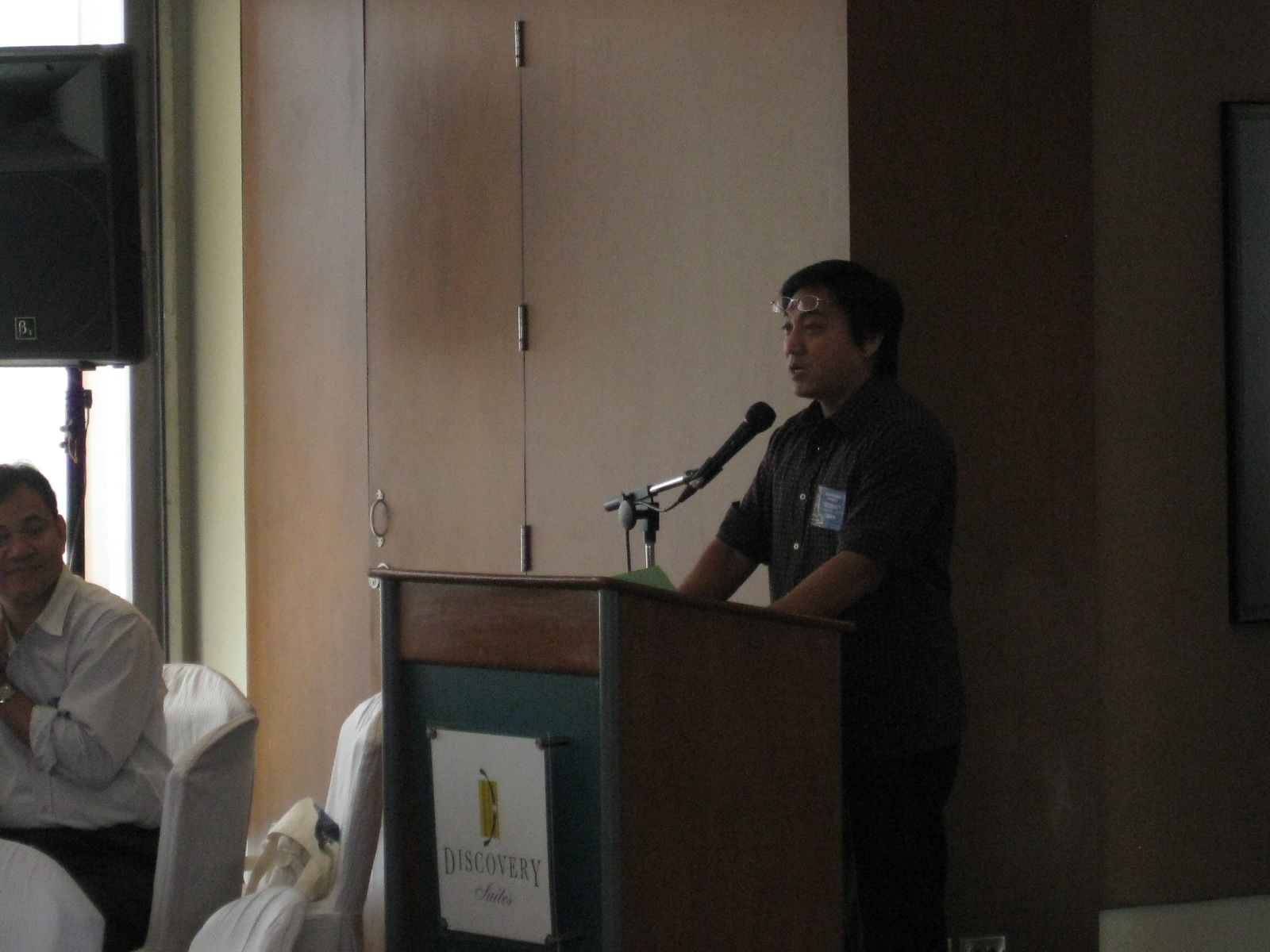 Master of ceremonies – Dr. Sean Palmiano of the ICE welcomed participants to the seminar. He is also a Fellow at the NCTS and part of its Road Safety Research Laboratory.
 Opening Remarks – Dr. Alexis Acacio, ICE Director, opened the seminar, enjoining everyone to participate in the discussions and wishing a fruitful day.
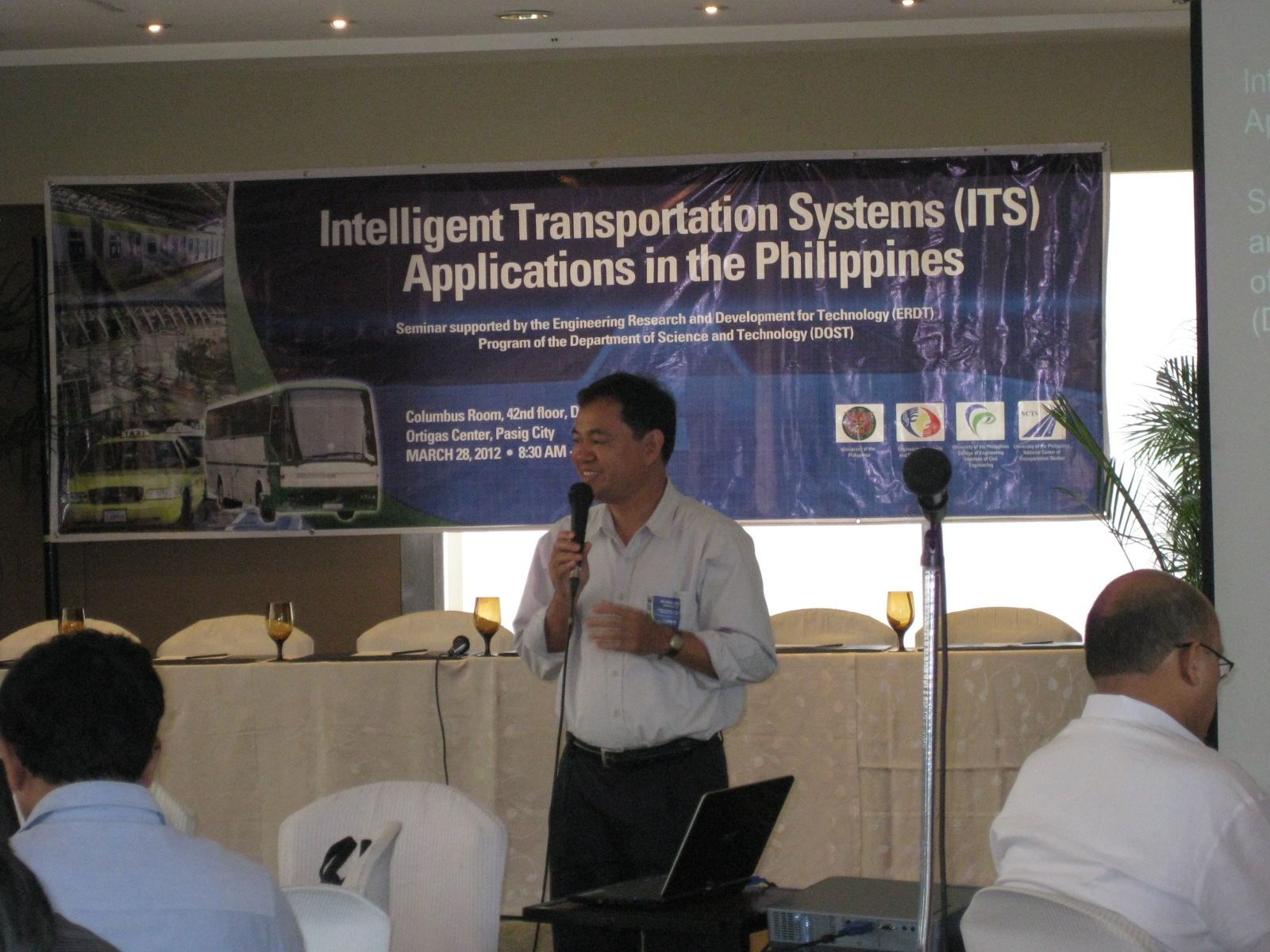 Keynote presentation – Dr. Ricardo Sigua, Professor at the ICE and also a NCTS Fellow delivered a presentation entitled “State of ITS in the Philippines.” It provided an excellent intro about current applications of ITS in the country.
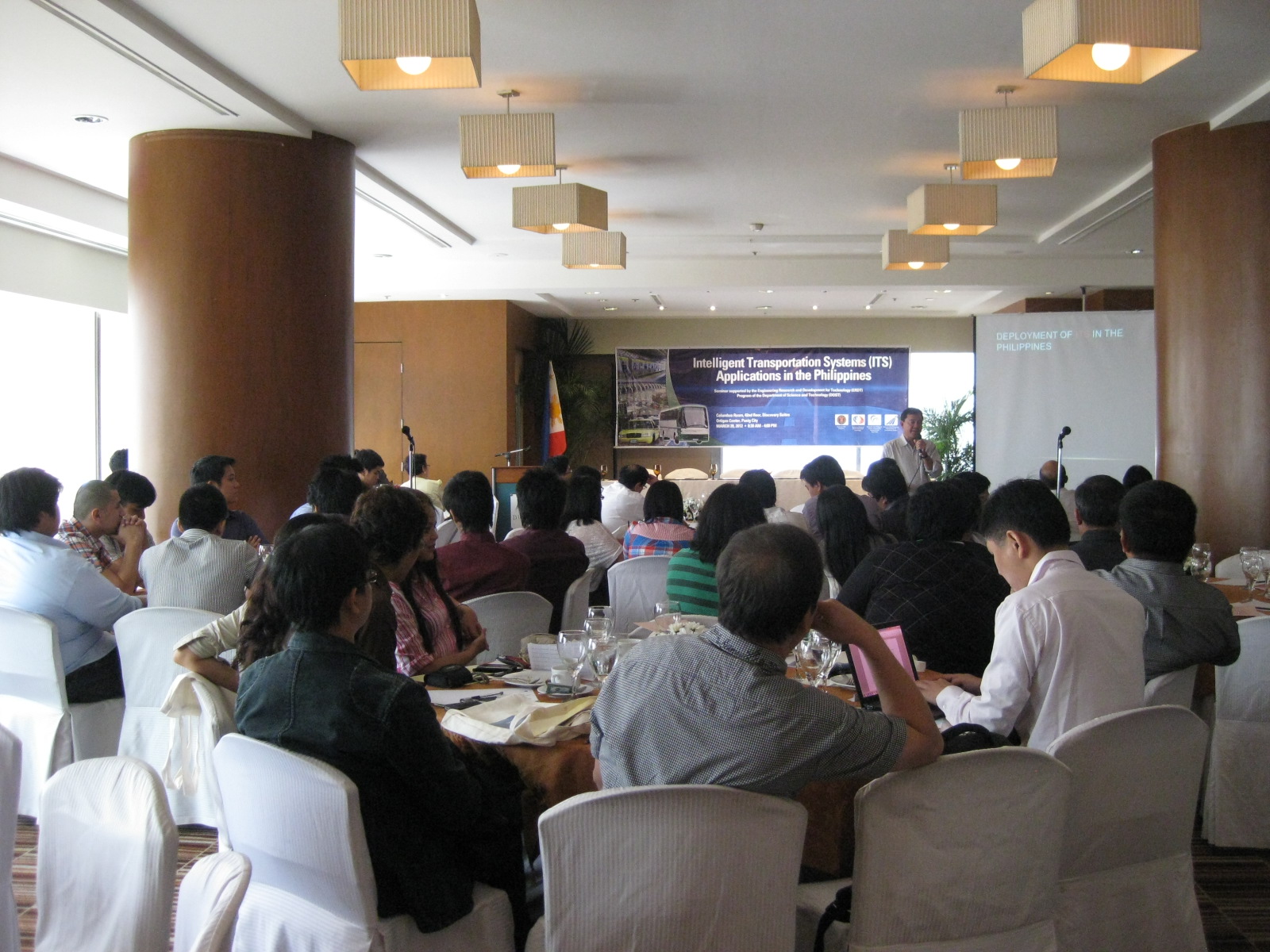 Full house – the seminar was well-attended with, in addition to the universities and DOST, participants from the DOTC, DPWH, MMDA and LTFRB, and the private sector particularly the MNTC.
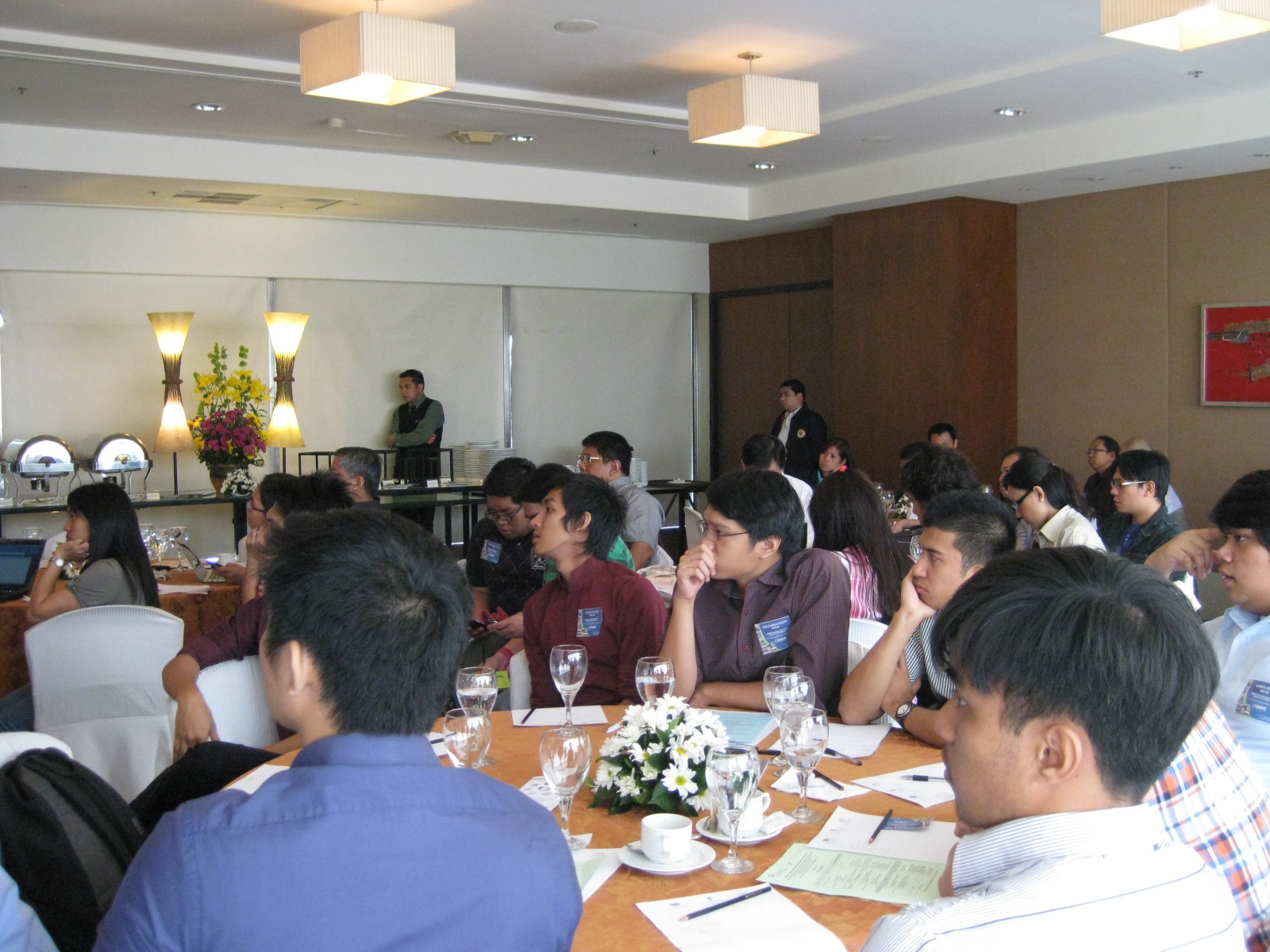 Next generation – it was delightful to see a lot of younger people attending the seminar. In fact, participants from the universities did not come solely from the Civil Engineering programs but included those in Electrical and Electronics Engineering, Mechanical Engineering and Computer Science.
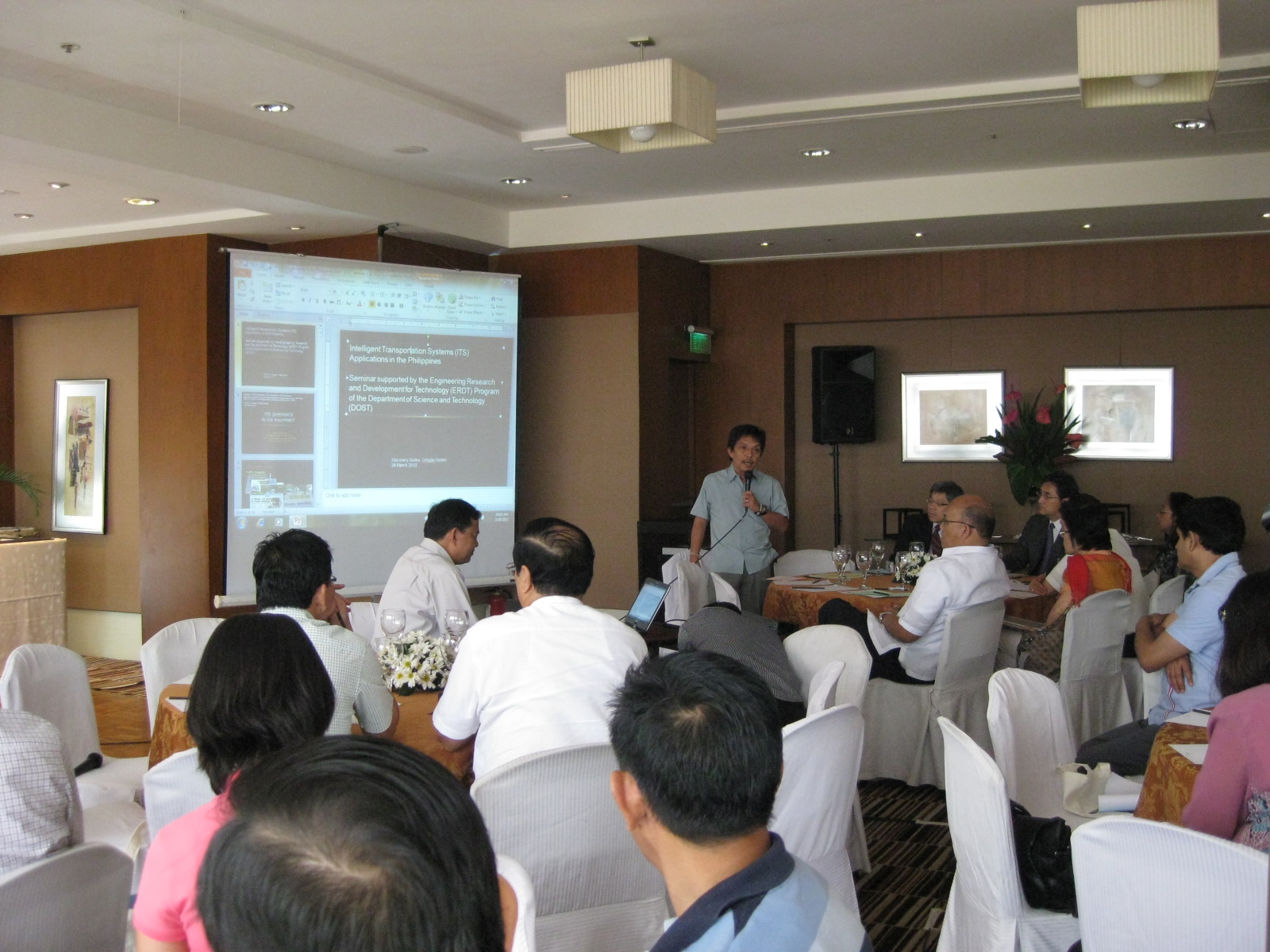 Open forum – Dr. Tho Lidasan of UP’s School of Urban and Regional Planning commenting on the presentation by Dr. Sigua.
 Open forum – Dr. Kardi Teknomo of Ateneo’s Computer Science also makes a point during the open forum.
 Electronic Toll Collection – Engr. Raul Ignacio, Manila North Tollways Corporation Vice President presents on ITS applications in the tollways including issues regarding interoperability. Currently, tollways offering ETC have incompatible systems.
 Q&A – former DPWH Usec. Ted Encarnacion making a comment on the MNTC presentation.
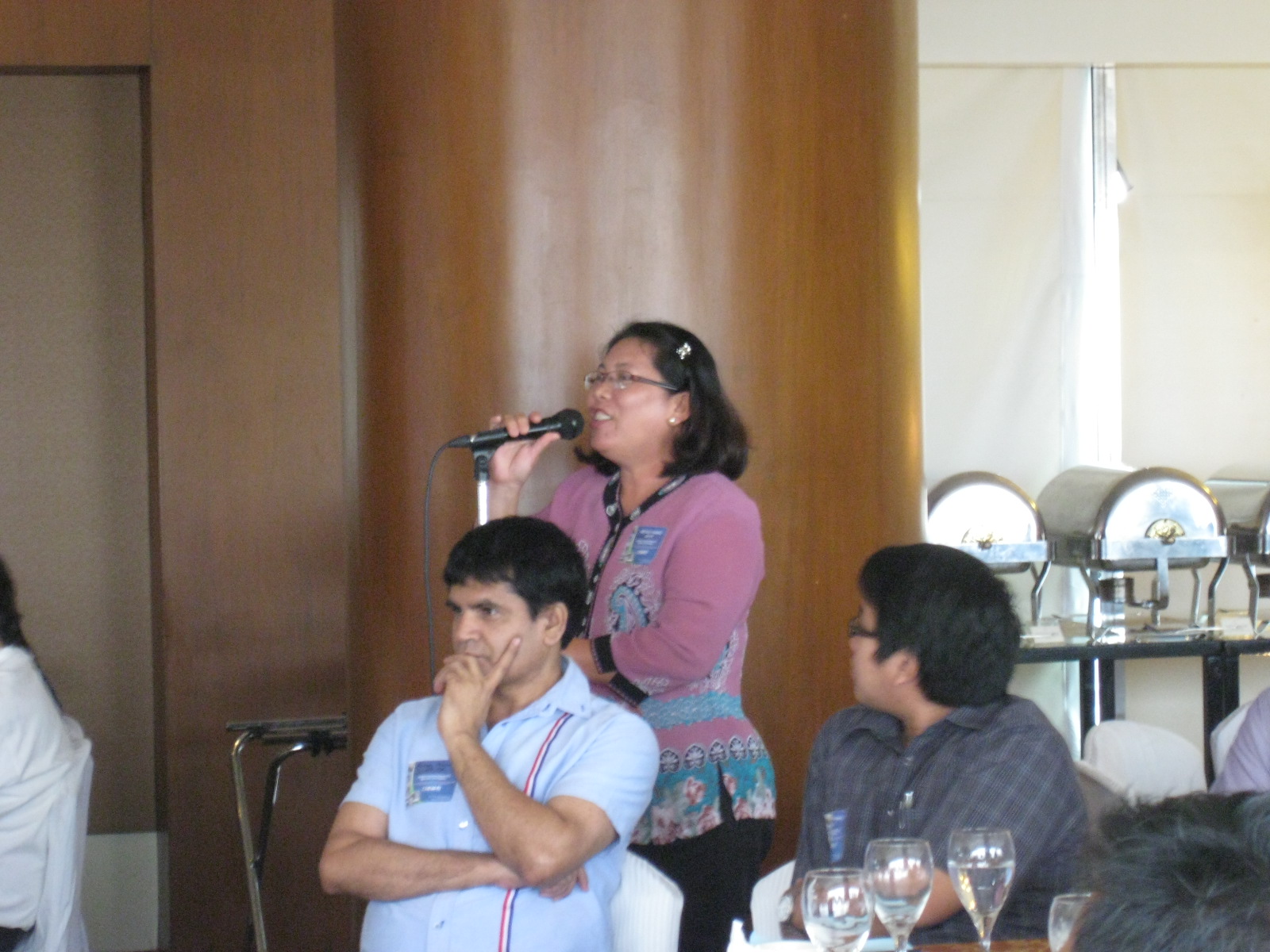 Q&A – Prof. Neneng Trinidad of the MSU-IIT asks a question about MNTC’s system.
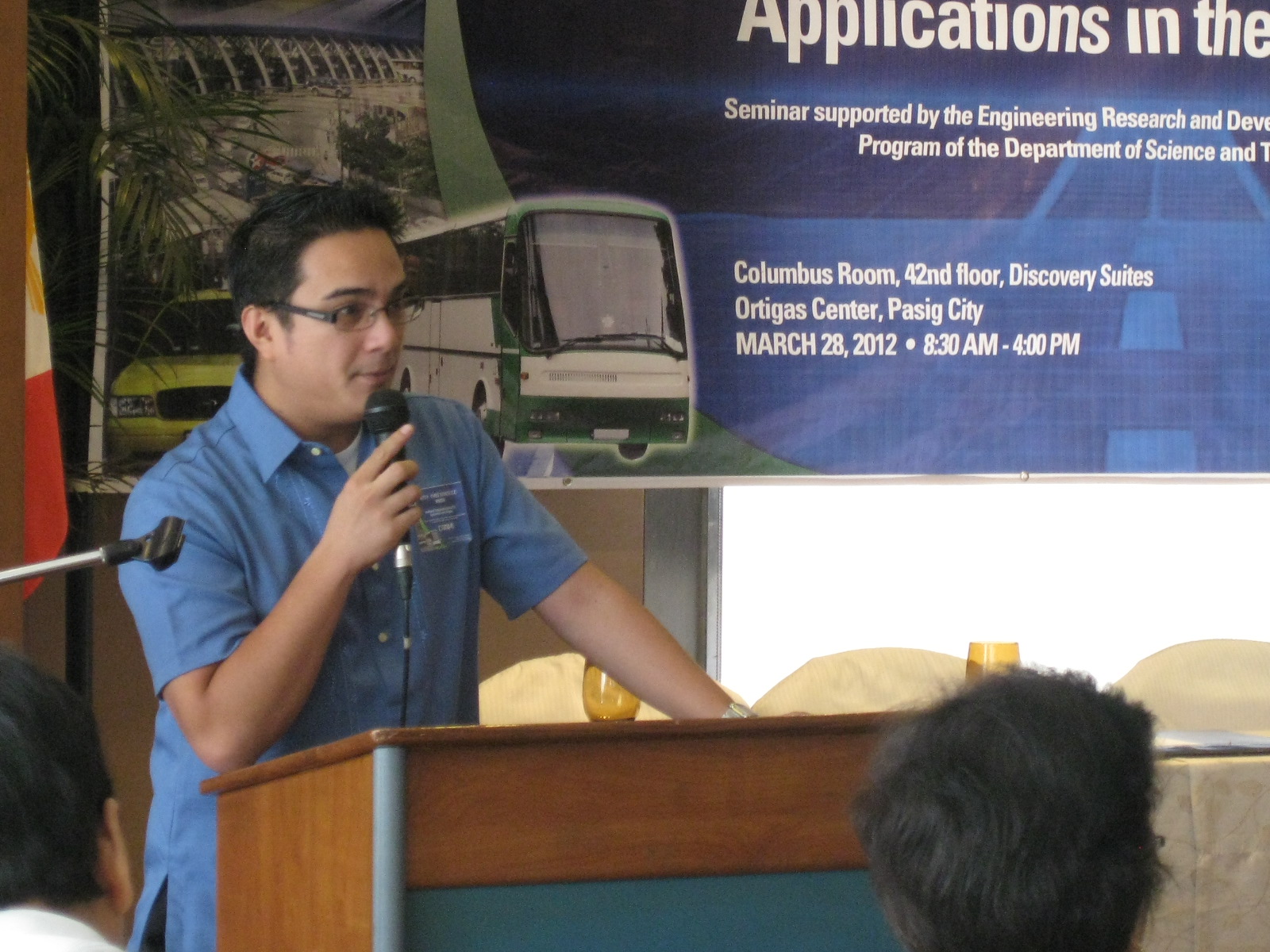 Traveler Information Systems – Atty. Yves Gonzalez, Director of the MMDA’s Traffic Discipline Office, presents on the agency’s Traffic Navigator system.
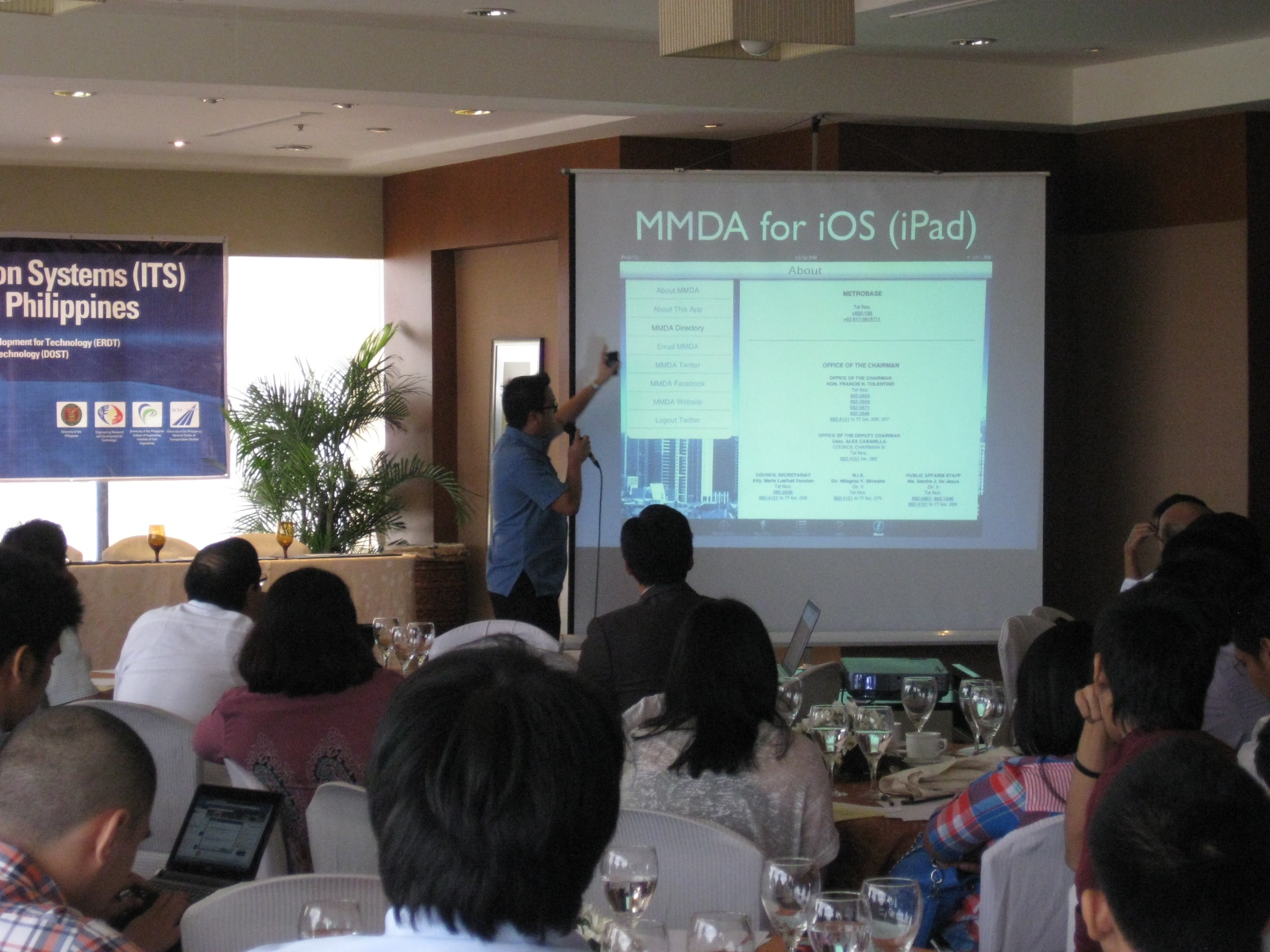 Live demonstration – Atty. Gonzalez even made a live demonstration of how the Navigator works and how the MMDA could monitor and manage traffic using these tools. The presentation impressed the audience and this reflected in the lively Q&A after his presentation.
 Q&A – Prof. Marloe Sundo of UPLB inquiring about the effectiveness of the MMDA’s Traffic Navigator.
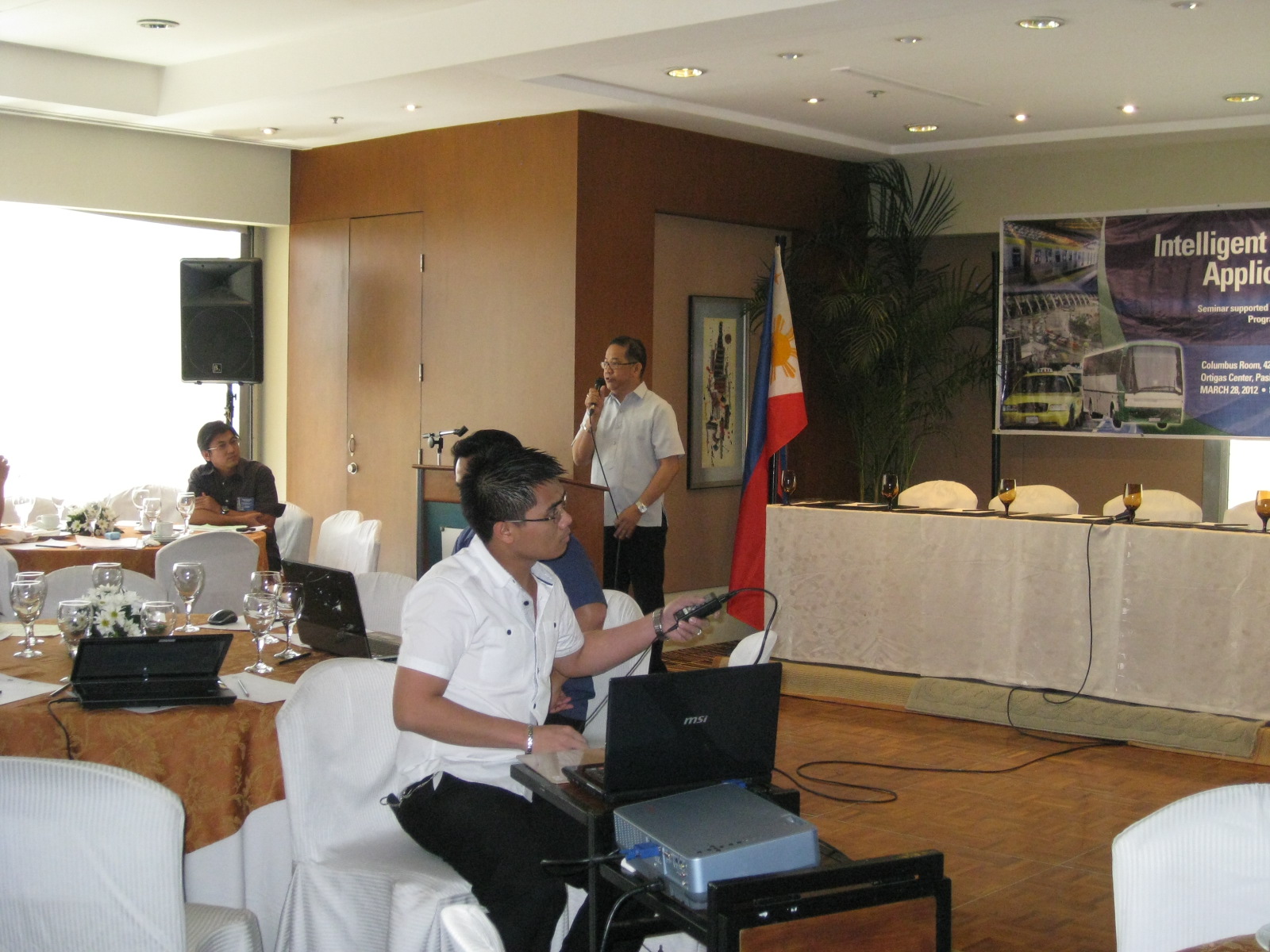 Smart traffic control – Mr. Abratique presents on smart traffic signals including the experience in Davao City. Modern traffic signal control may be found in only a few cities in the country including Cebu, which employs an old version of the SCATS system.
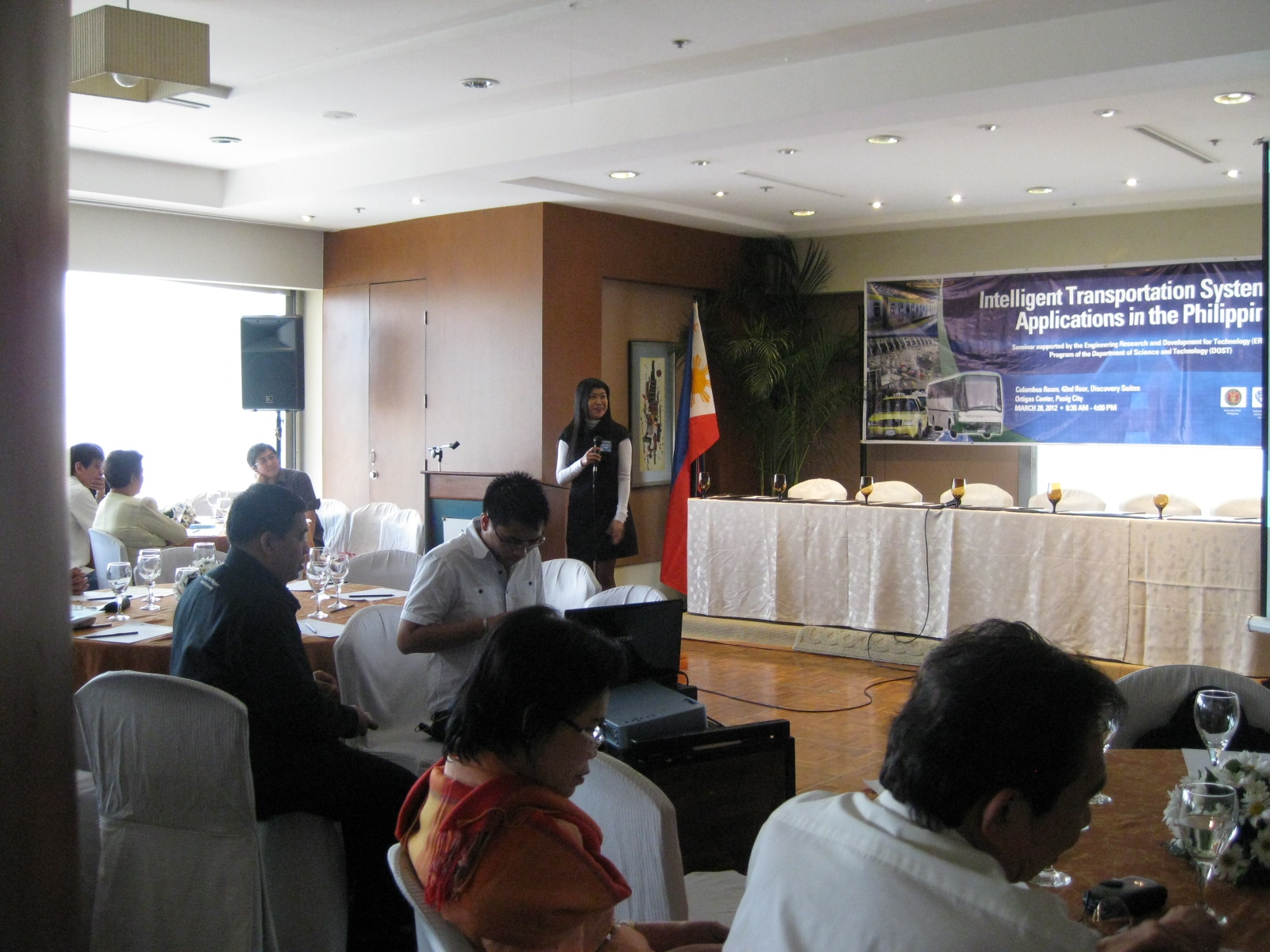 i-Bus – Ms. Elma Arboleras presents her invention that is intended to improve public transport operations, which won an award in London in 2011.
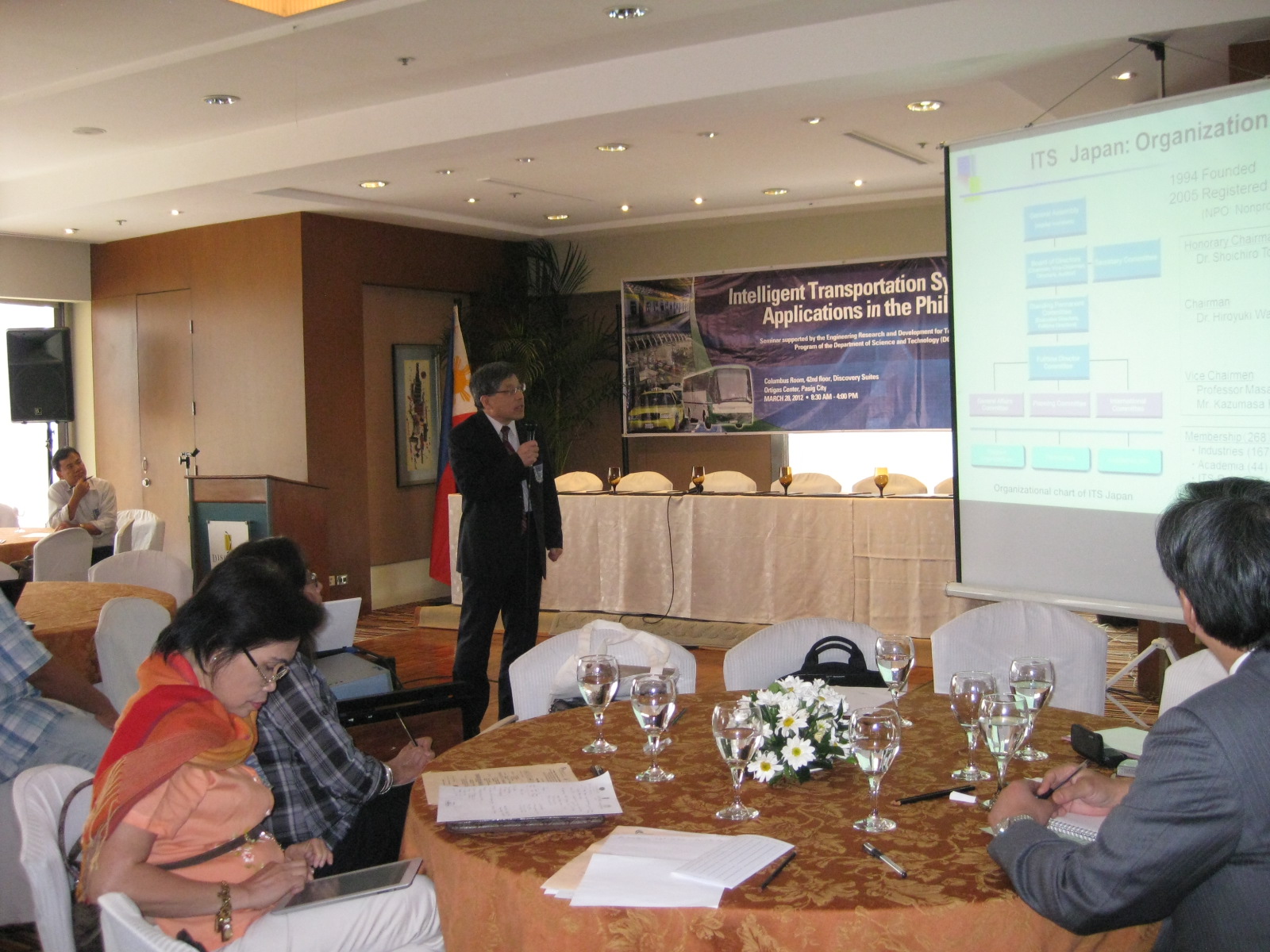 ITS in Japan and Asia Pacific – the afternoon session started with a presentation from ITS Japan.
 Panel discussion – the panel consisted of Ms. Cora Japson of the Road Transport Planning Division of the DOTC, Prof. Metodia Trinidad of MSU-IIT, Engr. Becky Garsuta of the DPWH’s PPP Office, and Engr. Glenn Campos of the MNTC.
 Reactions and remarks – DOTC’s Cora Japson providing a reaction to the question regarding what ITS are needed in the country.
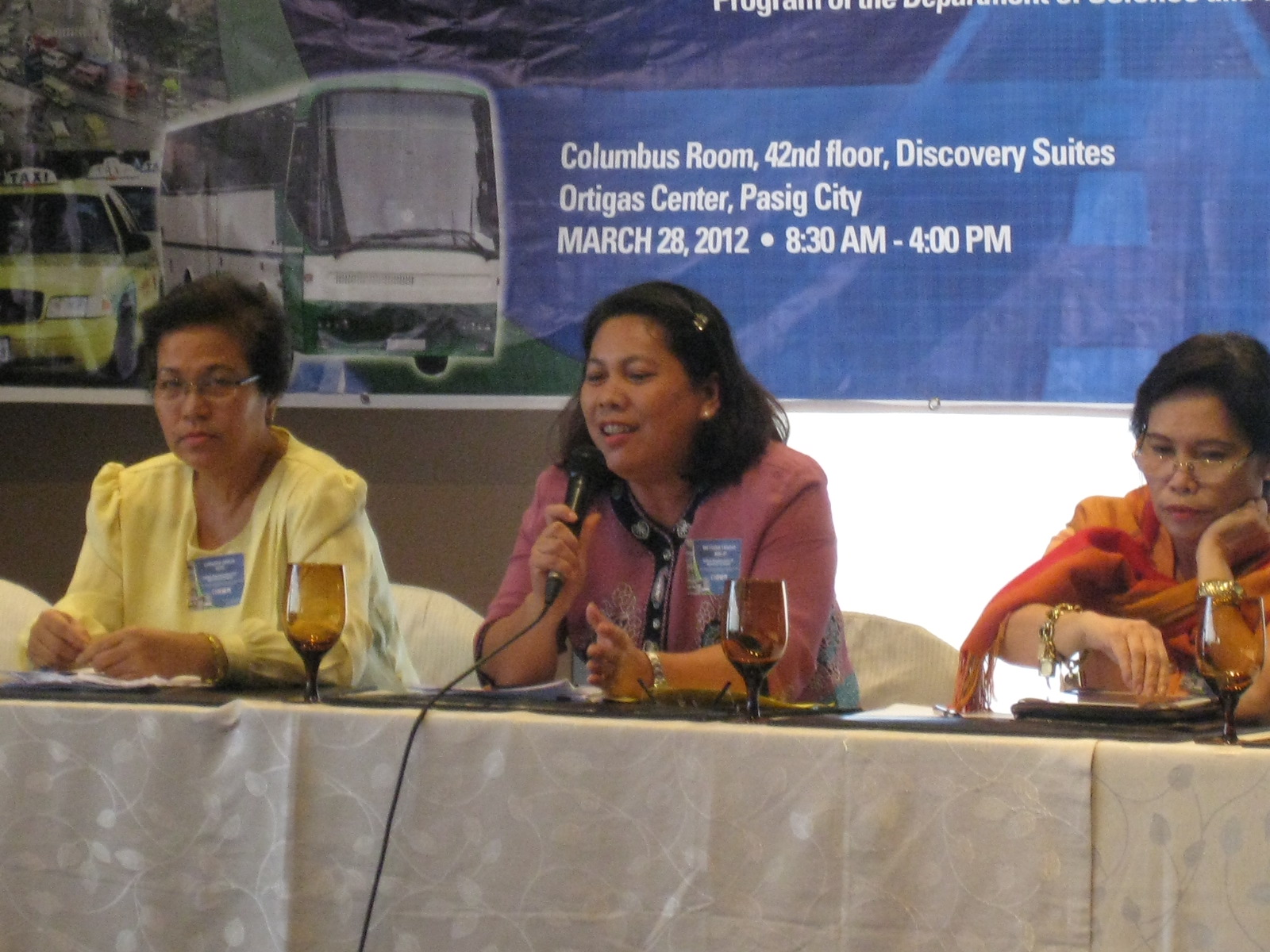 Reactions and remarks – Prof. Trinidad relating their experiences in Iligan City
 Reactions and remarks – Engr. Garsuta relating DPWH initiatives and what she thinks are systems applicable in the local setting. Incidentally, the DPWH just recently received technical assistance from JICA for ITS.
 Conclusion – Dr. Regin Regidor, NCTS Director, delivered the concluding remarks on behalf of the UP Diliman Chancellor.
 Group photo – participants to the Seminar on ITS Applications in the Philippines pose for a group photo.
–
Cagayan Valley Roads – Part 2
To continue with Part 1 of my feature on Cagayan Valley Roads, the following photos were taken along the national roads from Nueva Vizcaya to Cagayan (Tuguegarao).
 After Dalton Pass, motorists continue on winding mountain sections, often with little protection against flying off the road
 Community in a valley in the mountains as seen from the national highway
 The hills seem to be silent witnesses to intense logging in the past that has left us with a lot of barren hills and mountains. I could only imagine how these hills could have looked like if there were still trees.
 Entering Bambang, Nueva Vizcaya, I was a little disappointed that there was no grand arch like those marking boundaries in other cities or towns along national highways. Instead, there’s this sponsored sign on a gantry. Ahead, some of the chevron signs have been stolen, leaving only a few installed and empty posts.
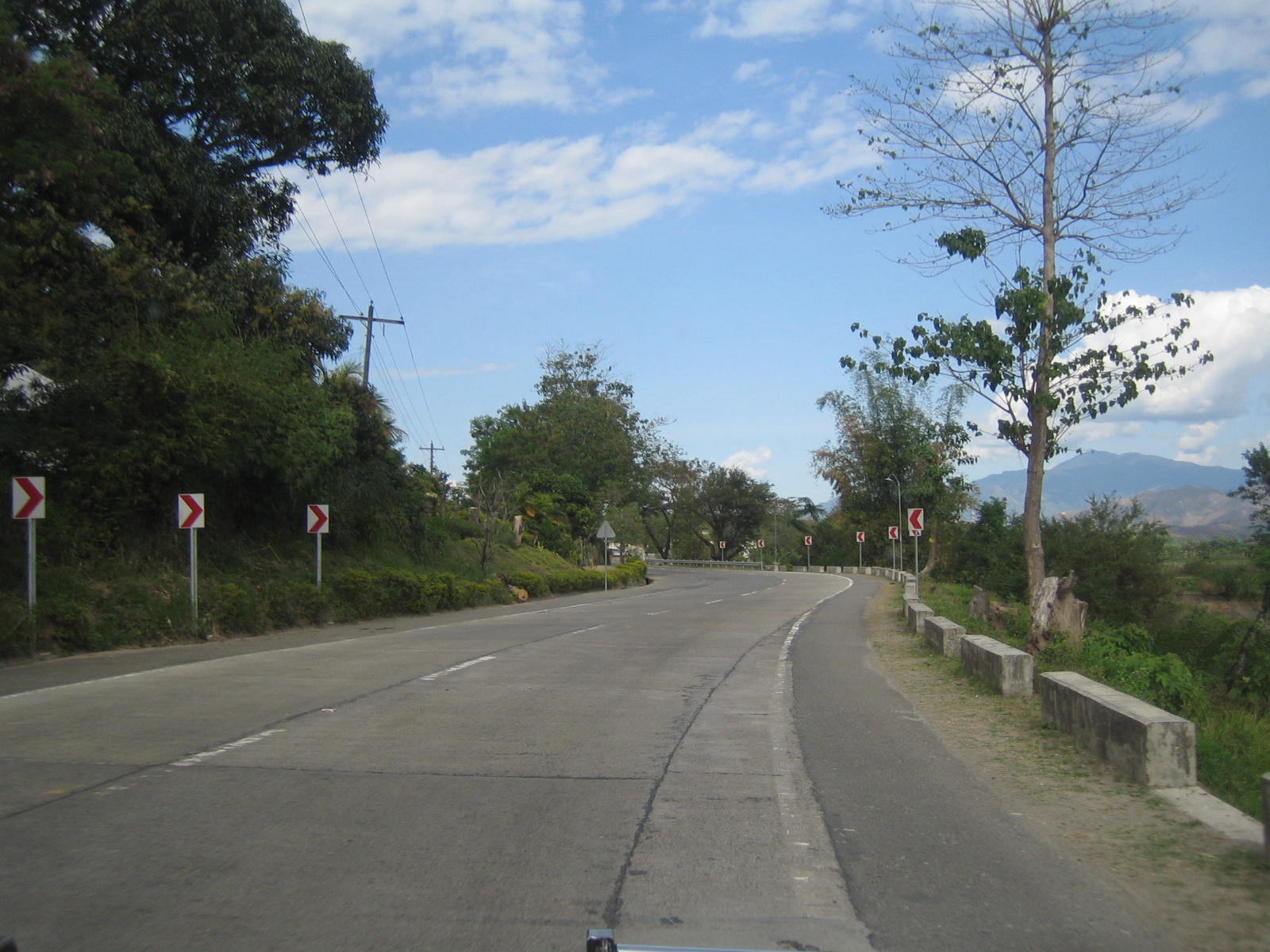 Reverse curve section with concrete barriers to keep cars from going off-road and into the ravine on the right. These barriers, however, will be unable to stop larger vehicles.
 I was both a bit surprised and delighted that tricycles used the shoulder (or is it parked?) and got out of the way of general traffic. I now forget the exact name of the place but this is somewhere in Bambang in Nueva Vizcaya and the tricycles here are not garapal users of the road.
 There are many trucks traveling along the Pan-Philippine Highway as this is a major route for a lot of goods. Isabela province, for example, produces rice that is transported mainly to Central Luzon and Metro Manila.
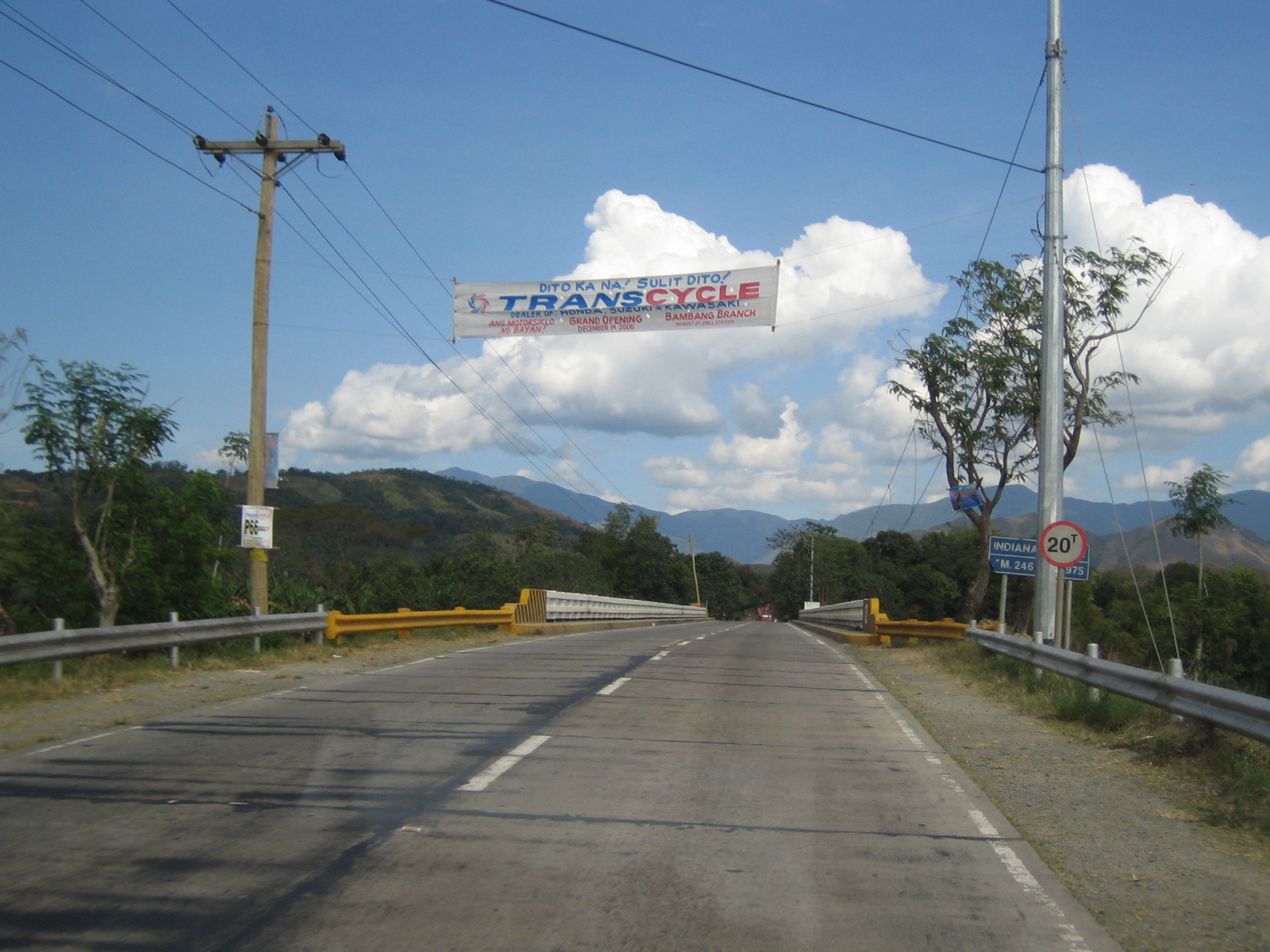 This typical 2-lane concrete bridge is relatively new judging from the 20-ton limit indicated in the sign. Older bridges would have 15-ton limits.
 The sign before the bridge allows motorists to assess distances to major towns along the highway: 8 km to Bayombong, Nueva Vizcaya, 13 km to Solano, Nueva Vizcaya, and 70 km to Santiago, Isabela. The two-lane bridge doesn’t have enough space for pedestrian use or breakdowns.
 There are many straight, long sections like this between Bayombong and Bagabag.
 I forget now but this section is also likely to be somewhere between Bagabag, Nueva Vizcaya and Cordon, Isabela. Bagabag is close to the provincial and regional boundary with Banaue Province (Cordillera Autonomous Region) and there are signs pointing travelers to roads going to Baguio City and Lagawe.
 I forget now but this section is also likely to be somewhere between Bagabag, Nueva Vizcaya and Cordon, Isabela.
 Calao Bridge in Santiago City, Isabela is an example of old school bridgework using steel trusses. It is similar to many other bridges including those still standing in the Visayas and Mindanao.
 From Santiago City, we decided to take the alternate route using the Santiago-Tuguegarao Road. Our assessment was that this would be less congested compared to using the Cagayan Valley Road, which passes through more populous towns like Cauayan and Ilagan.
 Arch announcing our arrival at Cabatuan, Isabela province along the Santiago-Tuguegarao Road.
 Typical two-lane bridge in Isabela along the alternate route to the Cagayan Valley road. Our decision to take this road seemed to be a good one as traffic was very light and we could travel without worrying too much about tricycles or pedestrians.
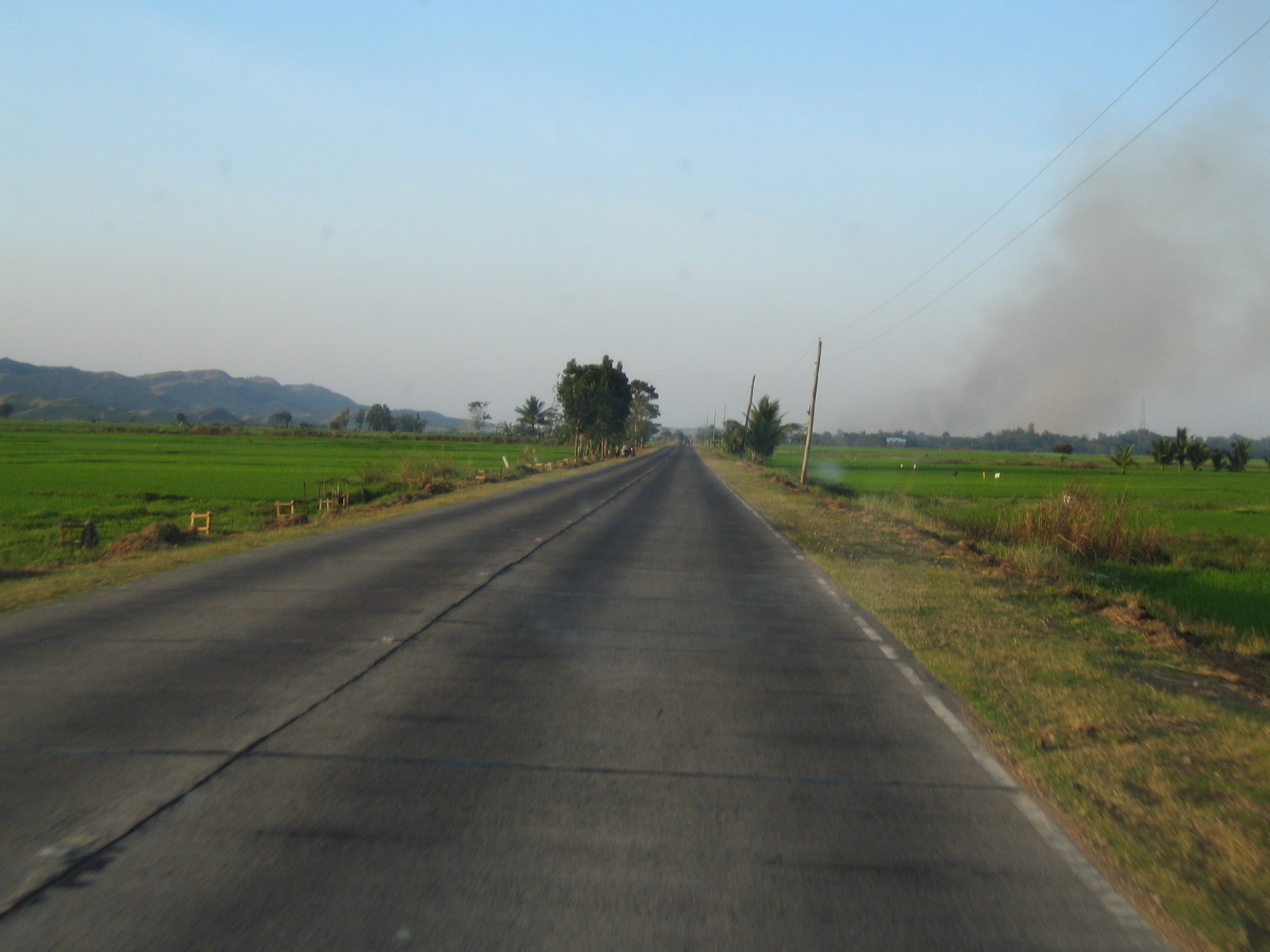 There were rice fields on both sides of the road. The concrete pavement was satisfactory and allowed us to travel at high speeds. Fortunately, there were few communities and people living along the highway at the time.
 I like seeing rice fields with the plants growing and the greenery indicating its is well-irrigated. This was taken in mid-February so I am pretty sure that since it was months before the wet season, the area had an abundant harvest.
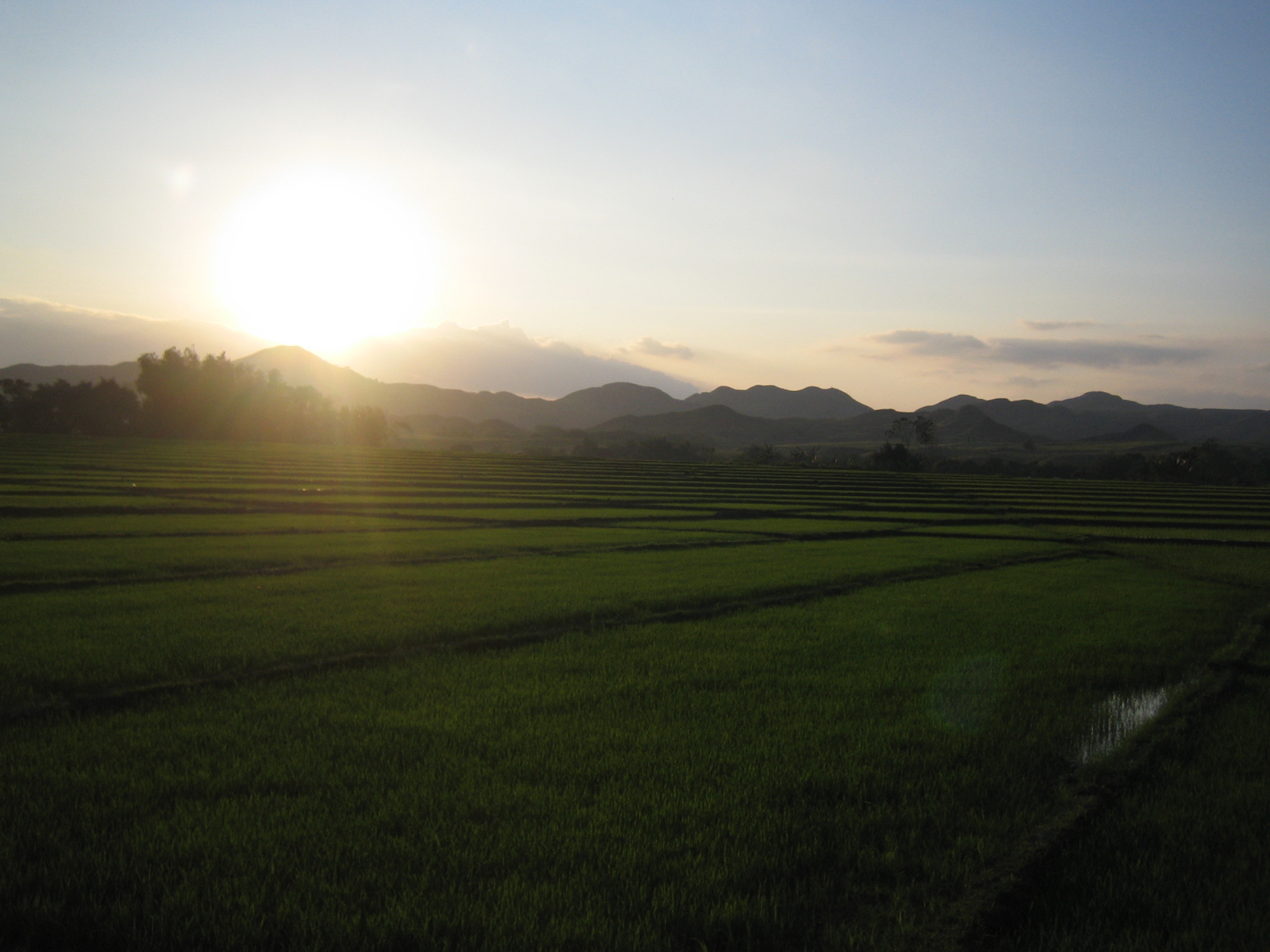 Sunset in the Cordilleras
 The light from the sunset presents travelers with surreal sights with the rice fields and the mountains often combining for picture-perfect moments. I took this with my Canon Ixy on-board a moving vehicle!
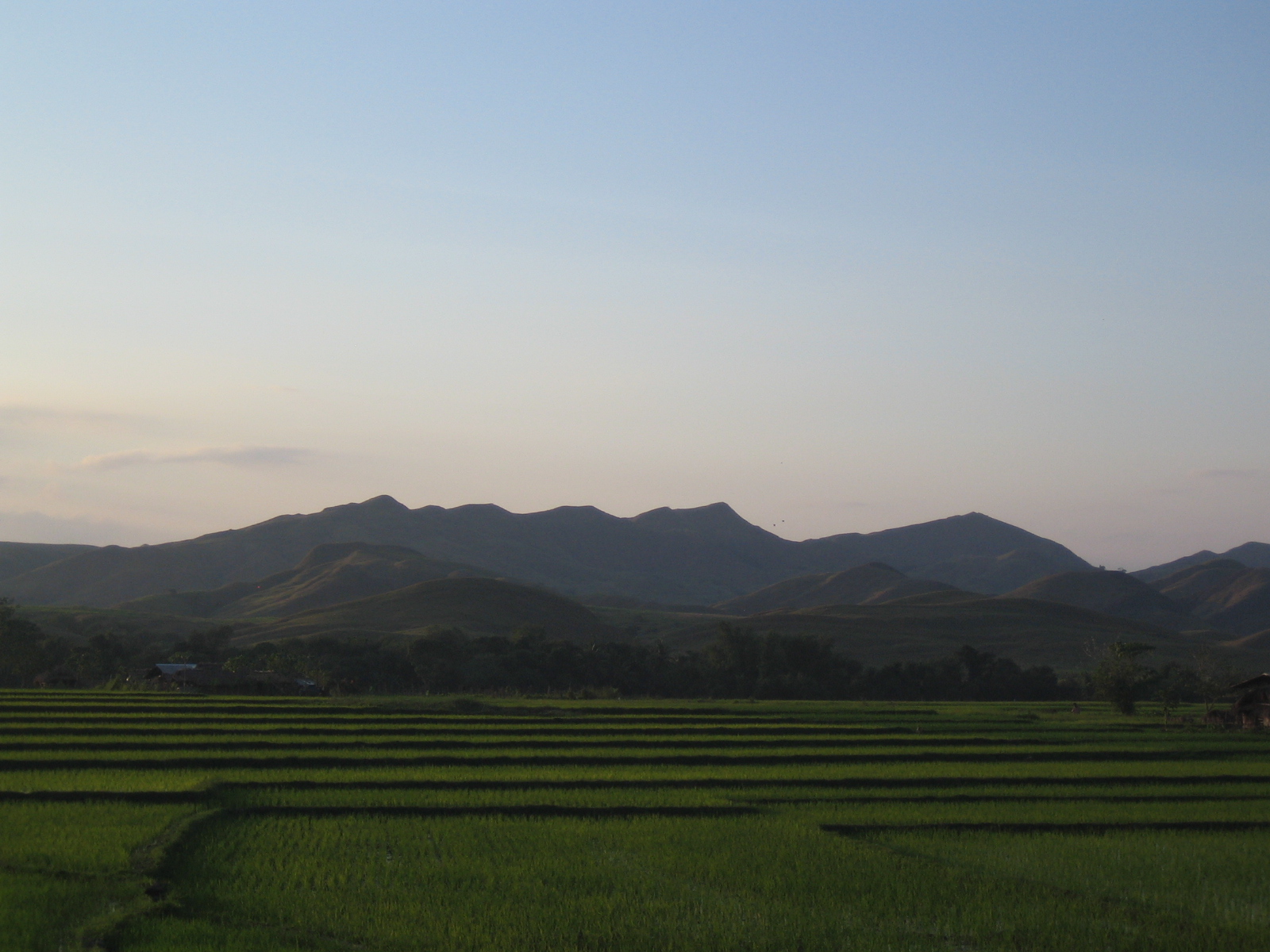 Another shot of the country side along the Santiago-Tuguegarao Road. This highway will actually pass through Kalinga province and there is a junction after Quezon town where travelers can turn left towards Tabuk, the capital town of Kalinga.
 Crossing the Buntun Bridge after Enrile town brings the traveler to Tuguegarao. The bridge spans the width of the Cagayan River, the longest and largest river in the Philippines, which deserves to be called by its name during the Spanish period – Rio Grande de Cagayan.
 Cagayan River is a wide body of water that is navigable and the source of fresh water for a lot of people in the Cagayan Valley. It stretches from Aparri to Dupax Del Sur, Nueva Vizcaya near the Nueva Ecija province and Pantabangan Dam. The river and its tributaries cover practically the entire valley of 4 provinces (Cagayan, Isabela, Quirino and Nueva Vizcaya).
Reviewing these photos and trying to remember the places is like reliving the journey. I am sure there has been a lot of changes since I took these photos in February 2007. Perhaps there have been substantial developments along the highways and there are more people living in those communities we passed by. Perhaps, too, there is more vehicular traffic along these roads, a definite sign of progress in these areas. I just hope that there would be more and not less trees in those hills we passed along the way.
–
Scenes along EDSA
The following photos are just takes on EDSA during one of those trips from a meeting to go back to the university. The pictures show what we encounter everyday along what may be the busiest thoroughfare in the country. Of course, it goes without saying that similar scenes are also observed along other roads including expressways.
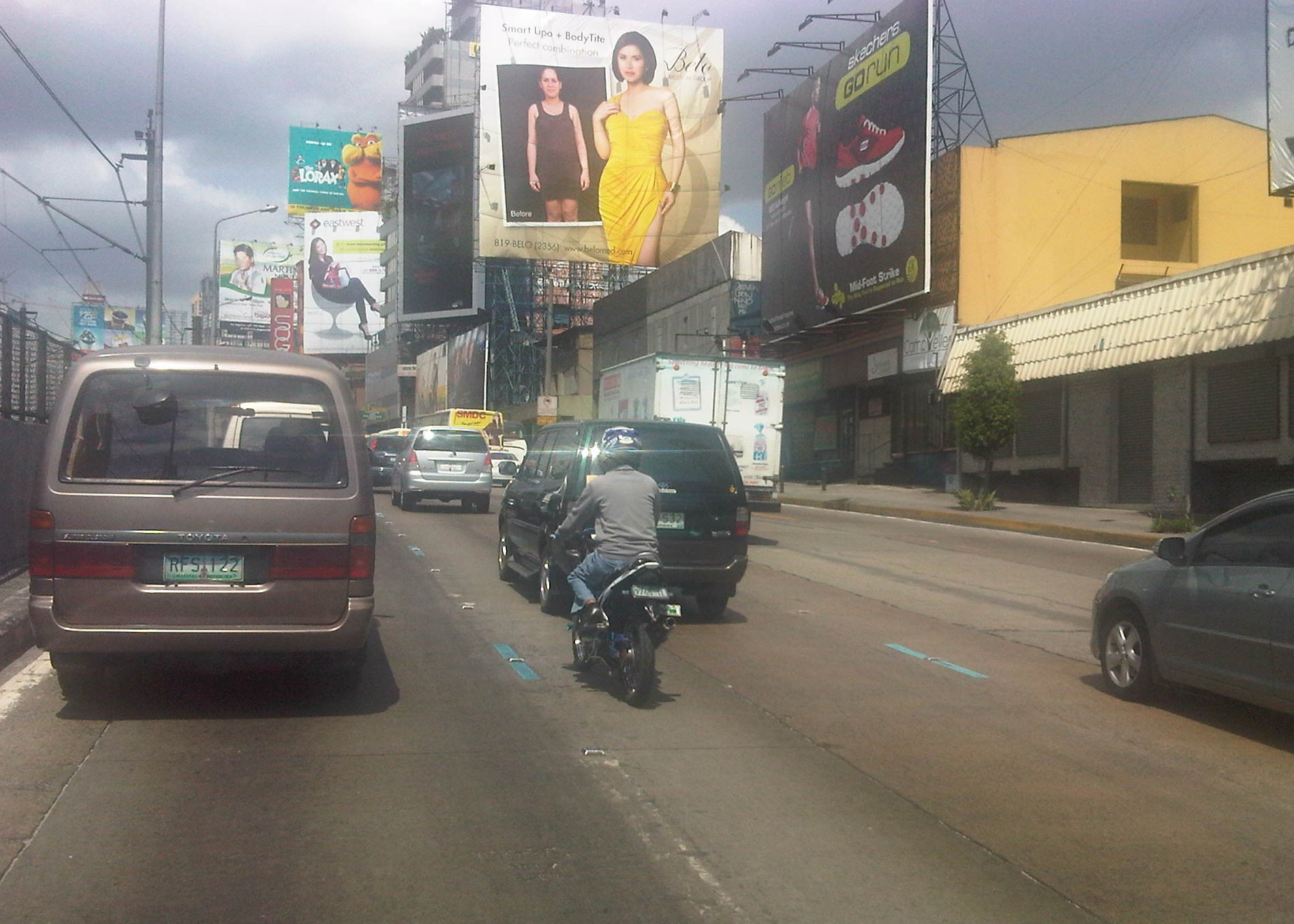 Visual noise – the billboards along EDSA remain to be a source of “visual noise” as some architects and planners refer to their proliferation. There are a huge concentration of these billboards in the Guadalupe area including LED screens that literally light up the road. Not a few people including MMDA Chairs have called for the removal of the billboards or at least regulating their content. With summer approaching fast, the models might have lesser clothing on them and become more of distractions for motorists and riders.
 Motorcycle lane – the imposition/implementation of motorcycle lanes along EDSA has received mixed feedback from various sectors. Unlike Commonwealth, EDSA’s traffic is significantly higher and the latter has less lanes and so during peak periods, there is no choice for motorists but to use the motorcycle AND bus lanes. The result is a chaotic mix of vehicles jostling for road space especially along areas where bus stops are located.
 NMT lane-splitting – I was fortunate to be able to capture this scene where a man on bicycle splits the lane along EDSA. The lane here is actually part of the 2 outermost lanes designated for buses (yellow lanes). However, in the vicinity of intersections, private vehicles are tolerated to use the lanes as the turn into or off from EDSA. I don’t think there is good data on how many bicycles travel along EDSA (or sections of the highway) everyday. This would be an interesting statistic that could enable us to determine the demand for cycling along this highway.
–
PhP 21.5 B for electric tricycles
Another article came out today, this time from GMA News about the NEDA’s approval of a PhP 21.5 Billion project for electric tricycles. The approval of the project is said to be based on the evaluation of a feasibility study submitted by its proponent, the Department of Energy (DOE). I have not yet seen this FS and I am not aware of any formal studies in this regard that has been made public so I cannot make a fair comment with regards to what the NEDA had as reference materials in their assessment. I am aware of one private initiative where UP was involved but to my knowledge this has not been disseminated or shared by the Client to government agencies. Though caution is still very much necessary and desired when moving forward with this e-trike project (What would happen to spent batteries? Is there adequate technical support? Charging stations? Policies regarding phasing out conventional tricycles?), it is hoped that this will be one of those “tipping point” moments that will ultimately benefit the country.
The article on the e-trike is reproduced below:
MELAY GUANZON LAPEÑA, GMA News March 26, 2012 5:29pmThe National Economic and Development Authority (NEDA) approved a P21.5-billion project to promote sustainable transportation and achieve energy efficiency.
The Market Transformation through Introduction of Energy Efficient Electric Tricycle (E-trike) Project will reduce fuel consumption of tricycles by 2.8 percent, equivalent to 560,926 oil barrels, NEDA said in a statement Monday.
“The project will distribute 100,000 E-trikes to tricycle operators on a lease-to-own arrangement, replacing their old gas-fed and two-stroke gasoline engine units. This way, we are also able to protect our environment,” according to NEDA, citing Socioeconomic Planning Secretary and NEDA board vice chair Cayetano W. Paderanga Jr.
“The electric tricycle is a specially designed, highly efficient tricycle that runs on a motor powered by a battery charged by electricity. E-trikes produce no noise, no tailpipe emissions, and represent an opportunity to make public transportation in the Philippines more environmentally conscious while improving the livelihood of tricycle drivers across the country,” reads the project description on the website of Asian Development Bank, which is financing part of the project through a P12.9-billion loan.
The project was proposed by the Department of Energy (DOE).
Additional financing will come from the Clean Technology Fund (P4.3 billion loan and P43 million grant), Clean Development Mechanism facility (P860 million), Philippine government counterpart funding (P3.397 billion).
Early this month, the DOE selected 10 winners in a nationwide contest for the best E-trike design on a theme of “Bright Now! Do Right, Be Bright.”
According to the DOE, the design is optimized to ensure structural integrity.
ADB explained that the project gives tricycle drivers the opportunity to lease or lease-to-own the E-trikes by paying less than 200 pesos a day, which translates to a higher take-home income.
“For example, a conventional tricycle needs between 5 and 7 liters of gasoline to travel approximately 100 kms, costing P250 to P350. To travel the same 100 kms, an E-trike will use between 3 kWh and 5 kWh of electricity, costing only P30 to P50. The 200 peso difference in fuel savings will help the driver pay for the cost of the E-trike,” ADB added.
The pilot project was launched in April 2011, with 20 E-trikes deployed in Mandaluyong City. The E-trikes use two different types of lithium ion battery technology—the 3 kWh and 6 kWh battery packs.
Models with the 3 kWh battery pack can run as far as 50 km on a single charge, and can be recharged to 80 percent in under 30 minutes at fast charging stations. Models using the 6 kWh battery pack can go up to 100km on a single overnight charge.
Sen. Edgardo Angara, who heads the Congressional Commission on Science, and Technology, and Engineering, lauded the E-trike project, saying the use of e-vehicles could lower air pollution levels and lessen the dependence on oil.
“Once thousands of E-trikes begin to be manufactured, many new jobs could be created. Working together, we can give Manila cleaner air, bluer skies, and a more livable environment,” Kunio Senga, director-general of ADB’s Southeast Asia Department, said in an earlier report.
The Quezon City government is preparing pilot test the E-trikes. According to a news release, the city has conducted an Eco-Driving Training for Quezon City Tricycle Operators and Drivers Associations (QC-TODA).
Discussed was the impact of good driving behavior, proper engine maintenance for lesser emissions and reduced maintenance cost as well as increased fuel saving for the current conventional tricycles operating in the city.
QC will be given 22,000 E-trikes over five years—the largest allocation among LGUs in Metro Manila—2,000 this year and 5,000 every other 4 years.
“The project is expected to complement the city government’s continuing effort to mitigate the ill effects of pollution on public health and safety. This would also pave the way for the gradual phase-out of conventional tricycles now plying city roads,” according to a statement by the Quezon City government.
Under Phase I of the project, 20,000 E-trikes will be distributed to operators in Metro Manila, Boracay, Puerto Princesa City, Cabanatuan City, and Davao City from 2012 to 2013.
Eighty thousand units will be distributed to operators in municipalities and cities that are still to be determined under Phase II (2013 to 2016).
NEDA said the project aims to promote, establish and develop electric-vehicle support industries such as battery leasing, recycling and disposal, and motor supply chain and charging stations.
But the Electric Vehicle Alliance and the Partnership for Clean Air are questioning the project, saying its funds were reallocated from the renewable energy industry—originally stipulated in the Clean Technology Fund.
Greenpeace is also not happy with the project.
“Why are we rushing this project?” asked Greenpeace Southeast Asia campaigner Francis Dela Cruz.
While E-trikes are not bad in terms of technology, Dela Cruz said
they are not necessarily good for the environment. “Hindi siya magiging source ng mobile pollution, but because you use power outlets to charge, you are just shifting to a stationary source of pollution—the fossil fuel-fired power plants,” he said.In addition, the project-mechanism that involves LGUs as lenders make the project seem dubious to Greenpeace.
“Kaya bang magpautang at maningil? Baka magpapautang tapos hindi maniningil, ang magbabayad ang taong bayan,” Dela Cruz said, noting this will be unfair to taxpayers who don’t benefit from the project but may end up having to indirectly pay for it. — VS, GMA News
–
The Panay-Guimaras-Negros bridge: nice to have but is it necessary now?
An article came out of the Philippine Daily Inquirer about 19 congressmen backing a proposed 53-Billion Peso bridge project. The bridge is supposed to connect the main islands comprising Western Visayas namely Panay (which has 4 provinces – Iloilo, Capiz, Aklan and Antique), Guimaras and Negros (divided into two provinces – Negros Occidental and Oriental). The claim is that the bridge will generate traffic between the islands, leading to more economic activity. While this preliminary assessment is generally true, it is the magnitude of the traffic and the resulting benefits that is difficult to determine. In fact, it is very difficult to establish a likelihood for what are expected to be tremendous benefits given also the tremendous cost of the bridge. The price tag will require quite a stretch should the usual economic analysis of NPV, IRR and B/C Ration be applied to justify the project, even factoring in employment opportunities (after the project, what then becomes of the workers?)
Meanwhile, it is interesting to make a reality check about the constituencies of these same congressmen. Do they have health centers to serve their people? If so, are there medicines and other essential equipment or staff in these centers? These are just examples of what needs much and immediate attention other than constructing what may likely become a monument to folly. First things first! There are many other things that need to be prioritized other than sinking funds into this project.
From a purely civil engineering or architectural viewpoint, the bridge would definitely be a great project. It could be a showcase project for an emerging economy, a statement for a country wanting to be recognized among its more progressive neighbors like Thailand and Malaysia. Yet, considering many other things like recovery from the disasters that visit the nation every year (think Ondoy and Sendong) it is another one of those projects that I believe is nice to have but is unnecessary at this time. In fact, the cities in the islands of Panay and Negros would probably benefit more if their traffic and public transport systems are upgraded. But that’s just one opinion…
The article is reproduced below:
19 solons back P53-B bridge project
By Nestor P. Burgos Jr.
Inquirer Visayas12:03 am | Sunday, March 25th, 2012ILOILO CITY—Crossing party lines, 19 Visayas congressmen have asked President Aquino to prioritize the construction of a bridge network linking the islands of Panay, Negros and Guimaras.
The legislators, in a resolution, called on Mr. Aquino, the Public-Private Partnership (PPP) Center, the Department of Public Works and Highways (DPWH) and the National Economic Development Authority to prioritize the construction of bridges connecting the islands in the government’s PPP program.
“The construction of trans-link bridges will open new economic opportunities, reduce transportation and business transaction costs, increase access to social services and boost tourism in the entire Western Visayas region,” according to the resolution.
The resolution was initiated by Iloilo City Rep. Jerry Treñas and was signed by 19 of the 21 legislators from Western Visayas and Negros Oriental.
Aside from Treñas, those who signed the resolution include Representatives Janette Garin (Iloilo), Augusto Syjuco (Iloilo), Arthur Defensor Jr. (Iloilo), Ferjenel Biron (Iloilo), Niel Tupas Jr. (Iloilo), Florencio Miraflores (Aklan), Paolo Javier (Antique) , Antonio Del Rosario (Capiz), Jane Castro (Capiz), JC Rahman Nava (Guimaras), Anthony Rolando Golez Jr. (Negros Occidental), Aflredo Marañon III (Negros Occidental), Alfredo Benitez (Negros Occidental), Jeffrey Ferrer (Negros Occidental), Mercedes Alvarez (Negros Occidental), Jocelyn Limkaichong (Negros Oriental), George Arnaiz (Negros Oriental) and Pryde Henry Teves (Negros Oriental).
Only the late Rep. Ignacio “Iggy” Arroyo and Rep. Julio Ledesma IV, both of Negros Occidental, were not among the resolution’s coauthors.
House Resolution No. 2018 was read on Jan. 16 and was referred to the House committee on public works and highways.
Steel bridges
There have been various proposals and studies to construct the bridges over the years but none has led to an actual project because of the high estimated cost. In the past, however, the government used modular steel bridges for its various projects. The bridges, unlike concrete ones, are easier to build and less expensive.
A study of Japan International Cooperation Agency conducted in 1999 pegged the cost of the project at P53.661 billion with a total span of 23.19 kilometers.
This includes P14.173 billion for the construction of the 2.59-km Panay-Guimaras bridge and P39.488 billion for a 20.6-km bridge linking Guimaras and Negros islands.
In a separate DPWH study in 2010, the project cost was estimated at P28.496 billion covering 13.16 kilometers. This include 3.6 km for the Panay-Guimaras bridge at P9.438 billion and a 9.56-km bridge to connect Guimaras and Negros costing P19.08 billion.
The 13.16-km span is the shortest among the target areas for bridge construction.
Based on this projected length, a bridge will be constructed to connect Leganes town in Iloilo to Buenavista town in Guimaras. Another bridge will link San Lorenzo town in Guimaras to Pulupandan town in Negros Occidental.
‘More realizable’
Treñas said the projected cost in the DPWH study “makes the dream more realizable.”
The Visayan legislators pointed out in the resolution that the promotion of the project under the PPP is an integral part of the President’s socioeconomic program.
They said infrastructure and economic development projects should also be implemented beyond the capital.
“The National Capital Region receives the lion’s share of the national budget despite the Visayas islands having a population greater than that of Metro Manila,” said the resolution.
They said the archipelagic nature of the country “requires the development of a unified well-integrated economy which allows people and goods to be transported swiftly and efficiently.”
Treñas said they hoped that the national government could release funds for a comprehensive feasibility study that would pave the way for the approval and implementation of the project.
–
PNR Field Trip 2012
We took our students to a field visit to the Philippine National Railways (PNR) station and depot in Tutuban in Manila. It was a good experience for all of us who joined the trip as the PNR is currently in the process of upgrading their services with the acquisition of refurbished rolling stock and the resumption of services to Bicol. We were quite curious as to the current state of the PNR after what has been a long period of neglect from a government that is supposed to promote safe, efficient and affordable mass transit not just for the urban setting but for long distance travel as well.
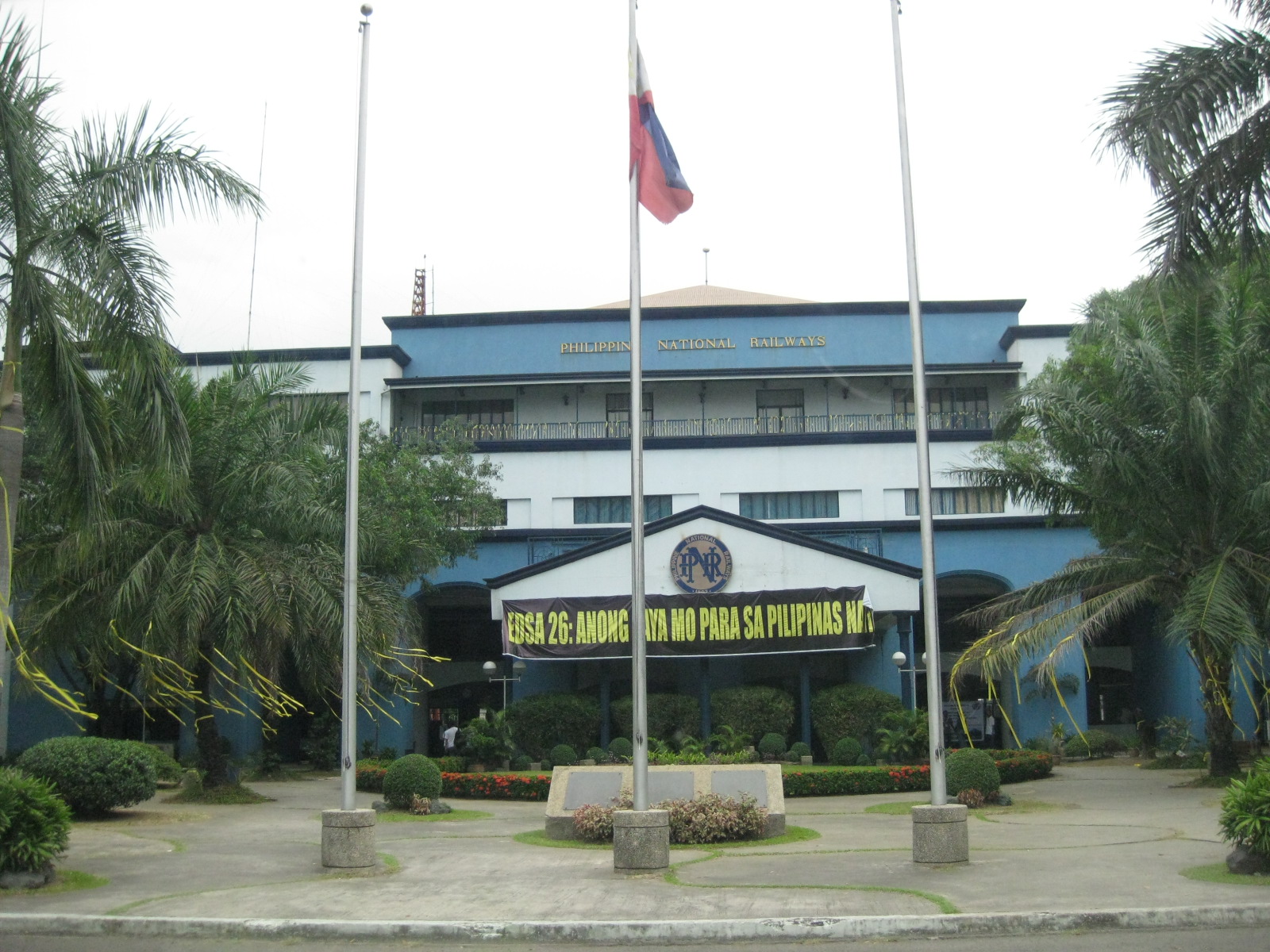 The PNR station and office building at Tutuban – the old station is actually where the Tutuban is now located. Access to the Tutuban Station is through a gate and the surrounding area is not suitable for a main or central station. There is no station plaza and as we will see in another photo, the space including the platform will not be suitable should operations expand in the next few years. In fact, passengers entering the station are processed as if they are entering an office building. This is partly true as the building serves as head office for the PNR.
 Train schedule for the PNR commuter line – service frequency is still low with headways of 30 minutes (a train every half hour). With the number of passengers steadily increasing, the current capacity of trains has already been exceeded. The PNR should resolve issues pertaining to conflicts along its tracks and deploy more trains and/or more cars.
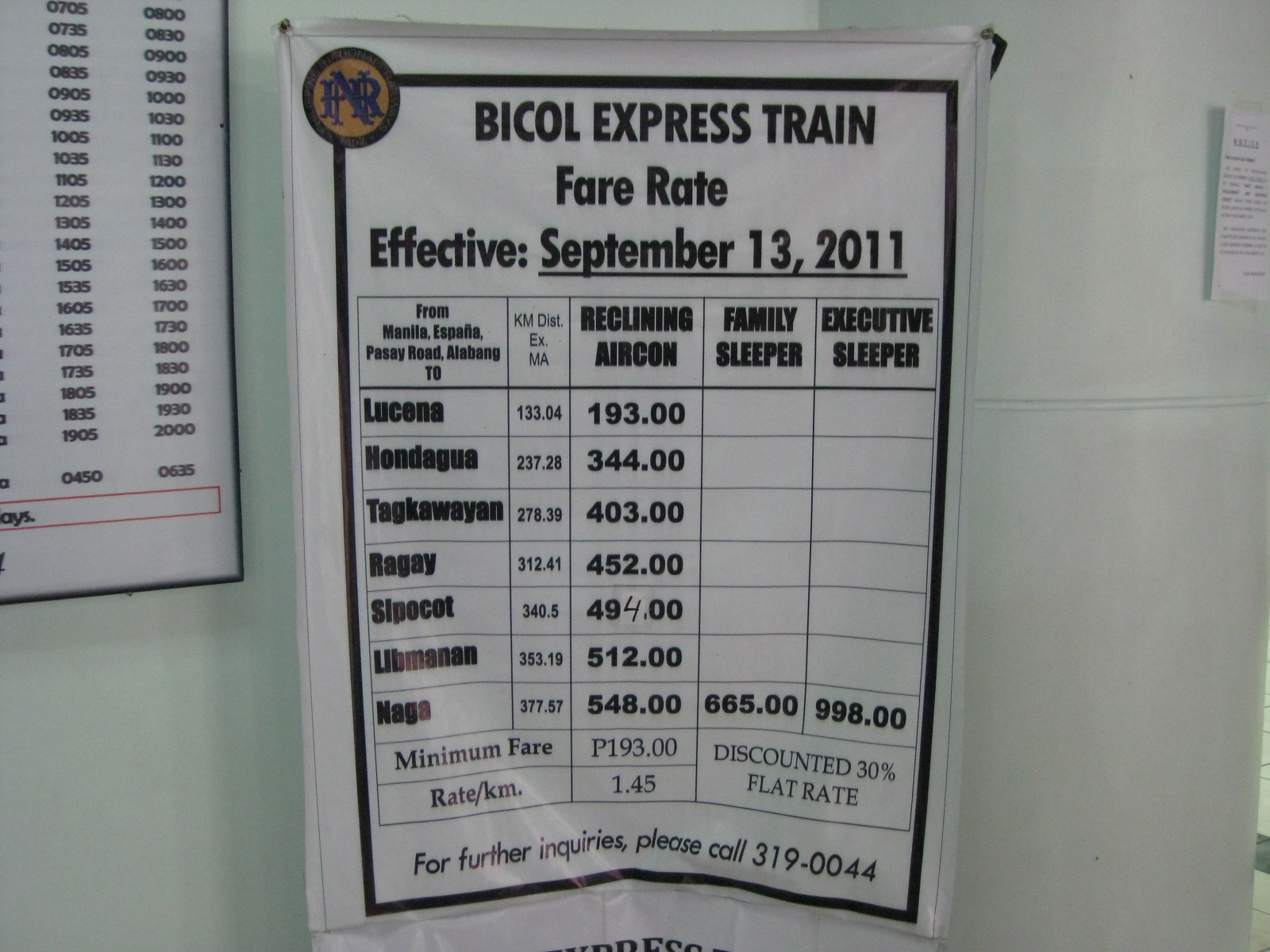 Fare table for the resurrected Bicol Express – family and executive sleepers were supposed to start operation last March 16. We were told that the PNR hosted representatives of travel/tourist agencies to an exclusive initial run of the sleeper and recliner cars to Bicol and back. This was part of the promotion of rail services to travelers especially as the summer months are approaching.
 Replica of old PNR train car – there were many photos and other memorabilia on display at the Tutuban station. Unfortunately, the security people seem quite iffy about people taking photos. They had to be told by our host PNR officials that we were visitors from the State University. I found this to be very odd and a definite turn off for people interested in the trains. Rail needs to be promoted and PNR security is not helping in this aspect.
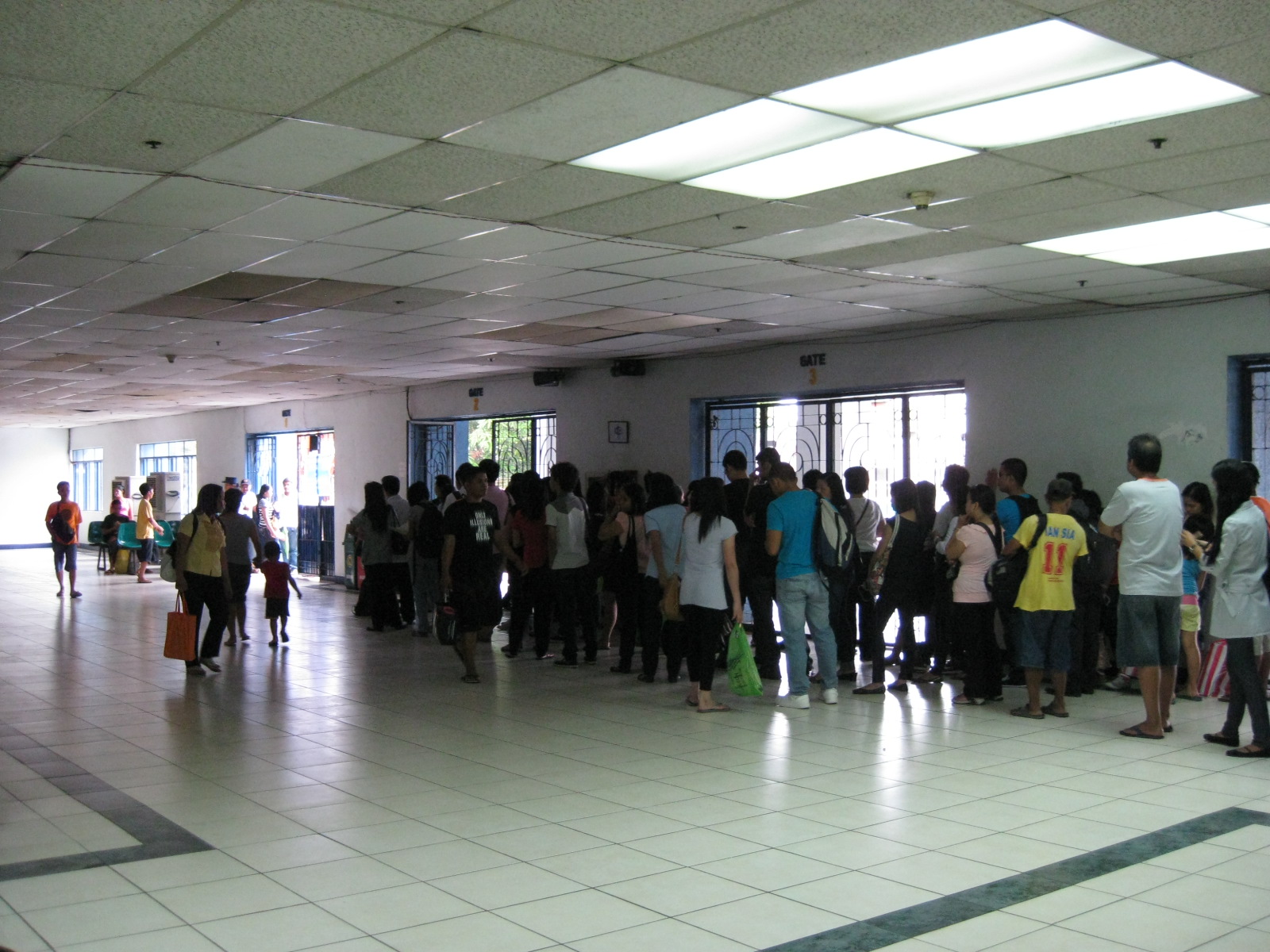 Passengers queued at the Tutuban Station – there were very few seats in the waiting area and passengers who want to board the next train emanating from Tutuban had to stand in line from the gate where PNR staff and security process passengers. A better system should be established here including the introduction of ticketing machines and turnstiles to better serve passengers. It won’t hurt also to have an electronic information system for train schedules and announcements.
 Maintenance cars – when our hosts led us to the platforms, the first things that caught my eyes were the maintenance cars. These have allowed the PNR to provide better maintenance work on their tracks, no longer relying solely on manual labor for inspection and other works. Behind the equipment are cars familiar to me and my colleagues – Japan Railways (JR) retired these cars from the Saikyo Line that served areas along a route connecting Tokyo and Saitama Prefecture.
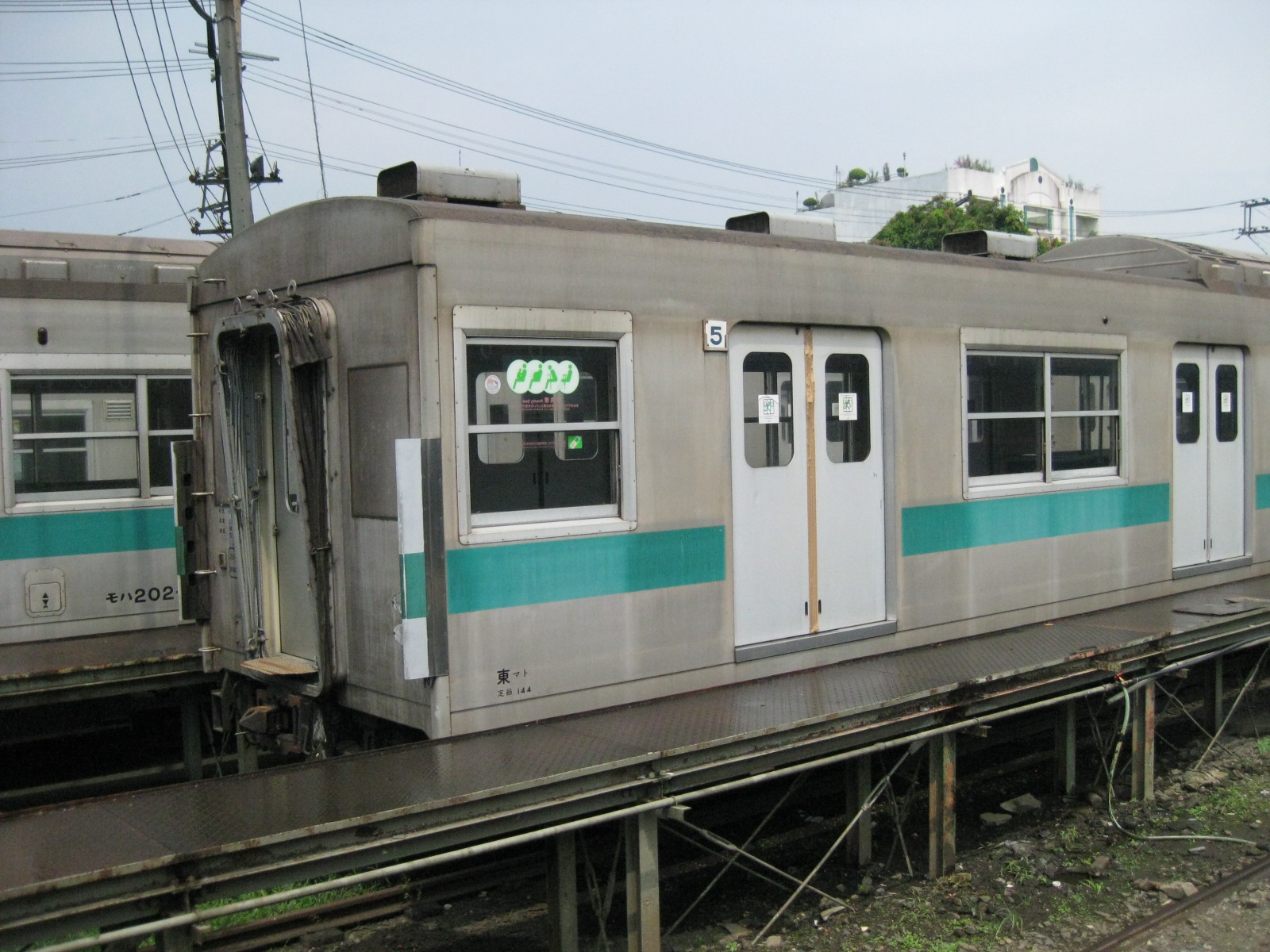 Nostalgic – these cars were the very same cars we used to ride along JR East’s Saikyo Line, which now runs between Omiya in Saitama Prefecture and Osaki in Tokyo via Ikebukuro and Shinjuku. It was usually my choice for going to Tokyo from Saitama University if I was heading to Shinjuku or Shibuya. From the university, I ook a bus to Minami Yono Station where I can also see Shinkansen trains passing through the station. The latter were also headed to Omiya where the Shinkansen lines branch out to Nagano, Tohoku and Akita. The cars shown in the photos are donations from Japan and the PNR only paid for its transport.
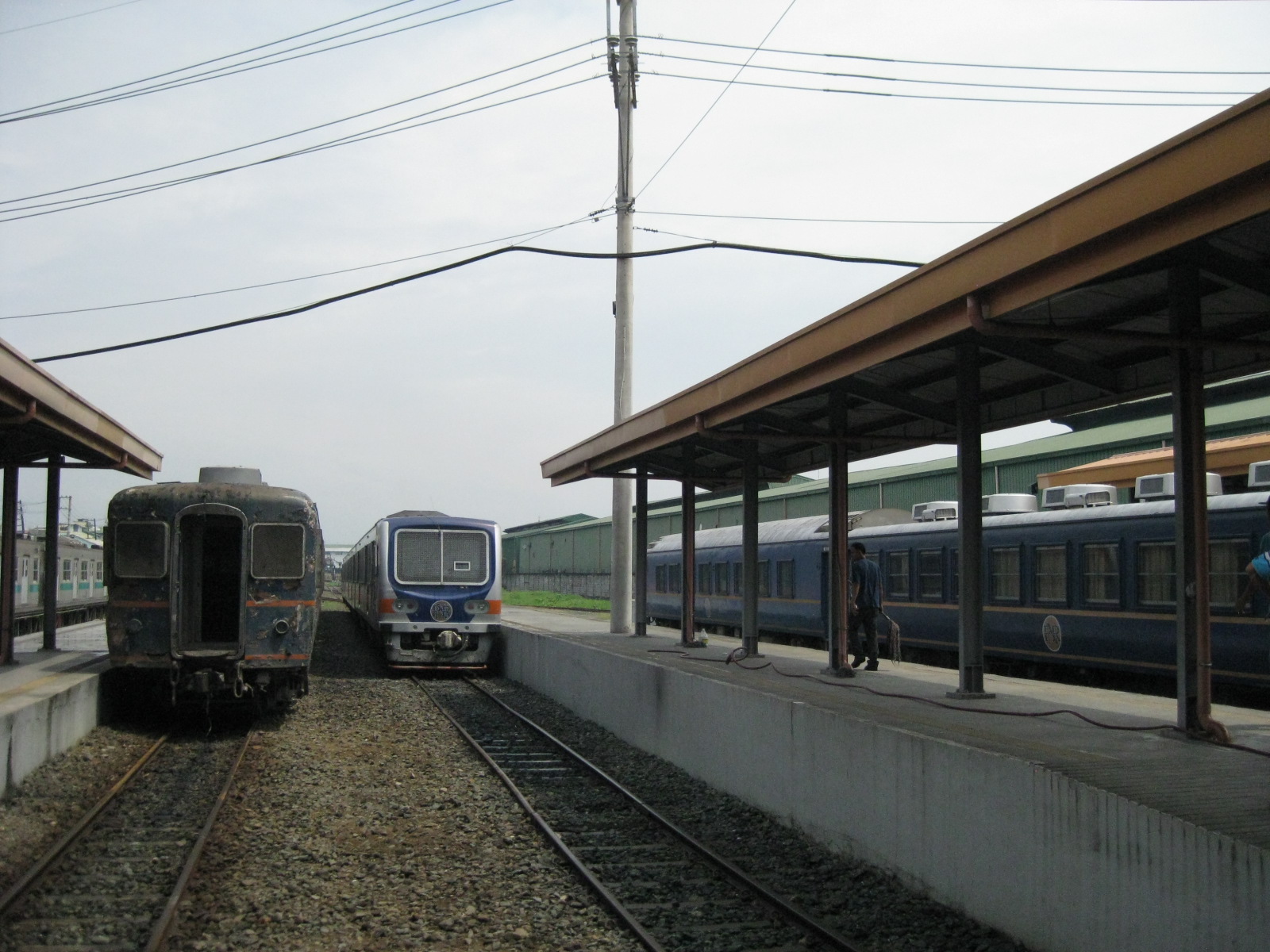 Old and new – old cars of the PNR may also be found at the Tutuban depot like this old passenger coach at one of the platforms. We were not able to ask if the PNR had plans to preserve these old cars. In other countries, there are railway museums like the one near Omiya Station in Japan. I’m sure the PNR would not lack for museum pieces including the old locomotives on display at its gates.
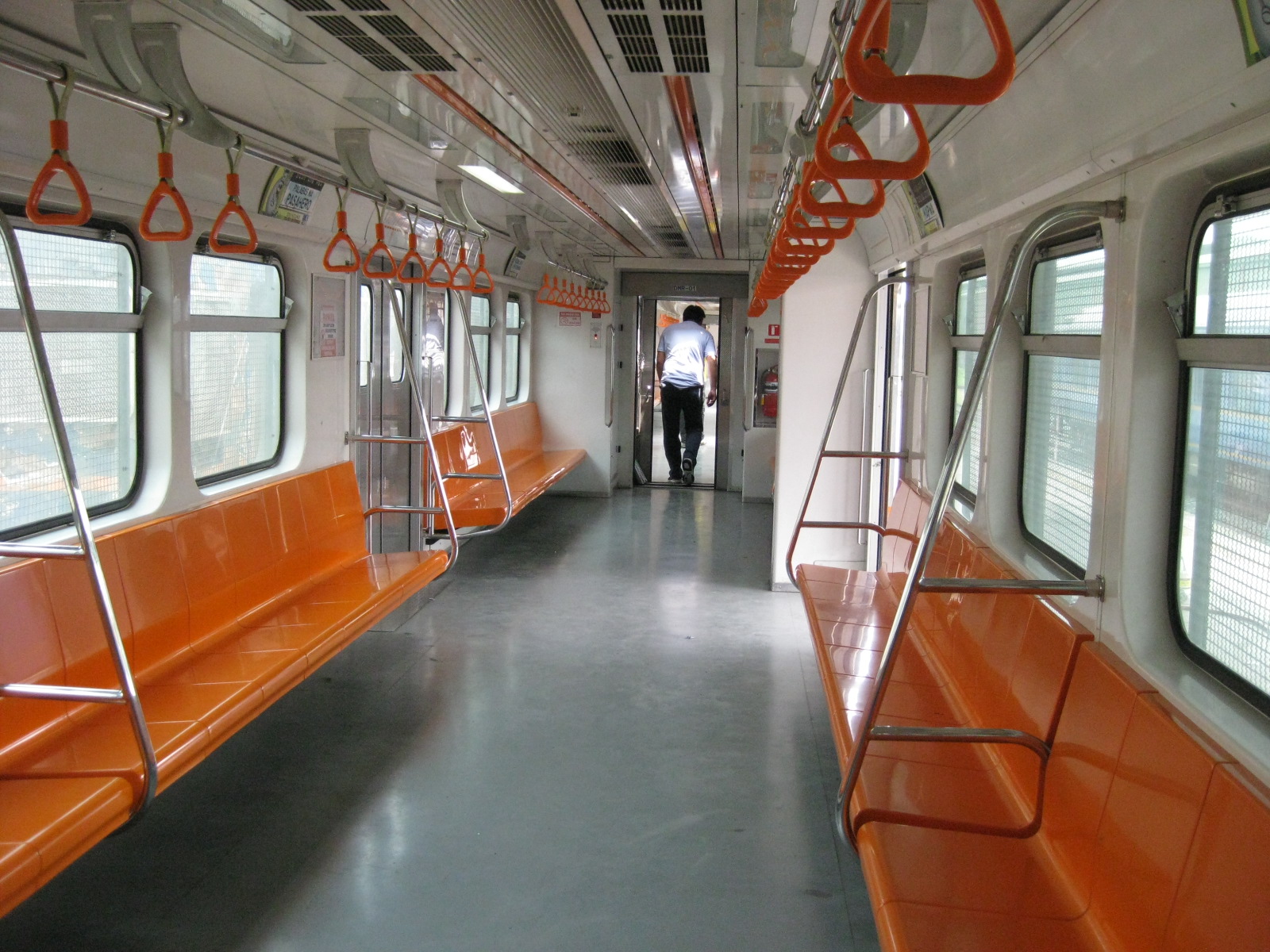 Sparkling – The interiors of the commuter trains reflect the service upgrade for the PNR. The trains are clean and spacious (appropriate for the capacities required for commuter service).
 Try-outs – our students and my colleagues try out the seats as we were ferried from the Tutuban platform to the depot where our hosts gave us a technical tour of the rolling stock and other facilities.
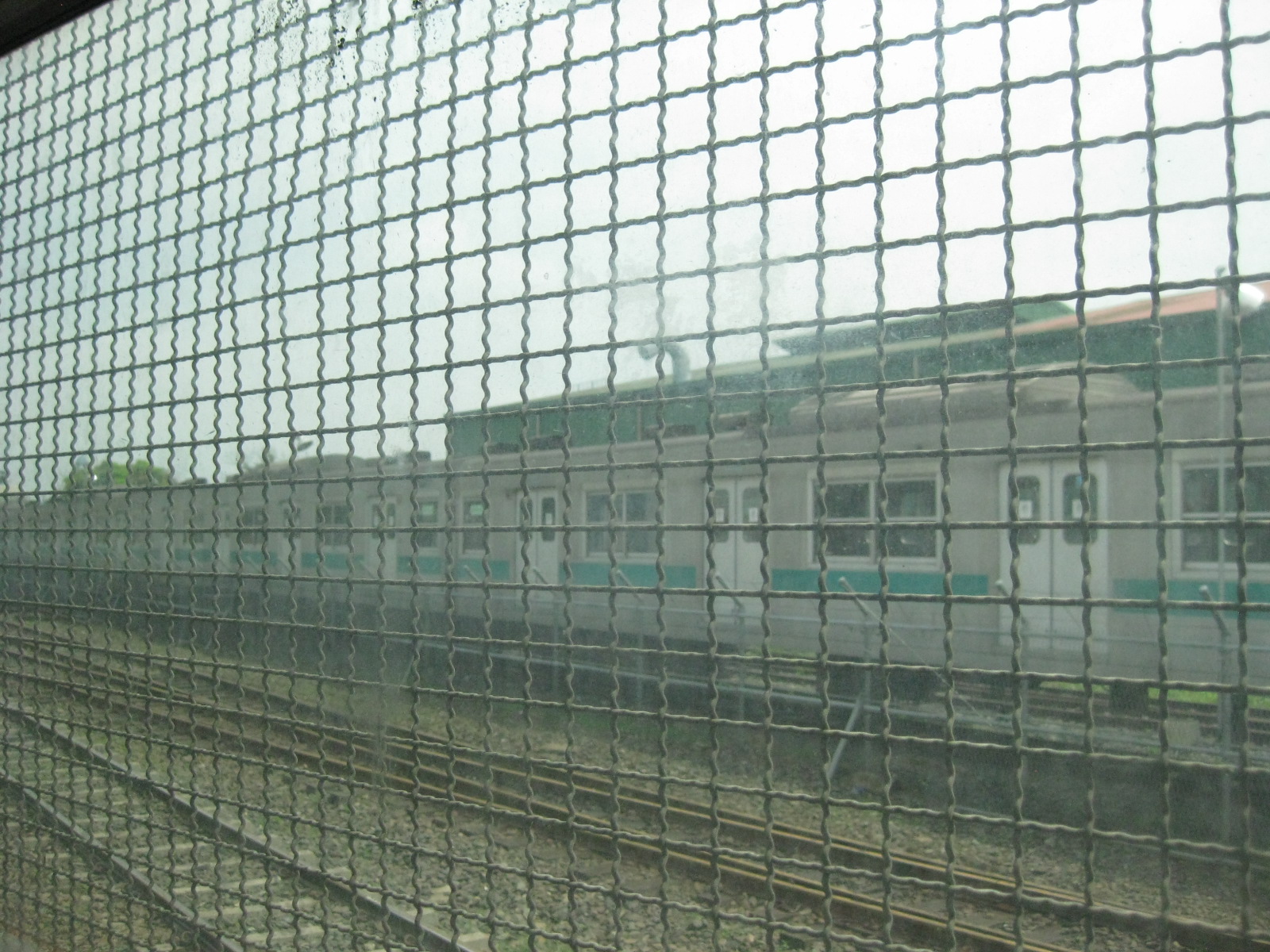 Grilled reminder – PNR coaches have their windows fitted with grills like this on the PNR commuter trains. Despite efforts to clear its right-of-way of informal settlers, there are still many along its route and these have often vandalized trains. In many instances, garbage and other items are thrown at the trains. These incidents have been significantly reduces but the PNR continues to experience such, necessitating the installation of grills. The coaches from Japan will not be operated until they are fitted with the same grills. Hopefully, the PNR ROW will be clear of informal settlers as well as other sources of impedance.
 Control panel – the lead car of the train features this more modern panel for the train controls. Note also the grills on the windshield of the train to mitigate the impacts of stones or other items thrown at the train as it rolls along its tracks near communities that include informal settlers.
 Exit route – when our train reached the depot, we had to climb down from the train as there were no platforms in the area. For this, one had to climb down backwards and feel for the steps just below the doors.
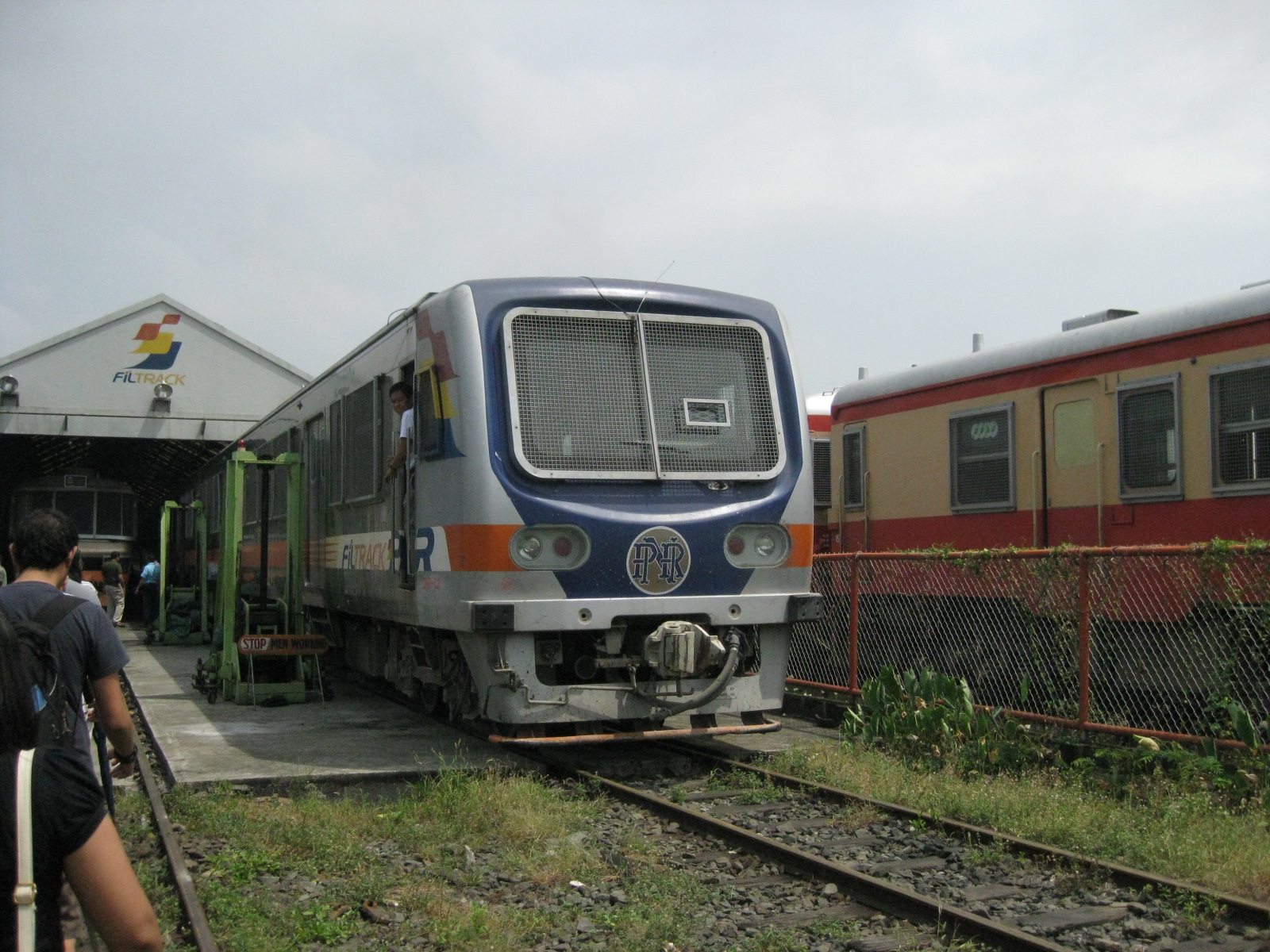 Maintenance yard – one of the newer commuter trains from Korea undergoing maintenance work at the depot. The coaches on the right are also Japanese donations for refurbishing, and are fitted for long distance travel though not as comfortable as the recliners or sleeping cars. These are more for longer distance commutes like from Laguna to Manila, which are similar to commutes along the JR Tokaido Line.
 Busy bees – with the resumption of Bicol Express services and the revitalized commuter line, the PNR’s maintenance staff have become more busy. There seems to be higher morale, too, as the long-neglected railway company gets a much needed proverbial “shot in the arm.”
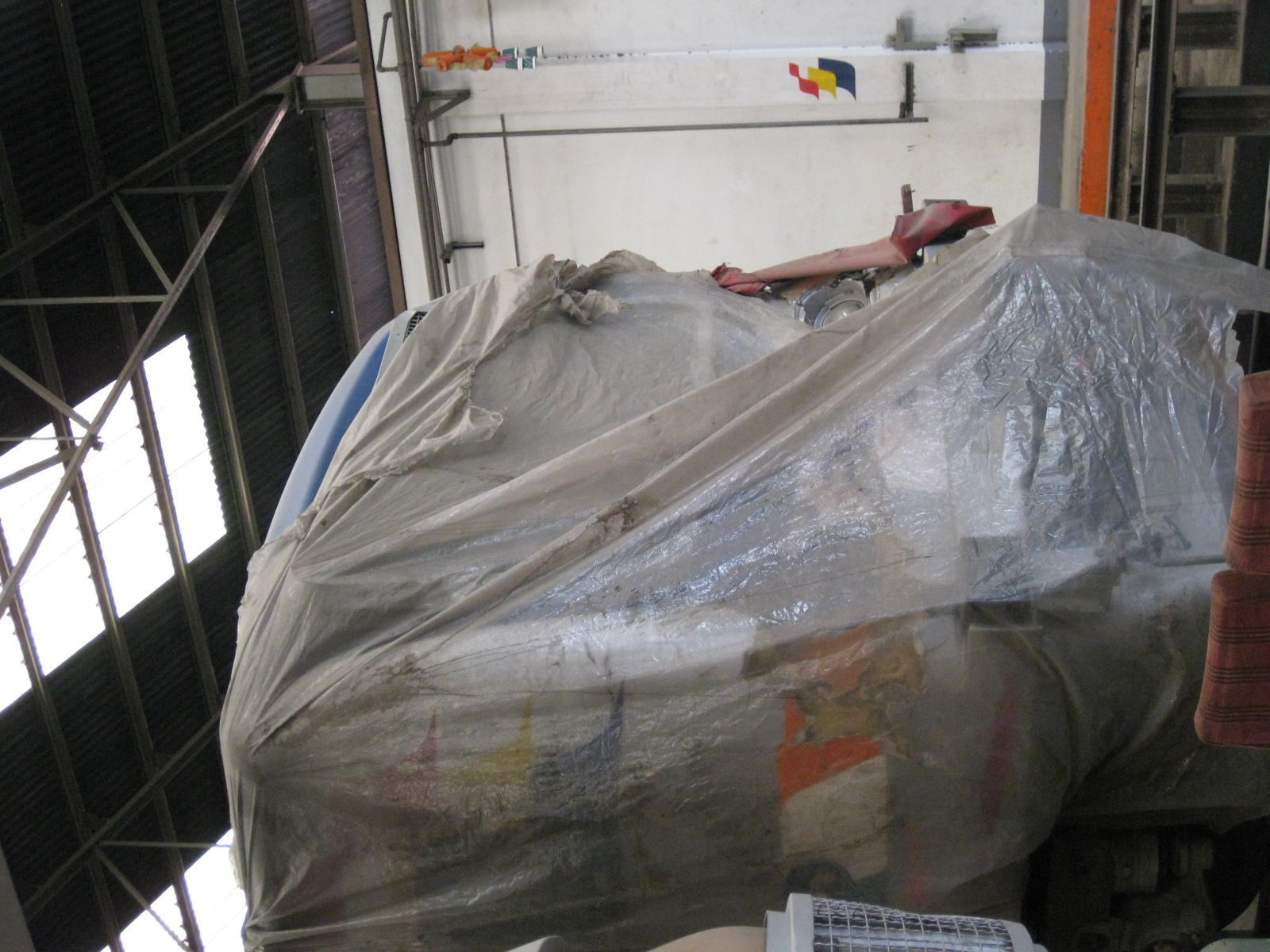 Crash victim – one of the commuter trains was involved in a crash when a truck proceeded despite the warnings and the barriers indicating an approaching train. That effectively knocked out one train and will cost the PNR a lot to repair the train. There are still many issues pertaining to safety along rail crossings, and many motorists and pedestrians remain hardheaded (pasaway?). As the PNR increases its frequencies for both its commuter and provincial services the subject of safety will become more serious and one that needs much attention.
 Briefing – colleagues ask our hosts about operations and other matters concerning the PNR today. Our students also had the opportunity to ask about employment possibilities at the PNR including what qualifications are needed for railwaymen.
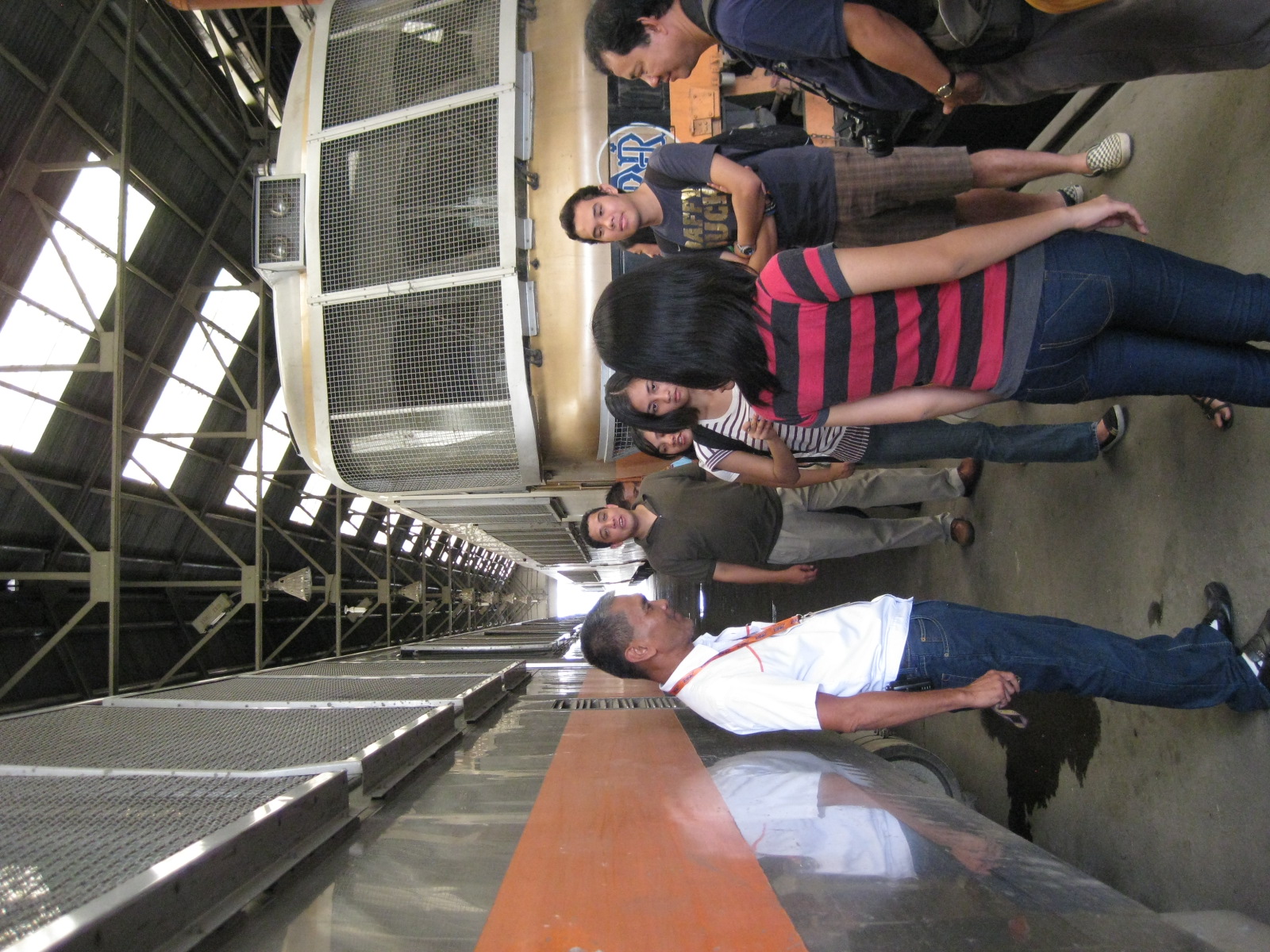 From JR to PNR – those are more Japanese trains in the background. We were not really surprised about the conditions of the trains considering that JR does a great job maintaining their trains given their usage.
 Recruitment pitch – our students had plenty of questions for our host including those about the trains and the history of the PNR. They were informed that the Polytechnic University of the Philippines (PUP) has a baccalaureate program in Railway Engineering and that our host taught courses there. When asked where the graduates go for employment, our host mentioned its difficult for them to get employment locally as railway engineers and that the program will soon terminated.
 Noontime rush – back at Tutuban Station, we witnessed passengers alighting at the station and walking towards the exit. The number of passengers was significant considering the limited capacity of the trains and the fact that it was already noontime. There are probably more passengers during the morning and afternoon peak periods.
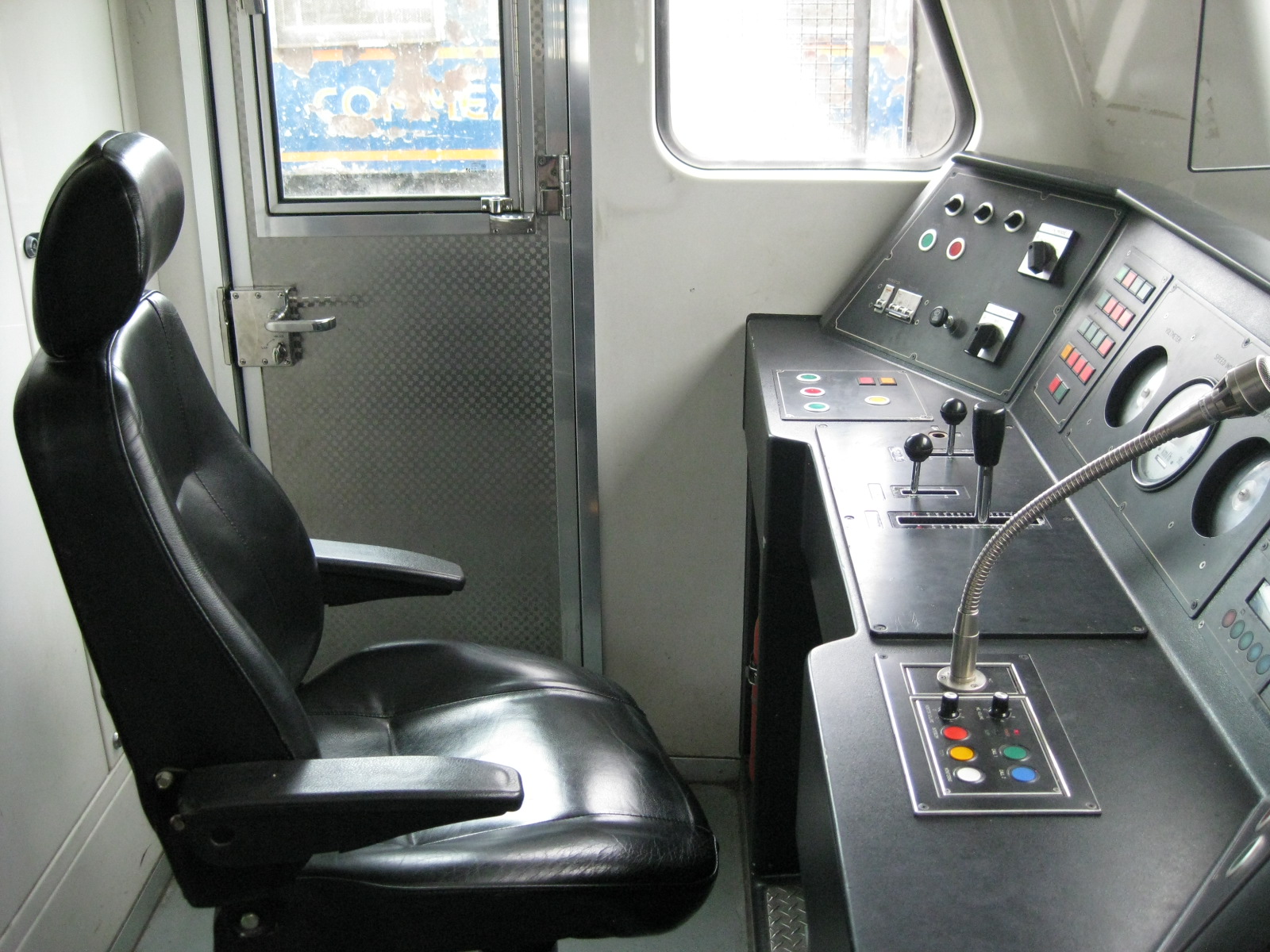 Driver’s seat – I took this photo when we boarded our train from Tutuban to Espana. Our hosts were very kind and generous to allow us to ride in the cockpit where all the action takes place. We also got a firsthand experience of what the driver had to go through (his hand was practically on the horn the whole time he was running the train) to earn a living.
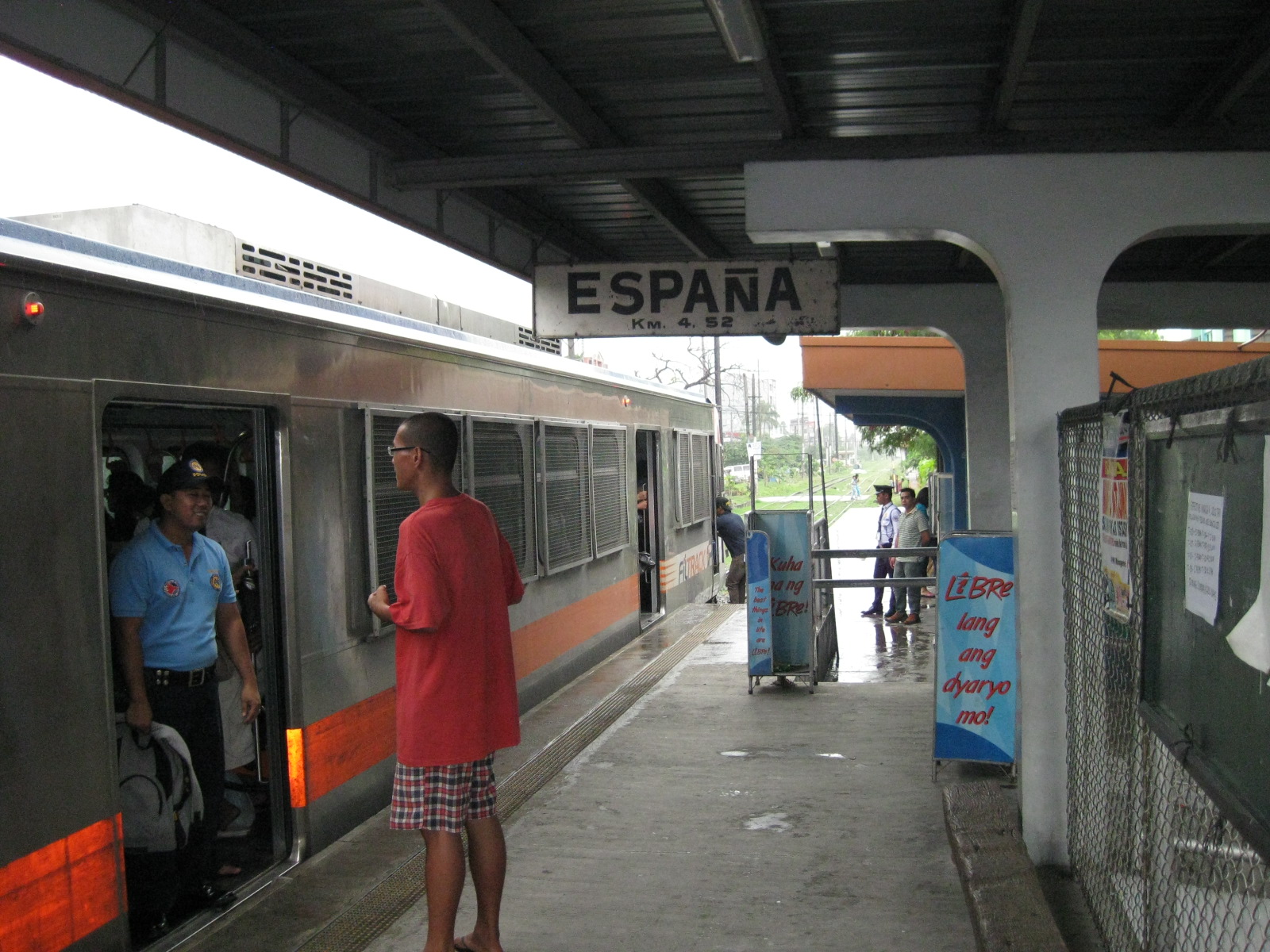 All aboard! – the Espana Station platform after all passengers have boarded the train. One passenger seems to be talking to the security personnel at one of the doors. The DOTC and the PNR posts security staff on the trains to ensure safety and security on-board. Their presence is a deterrence against criminality including snatchers and con-men who prey on students and the inattentive.
 Capacity – the train is filled with passengers, underlining the demand for more efficient public transport services in Metro Manila. This, despite the fact that trains have 30-minute headways. The PNR commuter line provides an inexpensive alternative to commuters.
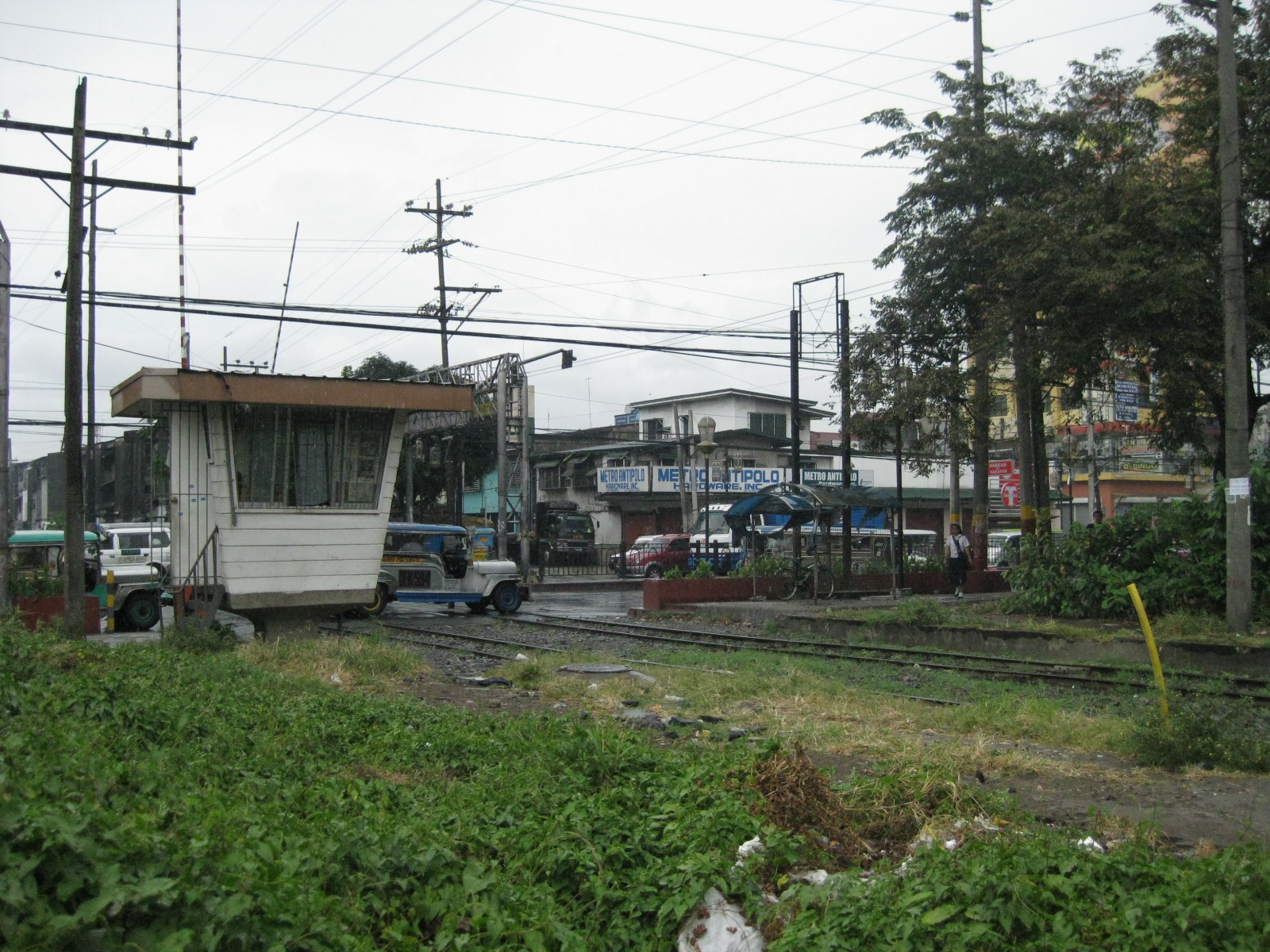 Crossings – the junction at Espana Avenue in Manila is among the busiest given the road traffic along this major arterial. If the PNR will increase service frequencies (and therefore capacity), this will result in higher likelihoods for crashes involving trains. During our short ride from Tutuban to Espana, we already saw a lot of crossings along the railways that require much attention and safety devices.
 Line diagram – like most trains, the PNR displays information on the stations along its commuter line. We visited their main station at Tutuban and rode a train from there to Espana. I can imagine that the stations listed in red would be express stations in the future but then conspicuously “blue” are Paco and Buendia Stations, which I believe should be major stops for the PNR.
–
Lane separators along Commonwealth
The MMDA and the DPWH are currently constructing what they term as lane separators along Commonwealth Avenue. These are concrete islands very similar in form to curbs, whose function is to delineate the outer lanes of Commonwealth. These will physically separate public utility vehicles from motorcycles and most private vehicles who generally use the middle and inner lanes. There are, however, early criticisms due to what is perceived as an increased risk for crashes due to the separators themselves. Some motorcycle groups have already expressed their apprehensions about the facilities that were supposed to protect them from aggressive PUVs. Meanwhile, one DPWH official was interviewed and proudly claimed the safety features of the separators including their being unmountable by large vehicles. From the height of the separators shown in the following photos, I am not so sure that these devices can stop trucks or buses, even jeepneys or cars from going over the other side.
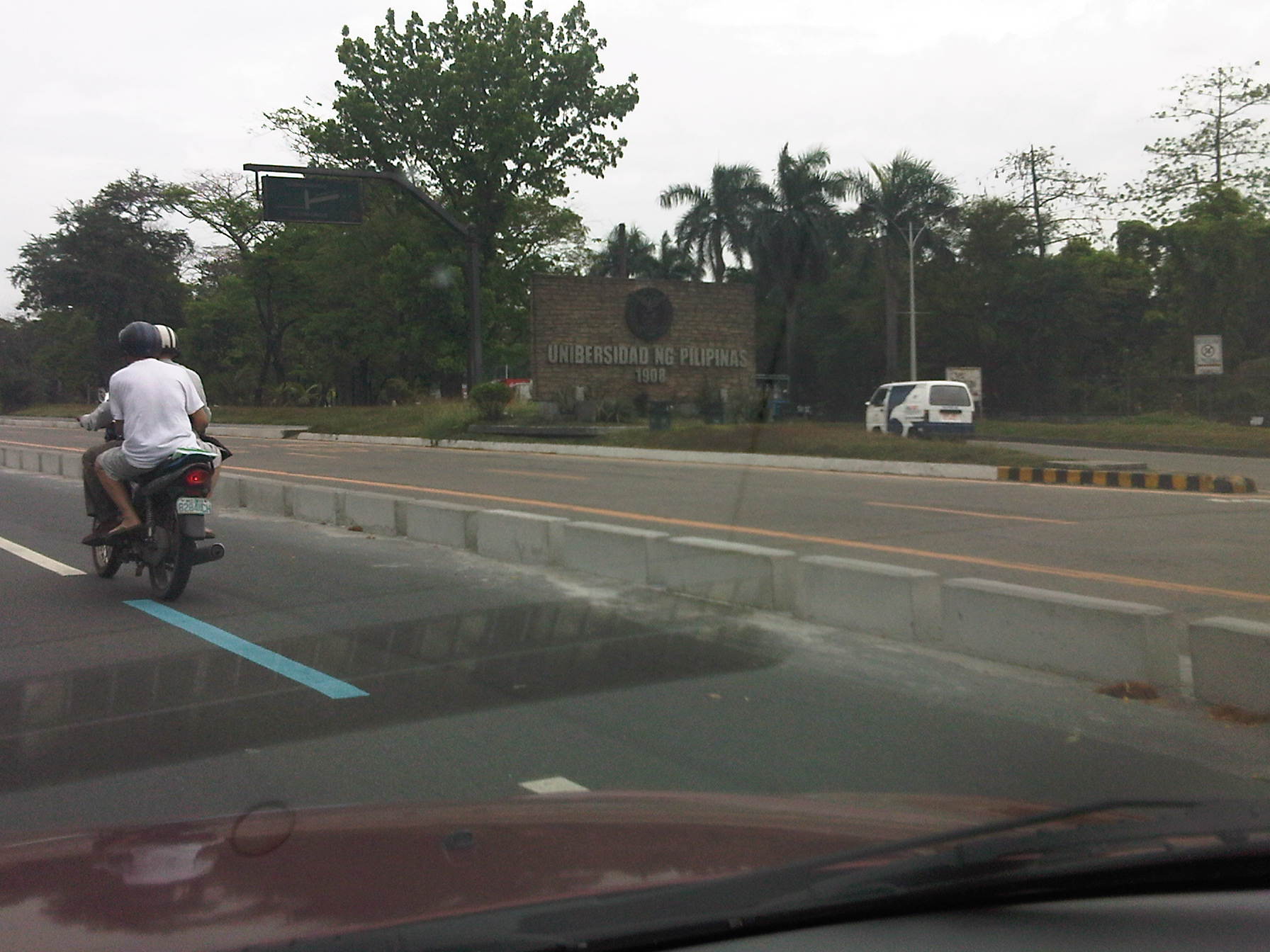 Separation device – the lane separators are basically barriers separating the 3 outermost lanes of Commonwealth from the rest. Of these 3 lanes, 2 are designated for public transport (yellow lanes) and one for private vehicles. The lane immediately to the left of the separator is the motorcycle lane. Note the blue lane marking denoting the MC lane.
 Service road – the separators practically create a service road along Commonwealth where PUVs and some private vehicles will travel along. Drivers and riders who intend to make right turns should shift towards the inner lanes through one of the relatively narrow slots along the separator line.
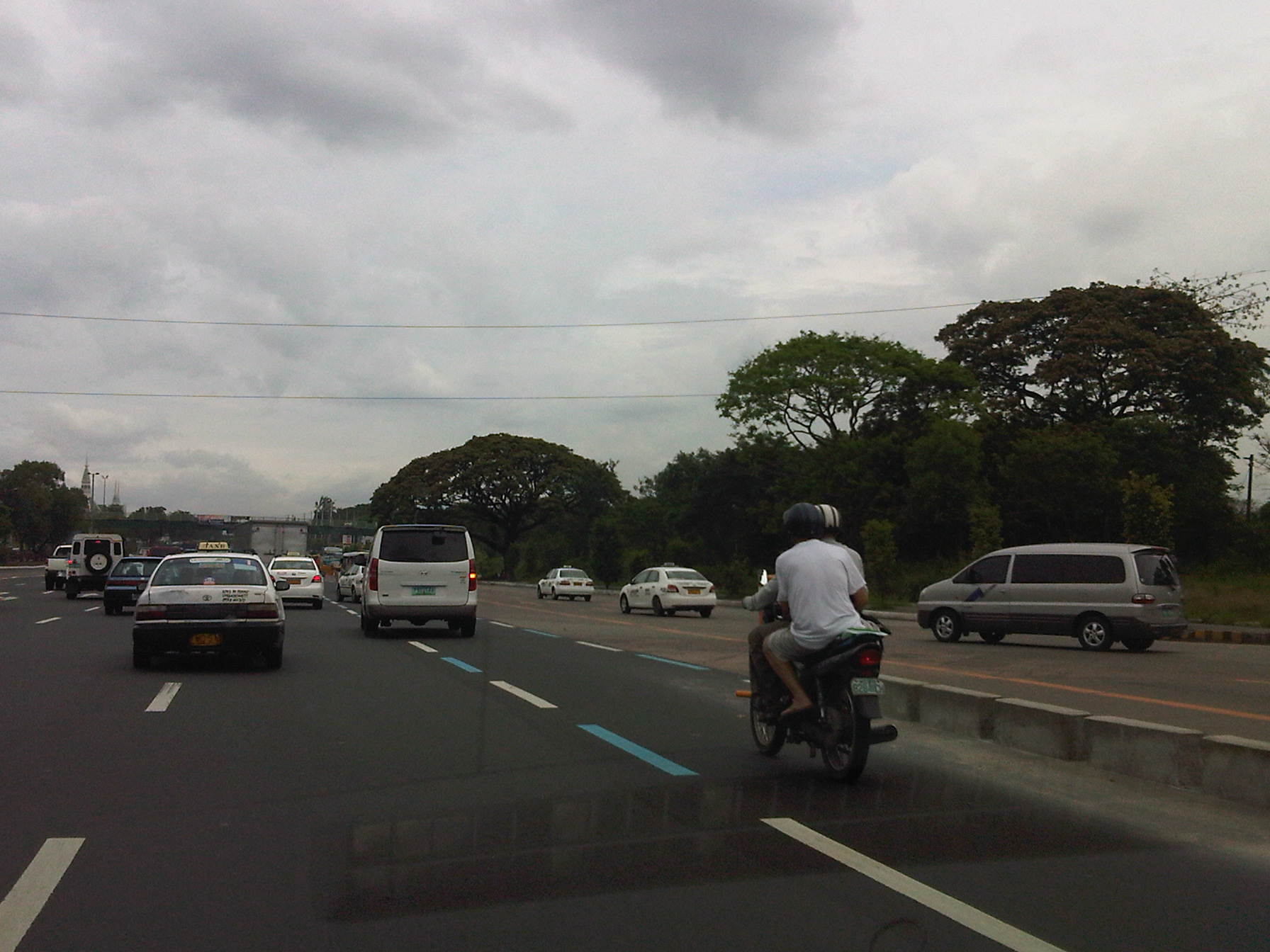 Small window of opportunity – vehicles turning from the University Avenue to Commonwealth must weave in traffic as many shift towards the nearest U-turn slot. The separators add another constraint to their movements. There is a similar narrow opening for vehicle turning towards the University Avenue from Philcoa but this can be quite tricky with the speeds of vehicles as well as the trajectories of those coming from the outer lanes of the mall to merge with the main flow along Commonwealth.
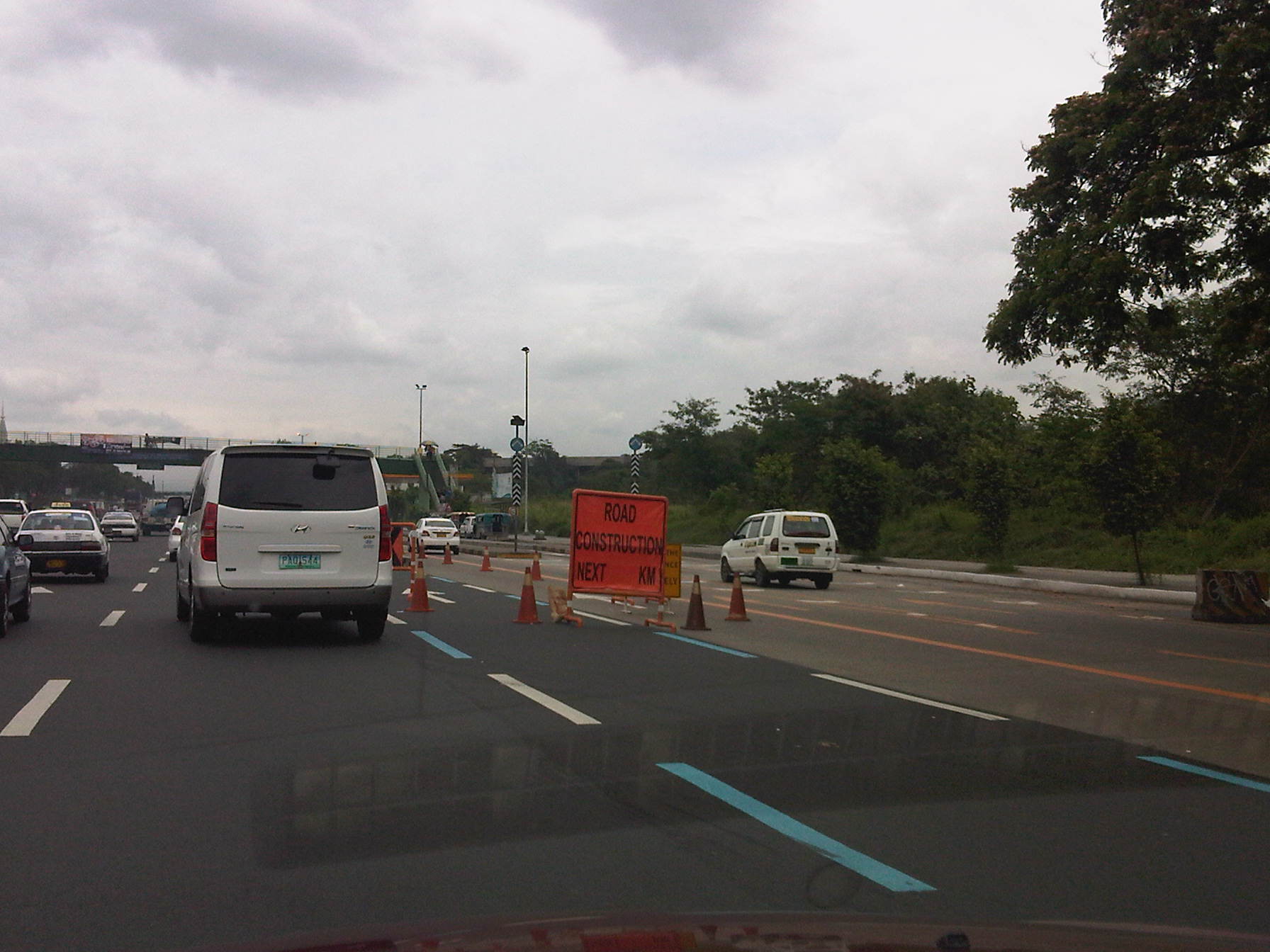 Under construction – tarpaulin sign and traffic cones mark the beginning of an area cordoned for the construction of the lane separators. The separators are supposed to be built along both directions of Commonwealth and may stretch all the way to Fairview. These should also aid traffic enforcers in apprehending PUVs traveling outside their designated lanes.
 Temporary displacement – motorcycles use the another lane as the construction of the separators use up the space of the motorcycle lane. Riders have become accustomed to using the lane from the time they were first implemented along Commonwealth.
 Now you see it, now you don’t – the motorcycle lane along Commonwealth northbound leads into the stairs of a pedestrian overpass. This necessitates motorcycles to shift towards the lane to their left. The rightmost lanes are for public transport.
 Respect and discipline – Motorcycles now typically use the lane designated for them and fewer vehicles encroach along these lanes for most part of Commonwealth where there are no weaving due to the U-turn slots. The separator will further lessen vehicle intrusions (and lane changing) as PUVs will be confined within the outer lanes courtesy of the separators.
The jury will definitely be out for the concrete lane separators currently being constructed along Commonwealth. It is still early for a fair assessment but many motorists are already pointing out the separators as increasing the risks for crashes. Surely, the MMDA and the DPWH carefully thought this out before its implementation and have the best intentions in favor of road safety. However, even the best intentions can still result in unintended consequences. Hopefully, this is not another case of the latter.
–
 Caught (up) in traffic