
No Car? No Problem!
It’s been months now since I’ve had a car. Lost old reliable to Ondoy last year and decided to commute part-time (I still drive when I’m with the wife.) to work. Sometimes, I am able to get a ride from officemates to our subdivision’s gate but that doesn’t happen often considering my work hours.
One night, I decided to walk home from SM Marikina partly out of necessity and partly out of choice. Of course, it can be argued that I made the choice out of necessity or that it was a necessary choice given the circumstances but these are just semantics. The choice to walk and the choice to commute is something that was essential to re-establish a routine I came to know and appreciate when I was still a student both here and in Japan – but mostly in Japan where I lived for some time.
I used to walk a lot during my stays in Japan. It’s always a delight to take long walks as long as the environment is conducive. I started walking when I stayed in the University dormitory that was a kilometer away from my laboratory. I also walked when I got off the train station to get to the church. This was no easy task considering that Sacred Heart in Yamate was located atop a hill. I could tell then that I was healthy as I didn’t have to make stops as I negotiated the steps to the cathedral.
When I transferred to an apartment (or mansion as the Japanese called it), I walked more from the nearest train station to my laboratory. Again, since the university was essentially on top of a mountain, the walk to school was a workout of sorts. I usually covered the distance without any stops but aided apparently by a piece or two of candy that I consumed while trekking. At times, the candies would be replaced by cold drinks during the summer and hot chocolate during the winter. I remember the hot can turning cold even before I reached the comfortable warmth of my laboratory. Of course, the walks back to my homes away from home was always the easier, mainly downhill and usually with the company of friends who were similarly heading home and using the same train station.
I enjoyed my walks in Japan mainly because the environment was conducive to walking (and commuting). The design of the steps, the pedestrian crossing facilities and the sidewalks, not to mention the driver discipline and courtesy in that country allowed for safe walks. Proof of this, I believe, is seeing a lot of children and elderly people walking (and commuting).
In contrast, it was both smoggy and noisy along Marcos Highway. I always had to watch out for vehicles that might sideswipe me as I walked near the carriageway when I ran out of sidewalk or foot path. I was lucky that it didn’t rain that night. I can only imagine walking in the rain and most parts of the foot paths transformed into mud. If so, I could also imagine that people would have to walk on the carriageway, risking life and limb to speeding jeepneys and reckless trucks. And in Philippine streets, I know for a fact that private cars aren’t that good either. You just assume that they won’t be joyriding and looking for people to splash water from the puddles forming on the road.
People who are supposed to find solutions to our traffic problems should try walking and commuting to see how bad traffic and our transport systems are. People who walk would always be able to notice what facilities are needed to enhance the experience and to ensure that walking would be a safe, enjoyable and healthy activity. Road safety audits, after all, are not performed while riding a vehicle but while traversing the length of the road and making detailed observations of its features. Such details will allow the auditor(s) to recommend specific measures based on well-grounded assessment. It is a lesson I know from first-hand experience both as a pedestrian and a road auditor. Perhaps it is a lesson a lot of people would be better of learning and applying. It is a lesson that will probably make our lives better and our cities a nicer place to live in.
Wang wang!
In the inaugural speech of Philippine President Noynoy Aquino, I and my colleagues were pleasantly surprised hearing him start with an item considered to be a pet peeve among multitudes of Filipinos – the use of sirens and blinkers. In fact, the reference to sirens as “wang-wang” puts it in the proper context where use is actually abuse. The “wang-wang” has been a symbol of how many of our government officials as well as those who perceive themselves as entitled have abused our traffic systems to get their way at the expense of others that they seem to believe have much lesser values of time compared to theirs.
Many who have been forced to surrender their sirens and blinkers state various reasons for doing so, including being professionals who needed to be in certain places at certain times. Among these are medical doctors and lawyers who have always claimed to be in a hurry, in the process of addressing emergencies of both the real and the imagined kind. While there are other opposing views on this, I firmly believe that the same people totally missed the point regarding the new president’s stand against “wang-wang” and his current personal crusade against beating the red light, counter-flowing, and the use of sirens by his own presidential convoy.
The statement should be pretty clear that only emergency vehicles may use sirens especially because they are responding to matters of life and death. These include ambulances, fire trucks and official police vehicles that should have distinct sounds according to international standards. The distinction is important for people to be able to recognize what type of vehicle is attempting to come through. But more importantly, the statement is also to show everyone, whatever his place in society may be, that the days of abuse are past and that this administration will do its part to bring back decency in our roads starting with the drive against “wang-wangs.” It is also actually an excellent case for leading by example, and one that hopefully can be sustained by P-Noy and adopted by his officials. For our part, we should make our own contributions and practice more discipline when we drive, commute or even walk along the street. It is not an exercise in futility but rather an exercise in humility and productivity – a demonstration of our commitment to change and help this country become great again.
Transitions in government and in transportation in the Philippines
“It’s the end of an era.” Perhaps that is one of the most quotable expressions every time change occurs, most especially when that change pertains to prevailing states or conditions and that includes governments. I have had the pleasure of working with many people under the current administration. And I can say that we in the academe have been fortunate that current officials of the Department of Transportation and Communications (DOTC) have been very receptive to collaborations. Such cooperative work is not at all new but something more like very good friends touching base once again and finding out that there’s so much more they could do together.
The reunion actually started sometime in 2003-2004 when the then DOTC Director of Planning Service and a bunch of faculty members affiliated with UP’s National Center for Transportation Studies (NCTS) got together in a meeting and over small talk extended each other’s ideas on how to improve transport in this country. More meetings, small talks and a few beers later saw the formalization of this collaboration when DOTC and NCTS held a Visioning seminar in 2006 to begin the charting of a road map for Philippine transport. There were no politics nor personal interests (other than the interest in improving transport) involved in this re-forging of old alliances.
Zoom to the present and I can only say now that the journey has been very productive; and if there is one thing I regret its that it is only now that we are reaping the fruits of our hard work put in the last 6 years. We can only hope that credit goes to those to worked so hard and dedicated their time, effort and resources to make things work. There were just too many challenges, obstacles to hurdle that today, one can look back and probably breathe a sigh of relief that we were able to accomplish much. Hopefully, the next administration will look at these achievements and see the good it has brought to the people. Hopefully, the next administration decides for continuity, even perhaps retaining people who worked so hard and honestly, who kept in their minds that the only things that are recalled as legacies are actually good things. And we can only hope that whoever we will be working with from July 1 would recognize the value of collaborative work between government and what was often referred to as an ivory tower.
Our warmest thanks to Acting Secretary and concurrent Undersecretary for Road Transport Anneli Lontoc – a true visionary and champion of Environmentally Sustainable Transport in the Philippines, Assistant Secretary Alberto Suansing – champion/advocate of road safety and reform both in his stints at the Land Transportation Office (LTO) and the Land Transport Franchising and Regulatory Board (LTFRB), Undersecretary Thompson Lantion – who in his capacity as LTFRB Chair engaged UP in providing training for public transport drivers, and of course, Executive Secretary Leandro Mendoza – who despite all the negatives pertaining to persistent criticisms from various parties in UP , committed the Department to collaborate with the University in worthwhile and unprecedented endeavors. One name is not mentioned here and that is the hardest working person of all – you know who you are and you know how much we appreciate your commitment and look forward to continuing our work together in the next administration and era.
Teaching transportation engineering
I’ve taught Transportation Engineering courses since I joined the faculty of the then Department of Civil Engineering at the University of the Philippines Diliman in 1995. This year marks my 15th year with UP counting my 3-year study leave in the late 90’s.
Since 1995, I have taught most of the transportation courses offered by the Department (now Institute) of Civil Engineering. These include the two undergraduate offerings ubiquitously titled Transportation Engineering I and II (CE 141 and CE 142) that are considered major courses, and part of a balanced curriculum leading to a Bachelor of Science in Civil Engineering degree. Being major courses, these are required subjects and all students must take these courses one after the other with TE I being the prerequisite of TE II.
Both subjects are not difficult ones to teach and it is easy to come up with examples that the students can visualize and understand. In fact, experiences from driving and commuting are common examples that allow me and my students to discuss actual manifestations of concepts we discuss in the classroom.
I don’t really have a favorite among the two undergrad courses though I must say that I like teaching CE 141 over CE 142. I like the content of CE 141 with topics on Traffic Flow Theory and Transport Planning, which allow me to use my imagination in conjuring new examples (and exams) each semester that I handle the course. I feel that CE 142 is more deliberate because it is partly a design course, and in the undergraduate level it is important to instill fundamentals in the minds of future Civil Engineers – future Transportation Engineers. Nevertheless, teaching CE 142 is not at all boring and lacking for challenge.
I always pray that I can share my knowledge and experience to my students. I assume that while I am not the best teacher in the subject, I do give it my best shot every time I give a lecture. I am hopeful that I am able to contribute in the molding of the next generation of Civil Engineers produced by UP – more so the next generation of Transportation Engineers who can continue the advocacy for better transportation systems and infra that this country of ours deserve.
Transport Forum
It’s that time of year again when the ADB holds and hosts a Transport Forum at their office in Manila. This forum is expected to attract more people than usual as the ADB will be presenting its new Sustainable Transport Initiative. Its new because it was formulated after Copenhagen and attempts to link transport with climate change. Thus, climate change mitigation and adaptation are among the general topics in the forum.
As usual, there will also be the sessions on urban transport, road traffic safety, rural transport, etc. Of particular interest to me will be the presentations by iRAP and GRSP on road safety on Wednesday aside, of course, to the Keynote Speech on road safety to be delivered by the International Ambassador for Road Safety who happens to be the actress Michelle Yeoh. I will have my chance to meet her sometime in the afternoon as she leads the laying of a time capsule for the proposed Road Safety Park at the UP Diliman campus.
I was actually at the ADB today and joined a meeting by the Partnership on Sustainable Low Carbon Transport (SLoCaT). Unfortunately, I couldn’t join the afternoon session as I had to rush back to the University for another engagement. The National Engineering Center held a forum on Public Service where I presented on NCTS activities including training, research and extension work in the last 5 years. At the end of my presentation, I showed a sneak preview of projects already in the pipeline including shamelessly plugging Michelle Yeoh’s visit to UP for the Road Safety Park.
For a more detailed schedule of the ADB Transport Forum, you can google the same and this will lead you to the ADB website and links to pdfs containing the schedule from May 25-27.
Transport Planning in Quezon City
I got a letter today from the Chief of Staff of the Mayor-elect of Quezon City. I was invited to deliver a presentation on transportation planning in Quezon City before the City Council where the Mayor-elect will be the presiding officer as outgoing Vice Mayor of the city. I still haven’t come up with a draft presentation but am already conceptualizing what I’d want to say before the council.
I will talk about environmentally sustainable transport (EST). I will speak about road traffic safety and the dangerous, killer roads in Quezon City. I will talk about land use planning and its interaction with transport (and vice versa). And though I am tempted to talk about parking, I will definitely talk about traffic impact assessment.
It is important to articulate at the simplest and most understandable terms what transport planning is all about. It is essential that sustainable transport is defined and promoted. Hopefully, the Mayor-elect will respond. Hopefully, the Councilors who will remain will take notice and appreciate the importance of having a well-planned city. Hopefully, they will champion sustainable transport and help spread the word on this through their actions.
I will be joined by colleagues when I go to present my case before the council. We will come in full force and maybe, at least, by our numbers we can show how serious and how important EST will be in solving transport and traffic problems in this part of Metro Manila. Hopefully, we can convince this large and progressive city to become an example that other cities may emulate.
Good luck to us all!
Parking as an election issue – Conclusion
Parking as an election issue – Part 2
Parking or the lack of it for many establishments is partly due to the obsolete minimum parking provisions stipulated in the National Building Code. A review of this guide reveals extensive shortcomings that will always result in inadequate parking spaces when followed to the letter. In a recent project I was involved in, for example, following the NBC would have led to the conclusion (and God-forbid the recommendation) that 20 to 21 parking slots would be sufficient for a 245-bed hospital! Meanwhile, parking generation rates from abroad (Note: We don’t have local rates.) suggest a more realistic 431 slots.
Architects, engineers and developers are quick to interpret minimum parking space requirements as equivalent to the required number of slots. However, it is obvious that NBC minimum parking provisions will never be a sufficient basis for estimating the number of parking spaces to include in designs. Trip and parking generation rates have been developed in other countries and have been the basis for determining a suitable and reasonable number of parking spaces. These rates are based on trip or travel behavior and factors in typical dwell (parking) times for various types of land use. Thus, there are different parking generation rates for fast food joints when compared with fine dining restaurants. There are also different parking rates between condominiums and subdivisions, and the same applies to different types of offices.
The major shopping malls have become more aware of this and have provided more than enough parking spaces for car-using customers. In many cases, there is only the perception of parking being inadequate because drivers will also have preferences on parking space location within a lot or building. One shopping mall manager mentions that even during the Christmas holidays when mall trip generation typically peaks, their parking building’s top floors are not filled up and motorists would rather wait for slots on levels closer to the bridges to the mall.
One issue that is almost always raised by establishments regardless of type or size is the cost of providing parking spaces. Indeed, it is cheaper to mark spaces along the roadside or arrange for the use of vacant lots for the one’s purposes. But what happens when the same open lots are developed to make way for other buildings and road space is required to address traffic congestion? In the case of high rise condominiums, the cost of a parking slot is not included when one purchases a unit. The price of a slot can even be as much as a studio unit. Thus, residents would often resort to parking along streets or renting for overnight parking in nearby lots or buildings.
The experience in Makati has shown that parking can indeed become a serious problem. Makati streets were used as parking lots and office buildings could not accommodate the increasing number of vehicles owned by employees who were becoming more and more capable of buying cars. The latter is a natural phenomenon due to continuing economic development and the resulting increase in incomes. Those who can afford new cars would probably purchase one (or more) while those with less budget will acquire used vehicles. It took some time before Makati was able to build parking buildings and enforce strict roadside parking policies including pay parking managed by the city’s parking unit.
Schools are major traffic generators attracting many car users. Some campuses are fortunate that they have vacant lots or seldom used roads at their disposal. However, as one can see through fences, committing vacant lots to parking is not at all the wisest usage for such space. And as one song goes, should we “pave paradise to put up a parking lot?” On the other extreme, and there are many such cases, schools do not have the space for parking. One such school along Ortigas Avenue imposes its parking problems on the general public when cars and school service vehicles take up lanes along the major arterial as well as occupy sidewalks while waiting for their passengers.
For public places like churches, parks, markets and the like, accessibility to public transportation is often used as an excuse for not planning and providing for parking spaces. The argument is that since these are public spaces, they attract mostly commuters. What is not stated is the reality that these same public spaces also attract car and motorcycle users that when proportioned with commuters would require a significant number of parking spaces. This is very much the observation near places of worship, public markets and parks where traffic congestion is likely caused by vehicles parked along streets and even on sidewalks. [In many cases, there aren’t even sidewalks so people use the streets anyway.]
[Next: The case of Quezon City, and Conclusion]
Parking as an election issue – Part 1
A magazine article caught my attention the other day. A candidate for councilor of Quezon City, the largest city among the units comprising Metro Manila, mentioned that the candidate was against pay parking and that if elected will oppose all initiatives for pay parking in public places in the city. Further, the candidate made statements to the effect that free parking for churches, markets and schools should be guaranteed by the government.
While I am tempted to trash the candidate for being moronic in his/her view of such issues as parking fees, I will resist such temptation. Instead, I offer here my arguments “for” pay parking and let the reader assess for himself/herself if a stand against parking fees could hold water. First off, allow me to trace the origins of this issue. I believe it was last year when a local bill was filed at the Quezon City Council seeking to charge parking fees for parking slots constructed by the Quezon City government along major streets including Tomas Morato. If my recollection is correct, the parking spaces were part of a bigger project that also constructed decent sidewalks along the same streets. It is important to note here that these were projects funded by local funds and therefore were sourced from taxpayers money. It should also be noted that among the justifications for the project were the expected alleviation of congestion along the roads, considering that there was a propensity for on-street parking or waiting, and the lack of sidewalks have resulted in pedestrians also using the carriageway.
One aspect of the problem that was rarely if ever it was mentioned was the fact that the parking spaces were constructed in high activity areas where establishments failed to provide an adequate number of spaces for their customers or clients. Many of these are restaurants and shops (e.g., the ones along Morato) while there are also examples of schools and churches. I say “failed to provide” here because it is quite obvious to even the untrained observer that establishments like restaurants and bars attract many people. In the case of those along Morato, the people attracted are most often the ones who have cars. When you attract a lot of cars and do not have the spaces for them to park along, it doesn’t take a genius (or even a 6th grader) to arrive at the conclusion that there will be traffic congestion in the area. Such congestion is the result of cars being parked almost anywhere where there is open space and that includes part of if not an entire lane of the road.
[Next: Trip and parking generation concepts]
Sustainable Paratransit
Environmentally sustainable transport (EST) includes the provision of sustainable public transportation. Such public transport is premised on other aspects of EST such as emission reduction, green fuels or sustainable energy sources, noise, and inclusive services and safe vehicle design. Most paratransit modes found in the developing countries are customized vehicles of 2 to 4 wheels. Customized vehicles are often lacking in safety features and produce greenhouse gases at a significantly higher rate than conventional vehicles. As such, the former are perceived to be unfriendly to people and the environment, and therefore, unsustainable.
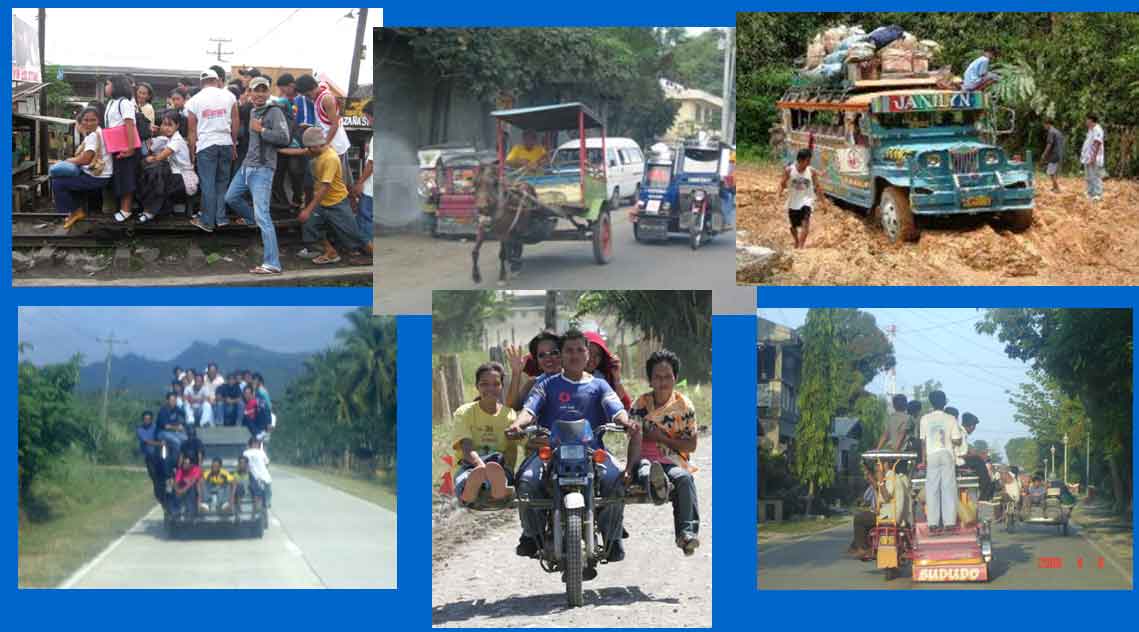
In the Philippines, for example, paratransit includes motorcycle taxis, tricycles, Asian utility vehicles (AUV), vans, and the jeepneys. With the exception of motorcycles, AUVs and vans, the two most dominant transport – the tricycle and the jeepney – are customized vehicles.
Jeepneys
The jeepney is the most popular mode of transport in the Philippines especially in cities because of its cheap fare and the convenience afforded to passengers to board and alight almost anywhere they want. In many parts of the Philippines, jeepneys provide long-distance transport services (rather than the bus) and may carry cargo, goods or freight in addition to passengers. Jeepneys in the provinces have also evolved to become significantly larger and tougher than those in the cities and are built to take on bad roads in all weather conditions. Jeepneys are locally manufactured and utilize surplus or second-hand diesel engines.
Tricycles and pedicabs
A tricycle is a motorcycle with a sidecar, while a pedicab is a bicycle with a sidecar and is classified as a non-motorized transport mode. These modes are 3-wheelers and are very convenient for passengers on short distance trip and feeder trip between residential area and arterial roads. Especially in the provinces, these modes play an important role because of insufficient bus and jeepney services. In Metro Manila the operation of tricycles is restricted partly because they cause traffic congestion. Franchising and supervision of tricycles including pedicabs have been devolved to the local government units.
AUVs
Asian utility vehicles (AUVs) refer to a variety of models designed according to the road and passenger characteristics of Asian countries particularly those in the Southeast Asian region. Vans include vehicle models produced by major Asian automakers like Toyota, Mitsubishi and Hyundai. AUVs and vans are four-wheeled vehicles with a seating capacity of seven to eleven persons including the driver. They provide services within a zone or fixed route of not more than 15 km. Fares may be set on a zonal asis or based on distance. FX services (so called FX because of the Toyota Tamaraw FX AUV that was very popular with those providing the service) evolved from the taxi as demand for a faster alternative to jeepneys arose in the 1990’s. Fares were higher than those for jeepneys but were eventually considered acceptable as longer travel times when using jeepneys became a major consideration for passengers, especially those who have constraints in their schedules like students and typical office workers (i.e., those who do not have the luxury of flexi-time). In 2003, the LTFRB issued a moratorium on the issuance of AUV franchises and pursued conversion and regulation of services into the Garage-to-Terminal Express (GTExpress). However, there is still a proliferation of vans for hire services, particularly those plying long distance routes in the rural areas. Meanwhile FX services remain in other cities in the Philippines.
Motorcycle taxis
Motorcycle taxis are also popular in the less urbanized areas including the small towns throughout the Philippines. These include the “habal-habal,” which are not regulated but have similar operations as their relatives in other countries like Thailand and Indonesia. Then there is the “skylab,” which is also a motorcycle taxi but with a wooden plank perpendicular to the motorcycle that allows for additional passengers balanced by the driver. Hence, the vehicle is made to appear like the fallen satellite of which it is named after.
Multicabs
Multicabs are similar to jeepneys but with most vehicles having about half the capacity of current jeepneys. However, their configurations are also evolving like the jeepneys, being customized vehicles like the latter. The resulting capacity has enabled these to have seating capacities equivalent to small or old model jeepneys. Multicabs are based on the Daihatsu or Suzuki mini-vans in terms of engine specifications and most came into being after the Philippines was flooded with second-hand or surplus vehicles. Their small bodies made them popular and they are now found in many cities, often competing with jeepneys and tricycles for passengers.
Other paratransit modes
Other paratransit modes are used in the Philippines in both urban and rural settings. There is the “kuliglig,” which uses a farm tractor to pull a wagon that is customized for passengers. These are mostly found in the country side where formal transport is lacking and even tricycles are unable to satisfy the demand for transport. Another paratransit mode is the “motorela,” which is a four-wheeler version of the motor tricycle. However, it is configured with the motorcycle in the front and middle instead of a one side such that it appears like the Thai “tuktuk.” These operate in cities and have capacities that are typically higher than the tricycles but significantly less than those for jeepneys.
Future of paratransit in the Philippines
The idea of environment and people friendly paratransit is always an attractive proposition. Given the current perceptions that paratransit like jeepneys and tricycles, there are many initiatives that are now being seriously considered if not yet engaged by both the government and the private sector. Some have been proposed for quite some time such as engine replacement and although financial schemes have also been proposed there have been very few takers for the program. Then there are those proposals for devices that have not been tested or validated but offer quick fixes to the emission problem, particularly claiming significant carbon reduction for a small price. Such are to be viewed as doubtful solutions that should not be pursued unless there is strong proof of their effectiveness.
Many taxis in Philippine cities have been converted to use LPG. Electric and LPG powered tricycles are now also being promoted in the Philippines. In fact, Quezon City, the biggest city in Metro Manila, only recently enacted an ordinance requiring all tricycles to convert to clean fuels or energy sources within 3 years. Such local legislation probably marks the beginning of a genuine and, perhaps, sustained effort towards making paratransit environment friendly. In the national context, a national EST strategy is currently being formulated (NCTS, 2009) and will ultimately recommend for actions to improve public transport in general.
An assessment of the jeepneys and tricycles as main public transport modes is necessary while at the same time it must be realized that jitney sized transport is necessary where passenger demand cannot justify mass transit modes including bus and rail transport. The World Bank (A Strategic Approach to Climate Change in the Philippines: An Assessment of Low-Carbon Interventions in the Transport and Power Sectors,2009) proposed medium and aggressive scenarios for the reduction of carbon in the transport sector. Among these scenarios are interventions for public transport particularly mentioning the conversion of jeepneys to CNG and assessing recent developments including options with high potential for carbon reduction, and technologies under testing such as CNG, LPG and electric powered vehicles. These are proof that the transformation of paratransit, in this case the jeepney, is essential and should be under way. Hopefully, it will be a matter of time when these popular modes of transport will gain the adjective “environment friendly.”
 Caught (up) in traffic