
Truck Ban
Another form of vehicle restraint focuses on freight and logistics vehicles, particularly trucks. These are commonly referred to as large vehicles having at least 6 tires (double-tired rear axle). The prevailing perception is that many if not most of these vehicles are overloaded and impede the flow of traffic due to their slow speeds as well as damage pavements not designed for heavy vehicles.
“The truck ban is a scheme first applied in the late 1970’s to address the perception that freight vehicles are the main culprits in congesting Metro Manila roads. Trucks were prohibited from traveling along major arterials including the primary circumferential and radial road network for most of the day. Exemptions from the daytime ban were applied to roads in the vicinity of the port area where truck traffic was practically inevitable.”
The coverage area of the truck ban included all of Metro Manila’s major circumferential and radial roads – C1 to C5 refer to Metro Manila’s circumferential roads while R1 to R10 refer to the radial roads. These comprise the main arterials of the Metro Manila road network. For reference, C3 refers to Araneta Avenue and related roads, C4 is EDSA, Letre and Samson Roads, and C5 refers to Katipunan, E. Rodriguez and C.P. Garcia Avenues. R1 refers to Roxas Boulevard, R5 is Shaw Boulevard, R6 is Aurora Boulevard, and R7 is España and Quezon Avenues.
“There are the different versions of the truck ban being implemented in Metro Manila. Truck Ban 1 is enforced along EDSA, Metro Manila’s busiest arterial and often its most congested road. Designated as Circumferential Road 4 (C4) it has a 10- to 12-lane carriageway with a mass rapid transit line running along its median. Truck Ban 2 practically covers all other roads except sections of arterial roads that have been designated as truck routes.”
Truck Ban 1 is enforced from 6:00 AM to 9:00 PM everyday except Sundays and Holidays. Meanwhile, Truck Ban 2 is implemented from 6:00 AM to 9:00 AM and 5:00 PM to 9:00 PM everyday except Sundays and Holidays. The second version attempts to minimize trucks during the morning and afternoon/evening peak periods.
“The chronology of the truck ban scheme started in 1978. In recognition of the critical situation of traffic congestion in Metro Manila, the then Metropolitan Manila Authority (MMA) issued Ordinance No. 78-04, which prohibited cargo trucks, with gross vehicular weight (GVW) of more than 4,000 kilogram, from plying along eleven major thoroughfares in Metro Manila during peak traffic hours – from 6:00 A.M. to 9:00 A.M. and from 4:00 P.M. to 8:00 P.M., daily except on Saturdays, Sundays and holidays.
In 1990, the Department of Transportation and Communication (DOTC) issued Memorandum Circulars No. 90-367 and 90-375, changing truck ban hours to: between 7:00 A.M. and 10:00 A.M. on weekdays; 4:00 P.M. to 8:00 P.M. for Monday to Thursday; and from 4:00 P.M. to 9:00 P.M. on Fridays. In response to the appeal of the members and officers of the various truckers’ associations for an alternate route and a 2-hour reduction of truck ban, the MMA issued Ordinance No. 19, Series of 1991, amending MMC Ordinance No. 78-04. This issuance provided alternate routes to the truck ban routes and effected a 2-hour reduction of the truck ban period, thereby prohibiting trucks on the road from 7:00 A.M. to 9:00 A.M. and from 5:00 P.M. to 8:00 P.M.
In 1994 the MMA issued Ordinance No. 5, Series of 1994, further amending Ordinance No. 78-04 as amended by Ordinance No. 19 Series 1991. The Ordinance restricts trucks from traveling or passing along 10 major routes from 6:00 A.M. to 9:00 A.M. and from 5:00 P.M. to 9:00 P.M. daily, except on Saturdays, Sundays and holidays. The Ordinance also provided for an “all-day” truck ban along Metro Manila’s major arterial road, the Epifanio Delos Santos Avenue (EDSA), from 6:00 A.M. to 9:00 P.M. daily, except Saturdays, Sundays and holidays.
In 1996, the MMDA, in its desire to further reduce traffic congestion even on Saturdays, issued Regulation No. 96-008 amending MMA Ordinance No. 94-05, imposing truck ban from Monday to Saturday, except Sunday and holidays. An MMDA Regulation No. 99-002, amended Ordinance No. 5, Series of 1994, wherein the “gross capacity weight” was amended from 4,000 to 4,500 kilograms.”
In the last few years, the MMDA has implemented adjustments to the truck ban scheme in coordination with Metro Manila local government units. Certain truck routes were identified to address the issues raised by the private sector, particularly industries and commercial establishments, regarding the transport and delivery of goods. Other cities in the Philippines have adopted the truck ban in one form or another, often directing trucks to use alternate roads in order to decongest the roads in the central business districts as well as to prevent their early deterioration as a result of truck overloading practices.
[Source of italicized text: Regidor, J.R.F. and Tiglao, N.C.C. (2007) “Alternative Solutions to Traffic Problems: Metro Manila in Retrospect,” Proceedings of the 11th World Conference on Transport Research (WCTR 2007), 24-28 June 2007, University of California Transportation Center, University of California, Berkeley, CA, USA, DVD.]
From Odd-Even to UVVRP… and back
Picking up from where I left off in the last post, I reproduce another part of the paper I co-authored with a good friend who now happens to be the Director of the Center for Policy and Executive Development (CPED) of the National College of Public Administration and Governance (NCPAG) of UP Diliman.
“The UVVRP or the “number coding” scheme, as it is commonly called, is a travel demand management measure that has evolved since its first implementation in 1995. The original intent was to use this measure to address congestion brought about in part by the many road and rail infrastructure projects being implemented throughout Metro Manila in the 1990’s. However, due to its perceived success in decreasing traffic along Metro Manila arterials, the scheme’s implementation was extended and even expanded to include public transport vehicles like buses, jeepneys and taxis.
The original programs involved only the main arterials of Metro Manila including its five circumferential and ten radial roads. These included the three expressways that connected the region to surrounding provinces in the north and south. All these are classified as national roads. The current program includes essentially all roads, with traffic enforcement units of cities and municipalities implementing the scheme for city and municipal roads. The MMDA enforces the scheme along most major roads.
The chronology of the development of UVVRP starts in 1995 when the MMDA Regulation No. 95-001 otherwise known as the “Odd-Even Scheme” was issued. The scheme bans private vehicles with less than three (3) occupants from plying restricted thoroughfares during AM and PM peak periods on particular days. Specifically, low occupancy private vehicles with license plates ending in odd numbers are banned on Tuesdays, Thursdays and Saturdays, while those with license plates ending in even numbers are banned on Mondays, Wednesdays and Fridays. Peak period is defined to be between 7:00 AM to 9:00 AM and 5:00 PM to 7:00 PM. The penalty was set at P 300 per offense. Exempted from this regulation are public transport vehicles, emergency vehicles, police and military vehicles, school buses, diplomatic vehicles and official media vehicles.
In 1996, the MMDA issued Regulation 96-004 otherwise known as the “Modified Odd-Even Scheme” in addition to the existing Odd-Even Scheme. The Modified Odd-Even scheme applied to public utility vehicles such as taxis, buses, public utility jeepneys, etc., which are banned from all streets of Metro Manila on particular days of the week from 9:00 AM to 5:00 PM based on the plate number ending of each vehicle, as follows: 1 and 2 on Mondays, 3 and 4 on Tuesdays, 5 and 6 on Wednesdays, 7 and 8 on Thursdays, 9 and 0 on Fridays. This regulation took effect February 19, 1996 and covered all roads in Metropolitan Manila.
Also, in 1996 the Metro Manila Council, MMDA, adopted and promulgated MMDA Regulation 96-005 entitled the “Unified Vehicular Volume Reduction Program” regulating the operation of certain motor vehicles on all national, city and municipal roads in Metropolitan Manila and repealed MMDA Regulation Nos. 95-001 and 96-004. The UVVRP, commonly referred to as “color-coding”, was adopted from the previous “Odd-Even” scheme which was first implemented in December 1, 1995 by the MMDA together with the Philippine National Police. Under this scheme both public and private vehicles are banned for longer hours (i.e., between 7:00 AM and 7:00 PM). This regulation was first implemented last June 1, 1996 and is still in effect.
In early 2003, the MMDA temporarily suspended the UVVRP. The resulting mayhem, probably due to the abrupt reaction of car-users, forced the MMDA to restore the scheme. A variant of the scheme was later introduced with a window from 10:00 AM to 3:00 PM (i.e., the off-peak period within the day) when banned vehicles may travel. Not all cities and municipalities in Metro Manila, however, adopted the scheme due to its perceived detrimental effects on traffic in their respective areas. The prime central business districts of Makati and Mandaluyong prompted these cities to implement the UVVRP from 7:00 A.M. to 7:00 P.M. This created problems as many roads run through different cities and municipalities, especially the circumferential and radial roads. Thus, it is possible for a motorist to use his vehicle in a city adopting the off-peak period window and get apprehended in another city that enforced the UVVRP during the daytime.”
[Source: Regidor, J.R.F. and Tiglao, N.C.C. (2007) “Alternative Solutions to Traffic Problems: Metro Manila in Retrospect,” Proceedings of the 11th World Conference on Transport Research (WCTR 2007), 24-28 June 2007, University of California Transportation Center, University of California, Berkeley, CA, USA, DVD.]
I am aware of certain stories circulating among those in the transportation and traffic circle(s) claiming an even earlier concept of the Odd-Even scheme. All stories seem to eventually lead to Oscar Orbos who had a brief stint as Secretary of the Department of Transportation and Communications (DOTC) in the Cabinet of Cory Aquino in 1990. He is, of course, credited with the conceptualization and implementation of the “yellow lane” scheme, as lanes alloted for exclusive use of public utility vehicles have come to be known. An earlier version of the Odd-Even scheme has been attributed to him and, perhaps subject to verification, was claimed as among the reasons he was eventually relieved and transferred to another post. I say subject to verification because I do remember but faintly that there was a lot of talk about how to drastically lessen the number of vehicles along Metro Manila roads at the time. I was quite naive to such being a college junior at the time and was quite indifferent to policies that years later I would be evaluating and writing about. Moreover, it has been established that certain stories if allowed to circulate long enough gains the appearance of being true.
At this point, I am already tempted to provide a brief conclusion on the lessons and experience of vehicle restraint policies as implemented in Metro Manila. However, I would have to defer until after another post where the topic will be another vehicle restraint scheme, this time one that is even older than the UVVRP and its various incarnations. It is a scheme that has been subject to probably even more discussions and scrutiny given that it is a scheme other cities have implemented in various forms and had its share of successes and failures. I am talking about the “truck ban.”
Traffic schemes in Metro Manila
I interrupt my writing on the U-turn Scheme to write about other schemes first and particularly about vehicle restraint measures that have been implemented in Metro Manila (and probably elsewhere in the country).
I was researching on papers that we could attach to our letter to the mayor of Quezon City prior to his attending a Metro Manila Council (MMC) meeting where the mayors of the 15 local government units comprising Metropolitan Manila would be discussing the proposed implementation of an Odd-Even Scheme along EDSA. The proposal would be presented by the Chair of the Metro Manila Development Authority (MMDA) for decision of the MMC. Earlier, the MMDA Chair gave interviews to the media and mentioned a study made by the NCTS pertaining to congestion along what is regarded as the busiest thoroughfare in Metro Manila and perhaps the entire country. The MMDA Chair did not say the title of the study nor were there specifics on the authors of the study. And so it piqued my interest enough to search for the paper that the MMDA Chair used in his statement. The search led to two papers I co-authored with two very good friends. The material I was able to dig up had enough for several blogs but rather than re-invent the wheel, I will just reproduce what has already been written, reviewed, published and presented back in 2006 and 2007. Since the following text will a verbatim reproduction of parts of the paper, I have italicized the material and cite the paper from where it came from.
“Traffic management refers to a wide range of measures and programs designed to improve traffic flow and enhance traffic environment without substantial capital investment that may include ROW acquisition. Traffic management is necessary due to the significant imbalance between demand and supply in traffic that results in chronic congestion and its derivatives – environmental degradation and decline in traffic safety.
Measures formulated to address Metro Manila’s traffic problems are based on established, conventional travel demand management (TDM) and transport systems management (TSM) schemes. However, the schemes have been adapted to local conditions and are still being modified to better address the requirements of Metro Manila travelers. The MMUTIS Technical Report No. 8 (1999) presents a comprehensive review of traffic management schemes implemented in Metro Manila from the 1970’s to the present. Among the schemes formulated and applied in various forms and extent are the following:
• Traffic signal control system (TEAM, SCATS)
• Flow management schemes (one-way systems, reversible lanes),
• Toll discounts (for the North and South Luzon Expressways),
• Bus management schemes (bus segregation, provincial bus restrictions, designated bus lanes), and
• Pedestrian-focused programs (overpasses, underpasses, discipline zones)
The UVVRP and the Truck Ban are TDM measures that have evolved since their introduction in 1995 and 1980, respectively. The U-turn Scheme is a TSM solution introduced in 2003 that was intended to promote uninterrupted flow in Metro Manila by reducing delay incurred at intersections (i.e., through intersection closure).”
Source:
Regidor, J.R.F. and Tiglao, N.C.C. (2007) “Alternative Solutions to Traffic Problems: Metro Manila in Retrospect,” Proceedings of the 11th World Conference on Transport Research (WCTR 2007), 24-28 June 2007, University of California Transportation Center, University of California, Berkeley, CA, USA, DVD.
Next: UVVRP
Full circle with the U-turns: Traffic Signals in Metro Manila
Since last week, it seemed as if a ghost of Christmas past has come to haunt me and my colleagues at the NCTS. We had some unexpected visitors from the Traffic Engineering and Management (TEAM) group of the Department of Public Works and Highways (DPWH). They were at the Center to consult about a project being formulated by the group together with the MMDA for new traffic signals for Metro Manila. DPWH-TEAM has a long history with NCTS starting when that unit was created when the Philippines invested on its first coordinated traffic signals in the 1970s.
At that time, the NCTS was still the Transport Training Center (TTC), and was the site of the first traffic control center for signals that were installed along Quezon Avenue. The package was funded by a loan from the Japanese government and hence involved traffic signals manufactured by Mitsubishi. Years and many TEAM project phases later, most of Metro Manila’s major intersections would be signalized and traffic signal control would be under the Traffic Engineering Center, which until 2003, was under the DPWH. In the 1990’s, the TEC and TEAM worked together to acquire the Sydney Coordinated Adaptive Traffic System (SCATS), which at the time was already installed and running in most major intersections in Cebu City.
SCATS was supposed to usher in a new era in traffic control in Metro Manila until some major problems eventually plagued its operation. One of these problems was power. However, this was something everybody else was concerned with because of the power crisis of the early 1990s. It was also something that seemed to be easily solvable with the acquisition and installation of uninterrupted power systems (UPS) and generators that allowed the facility to operate even during blackouts.
Another technical problem cropped up just about the same time when the TEC and TEAM people were trying to solve the power issue. This time, it was something much more complicated and perhaps, what led to the system losing its credibility in Metro Manila and a chain reaction of sorts in as far as reactions go. The communications problem was a critical one and rendered the system practically unreliable for what it was supposed to solve – congestion. SCATS required a reliable network for its controllers and computers to communicate with each other. This communication allowed its software to assess network-wide traffic demand measured by means of detectors embedded in the pavement at each approach lane of an intersection. Data from these detectors are transmitted to computers in the control center, which then compute for the optimum cycle times for each signalized intersection. The computers determine which intersections need to be coordinated and how (i.e., alternating or simultaneous), and this process allows SCATS to adapt to variations in traffic. Hence, its name which seemed only appropriate given its performance in what is now the expanded network in metropolitan Cebu.
The failure of SCATS in Metro Manila was further hastened by traffic enforcers who were only too eager to intervene. This intervention was more of interference as enforcers started switching the traffic signal controllers to manual mode at the slightest indication that the signals would appear to be non-responsive to changes in the traffic situation. In truth, it takes a few minutes for the detectors to collect data and send it to the computers that will compute for the appropriate cycles and signal settings as well as determine which intersections to “marry” and “divorce” – to borrow terms used by traffic engineers in Cebu City for the process of coordinating intersections throughout the day. Due to this rampant practice by enforcers in Metro Manila, it was only a matter of time before SCATS was declared a failure and claims were made that Metro Manila traffic is so much more complicated than Cebu’s, where SCATS was a success (it still is today).
Capacity Building
We’ve been quite busy at the National Center for Transportation Studies during this month of September. So far, we’ve conducted 3 training programs in the during each week of the month. Each program was conducted over a period of 5 days. We held the 3rd offering of the Traffic Administration Course (TAC-3) from September 6-10, 2010. That was followed by a Road Safety Audit training course for sister companies the Manila North Tollways Corporation (MNTC) and the Tollways Management Corporation (TMC) from September 13-17, 2010. And only yesterday, we completed the first offering of the Advanced Traffic Administration Course (ATAC) for participants from the Metro Iloilo-Guimaras Economic Development Council (MIGEDC) and sponsored by the Japan International Cooperation Agency (JICA). Also last week, I was among the a handful of participants for a special training on Eco-Driving conducted by Dr. Taniguchi of the Eco Drive Promotion Division of The Energy Conservation Center, Japan. Hopefully, the knowledge and experience gained from the training will allow me and my colleagues to share Eco-Driving to other drivers and enable the promotion and application of Eco-driving in the Philippines.
Next week, we will be resuming the Public Utility Vehicle Drivers’ Training Program, which is offered in cooperation with the Land Transport Franchising and Regulatory Board (LTFRB). This is a 3-day course that was formulated for PUV drivers in order for them to have a re-education of sorts. In the course, the fundamentals of traffic rules and regulations, road signs, ethics and customer service are taught by select lecturers from the DOTC, the PNP and UP. Such education is a necessity considering that most PUV drivers have not undergone any formal training considering how most of them were able to get their licenses. There is a tremendous amount of actual and anecdotal evidence out there pertaining to how most PUVs are driven. Hopefully, this course will benefit them and influence them to drive safely and prevent the loss of more lives as a result of crashes they may become involved in.
Fare hikes – MRT3
I was at a meeting this morning at the Department of Transportation and Communications (DOTC) when we heard what seemed like a rally in front of the building. The rallyists claimed and appeared to be students though it was really difficult to determine based on our view from the 16th floor. The issue of the rally was the impending increase in the fares for the EDSA Mass Rapid Transit (MRT-3). The rallyists proclaimed their opposition to such an increase and laid out their reasons while calling for the DOTC to cease and desist from the fare hike.
Their arguments are designed to appeal to the masses, particularly those who have a basic understanding of what it takes to provide infrastructure such as the MRT. I say basic here because they get information from common sources such as popular TV, radio and newspapers (most probably tabloids rather than the dailies). In most cases, the kinds of information are likely commentaries by opinion writers or even opinionated (but not necessarily knowledgeable and fair) personalities. Some of these may actually be misleading people regarding the circumstances leading to and surrounding the government’s intervention on MRT, particularly its take-over of a losing venture from a failed consortium.
One of those who were at the meeting with me joked that he be allowed to come down and face the rallyists. His argument against theirs will be based on the inconvenient truth that the main (and perhaps strongest) justification for the fare increase is that the government can no longer sustain its huge subsidies for the payments for the loans that covered the construction of the system. These subsidies are drawn from the national treasury, which in turn is derived from the taxes that we pay from our hard earned income.
However, the tax-base is the entire country (i.e., all taxpayers) and not just from Metro Manila and its adjacent areas. The latter area represents what could probably be assumed as the region that benefits the most from the operation of EDSA-MRT. Thus, it is safe to say that taxpayers in major cities like Cebu and Davao do not derive much, if any, benefit from the MRT. This last statement is an argument that is always challenged by those who prefer to imagine that the rest of the country actually benefits (indirectly?) from the operation of MRT, notwithstanding that the country is an archipelago and that the interconnections of these islands are unlike those in developed archipelagoes like Japan and the UK. But even for these countries it would be very difficult to attribute say Osaka’s development to the operation of Tokyo’s Yamanote Line. In numerical terms, why should 30 million taxpayers pay for something that effectively benefits about 3 million taxpayers? Note, too, that many people residing in Metro Manila aren’t paying taxes. Perhaps an eminent economist or two can shed light on this.
For sure, there are a lot of issues concerning the EDA-MRT. It has been hounded by controversies even during its planning when the flavor of the season was public-private partnership (PPP) in the form of BOTs. Incidentally, the current government has stated that it is encouraging PPP for the development of big ticket infrastructure projects. I just hope that the government has learned its lessons and can forge contracts that are advantageous to us taxpayers who will effectively be paying for the costs of development. And perhaps, I dare say, these projects will be in other regions where cities are rapidly developing without the benefit of much needed transport infrastructure.
Motorcycle lanes
There have been proposals to have exclusive lanes for motorcycles along major roads. The rationale for such proposals is the increasing number of road crashes involving motorcycles. It is assumed that having exclusive lanes will result in a significant decrease in motorcycle involvement in crashes since it is further assumed that with exclusive lanes, there will be fewer interactions among motorcycles and other motor vehicles. There are evidences to support these assumptions.
Anyone observing traffic along our roads can easily see that the biggest reason for the rapidly increasing number of road crashes involving motorcycles is the behavior of motorcyclists. Motorcyclists have the propensity to weave in traffic, heavy or not, often splitting lanes and catching drivers unaware. This behavior frequently results in crashes, most of which involve only damage to property and thus are usually relegated as minor incidents that are not newsworthy. However, crash statistics with both the MMDA (for Metro Manila) and the DPWH (for national roads) indicate that motorcycle crashes with fatalities are alarmingly increasing, and therefore require intervention. Motorcycles’ notoriety are now the among the pet peeves of many drivers, regardless of whether they drive cars, public transport or even trucks.
There are still many riders who do not wear helmets. And not a few bring their gear but choose not to wear these; a habit that has led to jokes about helmets being for elbows or shoulders rather than for heads. This is despite a Helmet Law stipulating penalties that are supposed to discourage non-compliance. The practice significantly increases the chances of having fatalities in crashes, especially considering that there are no restraints for riders or other protective devices for motorcycles like seatbelts and airbags that are already standard features for many other motor vehicles.
There is a bill filed before the Senate, SB 871, which stipulates the delineation of one-meter wide lanes for exclusive use of motorcycles. The bill has a provision directing the DPWH and local government units to designate motorcycle lanes, presumably for both national and local roads. SB 871 proposes fines (i.e., not more than six (6) years of imprisonment or a fine of not less than Five Thousand Pesos (PHP 5,000.00) but not more than Twenty Thousand Pesos (PHP 20,000.00), or both, at the discretion of the court) for motorcyclists using other lanes. There is no mention of penalties for drivers of vehicles encroaching on lanes designated for motorcycles.
While the bill is well meaning, it begs the question of whether its provisions are enforceable once the bill becomes a law given the extent of our national road system. After all, there are many laws that are not effectively enforced but were also designed to instill road discipline among drivers and riders, and to ultimately make roads safer for all users. And motorcycle riders are among those commonly seen as violators of road traffic rules and regulations.
In urban areas, for example, where many roads have multiple lanes, space for motorcycles may be derived from existing lanes but may lead to congestion due to the decrease in road capacities. In some cases, motorcycle lanes of at least one meter may be constructed by taking part of medians (e.g., islands) or shoulders. However, along roads where there are no medians, motorcycle lanes from shoulders may lead to conflicts with public transport vehicles that operate along the outer lanes of the road. Further, it is noticeable that there are no shoulders in most urban roads in the Philippines and there are also many instances where roadside parking is allowed or tolerated. And deriving motorcycle lanes from pedestrian rights of way such as sidewalks is definitely not recommended.
In the case of most national roads including rural highways, there are only 2 lanes and shoulders on either side that are most likely unpaved. Road rights of way are often unsecured, with structures such as houses and shops encroaching within the RROW and leading to shoulders being utilized for parking or other purposes. The DPWH Highway Planning Manual does not stipulate motorcycle lanes or even pedestrian walkways as standard specifications for typical national roads. And it is supposed that a law emanating from bills such as SB 871, should encourage if not mandate a review of road design standards to include provisions for motorcycles, and perhaps more importantly, for pedestrians and non-motorized transport (NMT) as well.
Other countries such as Malaysia have already incorporated in their road design manuals lanes that are for the exclusive use of motorcycles, bicycles and other NMTs. These have reportedly improved safety so much that their governments approved the budgets for implementing the provisions for roads where there is significant motorcycle traffic. Perhaps the Malaysian example is proof of the concept that having motorcycle lanes will indeed improve road safety. It should only be emphasized that road design improvements can go only so far if a key element, enforcement, is lax or nonexistent. Without this key element, motorcycle lanes in this country will just be destined for the ningas cogon hall of shame.
–
For more information about motorcycle lanes and road safety, one may refer to the website of the International Road Assessment Program. They also have a Flickr account showing their activities in Southeast Asia.
Licensed to Drive?
One recommendation often made in light of the increasing frequency of road crashes is on the review of the licensing system of drivers in this country. It may sound like a broken record but there are again calls for a review and even overhaul of a licensing system that appears to be insufficient in ensuring that drivers have an orientation towards road safety. Any person observing traffic along Philippine roads will easily come to the conclusion that most drivers are undisciplined and are not knowledgeable of even basic traffic rules and regulations.
Public utility vehicle drivers, in particular, can be seen speeding and making risky maneuvers, their drivers not seeming to care at all that they are responsible for the safety of their passengers. Truck drivers change lanes as if they are using compact cars. Motorcyclists seem to be oblivious that they are also covered by the same traffic rules and regulations governing all other road users. This is not to say that private car drivers do not have the propensity for aggressive or risky driving. In fact, we have the tendency to put much of the blame on PUV and truck drivers for dangerous situations in traffic when private car drivers are also highly likely to cause road crashes. Truly, it is one thing to know how to operate a vehicle and another to know how to drive one.
In the Philippines, a lot of people learn to operate a vehicle but even after several years, still do not know how to drive. This is a result of how these people learned to operate vehicles; a method that is often referred to by its sole requirement – lakas ng loob. Learning to drive via established schools or academies, after all, is not required as a prerequisite to qualifying for a license. One can take the written examination Practical examinations are virtually inexistent and unlike the ones conducted in countries with strict licensing systems. When I took my examinations for my license, I was surprised to learn that the only distinction between the practical tests for non-professional and professional licenses was that you get to drive a dilapidated truck forward then backward for the professional license. That was more than 15 years ago and at the central office of the licensing agency. This experience has always reminded me of how easy it was for one to get a professional driver’s license.
Perhaps there is a need to revisit how we grant drivers’ licenses in this country. There are many examples of good practices in other countries that it begs the question why we haven’t followed their lead. The Singapore Safety Driving Center offers at least twelve courses for different types of drivers including those for heavy vehicles, buses, taxis, motorcycles and motor vehicles. Such is required since each type of vehicle would require different skills. People wanting to become bus drivers in that country must secure a vocational license. Prospective truck drivers have a stricter regimen for training and an even stricter set of requirements in terms of experience.
In Japan, one is required to learn driving through a formal school. Schools have their own driving facilities where skills are taught and students are able to practice various maneuvers before they are even allowed to drive in actual traffic. New drivers are even required to attach a sticker (0ne that looks like a leaf) to their cars so that other drivers may be made aware of the former’s presence.
In the US and Canada, theoretical tests are computerized and questions are selected in random by a computer. This ensures that the people taking the exams will be tested for their knowledge of traffic rules and regulations, including signs that are often regarded as mere suggestions in the Philippines if not neglected outright by many who claim to be drivers. Practical tests are also conducted in a strict manner and the exam is designed to challenge one’s skills given different situations including what to do when changing lanes, making a turn and approaching an intersection. There is also the dreaded parallel parking maneuver that is a required skill for anyone intending to use roadside parking spaces.
It is not difficult to see that a review of our licensing system is long past due. Examples in other countries may serve as models for coming up with a system that will encourage safe driving and weed out those who are not qualified to drive. True, these countries especially the US have their own problems concerning road safety. However, we must realize that these are countries with good licensing systems – systems that were designed to at least minimize the likelihood of having people not unsuitable for driving being granted licenses and the responsibility of having in their hands the lives of other people. Such systems are not perfect but what system is? Human and other factors are also in the mix but then these results in what can rightfully be called “accidents,” incidents that could not be prevented let alone be predicted. In the Philippines, we cannot even categorize crashes as accidents because most are preventable and predictable, the latter being a result of the way people drive their vehicle in our streets and highways.
A quick rundown of recommendations include (but are not limited to) the following:
- The professional driver’s license should have at least 4 categories in the Philippines: (a) Basic – for drivers of taxis, rental cars and companies (limited to light vehicles including vans); (b) Intermediate – for drivers of jeepneys, AUVs/FX; (c) Advanced – for drivers of mini-buses, buses (including company shuttles and tourist buses); and (d) Heavy vehicles – for drivers of trucks of different types (incidentally, there could be a stricter rule for those driving articulated vehicles). Intermediate drivers may handle taxis and company cars and Advanced drivers may handle vehicles covered by Basic and Intermediate licenses. However, Heavy vehicle licenses are specifically for truck drivers and do not include passenger utility vehicles. All licenses mentioned allows the driver to handle private cars such as their own.
- Current drivers of PUVs and trucks should be required to undergo theoretical and practical examinations within a grace period (say 2 years) set by the LTO. Practical examinations should be able to simulate actual situations on the road. Failure in any or both examinations will require re-training of the person as a prerequisite for a second and last chance to pass the examinations.
- Theoretical tests must be computerized and questions selected randomly in order to ensure that both examination and the examinees are honest, and results are reliable.
Needless to say, the LTO is required to build capacity for such upgrading of the licensing system. The agency may even want to consider the acquisition of state of the art driving simulators for the practical exams. That way, it may be possible to have a very objective test for persons wanting to acquire a specific license. Expensive? Yes it is, but if that is what it takes to make our roads safe and arrest the rapidly increasing death toll due to road crashes, then it is a necessity. The loss of a life and/or a limb cost much more than a simulator. What more if we are talking about lives and limbs. Investing in road safety through investing in a more rigid licensing system is a necessity that we need not delay in addressing. After all, there is also that observation that the traffic in our streets reflect what we are as a nation. Figure that out!
The pitch for electric public transport
Electric vehicles have been in operation as public transport modes in the Philippines since 2007 when electric three-wheelers were introduced at the Bonifacio Global City in Taguig City, Metro Manila. At the time, the City Government of Taguig bought the pitch by the proponents of the E-Trike and supported their trial operations that have since expanded but are yet to be legitimized due to the vehicles not being registered with the Land Transport Office. These could not “legally” charge their passengers since they also did not have franchises with the Land Transport Franchising and Regulatory Board (LTFRB) nor with the local government (i.e., like conventional tricycles).
 E-trike in Fort Bonifacio
Meanwhile, around the same time, another electric vehicle was introduced in the Visayas. In this case the vehicle was in the form of a national icon – the jeepney. Electric jeepneys were first built out of China and directly imported as a “proof of concept.” What were initially launched in Bacolod and Silay Cities in Negros Occidental were examined by local partners based in Manila, and eventually a locally manufactured E-jeepney came out in 2009, care of the Motor Vehicle Parts Manufacturers Association of the Philippines (MVPMAP) and Motolite with assistance from the Dutch Stichting Doen. The project quickly gained proponents including two very influential mayors and their cities – Binay of Makati and Hagedorn of Puerto Princesa. It is to the credit of the cooperation between the Institute for Climate and Sustainable Cities (iCSC, the original proponents of the E-jeepney) and Makati City that there are currently two E-jeepney lines in that city. But while the vehicles have been registered with the LTO (using the conspicuous orange plates), they have yet to be granted franchises by the LTFRB. The vehicle gained more attention when the newly elected Vice President Binay rode the vehicle to the inauguration. Currently, the E-jeepney is subject to studies at the National Center for Transportation Studies of the University of the Philippines and has gained interest from private firms as well as other researchers. Together, the E-jeepney and the E-trike represent the strongest cases for electric vehicle applications in public transport.
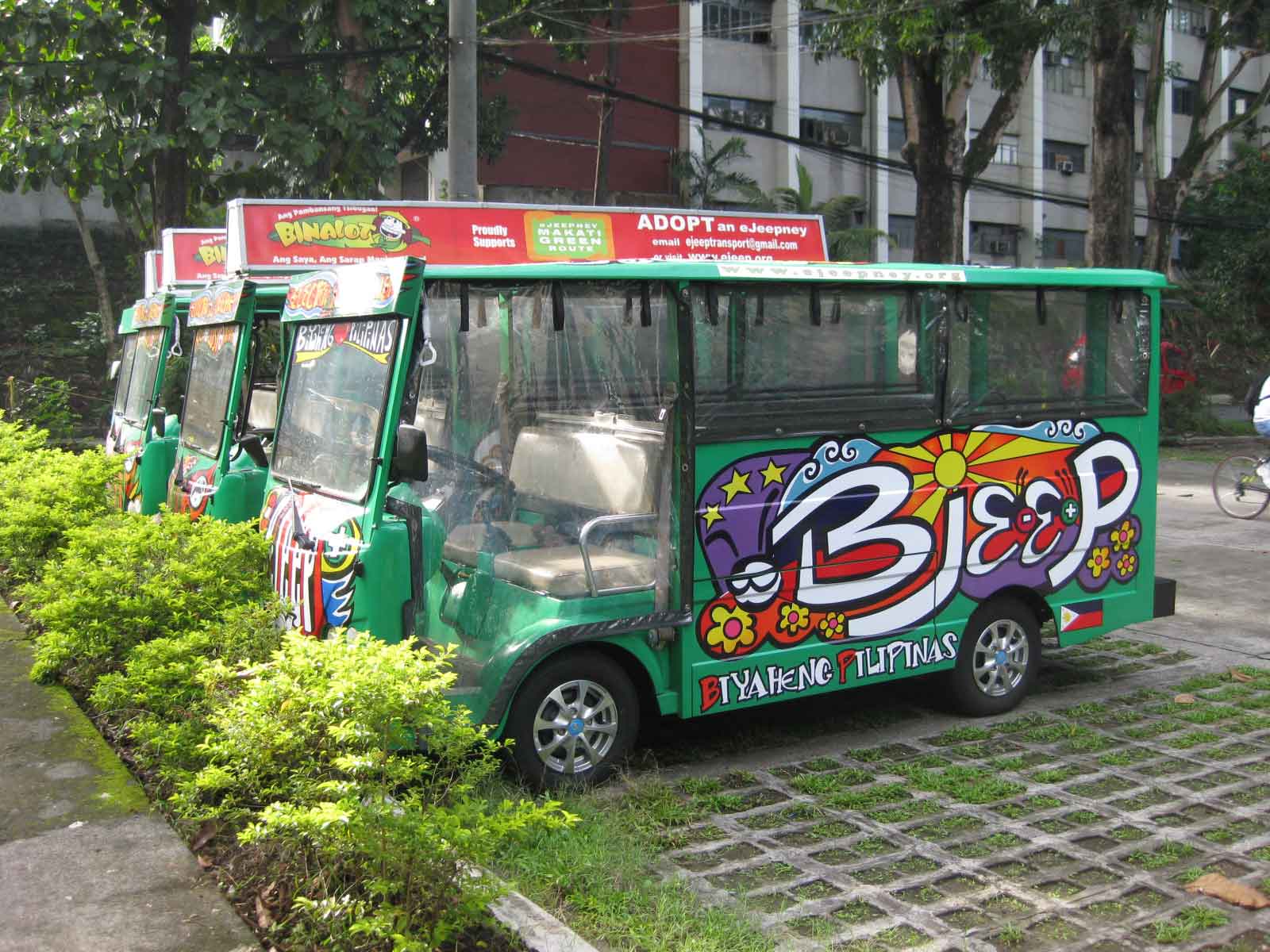 Electric jeepneys parked at UP Diliman – the Bjeep is the one used by Vice President Binay during the inaugurations
I reproduce below a news item from the GMA News website that features an initiative from the ADB that may finally push electric vehicles to gain a significant share of trips across the country:
The Asian Development Bank is offering as much as $280 million in loans for the Philippine government to finance a proposed re-fleeting program for tricycle drivers and operators shifting to electric motorbikes or e-bikes.
“The loan will be coursed through ADB conduit banks like Land Bank of the Philippines for re-lending to tricycle drivers who may want to shift into using e-bikes,” Environment Secretary Ramon Jesus Paje told reporters in a briefing Tuesday.
He said ADB will give 30 e-bikes as donation to city governments in the Metropolis.
“ADB wants to us to sample the bikes to see for ourselves that these machines are totally pollution-free. No emissions, less pollution,” he said.
If all Philippine tricycles are e-bikes, the country can save much as 20 million metric tons of carbon footprints a year.
“We could go into carbon trading. That will earn us dollar equivalent which we can use to offset a portion of the loan,” said Paje.
Tricycle drivers can save up to P300 in daily fuel costs with the use of e-bikes.
“Four hours of charging would only cost P40 compared to P340 for fossil-based fuels. The acquisition cost is about 20 to 30 percent higher than fuel-fired motorcycles but the overhead cost is certainly lower,” Paje said.
Of the total 5 million tricycles in the country, 2.8 million are in Manila.
The department said that the shift to e-bikes would reduce pollution 25 percent to 30 percent in the country’s urban centers by 2011.
As of 2009, the country’s total suspended particulates – a concentration of micro pollutants in the air – in all cities and urban centers is 134 micrograms per normal cubic meters, which is 48 percent beyond the normal standard of 90 micrograms per normal cubic meters.
The major sources of these particulates are diesel vehicles and coal-burning power plants. Dust from unpaved roads and construction activities contribute to the rise in particulates especially during summer months.
Vehicles contribute as much as 80 percent to air pollution, while the remaining 20 percent are from industries.
Department monitoring shows that more than 50 percent of vehicles are registered without prior actual testing by accredited Private Emission Testing Centers.
“If all vehicles are tested for emission prior to registration, the 30 percent reduction in particulates will be easily realized,” Paje said. —With MR Gavin/VS, GMANews.TV
The ADB initiative comes at a critical time when the national government is still finding its way with regards to local public transport modes, particularly how the tricycle has established itself as the primary (sometimes, the only) public transport option in cities and municipalities across the country. It is inevitable that the issue of proliferation and regulation of tricycles will have to be addressed. National and local government would have to discuss the nuances of the Local Government Code in as far as public transport operations, franchising and fare setting are concerned. On top of this, the time is critical also because there is a strong call for environmental sustainability; one that is anchored on the increasing awareness for climate change and its impacts. The long-standing perception is that the conventional tricycles contribute to the continuing degradation of our environment as the collective emissions from these vehicles effectively suffocate our cities, and the key is for local governments to realize this and be a major player in transforming local transport into the environment-friendly kind. It is, after all, in the best interests of their constituents that clean air be pursued to ensure that there will be a bright future for their cities and this country.
Through Traffic – Part 1
As I was reviewing a paper concerning a study on vehicles utilizing residential streets as alternate routes to congested arterials, I couldn’t help but compare the circumstances described by the authors to the current situation at the University of the Philippines Diliman campus. It is a classic case of motorists who, having free access to roads regardless of the nature of the land use, will choose to take this roads in order to bypass what they perceive to be congested roads. The objective is simple, take the route where travel time is significantly less, thereby getting to your destination faster. Such traffic is often termed as through traffic mainly since they do not have any other purpose along the street.
While the paper I was reviewing focused on a single street in a residential district somewhere in Tokyo, the problem in UP Diliman is much more complicated. The UP Diliman campus occupies 493 hectares of prime land in Quezon City, the largest component of Metropolitan Manila. The campus is located between two major thoroughfares – Commonwealth Avenue and C.P. Garcia Avenue (more popularly known by its former name, Katipunan Avenue as well as its designation in the basic circumferential and radial network for Metro Manila, C5). It used to be that campus roads were fair game to general traffic bypassing the traditional connection of Commonwealth and Katipunan at Tandang Sora (where the intersect). The latter being a narrow 2-lane, undivided street often congested because of truck traffic and the operations of tricycles serving the dense residential areas at either side of the road. Many vehicles, particularly private cars because trucks were not allowed to use campus roads, came through the campus via its Main Gate along University Avenue and its other gate along Ylanan Road (along Commonwealth) and exit via gates along Magsaysay Avenue (Asian Center), Schuster Street (Narra Residence Hall), or Velasquez Street (NIGS), and vice versa.
Due to the increasing volume of through traffic, the University agreed to grant right-of-way to what was to become C.P. Garcia Avenue (later downgraded by the MMDA to C.P. Garcia Street), which practically separated the academic areas from the residential areas located in the south portion of the property. Traffic has since shifted significantly from campus roads to C.P. Garcia but there has been a resurgence of through traffic in the past 3 years mainly due to C.P. Garcia being congested during peak periods. Most through traffic in the morning are vehicles bound for private schools along Katipunan Avenue and these are clearly indicated in the stickers on the windshields of the vehicles as well as the characteristic uniforms of students on-board. There are also significant traffic from motorists bound for the Pasig/Mandaluyong (e.g., Ortigas CBD) and Makati/Taguig (Bonifacio and Makati CBDs) via C5. Such traffic have significantly and detrimentally imposed themselves on the University, affecting the community and more specifically its academic constituents.
 Caught (up) in traffic