
On walkability and walkability scores
I’m sharing a couple of articles on walkability and walkability scores. The first one actually points to the second but provides brief insights about the concept of walkability while the second is a more detailed article on the findings of a study on walkability.
Ionesco, D. (May 4, 2022) “Walkability Scores Don’t Tell the Whole Story,” Planetizen, https://www.planetizen.com/news/2022/05/117075-walkability-scores-dont-tell-whole-story?utm_source=newswire&utm_medium=email&utm_campaign=news-05052022&mc_cid=c04e3e4dc0&mc_eid=9ccfe464b1 [Last accessed: 5/7/2022]
To quote from the article:
“if cities truly want to be pedestrian-friendly, they need to think beyond the sidewalk…”
The second article is from late April:
Gwam, P., Noble, E. and Freemark, Y. (April 28, 2022) “Redefining Walkability,” urban.org, https://www.urban.org/features/redefining-walkability [Last accessed: 5/7/2022]
To quote from the article:
“To create a more comfortable walking experience, our research points to a few steps DC planners and policymakers can take to increase racially equitable walkability across the city:
-
expand tree cover in the densest parts of the city,
-
increase nonautomotive modes of transportation in central areas,
-
reduce noise pollution,
-
support more equitable access to key resources, and
-
prioritize road design that limits the need for police traffic enforcement.”
While the article puts emphasis on the topic of racial equity, such concept can easily be adapted and adopted for our purposes. For one, it could be interpreted as being inclusive if one is not comfortable with the term “race”.
Don’t miss downloading the technical appendix of their report. This will be very useful to researchers, practitioners and advocates of active transport.
–
On trucks and road safety again
The past days saw many trucks being involved in crashes along my commuting route. My social media feed also gives me updates on the traffic situation in my home city. And there are many reports of the same – trucks involved in road crashes or stalled due to a variety of reasons (engine problems, flat tires, etc.) . It is not an understatement to say that such incidents are a matter of concern especially since these may have been fatal (i.e., deaths due to road crashes). Here are a couple of photos we took as we passed a truck on its side along Ortigas Avenue Extension along one of my usual commuting routes.
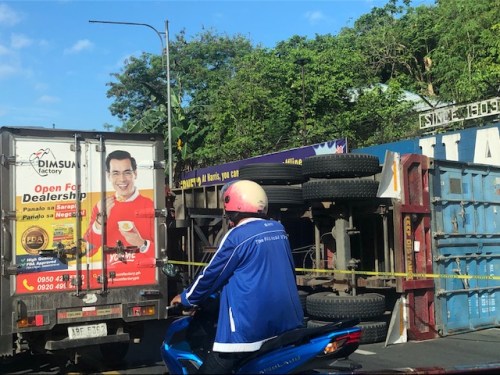
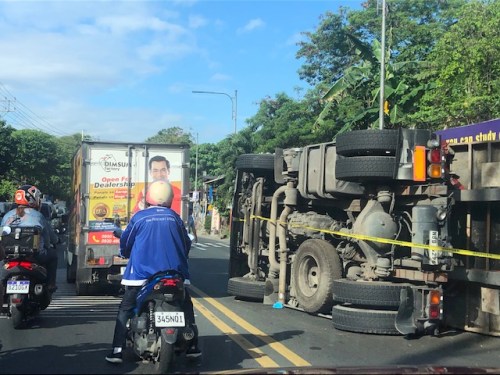
It is fortunate that this did not result in any fatality but from the photos one can surmise the potential or likelihood of serious injuries if not death/s. Such underlines the importance of both proper maintenance and operations of these vehicles including how they are loaded. Shifting or unbalanced loads on moving trucks negotiating turns or maneuvering, for example, will result in loss of control and overturning that also leads to traffic congestion. Are the drivers competent, awake, alert? Or are they sleep or perhaps driving under the influence of alcohol or other substances?
–
On ways to make streets safer
Here’s a quick share of an article suggesting a simple way to make streets safer:
Berg, N. (April 27, 2022) “The ridiculously simple way to make streets safer for pedestrians,” Fast Company, https://www.fastcompany.com/90745296/the-ridiculously-simple-way-to-make-streets-safer-for-pedestrians [Last accessed 5/1/2022]
To quote from the article: “Art projects painted onto streets and intersections significantly improve safety, reducing the rate of crashes involving cars and pedestrians by up to 50% and all crashes by 17%, according to the study.”
The article’s sub title states that you only need a bucket of paint rather than expensive new traffic signals or road blocks to keep pedestrians safe. I remember there were similar attempts to do the same in Antipolo prior to the pandemic. A group painted on the pedestrian crossings along major roads in the city. These, however, appeared to be somewhat invisible to most motorists and did not succeed to slow down traffic. Perhaps, as the article states, the artwork needs to be more visible or conspicuous in addition to its being comprehensive for intersections as the examples in the article show. These cannot be piecemeal or appear as publicity stunts for them to influence driver behavior and help improve safety.
–
Early morning commuting
Early morning commutes are not new to me as I’ve been doing this since I started to commute by myself decades ago. My usual trip between home and school consisted of two jeepney rides or one jeepney ride and a tricycle ride, depending on whether I carried a lot of items or if I didn’t feel like walking the so-called last mile between the jeepney stop and my home. While traffic wasn’t as bad in the 1980s and 1990s as it is today, it was still difficult to get a ride. Little has improved with public transport even though there are air-conditioned vans, P2P and additional railway option for me now along my usual routes to the office.
Back in the day, I liked to enlist in the 7:00 – 8:30 AM classes at UP Diliman as it was easy to get a ride at 6:00AM. That allowed for some time to spare before class and in the rare cases when UP-Katipunan jeepney drivers were on strike, you can walk the length of Katipunan and arrive in time for class. It was later when my classes were mostly in the afternoon that I had to delay my trips so I wouldn’t have to travel during the peak periods. It was difficult to get a ride and travel times were longer. When I was already working, I often traveled early if we had field work scheduled. That meant traveling before 6AM. There were fewer jeepneys but most were not full and it was easy to get a ride.
I took a couple of photos of a bus plying the Antipolo-Cubao route at around 5:30 AM one Friday morning. This was before the return to work order was issued to many workers so perhaps it does not show the current situation for the same time.
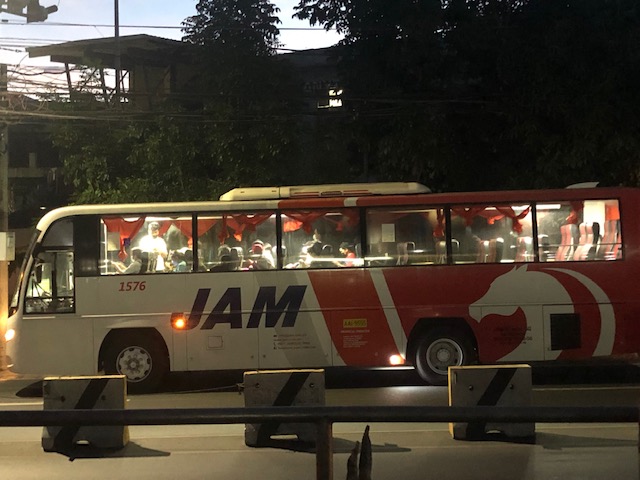
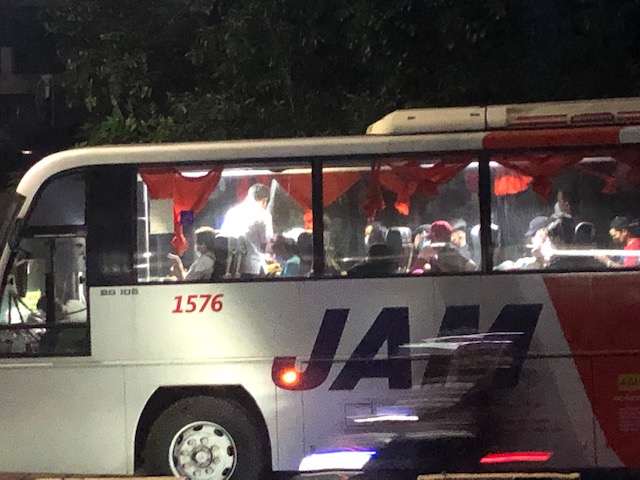
I now go to the office twice or thrice per week. On my way at 7:30 AM, I see many people lined along the streets at the typical loading/unloading areas along my routes. People would have to travel earlier if they want to easily get a ride and if their travel distances are relatively far (i.e., many people live outside of Metro Manila and have to travel 10+ kilometers one way).
–
NAIA Parking Rates as of April 2022
Here’s a quick share of information about the parking rates at the NAIA airport terminals:
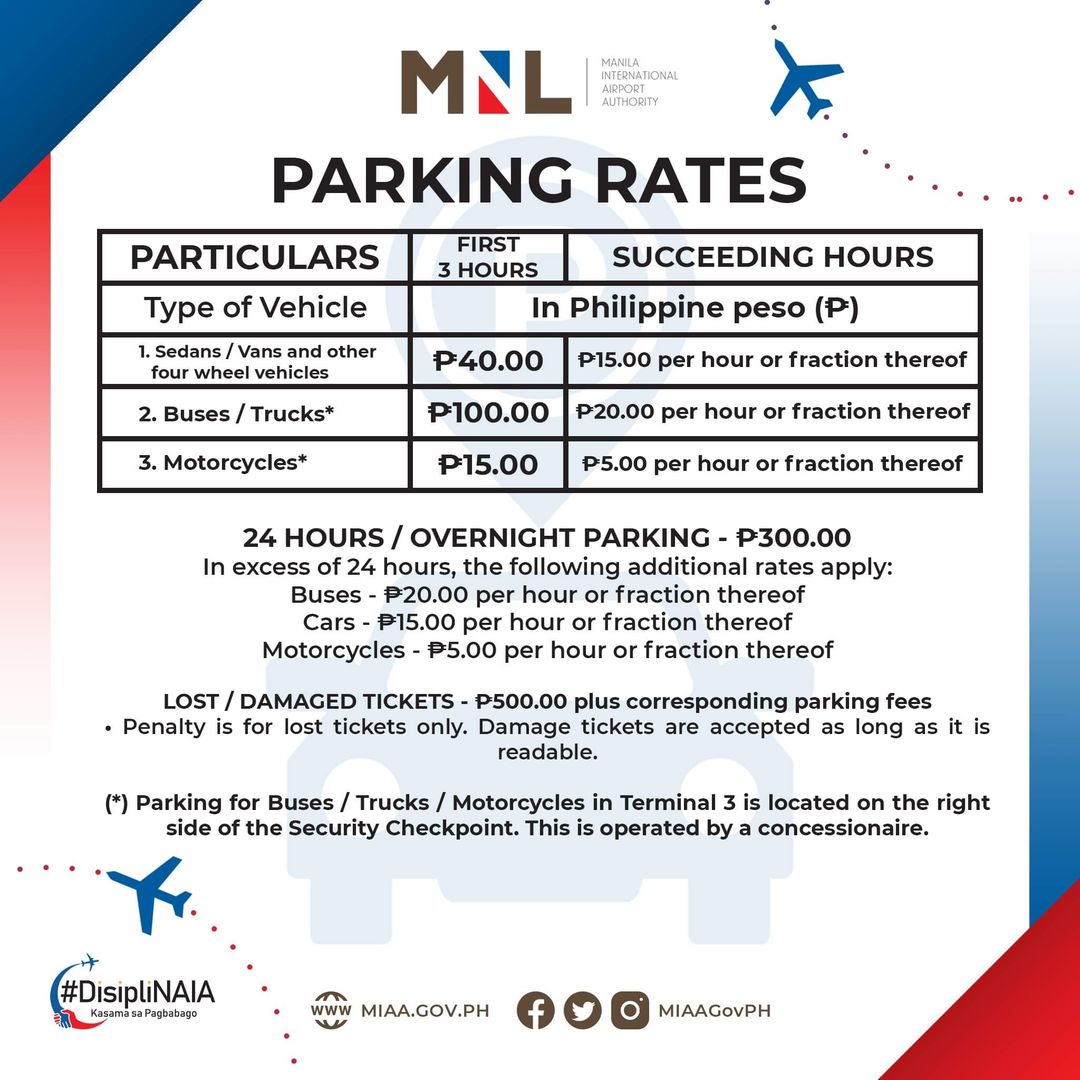
The infographic is from the DOTr Facebook Page and should be useful for those picking up people at the airport or who would be leaving their vehicles there as they travel again with the easing of restrictions due to the pandemic.
–
Road safety history – first fatality and crash
Have you ever wondered when the first road crash involving a motor vehicle occurred? Or who was the first person to die (i.e., fatality) in a car crash? Here’s a brief but informative article on this topic:
Sal (April 15, 2022) “Who Was the First Person Ever to Die in a Car Crash?” Medium.com, https://sal.medium.com/who-was-the-first-person-ever-to-die-in-a-car-crash-8385add6cbcb [Last accessed: 4/20/2022]
Were you surprised about the 3 mph speed of the car that ran over the first fatality involving a car? That’s really slow considering the speeds of vehicles these days and how high speed limits are along streets where there are many pedestrians. Meanwhile, the circumstances about the first crash appears to be similar to what we still have now. That is, reckless driving, increasing speed limits and (truth be told) pedestrians not being aware of their surroundings (say what you will but the car was traveling at 4 mph and there was a claim that the driver tried to get the attention of the victim to no avail). I agree though with the author that this was a portent of worse things to come as road crashes has become a top killer and health concern.
–
Bike-friendly fast food
While doing field work early this week, we decided to do a quick drive through for refreshments. As we queued for the drive through window, we came upon this recent addition to many fast food restaurants in light of the increasing popularity of cycling amidst the Covid-19 pandemic. Here are a few photos of the Bike & Dine at McDonald’s along Rodeo Drive in Alabang.
 Our first close look at the bike & dine section of a fast-food restaurant ironically was via the drive through of a restaurant.
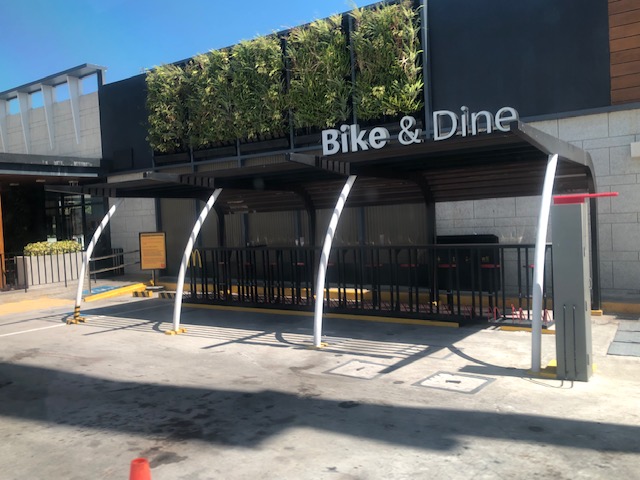 McDonald’s bike & dine facility – many if not most of their newer branches have allocated space for bikers. These clearly show that such facilities or features can be included in the space layout and design of such restaurants.
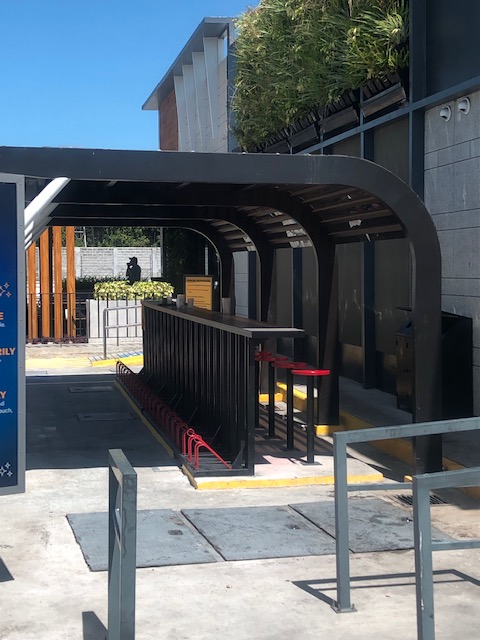 Cyclists may park and secure their bikes on one side (left with a slot for a wheel) and sit to eat and/or drink on the other side of the table.
 A close-up of the table, seats and bike slots
More and more establishments are now putting up bike facilities such as parking and bike & dine. We hope that these will help encourage more people to cycle while also proving that active transport is good for business.
–
Inflight snacks in the time of Covid-19
Inflight, there wasn’t really much difference pre-Covid-19 and now (not yet post-Covid-19) except perhaps that the flight attendants were wearing PPEs and masks. We were on full flights both outbound and inbound of Manila and the airport terminals were also already crowded. We flew on Philippine Airlines so there was no food and drinks for sale on the flight. But they did distribute some snacks and drinks to passengers.
 |
| Butter cookies and water were our inflight snacks for the MNL-TAG flight. For drinks you actually can opt for coffee or tea. |
 |
| The cookies were by Figaro and not from some obscure manufacturer. |
 |
| We had green peas and water on the TAG-MNL flight. |
 |
| Nutrition information at the back of the pack. |
 |
| The guisantes pack was manufactured in Cebu and is certified Halal. |
I assume that longer flights on board full service airlines like Singapore Airlines or Japan Airlines would have modified their inflight meals service in light of Covid-19. We are hopeful that we can soon travel overseas to again enjoy the attractions in other countries.
–
Flying again – NAIA Terminal 2 Departure
It’s been more than 2 years since the last time I went on a trip via aircraft. We finally decided it was safe to take a brief vacation and to take advantage of the still few tourists heading to resorts out of Manila. Here are a few photos taken at NAIA Terminal 2 as we set out to travel to Panglao Island in Bohol for a much needed break from work and from Covid-19.
 Check-in counters at NAIA T2 were already busy when we arrived at the airport
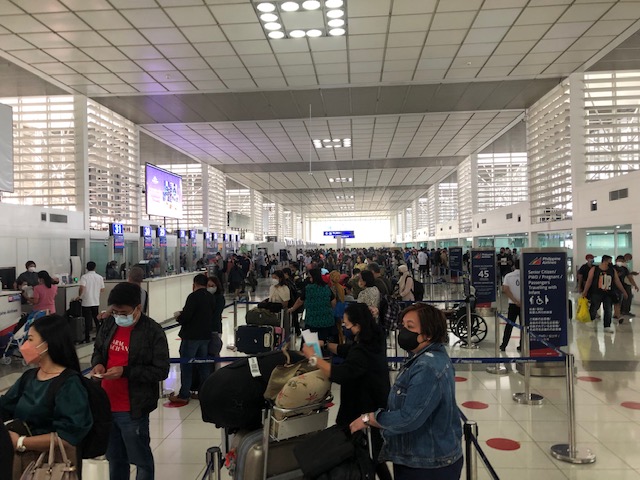 The scene at the terminal lobby was as if there was no pandemic (technically, we aren’t out of the Covid-19 pandemic yet).
 Past the final security check and into the pre-departure area
 Some sections were less crowded. This section where we had some light lunch as we waited for our gate to be announced was usually reserved for international flights. Here were gates for US destinations and it was spacious because of the number of passengers and the gauntlet-like security checks required for US-bound passengers.
 Our boarding gate for our flight to Tagbilaran-Panglao Airport
 Passengers waiting for their boarding calls near our gate
We can only imagine how much more crowded this terminal could still be once we go back to “normal” or pre-pandemic travel conditions. It is good to see at least most passengers wearing masks. All adults at least were wearing masks and only small children and infants weren’t. We also hope that airport terminal staff do their part in ensuring the facilities were disinfected regularly so as to minimize the risk of Covid-19 and other infections.
–
Island hopping again
It’s been more than two years since we last traveled by plane and 10 years since our visit to Panglao in Bohol. So its really something we looked forward to considering we now travel with our daughter and there’s a lot to write about on the experiences.

And there’s a lot about transport to write about and share in this blog. There’s a new airport, the nice roads and the journey between Panglao and Balicasag, among others that I will be writing about soon.
Abangan!
 Caught (up) in traffic