
On the increase of road crash fatalities during the pandemic
The general observation has been that roads have become less safe as drivers and riders have tended to speed up their vehicles during this pandemic. Speeding up apparently is just part of a bigger picture and even bigger concern considering what is perhaps also an issue related to mental health. We’ve read, heard or watched something about people’s transformation once they are behind the wheel or riding their motorcycles. I remember a Disney cartoon showing how Goofy transforms from being mild-mannered to somewhat demonic once behind the wheel of the car. The article below reinforces that and relates this behavior with the pandemic.
To quote from the article:
Art Markman, a cognitive scientist at the University of Texas at Austin, said that such emotions partly reflected “two years of having to stop ourselves from doing things that we’d like to do.”
“We’re all a bit at the end of our rope on things,” Dr. Markman said. “When you get angry in the car, it generates energy — and how do you dissipate that energy? Well, one way is to put your foot down a little bit more on the accelerator.”
Roadside bike repair stations
Walking along 38th Street at the Uptown side of Bonifacio Global City (BGC) in Taguig, I came along this mini bike repair station conveniently located along the bike lane and just across from the schools along the street. It had some tools and a pump. Typical of what a cyclist or biker may need in case some quick repairs, adjustments or tire inflation are required. The first time I saw something like this was along Commonwealth Avenue; provided by a bicycle group that helped promote bike-to-work along that corridor and Quezon City.

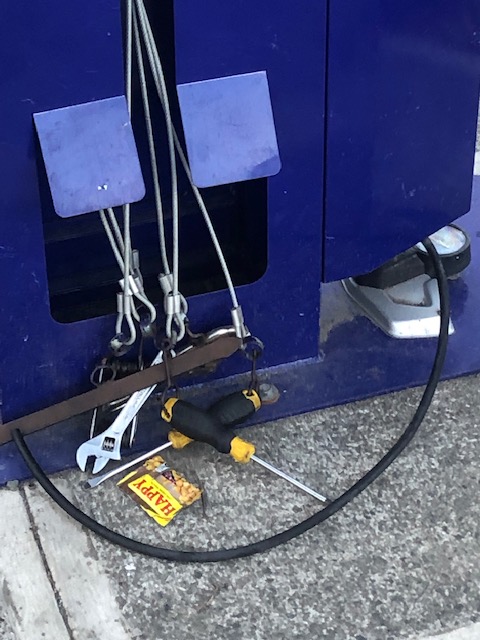

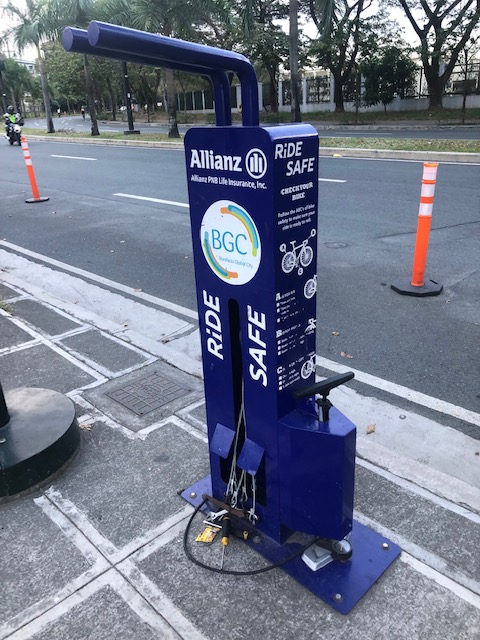
We need more of these especially along the major roads used by cyclists; especially those who bike to work. Granted that there are many bike shops and perhaps the vulcanizing shops as well as cyclists bringing their own tools and pumps but you never know when you will need some tools or perhaps a pump to inflate tires. Of course, these will need to be secured as there are people who have the propensity to steal, damage or vandalize tools.
–
Article on how cities can rapidly expand bike networks
With the increasing popularity of bicycles for utilitarian use (e.g., bike to work, bike to school, etc.), the need for strategies, programs and projects to support cycling has become more urgent. This is mainly to sustain the increase of bicycle use and partly to enhance the safety of cyclists. Here is an article that discusses how cities can rapidly expand bike networks:
https://www.urban.org/urban-wire/how-can-cities-rapidly-expand-access-cycling-infrastructure
To quote from the article:
“Our research points to several key recommendations for other cities hoping to expand their cycling infrastructure and encourage a more rapid shift toward biking and away from cars.
– Local governments can lead the implementation of a large-scale expansion of cycling infrastructure if local leaders can commit to ambitious, quantified mileage goals that will help structure how capital dollars are spent.
– Local implementation goals should include metrics related to increasing equity, particularly for people of color and those with low incomes. Although the Final Mile program increased the number of miles of cycling infrastructure, it did not directly prioritize the people who could benefit most from improvements.
– Philanthropic funders interested in supporting climate-friendly infrastructure should ensure their funds help hold local policymakers accountable to achieving their commitments instead of funding infrastructure projects directly. They can also encourage collaboration between cities and nonprofit advocates while working to fill local capacity gaps, such as through engineering consultants.”

Paper: Estimation of Transportation Energy Demand of the Philippines Using A Bottom-up Approach
Our paper from a conference last year is finally published in an open access journal. The paper is on the “Estimation of Transportation Energy Demand of the Philippines Using A Bottom-up Approach.” Here is the abstract of the paper:
“In the years 2000–2016, the sector with the largest share of total final energy consumption in the Philippines is transportation with an average share of 34.2%. The study aims to estimate the baseline transportation energy demand of road, maritime, air and rail transportation modes in 2016 using a bottom-up approach. Through a bottom-up approach and utilizing available transportation activity and fuel economy/energy efficiency data from secondary sources coupled with primary road transportation activity and fuel economy and railway operations survey data, the baseline transportation energy demand of the Philippines is estimated to be 12,956.1 ktoe in 2016. A comprehensive estimation of transportation energy demand of the country using bottom-up methodologies with more detailed transportation activity and vehicle fleet of the different transportation modes is implemented. Finally, the collection and keeping of certain data that are critical in the estimation of the transportation energy demand are recommended.”
Here is the link to the paper, which is published in the Asian Transport Studies, Vol. 8, 2022: https://authors.elsevier.com/sd/article/S2185-5560(22)00004-9
–
Article on evaluating transport equity
Here is another quick share of an article on transportation equity:
Litman, T. (February 2, 2022) “Evaluating Transportation Equity: ITE Quickbite,” Planetizen, https://www.planetizen.com/news/2022/02/116058-evaluating-transportation-equity-ite-quickbite [Last accessed: 2/4/2022]
Transportation equity is a very relevant, very timely topic as people in the Philippines are just beginning to understand and weigh the advantages of having more efficient transport in the forms of active and public transport over private vehicles.
–
UPSE Discussion Paper on Martial Law and the Philippine Economy
To those who were looking for references on the Philippine economy during the Martial Law years, look no further than a recent discussion paper from the UP School of Economics (UPSE). To quote from their social media post:
UPSE Discussion Paper No. 2021-07 (November 2021)
📌Title: Martial law and the Philippine economy
🖊Authors: Emmanuel S. de Dios, Maria Socorro Gochoco-Bautista, Jan Carlo Punongbayan
📄Abstract: Part of a proposed anthology, this article provides a concise review of the economic performance during the period of the Marcos dictatorship (1972-1985) from a comparative historical perspective. We examine the external events and internal policy responses that made possible the high growth in the early years of martial law and show that these are integral to explaining the decline and ultimate collapse of the economy in 1984-1985. The macroeconomic, trade, and debt policies pursued by the Marcos regime—particularly its failure to shift the country onto a sustainable growth path—are explained in the context of the regime’s larger political-economic programme of holding on to power and seeking rents.
📖 Read the full paper here: https://econ.upd.edu.ph/dp/index.php/dp/article/view/1543/1027
https://econ.upd.edu.ph/dp/index.php/dp/article/view/1543/1027
Why is this relevant to transportation in the country? Economic performance and policies during that period strongly influenced if not practically dictated infrastructure development during the period. Add politics to the mix and you get what ultimately affected future administrations in terms of debt servicing and other financial or fiscal issues that needed to be addressed due to the debt incurred during that period.
We should learn from this and hopefully not repeat it. Unfortunately, the fiscal discipline and reforms during the previous administration appear to have been abandoned and the current spending and borrowing spree will likely handicap future administrations. Are there bad debts around? Probably! And so there will likely be a need to do some due diligence during the transition to a new administration after the elections this year.
–
On the role of women in transportation
I found this podcast on “Advancing the Role of Women in Transportation” on the AASHTO thread:
This reminded me of the Women in Transport Leadership (WiTL) group that friends formed a few years ago. They are active in promoting the role and relevance of women in transport as well as equity in transportation.
–
Farewell to the arch?
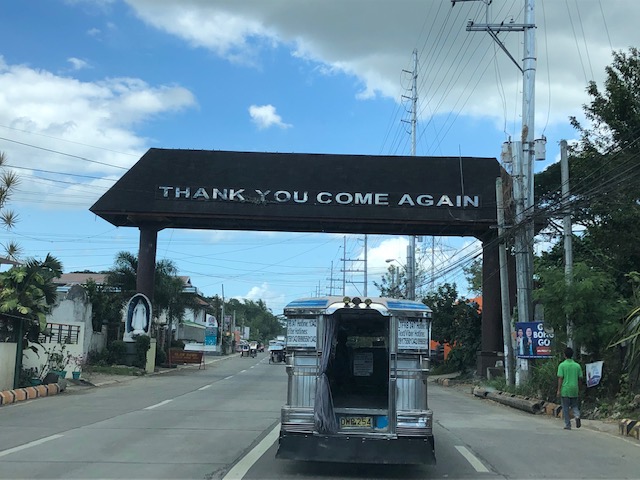
Arches (arko) were a common sight along national roads across the country. I have written about these arkos in previous posts including those with old photos that I took while on field work:
With all the road widening projects ongoing along many national roads, many arches have been demolished while new ones apparently have not been constructed (whether really new ones or those replacing the old ones). I still think these are good landmarks and an opportunity to feature products, traditions or whatever may represent or identify the city or municipality.
–
On “universal basic mobility”
You’ve probably heard or read about the concept of “universal basic income.” The concept has been discussed and implemented or attempted in some countries including those that have successfully tinkered with their social welfare systems. Here is an article that presents and discusses the idea of universal basic mobility:
Descant, S. (December 22, 2021) “‘Universal Basic Mobility’ Speaks to a City’s Values,” Government Technology, https://www.govtech.com/fs/universal-basic-mobility-speaks-to-a-citys-values [Last accessed: 12/24/2021]
It was in graduate school back in the 1990s when I first encountered the concept of the ‘transportation poor’ and ‘transport poverty’. While the term suggests people who are generally in the low income classes, the actual definition of transport poverty is more complicated and comprehensive than that. While sustainable transport and its current versions have always discussed the more fad issues on public transport, low carbon transport, active transport, etc., specific engagements on the more rad topic of equity in transportation have not been as common. Perhaps this current issue and discussions on the government’s “no vaccination, no ride” policy will open doors for equity to be out in the open?
–
Video share: replacing railroad ties
Here’s a quick share of a video of the modern, ‘state of the art’ way to replace railroad ties (sleepers):
I suddenly recall how satisfying or relaxing it was to watch concrete being mixed manually. I think watching the video above gives a similar feeling.
–
 Caught (up) in traffic