
Do people understand what Uber and Grab really are?
Over the holidays, I’ve read a lot of posts about Uber and Grab. Mostly, these were complaints about the surge pricing scheme of Uber. A lot of people cited the exorbitant rates Uber charged for trips even short ones like Ortigas to Center to Greenhills and Trinoma to Katipunan. Though the complaints are legitimate ones, I also try to see the other side of the coin considering Uber and Grab do tell potential passengers how much it will cost them for such commutes during peak periods (i.e., when roads are congested). Potential riders do have a choice whether they should take the rider (and therefore agree with the fare stated by the app) or take another transport mode instead. The issue here should not be entirely Uber’s or Grab’s fault. Our public transport system, particularly in Metro Manila, sucks. And that includes the conventional taxis that could have provided better services if regulations were strictly implemented or if the operators managed their drivers and maintained their vehicles well. Based on my experience, taxis in Cebu, Iloilo and Davao, for example, are better managed and regulated, and provide better service quality than those in Metro Manila.
Then there were the joint LTFRB and DOTr advisory for Uber and Grab units and the LTFRB order on surge pricing and fare rates.
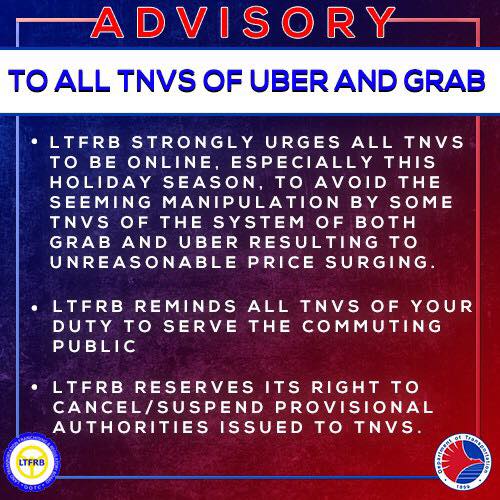
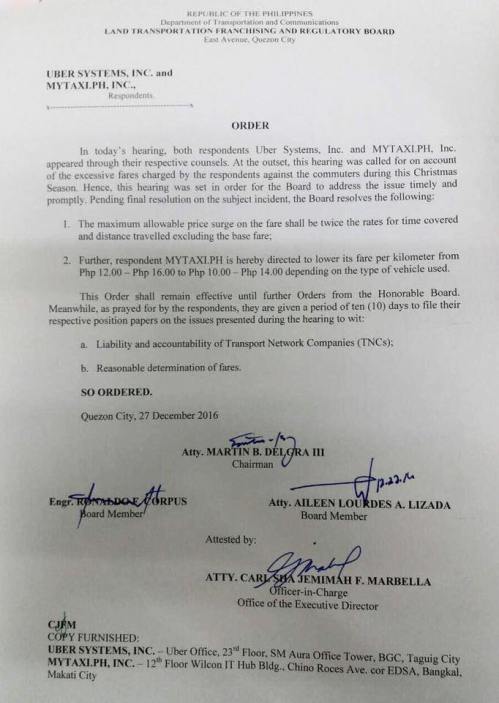
From both cases, it is clear that car-sharing or ridesharing services like Uber and Grab are treated as taxis rather than as premium services that likely entail higher fares but are subject to prospective passengers’ willingness to pay for such services.
Such opens the door for more questions than answers: Is this a misunderstanding or perhaps a deliberate action on the part of Philippine regulators (LTFRB and DOTr)? Why can’t they impose the same standards for vehicles, operators and drivers of conventional taxis? Wouldn’t it be in the best interest of the general riding public for LTFRB to clamp down on conventional taxis in order to reduce dilapidated vehicles as well as unqualified drivers? Surely, conventional taxis will become more attractive if they provide better services including significant reductions in the incidence of typical complaints against taxis like negotiating fares and refusing passengers because of their destinations.
Here are some more questions that need clear and objective answers for one to have a fair assessment of these services:
- Do these show how much we (both commuters and regulators) understand how these car-sharing modes are supposed to operate?
- Do officials at DOTr and LTFRB, who are supposed to be regulators of public transport services know how Uber and Grab are supposed to operate?
- How do they really fit in considering all the other modes of transport available to commuters?
–
Habal-habal in Agusan
The initial part of our research on motorcycle taxis has been completed last December 2016. We are currently drafting a paper for submission to an international conference to be held later this year. The paper contains the outcomes of the surveys undertaken in Surigao Del Sur, Agusan Del Norte and Metro Manila. These include a profile of motorcycle taxi drivers and vehicles that gives us a good idea of how much these people earn and the typical range and loads (passengers and goods) they carry.
Following are photos of motorcycle taxis in Agusan. I won’t post too much detail on the net income of drivers/operators but I guess they earn enough (some even more) given the typical cost of living in these areas where they operate. Motorcycle taxi drivers/operators actually are part of the so-called underground economy where, despite the work and income, people don’t pay their taxes like regular employees or professionals at various workplaces.
[All photos courtesy of Mr. Sherman Avendano of the National Center for Transportation Studies]
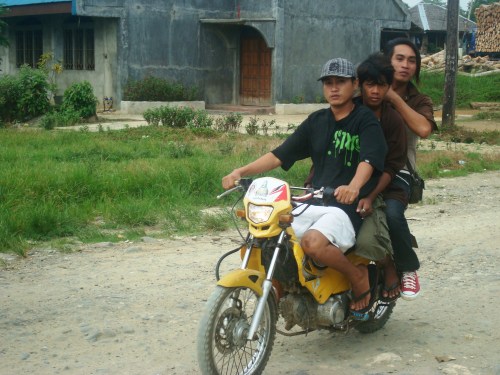 Typical habal-habal with 3 passengers
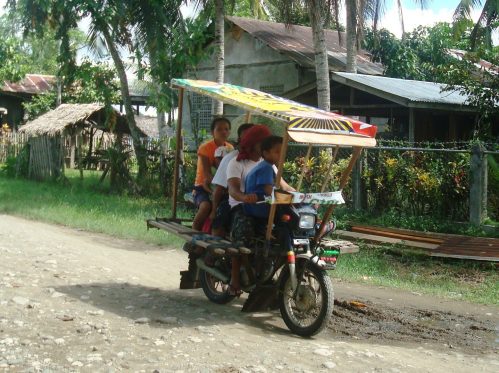 “Skylab” with roof – the planks or extensions on either side of the motorcycle are the main features of this motorcycle taxi.
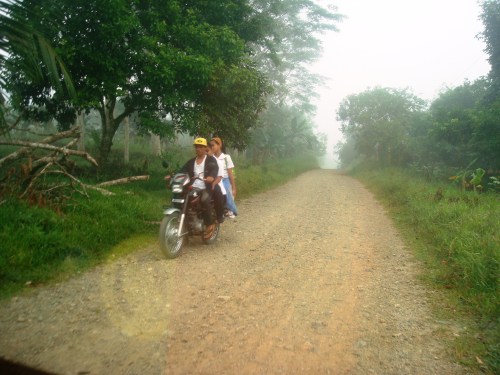 Typical rural roads in areas served by habal-habal are unpaved. These are muddy during the wet season and dusty during the dry season. As such, it can be a rough ride for those using motorcycles and perhaps even rougher by car.
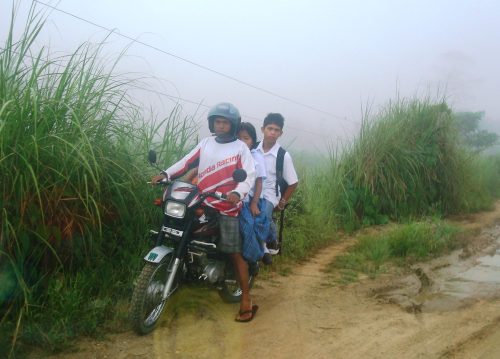 Habal-habal passing by a puddle on the road – the passengers are obviously children likely on their way to school based on their uniforms
More on motorcycle taxis soon!
–
On Antipolo’s railway heritage – Antipolo Station
I open 2017 with a post on history and rails. A reader of one of my previous posts on Antipolo and its railway heritage was very generous to include some photos of what remains of the Antipolo Station of the old (shall I say ancient), defunct railway line that traversed what is now still called Daang Bakal. Those comments and links to photos may be found under the post on old railway lines here.
Here is a photo I found in the Kalye ng Antipolo Facebook page:
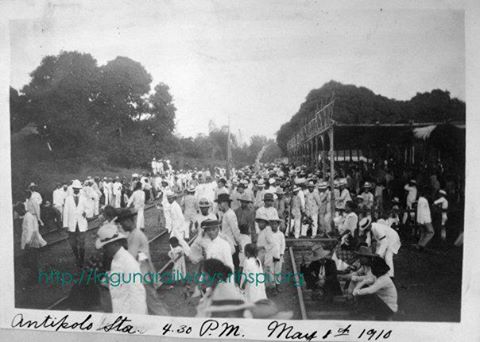
From what I see in the photo, this is a photo of the end station of the railway line that stretched from Manila to Antipolo via Pasig and Cainta through what is now Valley Golf and not via Ortigas Avenue as what some people are claiming. The last two stations were at Antipolo at Hinulugang Taktak, where the remains of the old station are well preserved and there is a historical marker, and at the area that is basically at the intersection of the Circumferential Road and San Jose Street, where the end station would have been closest to the shrine. I am also basing my assessment from the topographic features shown in the photo and the fact that there are three sets of railway tracks shown, indicating that this is also probably a depot for trains. Unfortunately, as mentioned by one of my readers, is in a state where it might soon be demolished due to the road widening project for the circumferential road. I hope the Antipolo government recognizes this important part of its history, its railway heritage, and perhaps help preserve what remains of the Antipolo Station and place a marker there for future generations to appreciate.
–
Grab vs Uber: the ridesharing services battle for supremacy?
I have made it a custom to share articles here on my blog. One reason for me to do this is so I have an archive of sorts for articles that caught my attention that I have either read or not that I want to get back to. Here is another article on ridesharing, this time from a popular magazine:
Grab vs Uber: Who’s getting the riders and making money?
This is relevant material for ongoing studies we are doing about ridesharing. I am also writing a couple of papers on this topic that we intend to present and publish next year.
–
Merry Christmas!
I just want to greet all my readers a Merry Christmas!
May your wishes be granted and may you be safe and healthy with your family.
Peace on earth!
–
Uber as a Ponzi scheme?
I came upon this article posted by an acquaintance on his social media account. The article appears to be click-bait given its title but reading through it, the author leads you to other articles of what seems to be a series about Uber’s operations. I won’t give any assessment here as we are also doing research on ridesharing (although for now its mostly about the passengers perspective and characteristics). I will let my readers digest the content and context of the following article:
Excellent, deep series on Uber’s Ponzi-scheme economics
–
No more bike share at BGC?
Walking back to the parking lot near Seda Hotel after my meeting near Net One Center yesterday, I noticed that the bike share rack near Krispy Kreme was empty of bicycles. I was about to rejoice but then I noticed, too, that the portal by which you can borrow a bicycle was also missing. Was it temporarily removed because of all the activities (Christmas season) that were ongoing at Bonifacio High Street? Or were the proponents already in the process of removing them? I hope it was the first or perhaps the second but only to relocate the rack elsewhere where it is more strategic and perhaps attract more people to use it. Meanwhile, a nearby bike rack for cyclists to place and secure their bicycles was full. This meant a lot of people actually took their bicycles to High Street but these were their own and not part of the bike share system.
–
NAIA airport buses
Among the things I liked when traveling to countries like the US, Japan, Singapore and Thailand is that I have many options to travel between their airports and the city. In Narita, for example, I had the option to take a bus (Airport Limousine Bus, etc.) or train (JR Narita Express, JR Yokosuka-Sobu Line Airport Narita, Keisei Skyliner, etc.) to and from the airport to Tokyo, Yokohama or Saitama where I’ve stayed before. Now, I am glad that there already an airport express bus serving the international airport in Manila.
UBE Express is a recently introduced airport bus service for people traveling to and from the passenger terminals of the Ninoy Aquino International Airport (NAIA). Here are a couple of images describing the service that was shared by the Department of Transportation (DoTr) FB page:
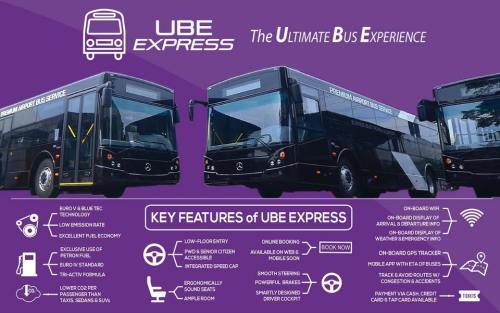
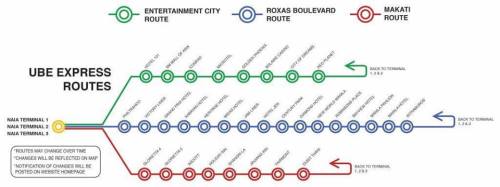
Their Facebook page states that they still charge a promotional fare of 150 Pesos (about 3 US Dollars) for a trip for this Christmas season. More information are available from their FB page and interested people can send them a message using this medium. It seems they reply immediately to comments and queries so that’s good for those who have questions about the service. Here are a couple more images from their FB page:
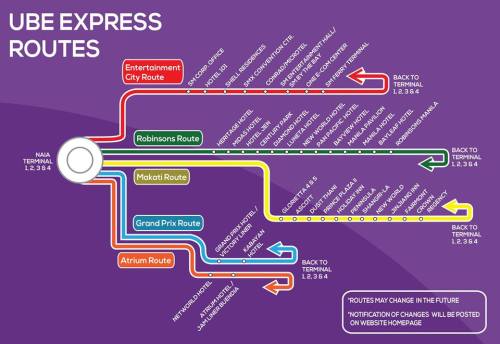
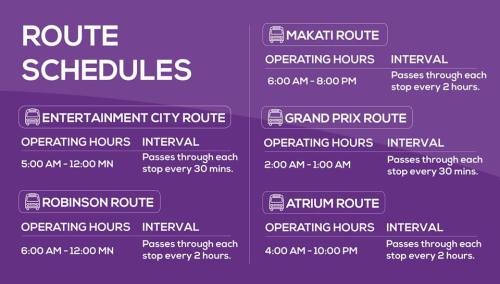
–
City coding anyone?
Last December 8, it was a holiday at Taguig City as they celebrated their foundation day. Not surprisingly, many major roads including C-5, Ortigas Avenue and EDSA were relieved of congestion and I was among those who benefited from this as we breezed through Ortigas to get to the hospital for our daughter’s regular check-up. I also saw many posts on Facebook in agreement with this observation as they too had shorter travel times particularly between Quezon City and Taguig.
I jokingly proposed on my social media account that perhaps, instead of tinkering with the number coding scheme, we should have something like coding for cities. I recall recommending something like making a holiday for one major traffic generating city for each of the five working week days. It’s like making Mondays off for Makati City, Tuesdays off for Pasig, Wednesdays for Makati, Thursdays for Taguig, and Fridays for Manila. I got some supportive comments including one that made very good sense about commuters losing the equivalent of a day anyway because of traffic congestion. The 4-day work week is not at all unusual or new since this has been practiced in many offices including government offices. In certain cases, there are offices that allows you to work from home once a week so you only need to be physically in the office for 4 days. It would be nice for an analysis for this proposal be made and supported perhaps by some modelling so we can have metrics for the potential benefits to all of such 4-day work weeks.
–
Bike share success?
There are two articles about bike sharing that got my attention today. These are both asked the question of weather bike sharing programs actually work or are successful. Following are links to the two articles available online:
Both articles draw upon the experiences in many cities in the United States where various bike share programs have sprouted. Many seem to have had some measure of success but most are not as successful when evaluated using criteria mentioned in the articles. I guess there’s much to be learned here but the experiences should not be limited to the US. There are better examples in Europe where bicycle use is quite popular compared to the US. Perhaps Asian examples, too, need to be assessed but then all need to be examined objectively and according to the unique situations and/or circumstances for how these bike shares came to be in the first place. In Metro Manila, the bike share program by the students at the sprawling University of the Philippines campus in Quezon City is a recent one but is very popular with students. Another, more endowed program in a more posh district in Taguig City is much less successful judging from the usually full racks of bicycles. There are also lessons to be learned here and perhaps things that can be shared with others looking to come up with their own bike share programs in their cities and towns.
–
 Caught (up) in traffic