
Tales from a jeepney ride
Jeepneys get a lot of flak these days for the poor services they provide including many cases of reckless driving that could cause (if not already have caused) road crashes. Many of these crashes do not involve serious injuries or fatalities. Often, these are sideswipes or rear-end collisions, the latter being the result of aggressive drivers not being able to brake in time partly as they like to tail-gate (tutok) other vehicles. The social side of a jeepney ride is often the subject of many tales that illustrate typical human behaviour. There are the body language involved in passing fares between passengers and the driver or conductor. There are the scents and smell of different passengers. There’s music and there’s talk among people riding the jeepney (e.g., friends or colleagues commuting together). There are even cases of PDA or public displays of affection, including among students who go home together. I think it is still common for males to show their affection by taking their partners home (to make sure they get home safely).
One time during a ride home, I was fortunate to get a jeepney whose driver wasn’t reckless and whose conductor was a jolly fellow who engaged passengers in small talk while we were on our way to Antipolo from Katipunan. One passenger asked him how come it was more expensive to go to Antipolo Simbahan via Sumulong compared to the older route via Junction. He answered correctly that the former was a longer route (Google maps will tell you that the route via Sumulong Highway is 16.1 km while the one via Cainta Junction is 15.0 km.) but quickly added that the route via Junction usually took more time to travel along due to the congestion along Felix Avenue, Junction and Ortigas Extension. The other passengers agreed and joined the conversation, commenting on how many Antipolo-Sumulong jeepney drivers and conductors often try to choose passengers or attempt to cheat passengers on their fares (e.g., not giving back the right change or in some cases not even returning change). The good conductor offered his own observations in an accent that seemed to me as one for a native of Rizal. I wanted to join the candid discussion but decided to just listen in and be a spectator in this exchange.
 This jeepney conductor was honest and engaged passengers in conversation. The driver was not reckless unlike many others of jeepneys I have rode on. (He was at least middle-aged but nearing senior status based on his looks.) I thought this was quite rare given the many “patok” jeepneys operating these days and the younger drivers and conductors who don’t care about safety or passengers’ rights like senior citizens’ and students’ discounts.
I think it wouldn’t have been like this where conductor and passengers were interacting the way they did if this were a “patok” jeepney. “Patok” or “popular” jeepneys often feature loud music (though many people will regard this as noise and no longer music) and passengers can hardly hear themselves talk. Often the loud music is an excuse for the driver or conductor not giving back the right change or any change at all to passengers despite the latter shouting at the driver/conductor. We were also lucky that our driver drove safer than your average driver. That meant a somewhat longer trip but I guess the interaction among passengers and conductor allowed for us not to notice the time. I guess these types of trips and interactions are what distinguished jeepneys from other transport. This is very much how commuting can be romanticised and is certainly something we will perhaps miss should the jeepney be phased out. Will it be phased out and is it necessary to remove jeepneys from our roads? I don’t think it will be phased out completely, and I believe that there is a need for the jeepney to be modernised but at the same time operate within a sustainable framework and hierarchy. And we need more of this conductor and his driver to be part of this system while purging out the reckless, abusive and disrespectful kind who make commuting unsafe and uncomfortable for many.
–
The inconvenience of pedestrians
Walking is our most basic mode of transport and yet it seems that we have failed to design facilities that would make us walk more conveniently and comfortably. Many Philippine cities have been developing their transport systems that favor road transport and motorized vehicles while generally neglecting the needs of pedestrians. Metro Manila cities have been quite inconsistent in the way they deal with the needs of pedestrians (i.e., walking) and often pass on the blame to the DPWH. While that agency also is definitely responsible with a lot of issues pertaining to suitable designs of transport infrastructure, I think LGUs should also be responsible and take up the challenges with respect to design of people friendly facilities. There are a lot more local roads than the national roads under the DPWH. And so LGUs, especially the more developed cities have a bigger role in developing their transport infrastructure to be more people oriented.
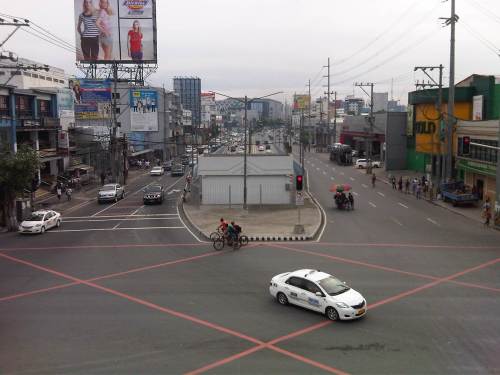 Pedestrians can no longer cross at-grade at the intersection of Quezon Avenue and Araneta Avenue. Note the vendor in the photo (with umbrella) crossing counter-flow with his pedicab full of plastic merchandise. The cyclists in the photo are risking their lives and limbs in crossing the intersection. Fortunately for them, there seems to be no traffic enforcers around to apprehend them. The “yellow box” has been replaced by a “red box” in many intersections including this one.
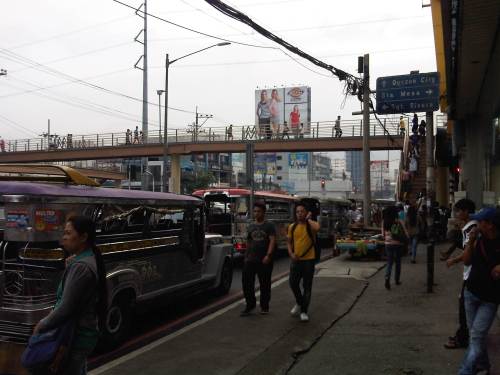 The pedestrian overpass at Quezon Ave.-Araneta Ave. as seen from the sidewalk along the Q.C.-bound side of Quezon Ave. The sidewalks are often obstructed by vendors but fortunately the overpass itself is not clogged by vendors unlike other overpasses.
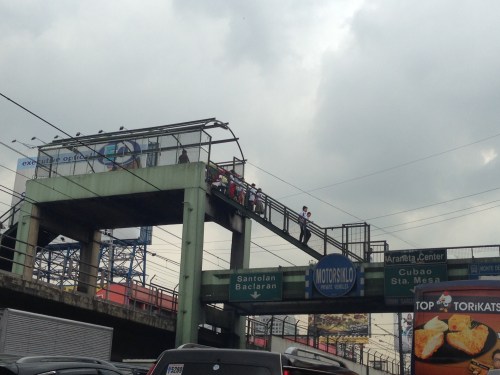 This overpass along EDSA is the outcome of pedestrian crossings being only an afterthought (some would say aftermath) of the EDSA MRT design. It is an example of the “pwede na yan” (this will do) attitude of many engineers and architects when it comes to transport systems.
All of the above examples are found in Quezon City. That city is among the most wealthy cities in the country and there have been a lot of transport-related developments in the past few years that are more people oriented. These include the construction of sidewalks, overpasses and underpasses outside those typically under the MMDA. However, there are still a lot to build and may I say correct in order to promote walking and other non-motorized transport in the city. Quezon City and other cities can be walkable cities and walkability should not be limited to CBDs that are often (and again) passed on to the private sector for development. LGUs should not be too dependent on what the private sector can offer in terms of infrastructure for walking and cycling. There are not many responsible private companies out there who would commit resources towards walkable and cycling-friendly developments. Often they are tempted to maximize space for buildings, even sacrificing space for parking and motor vehicles, and ultimately at the expense of the general public. This is where LGUs, and not even national government, comes in to put things into order. However, the caveat here is that LGUs should have a plan to guide them in development and again, there are few LGUs that have this capability and capacity to plan and implement such plans. And here is where national agencies like the DOTC and the DPWH can provide help to LGUs given their resources and expertise.
–
PNR Espana
While inspecting the installation of flood sensors along Espana a few weeks ago, I wandered off our site between Antipolo and San Diego Sts. to take a few photos of the PNR trains and the PNR Espana Station surroundings.
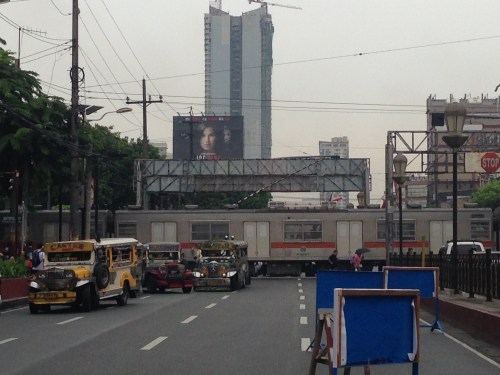 A PNR train crosses Espana as road vehicles and pedestrians pause to let the train through. One barrier is shown in the photo as not being able to go down completely to block traffic from the other side of Espana.
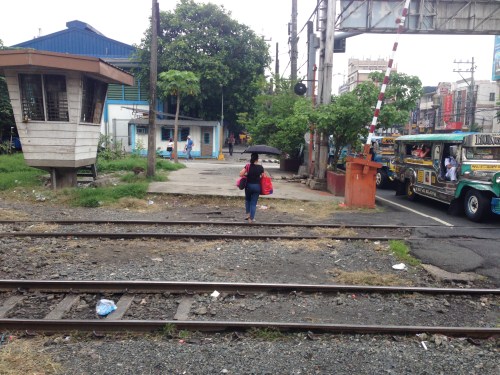 A pedestrian crosses the PNR tracks as vehicles run along Espana
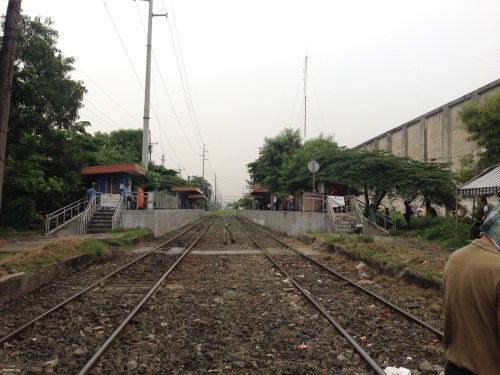 The PNR Espana Station as seen from along Espana. People usually cross the tracks casually as there are few trains in operation along this line.
–
More nuts on the road and a simple solution for traffic congestion
I have written recently about reckless drivers including one that drove as he was “busy” with his girlfriend in the car. The latter, however, is more an exceptional case rather than one you’d commonly find in our roads. Perhaps the most annoying behaviour by what I term as “nuts” on the road, is counter-flowing. Counter-flowing often happens along undivided roads (no median islands or barriers to split opposing traffic). Traveling home one afternoon, we took the bridge from C5 and the Marikina Riverbanks Road to Santolan, Pasig.
 I think we all thought that the driver of this Honda Civic was bold enough to have been able to cover a long distance before opposing traffic collectively forced the driver to back off.
While counter-flowing is dangerous and obviously a traffic violation, there seems to be few if any apprehensions regarding this behaviour. Such non-enforcement of traffic rules and regulations lead to more drivers and riders to be encouraged to counter-flow just so they could get ahead of all the others before them who did follow traffic rules by queuing properly. For one, there are issues of police or enforcer visibility in many areas, and when they are visible they are usually busy managing traffic at intersections and or watching out for number coding violations rather than enforcing all the other traffic rules and regulations that can be more or equally important than number coding violations in terms of their impacts on traffic. One such violation is counter-flowing that often leads to severe traffic congestion as counter-flowing vehicle block opposing traffic and force their way in front of queued vehicles. I think this has caused a lot more problems, congestion and safety-wise than number coding violations, and deserve to get more attention from traffic enforcers and managers looking for solutions to the traffic mess we encounter everyday.
–
How to get rid of traffic jams using intelligent transport
I came across a few more online articles recently and this time one article featured mostly intelligent transport systems (ITS). ITS has been around for quite some time now and the big difference between now and a couple of decades ago is the cost for these systems. I would not delve into the details of ITS, and leave it up to the reader to perhaps google about this and all the different types of ITS.
The article “Here’s How to Get Rid of Traffic Jams” presents the various systems that have been implemented in other countries. Some have been implemented one way or the other in some parts of the Philippines, particularly the coordination of traffic signals (Manila, Cebu, Davao) but most have not even been attempted so there’s a lot of room for the improvement especially where congestion is becoming more serious and unmanageable due in part to limitations among agencies and the people themselves who are involved in transport and traffic management.
It also refers to a study on traffic congestion that was conducted for Los Angeles, CA. Reading through the document I couldn’t help but note that much of what LA has experienced and is still experiencing describes what we also try to deal with in Metro Manila and other major Philippine cities. Be sure to browse for the full document and not just the summary for the study. There are also a lot more materials on transport that you can find this website so be sure to bookmark Rand’s website.
–
Some thoughts on transport safety and security
There is an Office of Transport Security (OTS) under the Department of Transportation and Communications (DOTC). Under its mandate is coming up with plans and programs in order to ensure safe and secure travel for all. Security here is most often associated with the prevention of crime and the control of criminal elements in how they could affect transport (i.e., terrorists, robbers, etc.). I believe that this interpretation extends to safe driving as well since reckless driving is practically a criminal act especially when we realize the potential for fatal crashes due to these behaviors by drivers and riders. Unfortunately, the OTS like many agencies under the DOTC have a lack of personnel to be truly effective in carrying out their mandate.
I think passengers should be more proactive in ensuring their rides will be safe and secure. They should be in a position to pressure the driver to be more careful and responsible with the operation of the vehicle. However, there will always be apprehensions on the part of any passenger who might be thinking about the backlash or negative reactions they would get from the driver, conductor or even fellow passengers. Ironically, its the reactions from the latter that could turn something proactive to an embarrassing or humiliating experience. I recall one time a friend was conducting a survey on bus operations and one driver commented that passengers get angry with them when they slow down, saying the reason they rode buses of this particular company was because they drove very fast. Such thinking betrays their ignorance and disregard for safety – until, of course, they happen to be involved in a crash!
And so perhaps the OTS and other responsible agencies could enlist the help of other government personnel who would have the training required for authority figures on security and safety. For example, there are many of our servicemen in the armed forces and the police who take public transportation or who provide transport services by being operators or drivers (to augment their incomes with the AFP or PNP). Those who are passengers should assert themselves in the service of other passengers by accosting reckless drivers and reminding the latter of their responsibilities as service providers and the penalties for irresponsible driving. Servicemen can be formally (and legally) granted this authority by the LTO and/or LTFRB, which do not have the personnel to police the thousands of public utility vehicles around the country.
–
Innovations for cycling and walking
I usually browse the net for the wealth of information now readily available on transport facility designs that are pedestrian and/or cycling friendly. In the Philippines, there has been an increased awareness lately for people-oriented systems encouraging cycling and walking. These have extended to calls for more bikeways and walkways to enhance mobility, with several projects being implemented to further the advocacies for non-motorised transport (NMT). Of course, there are already existing examples of both good and bad practices around the country including ideal and undesirable cases in Marikina City, which is the first (and only?) city in the Philippines to have a comprehensive network of bikeways.
Recently, I found this article entitled “Urban Innovations That Could Turn Your City Into a Bicycling Paradise” on one of my favourite websites io9.com. It contains some of the more prominent examples of bicycle and pedestrian-friendly designs that have been implemented elsewhere that we could probably take note of as good practice references when we do plan and design similar facilities in our cities. I’m sure there are many people out there, and not just architects or engineers, who would have good ideas for people-friendly infrastructure design. We need to encourage them to come out and propose these ideas that can be adapted into sound design according to architectural and engineering principles (i.e., the designs would still have to follow standards or guidelines, e.g., seismic, wind, etc. in order for these to be safe for use and last long.
Government agencies especially the DPWH and local government units should be open to new ideas or innovative designs to help transform our transport system to become more people-oriented than vehicle-oriented. There should be initiatives from within these agencies to come up with innovative designs while keeping the details up to standards or following established guidelines. So far, there have been no notable push for updating road designs, for example, despite road safety assessment findings and recommendations that should resonate more within agencies and LGUs if they are not comfortable dealing with NGOs or civil society groups advocating for people-friendly infrastructure.
I believe government engineers are competent and have the talent to come up with innovative designs and guidelines but there is a lack of incentive for them to do so and to think out of the box. The bottom-line is still to create an enabling environment for such design ideas to come out and be implemented. Perhaps the academe could lend a hand here with their strong linkages with government planners, architects and engineers. The schools could provide the environment for encouraging new thinking in as far as transport infra is concerned and the leading universities would have the resources that can be harnessed towards innovative designs.
–
Walking vs. cycling?
I remember an episode in an old series, The West Wing, where White House staff had to meet with various proponents of renewable energy. The very same proponents advocated for the RE they thought should get the most attention, and therefore funding support from the government. They ended up criticising each other’s advocacies, even pointing to the flaws of each and basically putting each other’s proposals down. The POTUS (ably played by Martin Sheen) had to intervene and scolded these people for working against each other rather than working together to push a common RE agenda.
This is pretty much where we are now with many proponents of sustainable transport initiatives. People and certain groups would advocate for walking, cycling, BRT, rail transit, etc. as if these are exclusive from one another. The results have often been haphazard facilities such as entire pedestrian facilities being painted and designated as bikeways and regular bus services being mislabeled as BRT. I have some friends who insist that cycling is the way to go simply because they cycle between their homes and workplaces, not fully understanding that this mode is not for everyone especially with the various issues in urban sprawl affecting our choices of residence. Clearly, what is good for one person is not necessarily applicable to everyone else, and that is why we should have options for travel or commuting. These options would have to be integrated, complementary, affordable and people and environment-friendly.
 The MMDA fenced off entire stretches of sidewalks and painted the pavement red to designate them as bikeways. This basically alienates pedestrians and while the wire mesh fence has its benefits from the perspective of safety, it also effectively constricts the space that cyclists and pedestrians have to share. Note also the trees and poles that pedestrians and cyclists would have to evade or risk injury.
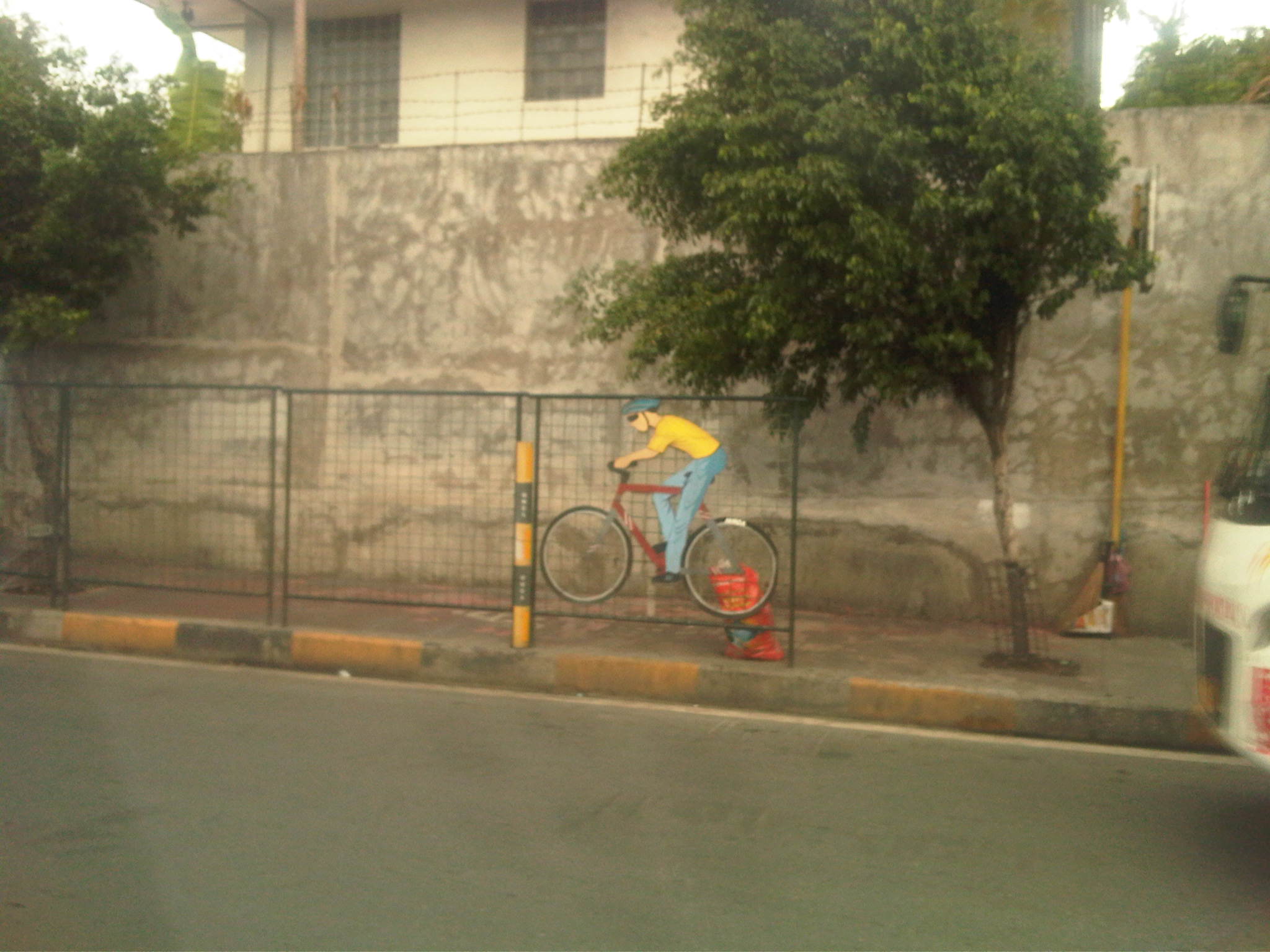 Along EDSA, the same treatment of fences and coloured pavements was applied ahead of Temple Drive/Corinthian Gardens. The space is just too constrained for sharing given the trees and poles and then you have the smoke belching buses adding to the misery of people using these facilities.
While there have been some quick wins for pedestrians and cyclists, it seems to me that many if not all do not seem to be as sustainable as we want them to be. Many cases are classic for their being “pwede na yan.” There is no innovation in design or no design involved at all much like what we typically see as best or good practices abroad. Marikina still has the best examples so far for integrated bikeway and walkway design though there are many examples of good pedestrian facilities around including those in Makati and Bonifacio Global City (I tend to resist saying Taguig because that city practically has no say in how BGC is developed.). Quezon City (along Commonwealth) had a little promise and the UP Diliman campus but perhaps that can be realised with the rise of a new CBD in the North Triangle area. Of course, we look forward to developments in Iloilo City what with the bikeways being constructed along the long Diversion Road. Still, I believe that there should be a conscious effort not just from the private sector but from government agencies, especially the DPWH, to come up with new designs and guidelines that LGUs could refer to. That agency so far has not measured up to the expectations of many for it to take a lead in revitalising our roads so that facilities can be truly inclusive and environment-friendly.
–
Sunday smog
We were staying at a hotel over the weekend and our room afforded us a good view of the cityscape to the left and seascape to the right. We weren’t able to get a good view of the sunset as we were practically facing south-east and the orientation of the window prevented any, even slight view of what is always a nice Manila Bay sunset. We did expect to see the sunrise the following morning.
As the sun came up, we took this photo of the cityscape. Closer to us were buildings in Pasay City while those farther away were buildings in Bonifacio Global City. I remembered reading somewhere that what makes our sunsets so colourful or spectacular are the elements in our atmosphere. Air pollution tends to bring the most dramatic colors for sunsets and I believe that’s in a way also applicable to sunrises. I took a snapshot of the cityscape from our hotel window expecting the worst for what could be the equivalent of an exposed negative in the old days. Instead, I got the pretty decent photo below showing the sunlight reflecting off the haze around Metro Manila and giving the cityscape that eerie look on a Sunday morning.

There’s a joke that is often recycled concerning air pollution and air quality. According to this joke, the Philippines doesn’t need to worry about air pollution since every year it is visited by many typhoons. These typhoons passing through the country sweep away the pollution thereby making the air around us cleaner. This is actually true and one need only to get outdoors after a typhoon to smell the fresh air. Of course, it doesn’t take long before the smog returns and therein lies the punchline to the real joke. At the rate we are going in terms of vehicle emissions alone, we would probably need at least a typhoon every week for the entire year if we wanted clean air to breathe. The dry seasons would probably be the worst in terms of poor air quality. And so we must see that the joke is on us and air quality will only continue to deteriorate if we do not act now and do not pitch in for the fight for clean air.
–
Nuts behind the wheel
Last night as we were on our way home, we noticed a vehicle in front of us swerving left and right as if the driver . We were in heavy traffic and vehicles from the adjacent lane were already falling back in order to avoid this vehicle. Even with the tint on the vehicle’s rear window, we could see the driver frequently leaning over the passenger side. At first, we would have dismissed this as the driver likely just taking care of the passenger (i.e., a parent perhaps checking on his/her child). However, closer inspection revealed what appeared to be a male driver leaning over to kiss what was likely a girl in the passenger seat. This went on for quite some time as we crossed the bridge along Marcos Highway and at full stop, we could see how busy the guy seemed to be with his display of affection. And so to get the driver back to focusing on his driving, we decided to give them a rap of the horn and flashed the high beam to their attention. The car swerved quickly to the right and sped off in what seemed to be a manoeuvre of embarrassment (We do hope he was embarrassed enough to focus on the road and driving, and not on “enjoying” his passenger. The road is not the place for such actions as they endanger other road users.
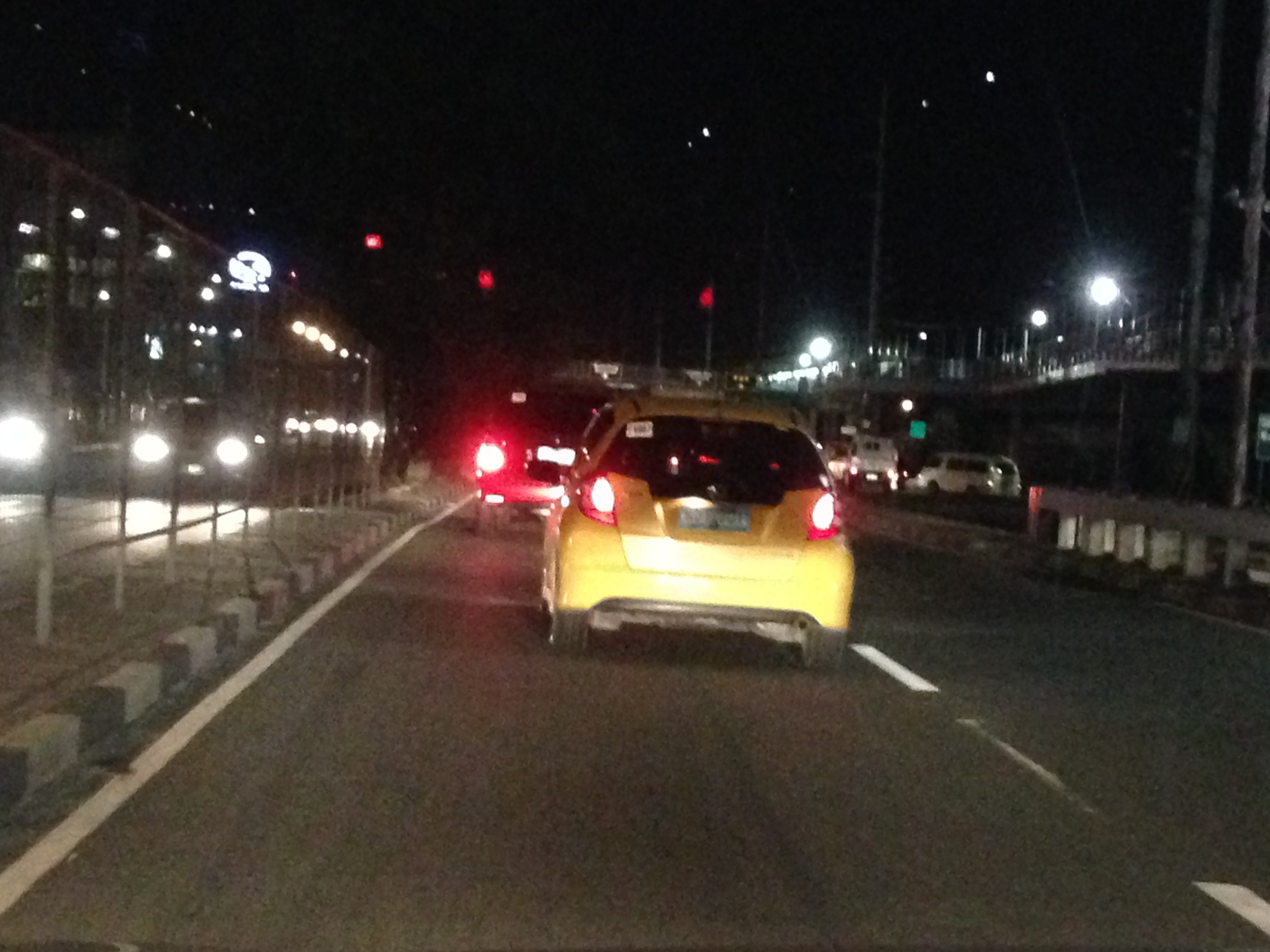 Yellow Honda Jazz with plate number NUT 801 was zigzagging along the road and there was no one to apprehend such drivers despite cameras supposedly installed along this road to monitor traffic.
This is a reminder to us that what’s wrong with a vehicle might be the one sitting behind the steering wheel – it’s driver. Drivers and other road users should always think about other people around them. Their behaviour and interactions along the road will determine how safe our roads would be for all users. This is practically the same principles regarding drunk driving or sleepy drivers whose behaviours under the influence or due to drowsiness could result in fatal crashes. These crashes and the resulting injuries and/or loss of lives are preventable with proper driving, riding and even pedestrian behaviour and is something each road user also has a responsibility to promote, even if it means simply getting the attention of another driver for him to drive more responsibly.
–
 Caught (up) in traffic