
Video games for aspiring planners?
I saw this article on what are supposed to be the best video games for would-be or aspiring planners. To put this into the proper context, these are mostly newer games (or so I think considering certain games evolve over the years from the time they were first released).
Smith, A.N. (December 23, 2022) “These are the best video games for wannabe urban planners,” Bloomberg CityLab, https://www.bloomberg.com/news/articles/2022-12-23/these-are-the-best-city-builder-video-games-of-2022
When I was younger, the games to play were SimCity and Civilization. These have also evolved, and I think SimCity and Cities: Skylines (a game introduced to me by one of my students) might be the better ones for aspiring planners. You can test many concepts on these games such as transit oriented development (TOD), compact cities, etc. Of course, one can also play with actual planning and simulation software. If one has access to the transport model for Metro Manila, for example, you can test scenarios on this to see how the model will ‘react’ to various conditions or situations.
–
Another definition of the 15-minute city
We begin 2023 with an informative article defining the “15-minute city”. This is actually an entry in Planetizen’s Planopedia, which contains definitions of fundamental concepts in urban planning:
Ionescu, D. (December 2022) “What is a 15-minute City?” Planetizen, https://www.planetizen.com/definition/15-minute-city?utm_source=newswire&utm_medium=email&utm_campaign=news-12292022&mc_cid=ee083e2ee7&mc_eid=9ccfe464b1 [Last accessed: 1/1/2023]
I’ve written and shared articles about this concept before. Here are a couple from 2021 where I offered my opinions about the concept as already applied in the Philippines:
Didn’t we already have 15-minute cities and towns in the Philippines?
–
Examples of legislative actions in support of active transport
While the Philippine government and various local government units seem to be reneging on their commitments to support active transport, other countries have been building on their gains during the pandemic. Here are examples of legislations in New York State that will support active transport through funding of complete streets projects and institutional arrangements for representation of transit dependent individual:
The article is about two legislations:
Legislation (S.3897/A.8936-A) Provides Funding for “Complete Streets” Projects Inclusive of a Holistic Approach to Street Design
Legislation (S.3959-B/A.7822-C) Adds Board Seats to NFTA, RGRTA, CDTA, and Central New York Regional Airport Authority Dedicated to a Transit Dependent Individual
We hope to see something like these at least at the local level. Perhaps if LGUs are able to legislate and implement these, there will be more good practice examples that will compel national government to support active transport development. The latter is actually ironic considering that many plans are supposed to spell out the national government’s commitment to active transport. There are still live memorandum orders and department orders supporting and promoting active transport. Are these also being waylaid? That will be tragic for transportation if we didn’t learn or gain anything from the experiences during this pandemic.
–
On electric vehicles and road safety
Electric vehicles are still basically motorized vehicles and should be treated so on the roads. While the previous models were slow and small, many of the newer ones coming out of the factories have similar performance features (e.g., speed, power, etc.) and dimensions as conventional vehicles. Many conventional models have electric or hybrid variants as companies attempt to attract customers using their tried and tested models and brands. BMW, for example, has electric sedans that are practically the same in interiors and exteriors with their conventional models. It is not surprising that vehicle safety researchers are now studying how electric vehicles fit into the road safety conundrum. I am sharing this brief but informative article that describes the efforts of the Insurance Institute for Highway Safety (IIHS) of the US in studying the EVs and safety:
Tucker, S. (December 27, 2022) “How electric cars are creating new challenges in car safety,” MarketWatch, https://www.marketwatch.com/story/how-electric-cars-are-creating-new-challenges-in-car-safety-11671646057?mod=technology [Last accessed: 12/29/2022]
To quote from the article:
“It’s comforting to know that EVs will face the same tests as gas-powered cars. But the fact that the IIHS worried it might need to build new equipment to accommodate them illustrates something important.
At the rate the auto industry is modernizing toward EVs, almost all of us will be driving them someday. But there will inevitably be an overlap period when some cars on the road are electric, and others are gas-powered.
In an accident, weight matters…
Crash tests can only estimate the likelihood of injury to someone inside the tested car. They can’t predict injuries in the other car. And we’re all about to share the roads with other cars that dramatically outweigh ours.”
–
On the coordination of traffic signals
I took a couple of photos while we were traveling along Espana Boulevard. I wanted new photos of the traffic signals along Espana to use as visuals for my examples whenever I discuss traffic signals and their coordination or synchronization in my lectures.
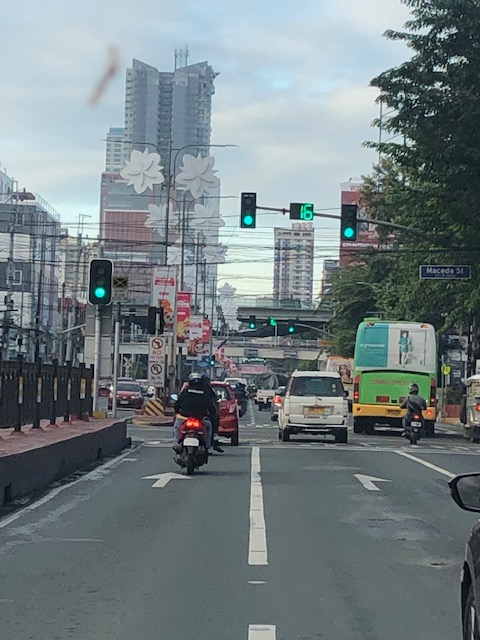 Green signal for traffic. If the traveler is able to travel at the optimum speed, one will be able to catch the green light at so many intersections along Espana. The road is the major thoroughfare in the area and traffic along it is prioritized over those from the side roads to maximize the throughput along Espana.
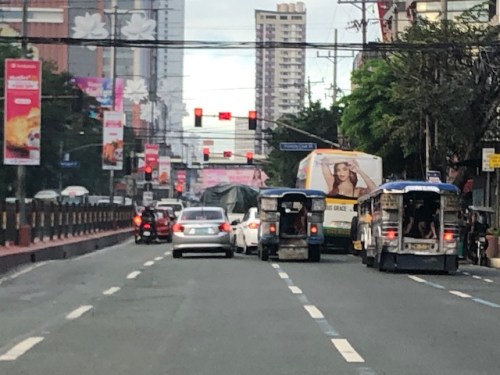 If one catches a red light at one intersection, it is possible that the traveler will catch a red light in the next intersection(s).
–
On the Robinsons Antipolo Transport Terminal – again
I took the following photos of the transport terminal at Robinsons Antipolo last December 24. I have shared photos at the ground level and mostly close-ups of the buses, vans and tricycles that operate to and from the terminal. I was at the toy shop last Saturday for a last minute purchase and saw a nice vantage point to show the expanse of the terminal.
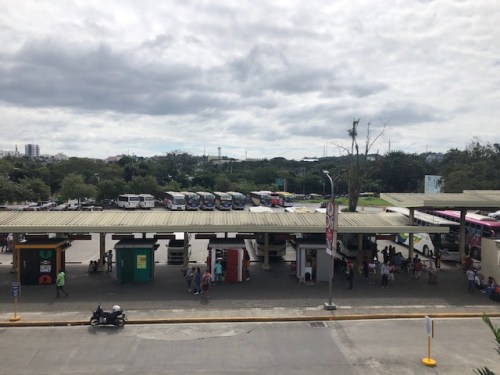 Bus ports and garage (in the distance)
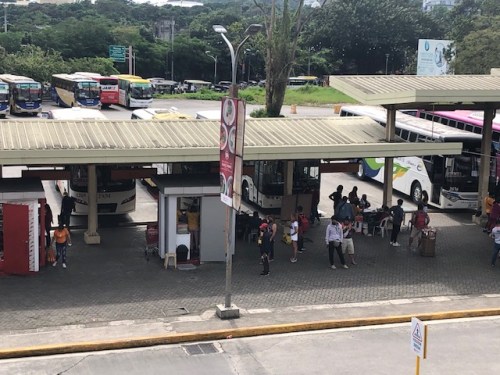 There are regular trips here between Antipolo and Cubao (aircon buses), Antipolo and Ortigas Center (P2P buses), and Antipolo and other provinces (Quezon, Bicol, Samar, Leyte and Bohol).
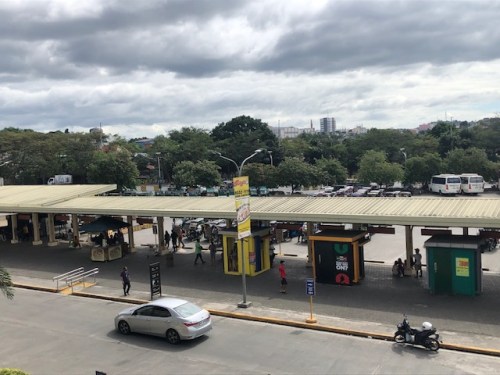 People can transfer to modern Jeepneys (actually mini buses) that ply the Antipolo-Marikina route or perhaps take a tricycle (conventional or electric) to their final destinations.
–
On the future of bike lanes in Metro Manila and other cities and municipalities in the Philippines
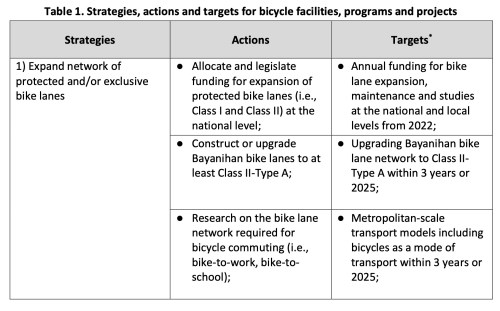
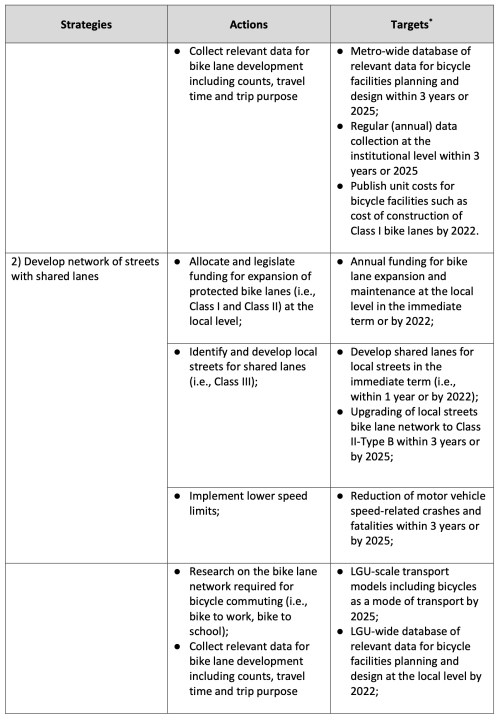
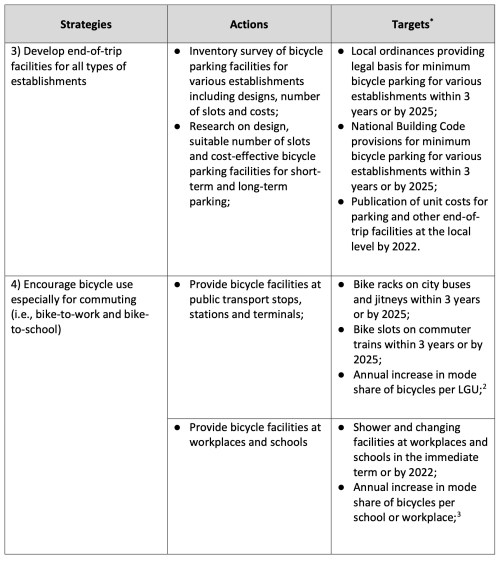
My friends and I were talking about the current buzz about the bike lanes including statements made by certain personalities (influencers, advocates, government officials, etc.) about biking and bike lanes. There were many recent pronouncements of motorcycles being allowed to use bike lanes or the outright removal of bike lanes. We all agreed this was backward and the way forward is to build on the current network and facilities. What we have in our cities and municipalities are not perfect and far from ideal but they are a start and perhaps the foundation for a bikeway network that can eventually make a dent on the car-centric transportation we have.
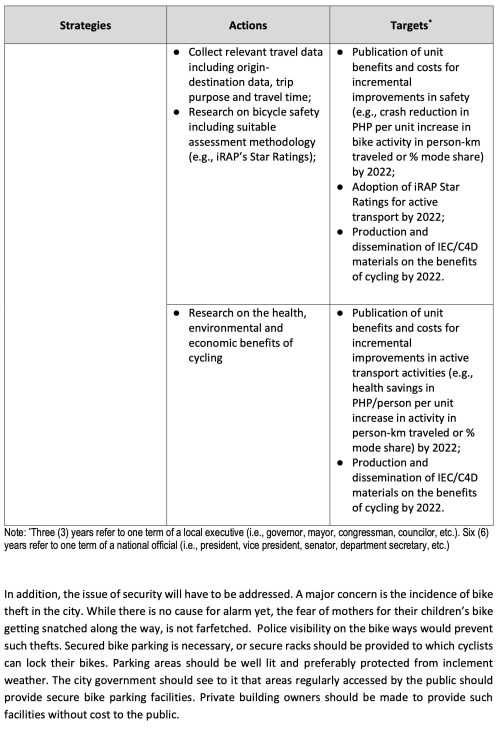
I share below the strategies, actions and targets for bicycle facilities, programs and projects from the Network Planning for the Establishment of Bike Lanes in Metro Manila, Metro Cebu and Metro Davao that was completed middle of 2022. The project is DOTr’s with support from the UNDP. The table is from the Final Report of the project.
A Happy Christmas to all!
–
Shared article: Active and Micro Mobility Modes Can Provide Cost-Effective Emission Reductions–If We Let Them
I’m sharing this article on active and micro mobility modes from Todd Litman, published in Planetizen.com:
Source: Active and Micro Mobility Modes Can Provide Cost-Effective Emission Reductions–If We Let Them
From the article:
“Common Active Transportation Leverage Effects:
–Shorter trips. Shorter active trips often substitutes for longer motorized trips, such as when people choose a local store rather than driving to more distant shops.
–Reduced chauffeuring. Better walking and bicycling conditions reduces the need to chauffeur non-drivers (special trips to transport a passenger). These often require empty backhauls (miles driven with no passenger). As a result, each mile of avoided chauffeuring often reduces two vehicle-miles.
-Increased public transit travel. Since most transit trips include walking and bicycling links, improving these modes supports public transit travel and transit-oriented development.
-Vehicle ownership reductions. Active mode improvements allow some households to reduce their vehicle ownership, which reduces vehicle trip generation, and therefore total vehicle-miles.
-Lower traffic speeds. Active travel improvements often involve traffic speed reductions. This makes non-auto travel more time-competitive with driving and reduces total automobile travel.
-More compact development. Walking and bicycling support more compact, multimodal communities by reducing the amount of land devoted to roadways and parking, and creating more attractive streets.
-Social norms. As active travel increases, these modes become more socially acceptable.
The article is a must read if we are to understand how important active transport and micro mobilities are in the context of today’s transport conundrum. Of course, part of the contextualization and perhaps ‘localization’ on these modes will be related to land use or development. The latter is a big challenge especially for the likes of Metro Manila and other rapidly developing cities in the Philippines where housing in the cities (related to compact development) has become quite expensive and has driven more and more people to live in the suburbs. As I’ve mentioned in previous posts, this has resulted in more pressure to develop transportation systems but infrastructure development cannot play the catch up game given the limited resources for their construction. Meanwhile, services are also behind in terms of quality and requires reforms and rationalizations.
–
On Metro Manila having one of the worst transit systems in the world
This is a follow-up to the previous post on the UC-Berkeley Study. Here is an example of how media featured the study outcomes:
https://www.facebook.com/CNNPhilippines/videos/1089453421728393
I didn’t see whether there was a response from government. These studies end up as features and nothing more if these do not prompt or push authorities to act on the problem. Even experts from academe or industry are reduced to being commentators or even pundits providing context, assessments and opinions, even recommendations that are perceived to fall on deaf ears. Perhaps government is already desensitized about these issues and will just trudge along at its own pace? In the end, it is the commuters mostly taking public transportation who continue to suffer and lose productive time to their daily travels.
–
On the best public transit systems in the world
Manila’s poor ranking in recent study conducted by the University of California Berkeley’s Institute of Transportation Studies with think tank Oliver Wynam on public transit systems caught the attention of a lot of people. Media was quick to feature this in the news and I am aware of at least GMA and CNN Philippines doing features of this in their news programs. Here is the article on the same that mentions the UC Berkeley ITS study:
Pollard, A. (November 21, 2022 ) “These Cities Have the Best Public Transit Systems,” Bloomberg CityLab, https://www.bloomberg.com/news/articles/2022-11-21/these-cities-have-the-best-public-transit-systems [Last accessed: 12/11/2022]
Manila, or Metro Manila to be exact, placed only 56th in public transit while ranking 48th in sustainable mobility and 58th in urban mobility readiness. I leave it to the readers to go read the UC Berkeley report rather than depending on media or social med influencers for their takes on the ranking. The report can be downloaded from the link I provided above.
Perhaps there should be an assessment of cities (at least the highly urbanized ones) in the Philippines to see how they are ranked. There should be a criteria (UC Berkeley and Oliver Wynam used distance to public transit, affordability, operating hours, crowding and commute speeds among others in their study) to be agreed upon where experts can score cities using a simple-enough scale, say 1 to 10 with 10 being the highest score. What are your top 5 Philippine cities in terms of public transportation?
–
 Caught (up) in traffic