
No vax, no ride – some insights and opinions
The Department of Transportation (DOTr) recently issued a memo stating unvaccinated people may not use public transportation in Metro Manila. People will have to show proof of vaccination (i.e., vaccination card) before he/she is allowed to board the bus, jeepney, van or train, which are all under the jurisdiction of the DOTr. I assume tricycles are not included here since these are under the local government units.
Certain groups quickly slammed the memo as being “anti-poor”. Note though that vaccinations are covered by government funds and are free. You only have to register and show-up for your shots. Given the period when vaccinations started, there should be few or no excuses for not being vaccinated at this time for most people (children under 11 years old are not yet being vaccinated as of this writing). In fact, many vaccination centers have already been giving booster shots from November 2021 and many have reportedly had fewer people getting vaccinated or boosters by December 2021. That changed when the current surge attributed mainly to the Omicron variant of Covid-19 led to a sudden influx of people at vaccination centers. Workplaces requiring their employees to be vaccinated also probably contributed to people being convinced they needed to get vaccinated. Otherwise, they could not earn a living.
A colleague explained that the modality of vaccinations requiring registrations online meant those without smart phones could only do walk-ins. While certain LGUs such as Cainta automatically registered their constituents, and particularly senior citizens, and posted vaccination schedules that covered everyone registered as their constituents, others especially larger LGUs might not have the capacity to do this simplification. Non-vaxxed people will also have to take some form of transport and not everyone will opt to bike or would have their own private vehicle.
Perhaps we should again look to science for an answer to the question whether this policy is good or bad. Ventilation or air circulation-wise, open air vehicles and without those plastic barriers present a better situation for lesser likelihoods of virus transmission among passengers. Many public transport vehicles though are closed, air-conditioned types. People are also obliged to wear masks (shields have been proved as ineffective and unnecessary) so everyone wearing masks should reduce the risk of transmission even with unvaccinated people (remember there was a time everybody when everybody was unvaccinated). Again the key word here is “reduce”. There is no guarantee that one will not get Covid even with excellent ventilation and mask use.
Implementation-wise, there are many challenges here including the additional delays to travel brought about by the vaccination card checks. If there are to be checkpoints, that’s another source of delay (and we already know how checkpoints can result in carmaggedon-level congestion). The even more recent DOTr pronouncement is their intention to deploy what they call “mystery passengers” seems amusing and inspired by similar people mingling in public to tell on people violating this and that law.
Meanwhile, here’s a question that’s easily answerable by “yes” or “no” but would likely elicit explanations or arguments for or against the idea: “Would you, assuming you’re vaccinated, be willing to take public transportation knowing that you will be riding a vehicle together with unvaccinated people?” I think the most common answer would be a “No”. Exceptional would be the “yes” reply if you consider the potential for spreading Covid-19 post-commute (by both the vaccinated and unvaccinated who are either asymptomatic or symptomatic).
As a parting note, a former student puts it quite bluntly in a social media post – “Smoking in public is banned precisely based on the science. Is smoking then anti-poor? And would you ride in public transport with people who are smoking while in the vehicles?” I think we also know the answer to this question without elaborating on the situation.
–
Placeholders and inheritors
[Notice to the reader: This post is not directly about transport or traffic.]
I like one post circulating in social media that is attributed to former Sen. Ramon Magsaysay, Jr. about the Vice President. I particularly like this part: “Did NOT choose to be a placeholder when her husband finished his term as Mayor in Naga.” If you do a scan of elected officials around the country, you can probably see how many if not most are held by political families. Even Marvel Comics recognizes this when they featured Filipino superheroes in an Iron Man series where the original team perished and was replaced by their children!
Placeholders are usually wives of politicians who have reached the maximum of their term limits. A mayor, for example, can only run for reelection twice for a total of 9 years continuously in power. After the nine years, he/she must step down to give way to a new mayor. Instead of honing someone competent from the other leaders in the local government (e.g., the vice mayor, a councilor, etc.). As they say, elective posts in the Philippines are family business and are often passed on to the next generation of what are termed as dynasties.
My most recent encounter with a “placeholder” was with the then Mayor of Tacloban City, Cristina Gonzales-Romualdez. She was on the second year of her term after she took over from her husband who was mayor for 3 terms (9 years). I must say that she had very competent staff and we thought they did their jobs well and for the benefit of many in Tacloban. And this was during the years immediately after the tragedy brought by Typhoon Yolanda (Ketsana).
Previous to that, we’ve also encountered or engaged with other local government units dominated by certain families. One town in Cebu even had the matriarch as mayor, the son as vice mayor and the uncles as councilors! The municipal hall had a portrait of the patriarch as a multiple term mayor in the recent past. You wonder if there were no other competent people in such towns and cities.
The next presidential elections will feature the son of a former dictator with the daughter of a current president as running mate. They are supported by other dynasties such those of two previous presidents including one who was been convicted of plunder but pardoned by his successor. He was allowed to run for president again despite the conviction as the Comelec failed to make a firm interpretation and stand vs. it. Now comes someone who believes he is entitled to the presidency despite also being convicted of tax evasion. While arguably a lighter crime, it is still a conviction and should mean he cannot run for the highest position in government. He’s also a fraud because he claims to have completed his education at a well known UK school when in truth he failed there. Would you trust a tax evader, fraud and one who does not admit guilt nor expresses regret or remorse for his family’s crimes with the presidency of the country? I certainly won’t and don’t!
–
What they are not saying about UTSMMA and Metro Manila’s first subway line
My social media feed is suddenly filled with shares of articles (the same PR text apparently) from the Department of Transportation, its Secretary and his fans and local rail aficionados about the progress of the Metro Manila Subway Project, which is dubbed as Metro Manila’s first subway line. While these posts start and appear as factual narratives, they are silent about certain facts that the writers conveniently did not include as part of their narrative. Perhaps it is because they are currently allied with the son of the dictator who decided vs. building what could have been the country’s first subway line and a game-changer for commuting in the metropolis.
UTSMMA or the Urban Transport Study in Manila Metropolitan Area was completed in 1973 and was immediately followed by a Feasibility Study on the Manila Rapid Transit Rail Line No. 1 that was completed in 1976. Here’s a nice render of a subway station platform from that FS:

Two things that need to be said:
- Marcos decided against the subway line in favor of LRT Line 1 after being heavily influenced by a World Bank report and the succeeding MMETROPLAN (funded by the WB). It is also said that he wanted to have the bragging rights to the first mass transit line in Southeast Asia but Singapore’s first MRT line would finish ahead of Metro Manila’s if the Philippines pursued the subway. The latter was a late and fateful decision because commitment to the RTR Line 1 could have been made earlier and construction could have started ahead of Singapore’s (and likely finished ahead if there were no major delays).
- The corruption during the Marcos dictatorship led to succeeding administrations including the current being saddled by debt and unable to put up major transportation infrastructure such as a subway line for decades (this is already well documented so denial or refusal to understand is the burden of the denier – no logic or fact can can probably change such people’s views or beliefs) without piling up more debt.
That said, I would caution vs. delaying the subway project any further. It is already almost 40 years since a subway was due and though the alignment is totally different from what was planned in the 1970s, there’s potential here to revolutionize how people will commute in Metro Manila. It will only become more expensive to build in the future.
–
Article on people-oriented traffic management
Here’s a quick share on a topic that is also very relevant especially for local government units – traffic management. To quote from the article:
“Today, when the mobility of Filipinos is severely constrained by limited public transport capacity, …and when there is heightened pressure for private vehicle use, there is no better time to re-orient traffic management in the Philippines in order to prioritize inclusive, efficient and environmentally sustainable travel modes. The crucial ingredient is not infrastructure but political will.”
Siy, R.Y. (January 8, 2022) “People oriented traffic management,” Mobility Matters, The Manila Times, https://www.manilatimes.net/2022/01/08/business/top-business/people-oriented-traffic-management/1828593 [Last accessed: 1/8/2022]
The article makes perfect sense as traffic management in the country has always been car-oriented including the strategies, policies, schemes, measures and others that have focused on facilitating private car travel over active and public transport modes. The challenge here is how to bring this up front and an election issue at both national and local levels.
–
Another goodbye jumbo?
With the phaseout of the Boeing 747, there was much expectation for what was supposed to be its successor in the Airbus A380. The latter was hailed as the worthy successor to what was probably the most popular and versatile plane in the B747. Unfortunately, after so many orders for the A380 were delivered and the plane being deployed by major airlines along the long-haul routes, it is now being reconsidered. Here’s a nice article on what is perceived as the decline of such supersized aircraft.
Alexander, K (October 22, 2021) “3 Reasons Behind the Premature Demise of the Airbus A380,” Medium, https://kevinaalexander.medium.com/analyzing-the-premature-demise-of-the-airbus-a380-c56d50ec827d [Last accessed: 1/5/2022]

–
Some thoughts on mobility in Metro Manila
I spotted these two riding what appears as monocycles in Bonifacio Global City (BGC). I was taking a walk between our our building to get to another when I saw them crossing the intersection ahead of me.
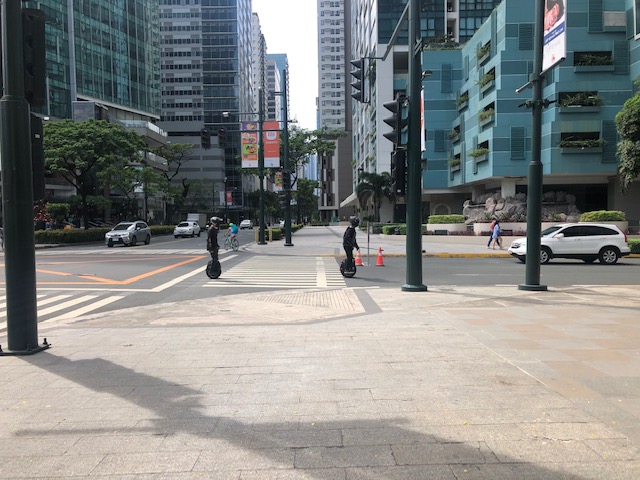
I thought these were cool modes of transport but I am unsure I can balance myself on these. I would more likely use a bicycle like the other guy in the photo (far side of the intersection crossing). I would also most likely use a bike on the sidewalk if this were allowed and also considering how wide the sidewalks there are. BGC also has protected bike lanes along certain roads so that’s another option if its prohibited to use your bike on sidewalks.
I keep mentioning sidewalks and how wide they are (at least in the photo) because we do need wide sidewalks that we can use for walking or cycling (basically moving about). It is always mentioned in various threads that we should plan and build our cities for the most vulnerable among us. That means a shift from the current car-centric set-up to a more people-oriented system. The latter requires more infrastructure for walking and cycling that includes wide sidewalks and protected bike lanes and paths. This also means more effort and resources will be required to improve public transport services since these have the most synergy and impact.
–
On transport equity
To start the year 2022, I’m sharing another article by Todd Litman. I thought this was a timely one as this is basically about transport equity and the results despite competent planners and perhaps good intentions.
Litman, T. (December 21, 2022) “Good Planners: Bad Outcomes. How Structural Biases Can Lead to Unfair and Inefficient Results,” Planetizen, https://www.planetizen.com/blogs/115621-good-planners-bad-outcomes-how-structural-biases-can-lead-unfair-and-inefficient?utm_source=newswire&utm_medium=email&utm_campaign=news-12232021&mc_cid=35d4ce69aa&mc_eid=9ccfe464b1 [Last accessed: 12/27/2021]
There should be similar studies for the Philippine case. We need to understand and correct bad practices including those related to an over-reliance to what is referred to as “old school” practices (i.e., “nakasanayan na”, “ginagawa na noon pa”, and so on), which is what young engineers and planners are taught by the “old boys” in certain agencies as an initiation of sorts if not part of their ‘continuous orientation’ at these offices.
–
Cities and Automobile Dependence: What Have We Learned?
We end the year with an article from Todd Litman via Planetizen. The topic is something that we really need to ponder on as we or if we are to move towards more sustainable transportation for our cities and municipalities. The experiences during this Covid-19 pandemic should have provided us glimpses of how it could be if we put active and public transport above automobile dependence or car-centricity.
Source: Cities and Automobile Dependence: What Have We Learned?
The main article may be found here (in proper citation for academic/researchers reading this):
–
On parking minimums again
A recent development on parking minimums is about Toronto removing these for new residential developments:
Davis, E.N. (December 16, 2021) “Toronto Removes Parking Minimums for New Residential Developments,” Storeys, https://storeys.com/toronto-removes-parking-minimums-residential-developments/ [Last accessed: 12/23/2021]
Indeed, the building code and local government provisions for minimum numbers of parking spaces for various buildings translate into more expensive units for prospective residents or lessees. Perhaps someone should be collecting and analyzing the data on buildings such as high-rise residential and commercial developments? This is to have the numbers for an objective and factual discussion about parking minimums for these types of development. Here is an excerpt from the National Building Code showing examples of minimum parking requirements for residential buildings:
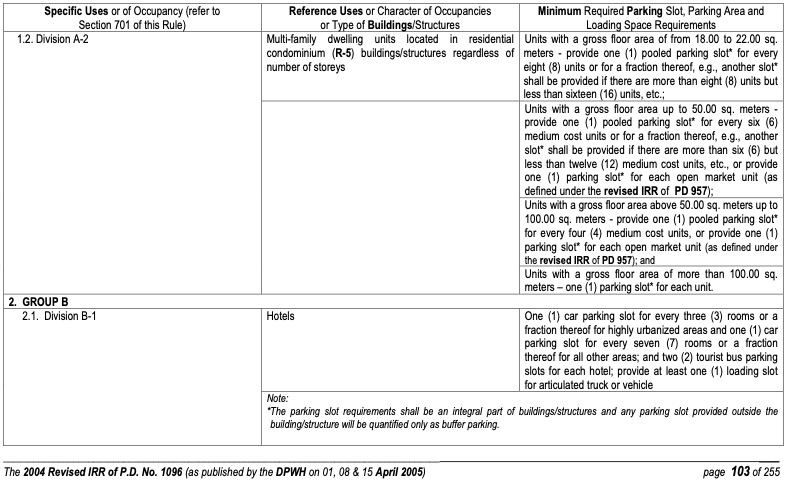
How many parking spaces are actually bought or leased/rented among the hundreds usually provided in buildings, to comply with building code and local government requirements? What is the ratio of parking slots per unit? Where are the trip-ends for these developments (especially for residential buildings)? The answers to these questions may help us understand the situation and formulate revisions to building code as well as local government requirements for the minimum number of parking spaces.
–
The case for bike lanes
There is a strong push for more bike lanes to be developed along both major and minor roads. Many pop-up bike lanes that were implemented and permanent bike lanes constructed in 2020, mostly during the lockdowns, to address the needs of ‘frontliners’ who opted to bike to work have been retained and even upgraded to adhere to guidelines issued by the DPWH. While these bike lanes are not yet as comprehensive as desired and most are not the protected types, recent developments have threatened their existence and consequently the safety of cyclists (especially bike-to-work) and the promotion of cycling as a primary mode of transport.

We need to transform our streets where it is possible in order to take advantage of the increasing popularity of cycling that has convinced some people to select cycling at least for their last mile trips and hopefully for the most part(s) of their commute. From a transport planning perspective, we should also determine if these mode shifts can be sustained and perhaps increased with proper integration of public transport and active transport thrusts.
The recent removal of protected bike lanes or barriers that serve to protect cyclists using the lanes in some cities are examples of regression rather than progression. These come as a surprise as these cities have made leaps and bounds so to speak in developing their bike lane networks. Where did the orders to do so originate and are staffs of these cities communicating, discussing and coordinating these actions? Apparently, there are internal conflicts and perhaps, I dare say here, politics involved. It is also possible that within LGUs, the concepts, visions and plans for transportation are not harmonized or understood making one project by one clique unacceptable to another or others. I know from personal experiences that LGU traffic engineering & management and operations staff are often not in synch with their planning counterparts. This is not and should not be a given since both need to collaborate in order to address transport and traffic issues that need more comprehensive and progressive approaches compared to what have been practiced before.
LGUs cannot rely on strategies and tactics that are along the lines of “ganito na ginagawa noon pa” or “ganito na inabutan ko”, which only proves these were ineffective (i.e., why not try other techniques, methods or strategies instead?). Transformations and paradigm changes to solve transport problems cannot be achieved by denying the change, innovation or new ideas required for emerging as well as persistent issues/problems.
–
 Caught (up) in traffic