
Another look at the Francisco Bangoy (Davao) International Airport – Departure Part 2
This is the last part of the feature on the Davao International Airport. Here are the last batch of photos I took of the airport departure areas.
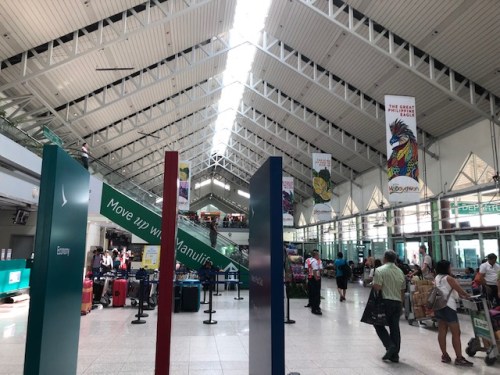 Spacious departure level containing the airline check-in counters
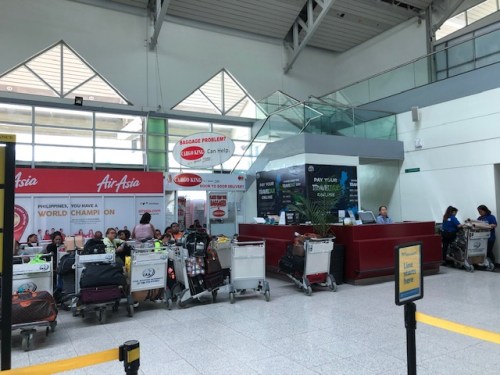 Passengers wait for their check-in times and counter for travel tax payments
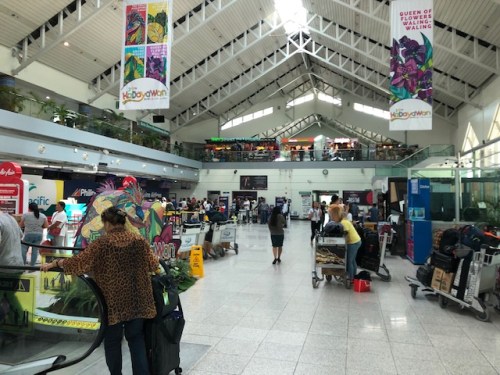 Passengers with their luggage filing into the terminal
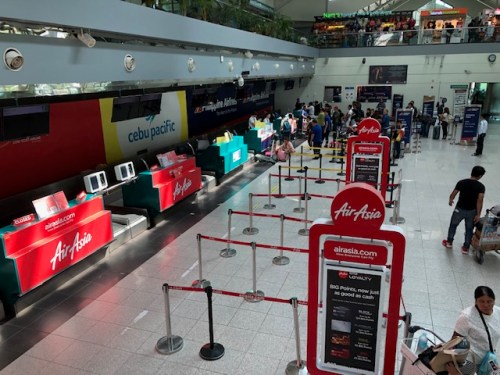 View of the airline check-in counters from the escalator
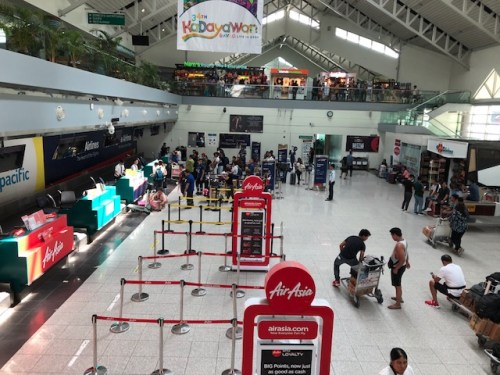 Another view of the airline check-in counters and the departure area. This photo also shows the shops at the second level.
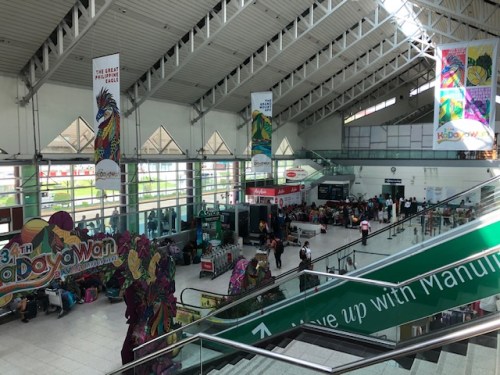 View of the terminal entrance from the escalator
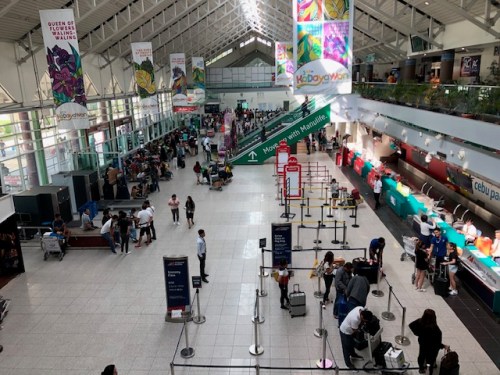 Another view of the ground floor area showing the airline counters and the escalators and stairs to the departure level lounges
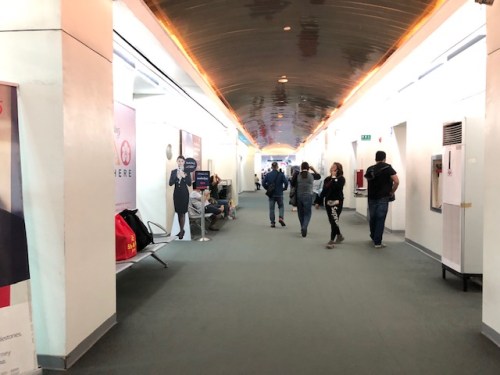 After clearing the final security check, passengers pass through this corridor towards the departure lounge and boarding gates
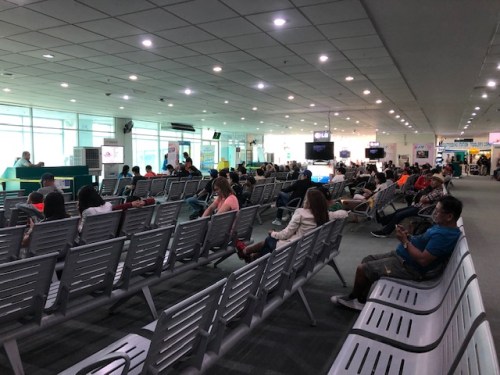 Passengers waiting for their boarding calls.
Coming up soon are photos of Changi (Singapore) and Bandaranaike (Sri Lanka) airports. I haven’t been to Singapore in 7 years and it was my first time to go to Sri Lanka so I made sure to take a lot of photos at those airports.
–
EASTS 2019 Conference
The 13th International Conference of the Eastern Asia Society for Transportation Studies (EASTS 2019) is currently underway. This conference is hosted by the domestic society of Sri Lanka from September 9-11, 2019. The conference was almost canceled or relocated due to the safety and security concerns following the bombings in Colombo last April. After assurances by the organisers plus the full support from government, the conference was decided to push through in Colombo.
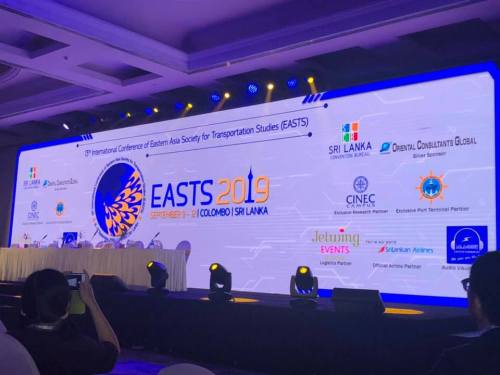 Backdrop of the opening program
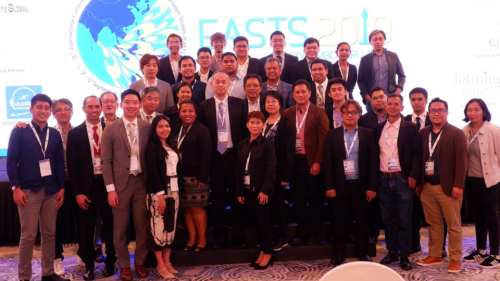 Delegates from the Philippines pose with EASTS President Prof. Tetsuo Yai and other friends from Japan
More information on the conference and others about the domestic society may be found on the EASTS homepage, which also has a link to the organizers’ website.
–
Another look at the Francisco Bangoy (Davao) International Airport – Departure Part 1
To continue on the series on Davao’s international airport, here are a few photos on the airport upon our departure last week.
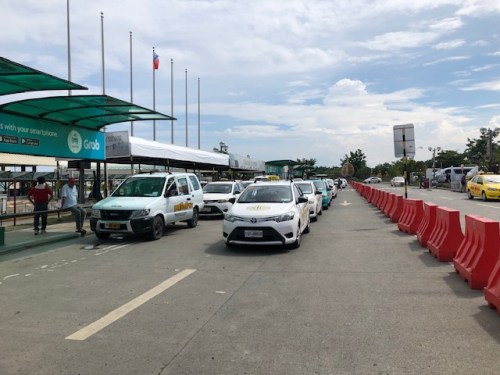 Taxi stand at the airport There are two lanes here along which taxis are queued to pick-up passengers. The other two lanes to the right in the photo are for dropping-off passengers.
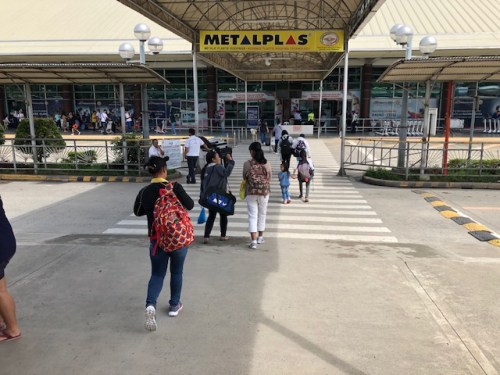 Passengers walking towards the terminal. Those with lots of luggage may avail of the porter services. The porter assists you until the check-in process.
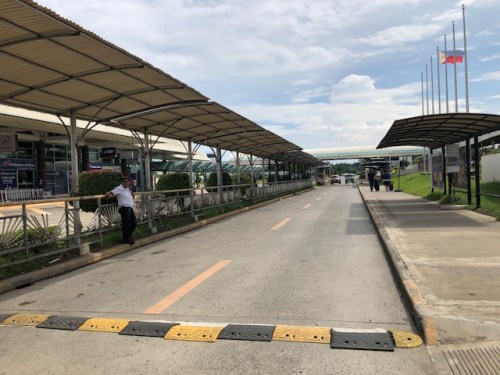 Driveway for private vehicles and VIPs
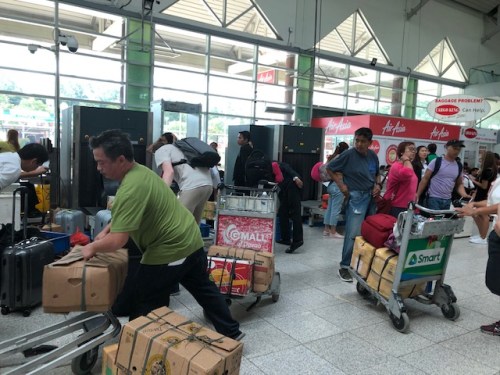 Typical scene right after the first security check at the airport
I will be completing this series with another post on this airport soon. Meanwhile, I am preparing for a trip to Sri Lanka via Singapore. That means more photos of airports. I have not been to Singapore in a while. The last one was in 2012 when Changi still had a budget terminal (terminal for low-cost carriers like Cebu Pacific and Tiger Airways) and I have not been to Sri Lanka at all. And so I am looking forward to there travels and will be sharing the experiences through photos and some narratives in future posts.
–
Another look at the Francisco Bangoy (Davao) International Airport – Arrival Part 2
This is a continuation of the post on the Davao International Airport. I made sure to take photos upon our arrival as I haven’t been to Davao in a while. So here’s a second set of photos on the airport.
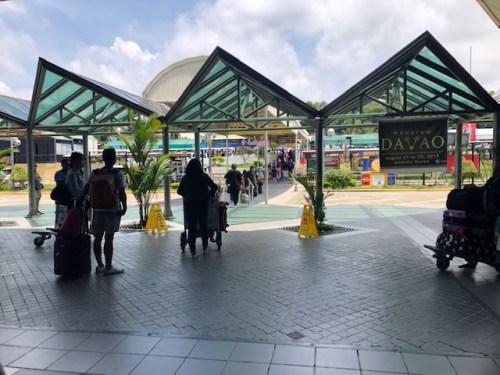 Upon exiting the terminal, one is greeted by a spacious are with covered walkway towards the taxi stand and the parking area.
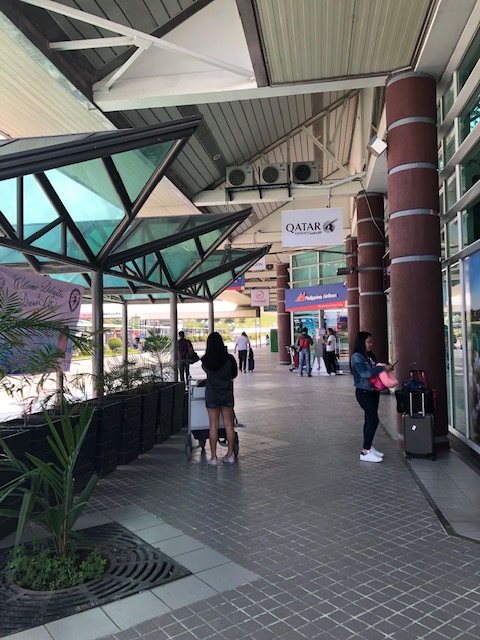 A view of the sidewalk and path to the departure wing of the terminal. Note the signs indicating the airline offices nearby.
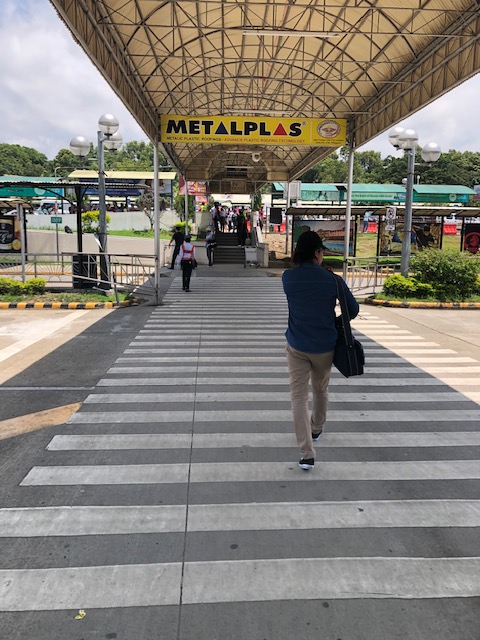 Crossing to the taxi stands and pick-up areas
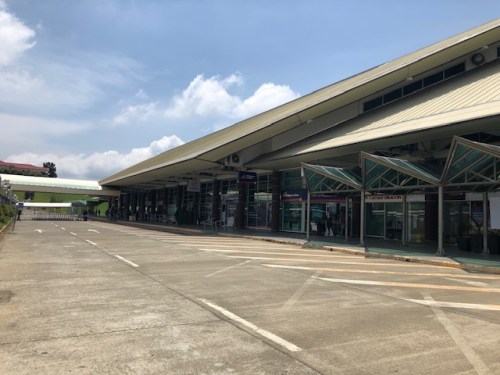 A look back to the terminal building
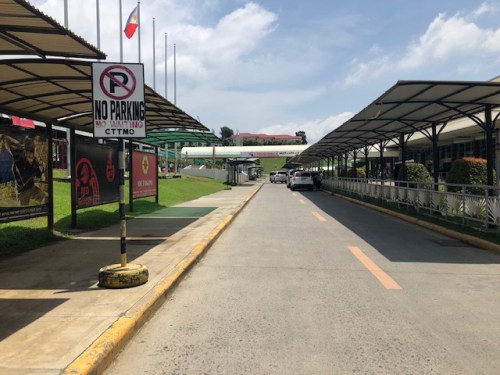 Driveway for private vehicles picking-up or dropping-off passengers at the terminal
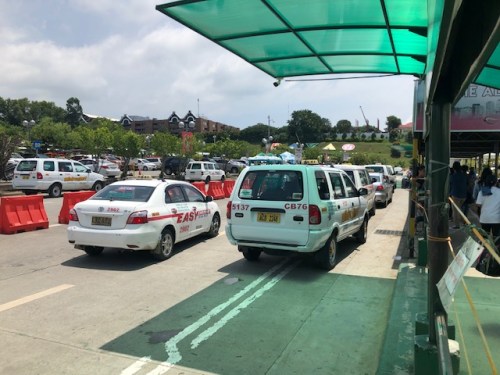 Taxi stands at the terminal. These are taxis picking-up passengers.
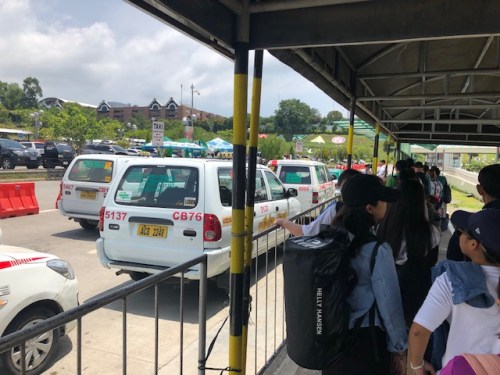 Queue at the taxi stand
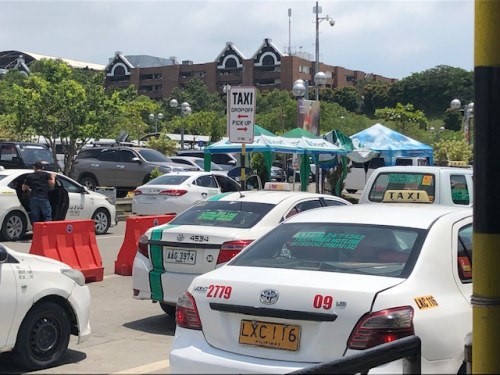 The taxis on the other lanes are those dropping-off passengers at the terminal. There are two lanes each for taxis dropping-off or picking-up passengers.
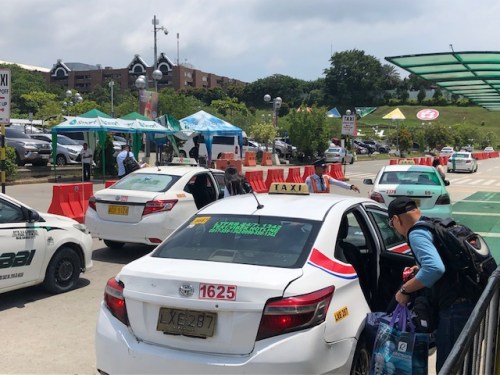 Passengers are given by airport security personnel a small sheet of paper where the information on the taxis are written. These are for future reference or use in case there is an issue or concern such as things left on the taxis.
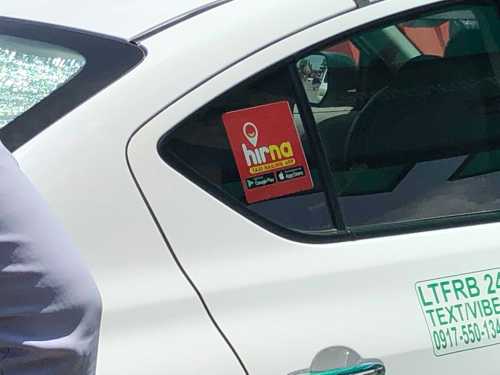 Taxi bearing a sticker of Hirna, a popular taxi hailing app in Davao. This homegrown company gives good competition to the industry leader Grab. I thought that we probably need more of these than Grab Cars.
I have always admired taxi operations in Davao. My experience there since my first time to visit the city is that it was easy to get a taxi and their drivers generally follow rules and regulations. The system in Davao seems to be effective in encouraging drivers to be honest and obedient to traffic rules and regulations.
More on the Davao International Airport soon!
–
Another look at the Francisco Bangoy (Davao) International Airport – Arrival Part 1
I have not been to Davao for some time now. I think the last time was over 6 years ago at a time when there was still no inkling of its mayor becoming the Philippine President. In fact, that was the time he was Vice Mayor to his daughter who was mayor the last time I was in the city. And so I was curious how it was in the city where certainly the popularity of the First Family should be at the highest in the land. Note that aside from the President, the first daughter is again Mayor, a son is Vice Mayor and another son is Congressman. But no worries for the DDS among my readers, I will not talk about politics in this post. I will just be sharing photos of the airport and some commentaries here and there.
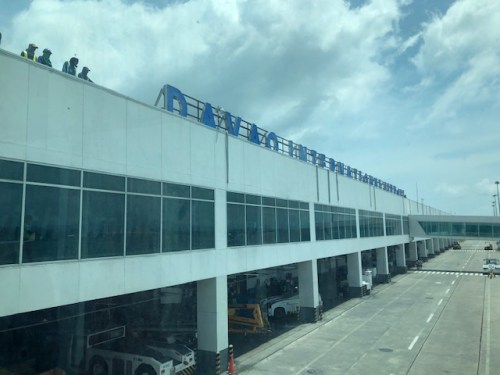 View of the airport terminal as we deplaned
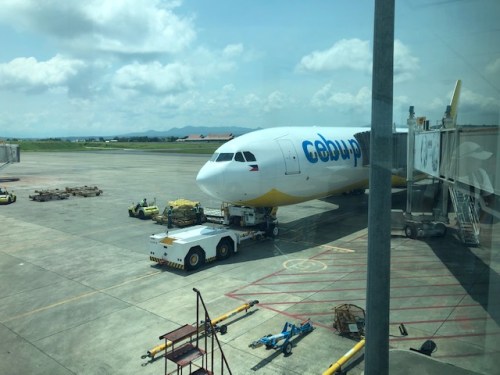 A look back at the Airbus 330 jet that brought us to Davao
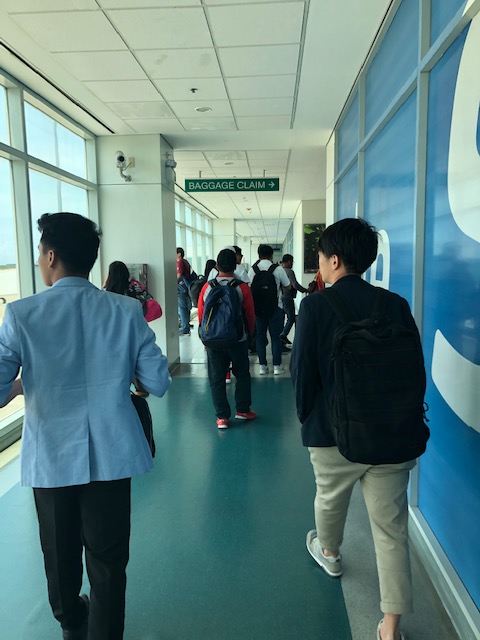 Passengers walking towards the baggage claim area, which is on the ground floor of the terminal
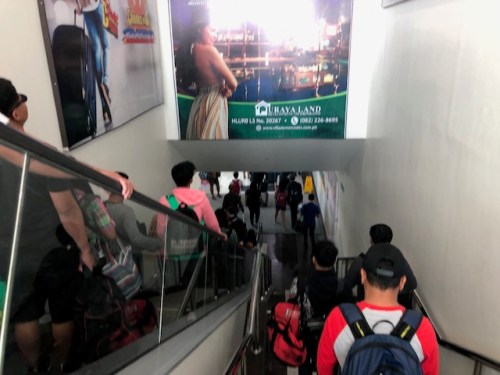 Passengers using either the escalator or the stairs to the baggage claim area
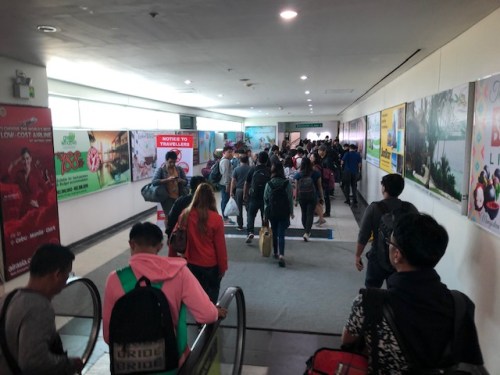 Passengers walking towards the baggage claim area pass by an area where sometimes quarantine is performed and people step on a mat that’s treated vs. foot and mouth disease (FMD).
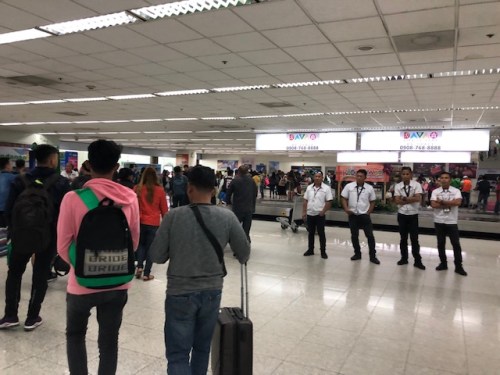 Porters line up to welcome arriving passengers and offer their assistance
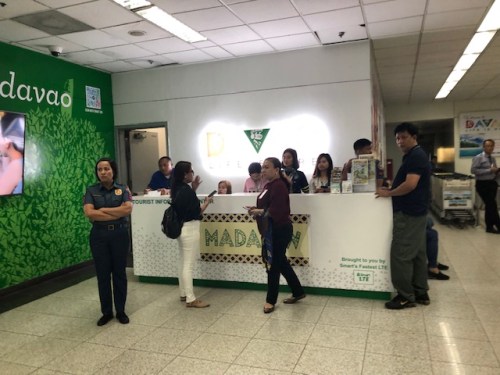 Information desk at the arrival area
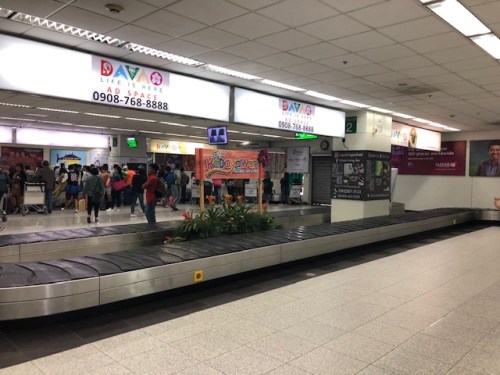 Baggage carousels – there were only two for domestic flights
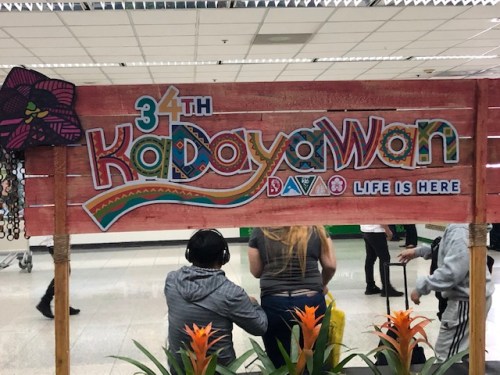 We arrived in time for the last days of the city’s Kadayawan Festival
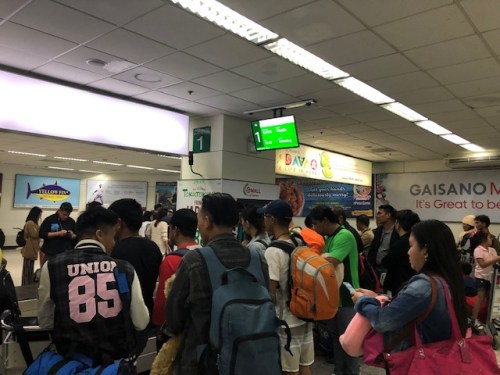 Passengers surround the carousel to await their checked-in luggage
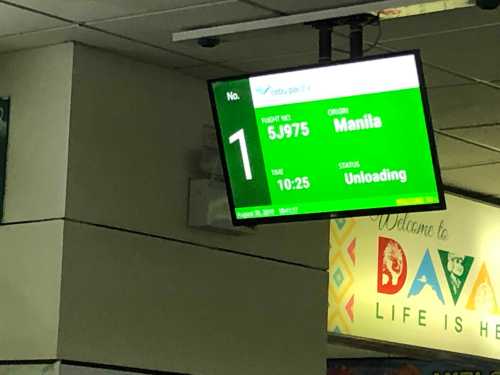 There is a screen informing passengers that their baggage are being unloaded. I thought it would have been helpful if Philippine airports provide more details like how its done in other countries. In the latter, they usually announce when the first and last bags are on the carousel for specific flights.
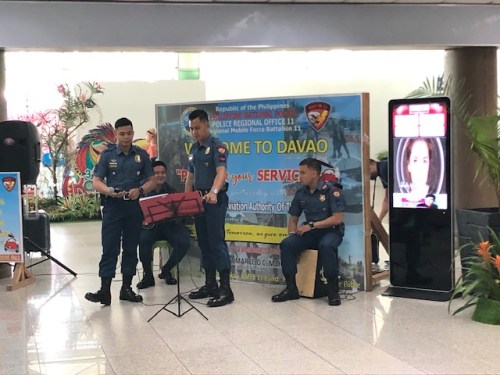 Policemen performing musical numbers at the airport terminal is a pleasing sight and sound and is certainly an effective P.R. initiative for the PNP and the city.
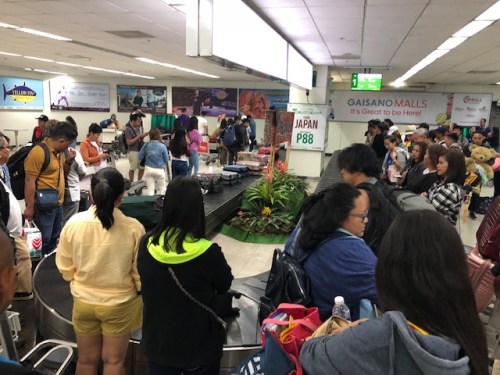 Another look at the still crowded carousel area. It took a while for our luggage to come out.
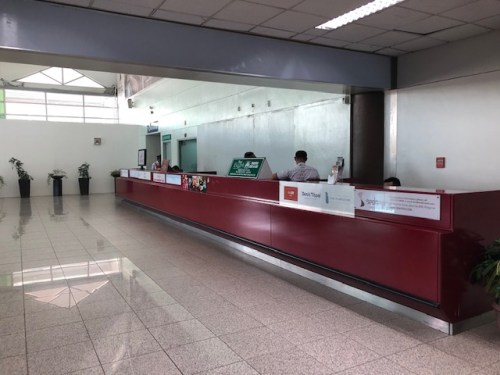 Hotel desk at the terminal for those inquiring about accommodations or perhaps their airport transfer services.
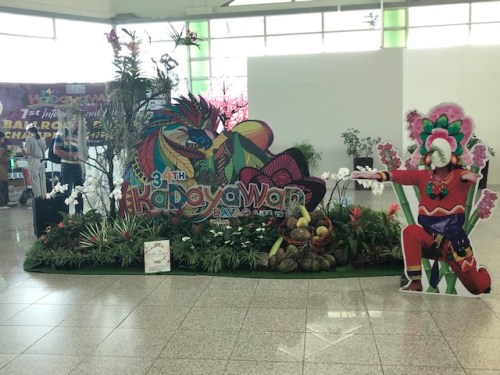 Another Kadayawan photo op feature at the terminal
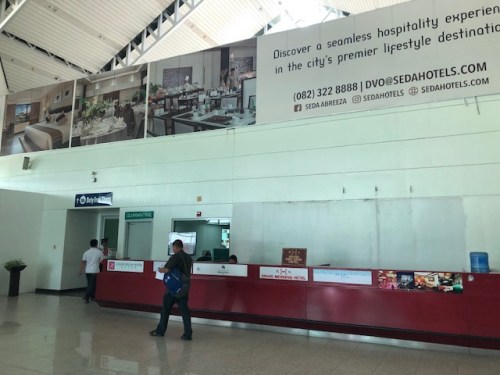 Another look at the hotels’ desk at the terminal just before the exit
I took a lot of photos at the airport so I will be sharing these in several posts. More photos soon!
–
On commuting characteristics in Metro Manila – Part 1
A friend posted the following two graphics showing commuting characteristics derived from a recent survey they conducted online. The 327 respondents are not much compared to the more comprehensive surveys like the ones undertaken by JICA and there are surely questions about the randomness of the survey. Online surveys like the one they ran can be biased depending on the respondents. This was mainly done via social media and through certain interest groups so statistically there may be flaws here. Still, there is value here considering there is often a lack of hard data on commuting characteristics especially those that are recent or current. We need these to properly assess the state of transportation or travel in Metro Manila and elsewhere.
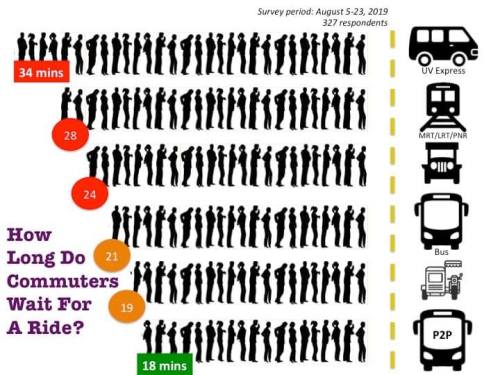 What’s lacking? Information on car and motorcycle users? And why the long waiting times? Are these really just because of a shortage in the supply of public transport vehicles thereby necessitating additional franchises? [Graphic and data courtesy of Toix Cerna via Facebook]
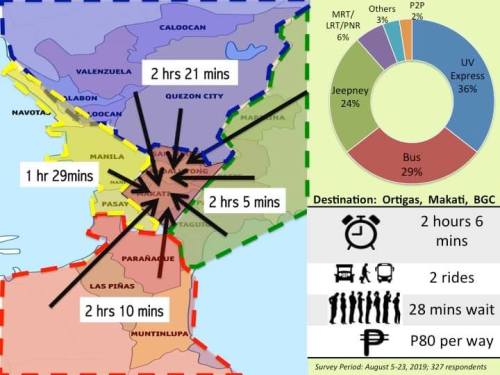 Again, the mode shares reported are incomplete. With the exception of walking, car and motorcycle shares are substantial and significant. There is some info here about trip chains (i.e., the average of 2 rides per commute) but it is unclear what percentage of the trip is made using whatever mode is used. [Graphic and data courtesy of Toix Cerna via Facebook]
The absence of information about cars and motorcycles is glaring due to their significant share of commuters. Yes, the term ‘commuter’ actually refers to someone who regularly travels between home and office. By extension, this may also apply to travels between home and school. The term is not exclusive to public transport users as is often assumed. Walking between home and office qualifies as a commute.
I am curious about how commutes using cars and motorcycles would compare to public transport commutes. The comparison is quite useful to show, for example, the advantages and disadvantages of car use (this includes taxis and ride share). More detailed information may also reveal who among car or motorcycle users use these vehicles out of necessity rather than as one among many choices for their commutes. One thinking is that if public transport quality is improved, then many people will opt to use PT rather than their private vehicles. However, there is also the observation that in many cases, those already using PT are the first to shift from the lower quality service to the better one. I also wrote about this as I posted my worries about how successful can Line 7 and Line 2 extension be in reducing car use along their corridors. Perhaps the ones who will truly benefit are those who are already taking public transport, and car and motorcycle users will just continue with these modes?
In Part 2, I will share some data we collected more than a decade ago for a study on jeepneys in Metro Manila. I will use the information to explain another angle of this issue on public transport supply and demand.
–
Quick share: “The ‘War on Cars’ is a Bad Joke
Here is another quick share. This time it is an article that I think attempts to diffuse what some many people regard as a war on cars being waged by those who advocate for public and active transport.
Litman, T. (2019) The ‘War on Cars’ is a Bad Joke, Planetizen, https://www.planetizen.com/blogs/105877-war-cars-bad-joke?fbclid=IwAR2_SZHQeYEUGiU2G8RUw0Za6GrkR-2peD3eSjshpNUOg9-G5SpDWm6OnFI [Last accessed: 8/25/2019]
The author makes very strong arguments supported by evidence and data to place this topic in the right context. That is, there is no need to “wage war” or use arguments that are more on the hateful side and therefore not constructive to both sides. I think there should be a mutual understanding of the benefits (and costs) of having many options for transport or commuting. That said, infrastructure or facilities should not heavily favour one mode (car-centric?) for transport to be sustainable and healthy.
Sadly, many so-called progressives (yes, I am referring to the younger generations who are still in the idealistic stage of their lives) appear to be blind to understanding but instead opt for the hardline stance vs. cars and those who use them. Instead of winning people over and convincing those who really don’t need to drive to take other modes, they end up with more people becoming more apathetic or unwilling to take a stand vs. the status quo. This is the very same status quo that is definitely degrading quality of life and is described as an assault to human dignity.
–
Quick share: “The changing role of transport strategy”
Here is a nice article briefly discussing the evolution of transport strategy planning that have led to local transport plans:
Gleave, J. (2019) The changing role of transport strategy, Transport Futures, https://transportfutures.co/the-changing-role-of-transport-strategy-598fce17e9e9 [Last accessed: 8/24/2019].
More importantly, there is a very good discussion here of the recent developments and the need to change approaches in order to become more effective at the local level. The article explains that there should be an appreciation of the availability of resources including tools that allow people to be more engaged or able to participate in the planning process for their cities, municipalities or communities.
–
Tartanilla – Calesas in Cebu City
We spotted these calesas or horse drawn carts while walking around downtown. These are also called ‘tartanilla’, which is familiar to us since its the same term used in Cagayan De Oro for their version of this transport mode. Here are a few photos:
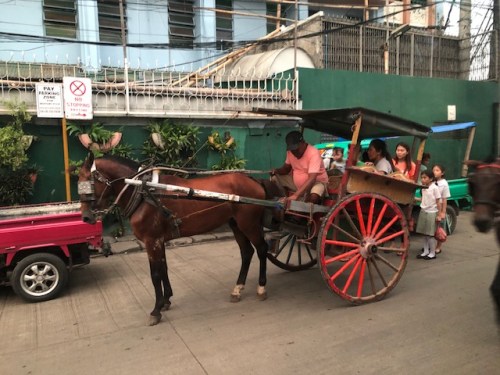 Although mainly used for tourism purposes in Manila, the tartanilla in Cebu seems to enjoy some non-tourist ridership. Most of the passengers we saw riding them didn’t look like tourists.
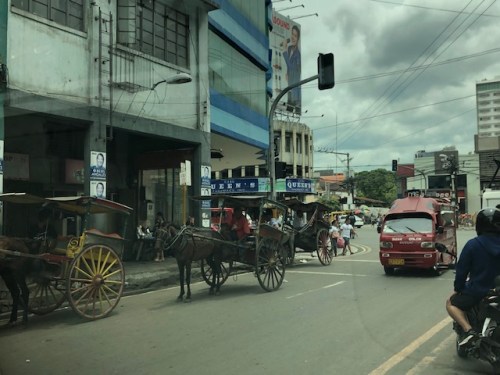 There are on-street stations for these tartanillas.
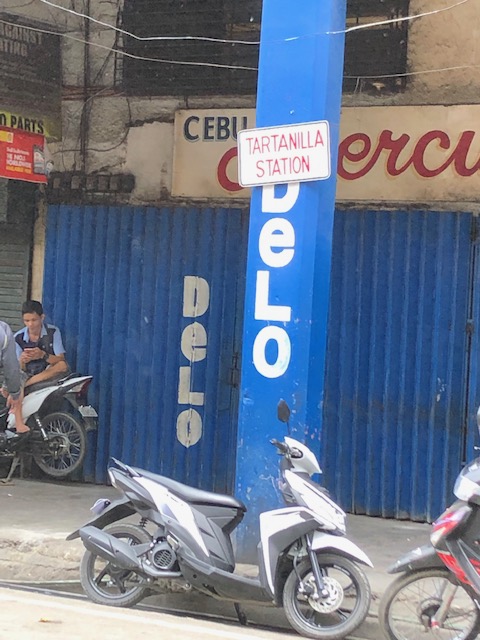 Tartanilla station sign – the stations appear to be informal but I guess the city is regulating their services and retaining them as part of the heritage of the city.
–
We need to work on road safety for children
Working on a project on road safety for children, I have had an increasing appreciation for the need to improve the plight of our children who are among the most vulnerable of road users. I have shared or posted many images showing examples of children being exposed to risk. These include children crossing streets without assistance and those riding on motorcycles with minimal protective gear (not that such gear can really save them from serious injury or worse should they be involved in a motorcycle crash).
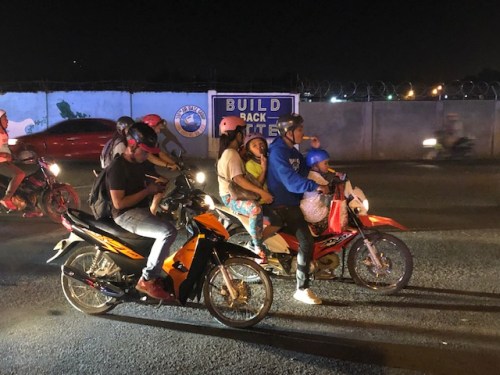 I took this photo as we waited for the signal to allow us to cross a very busy intersection in Zamboanga City. The entire family seems to be coming from dinner or the grocery where they picked up their popsicles. I hope the father is focused on balance and safe riding with his family considering the potential for tragedy here.
Some people may say that such scenes show the norm. But we must realise that treating these as normal means we accept that our children (and all other people) will be hurt one way or another. Is this really what we like or accept to be the situation? Perhaps not. And so the challenge is to find ways to make the journeys of children safer and one aspect we can focus on is the journey between home and school. This is perhaps the most common trip by children is between the home and school (to and from), which covers a significant share of the total trips made everyday.
In order to do this, we need to know, assess and understand the manner of their commutes and the facilities they use. We should collaborate with people who guide them including their parents/guardians and teachers. And we should engage those who are in the position to implement solutions such as government agencies or local governments in effecting interventions.
–
 Caught (up) in traffic