
Helmet or no helmet when biking?
We were at the Department of Science and Technology – Philippine Council for Industry, Energy and Emerging Technology Research and Development (DOST-PCIEERD) this morning to help defend our proposal for a bike sharing system. UP Bike Share is an initiative coming out of a group of students from various programs in their respective colleges at the University of the Philippines Diliman.
One question that was raised among the technical panel to whom the proposal was presented for evaluation was concerning safety of people participating in the bike share. One panelist asked if cyclists were required to wear helmets. We replied that those participating in the bike share were not required to wear helmets and that despite helmets being available few, if any, borrowed the available helmets. I mentioned that there was an article I came upon before that stated the requiring people to wear helmets discourage biking. It seems a coincidence that as I browsed my Facebook just now, I found a link to that very same article I mentioned in a meeting earlier today:
To encourage biking, cities lose the helmets [by Elisabeth Rosenthal from The New York Times, Sunday Review, September 29, 2012]
The article makes a lot of sense especially the observation that requiring helmets seem to send the message that it is dangerous to bike. People associating danger with biking with helmets tend to opt out of biking. I recall that in Japan before, I didn’t have a problem biking in urban areas and helmets were not required. Of course, drivers of vehicles in are very admirable by the way they drive safely and respecting other road users’ right to the road. Instead of having a campaign to require helmets for bikers perhaps efforts should be focused on how to make our roads safer for all users including bikers and pedestrians.
–
Towards safer roads: design, respect and education
Fatal crashes involving cyclists have been posted in social media including a recent one involving a mother of two who was run over by a garbage truck that encroached on the on-street/painted bike lane in, of all places, Marikina City. Emphasis on Marikina is made here because it is a city well-known for its comprehensive bikeways network. The network is comprised of segregated and on-street bikeways.
Following are some photos showing examples of good and bad practices pertaining to bikeways design in the Philippines:

Example of segregated bikeway at the University of the Philippines Diliman campus. Cyclists actually share the carriageway lane allocated from the Academic Oval with pedestrians and joggers. They are not physically protected from motor vehicles that can encroach on the bike lane.

Example of segregated and protected bikeway along Marcos Highway in Pasig City (similar design for the sections in Marikina, Cainta and Antipolo) – bikeway is on the sidewalk and cyclists essentially share space with pedestrians despite delineations.

Example of segregated and protected bikeway/walkway along EDSA in Makati City – note that space to be shared by pedestrians and cyclists is very constricted.

Example of poor design along White Plain Avenue – the MMDA seems to have designated the entire sidewalk space for cyclists.
Three examples from Marikina’s bikeways are shown below:
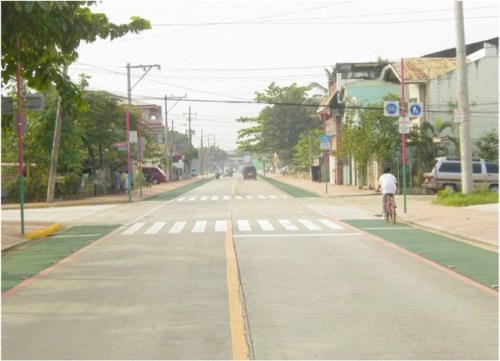 Painted, segregated bikeways on the carriageway on either side of a two-way road [Note: This is basically the design along the street where the crash in Marikina occurred.]
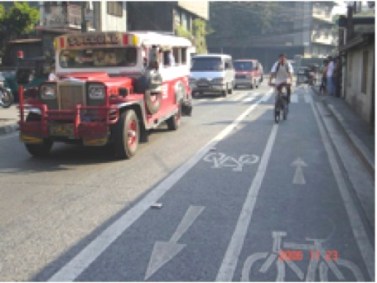 Painted, segregated bikeways on the carriageway along a one way road
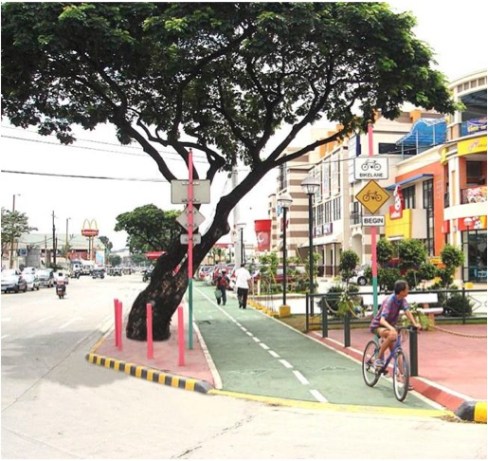 Segregated and protected bikeway off the carriageway along Sumulong Highway
Granted that the ideal set-up would have segregated or protected bikeways that are designed properly, we take a look at two other very important elements that are not at all as technical as design and planning of bikeways – respect and education.
Education is an important aspect of driving. Many Filipino drivers are poorly educated in terms of traffic rules and regulations, road design as well as local policies pertaining to transport and traffic. As such, there is a tendency for many drivers to disregard rules and drive/ride aggressively and recklessly. This must change and it starts with reforms in the way licenses are issued to all types of drivers including perhaps stricter certification systems for truck drivers and public utility vehicle drivers. Traffic education should also be integrated into the academic curricula of schools starting at a very young age. Road safety parks are one way to promote traffic education for kids.
Respect is partly derived from education but is also related to attitude. No matter how much driver or road user education or skill you get if you have a bad attitude, you will still have the tendency to be reckless or irresponsible with your actions on the road. One way to curb bad attitudes on the road and to educate road users (particularly errant drivers and riders) is strict traffic enforcement. Many cities already have CCTVs installed at major intersections that allow law enforcement units to be able to monitor traffic behavior and perhaps zoom in to determine driver and vehicle information including license plate numbers.
The crash that killed the single parent in Marikina is not so much as an issue one whether we need segregated and protected bikeways but is more an urgent need to assess the state of traffic education and enforcement in this country.
–
Articles on the crash and calls for reforms may be found in this link.
Common causes of crashes involving bicycles
I found a guidebook of sorts as I browsed one of my shelves for some references on public transport. It was something that I got from a seminar hosted by the Land Transportation Authority (LTA) of Singapore many years ago (I think in 2009.). The book contains tips for road users, whether motorist, pedestrian or cyclist. One page from the guidebook provided a list of common causes of accidents involving pedal-cyclists.
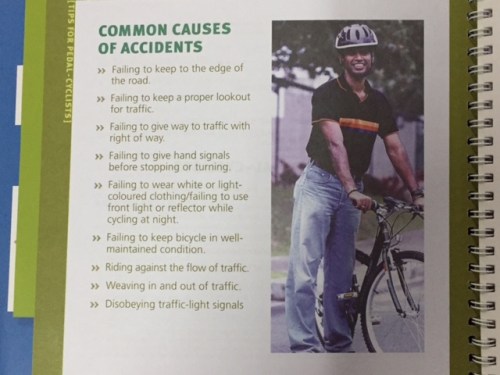
The page is practically a checklist for cyclists – reminding them of items that they need to keep in mind when traveling. In Singapore and elsewhere, there are rules for cyclists to follow in order to ensure safety on the roads. The assumption here is that other road users, especially motorists, will respect the right of cyclists. Each road user is expected to be responsible with his/her behavior whether as driver, rider, pedestrian or cyclist. Everyone is vulnerable and even the most safety conscious and careful road user may be involved in a road crash.
–
Mactan Cebu Airport taxi terminal
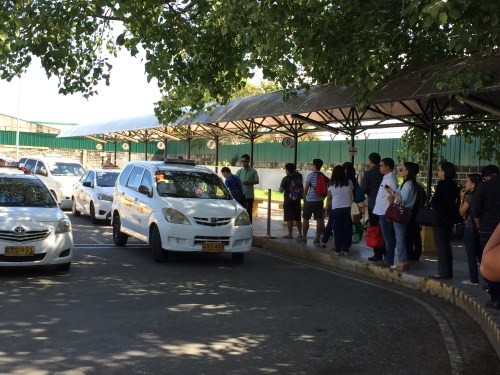
I wanted to post about the new taxi stands at the Mactan Cebu International Airport as early as September of last year but I didn’t have good photos to show in the article. Last December, however, I was able to get a load of pictures during 2 trips to Cebu. The terminal at the arrival level of the airport is basically divided into 2 stands – the White Taxi Stand and the Yellow Taxi Stand. Here are the photos of the taxi terminal at Cebu’s airport.
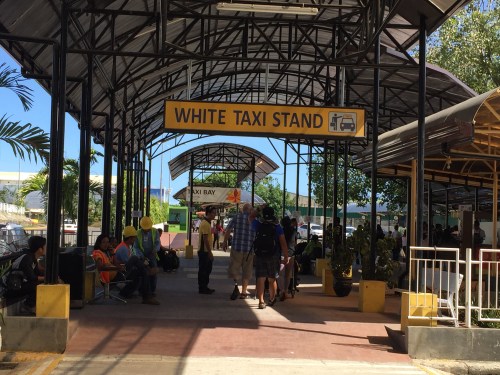 Covered facilities allow for all-weather queuing of passengers.
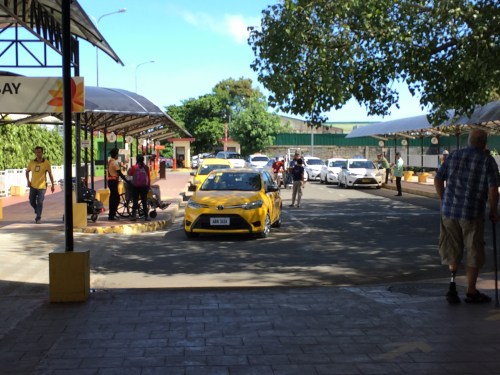 White taxis are regular taxis while the yellow ones are ‘airport taxis’ charging higher fares.
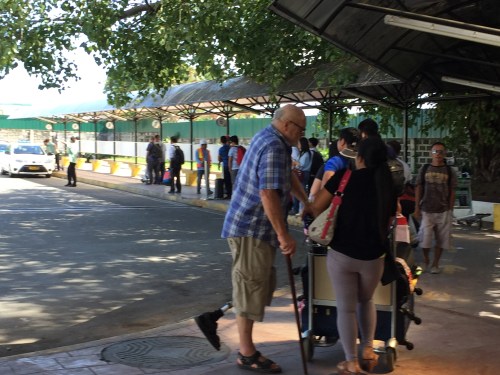 The lines for the white taxis are definitely longer and this is basically due to the lower fares charged by regular taxis.
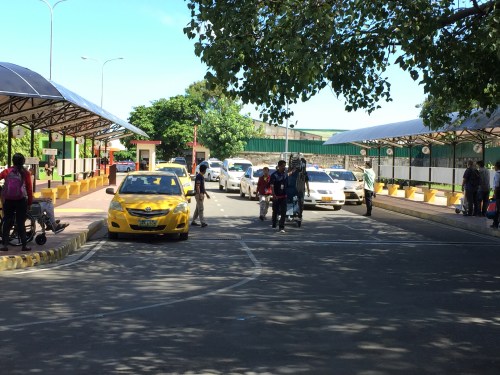 Obviously, there are more regular (white) taxis than yellow taxis so the queue proceed well and the waiting times are not so long.
 There are 5 spaces for taxis but everyone seems to be queuing for the first one. The dispatchers could do better to make the lines go faster.
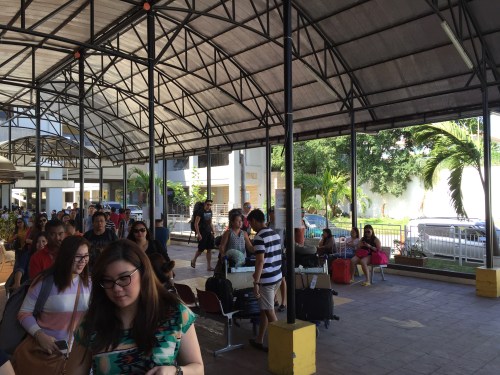 That’s the queue behind us, all going for the regular taxis.
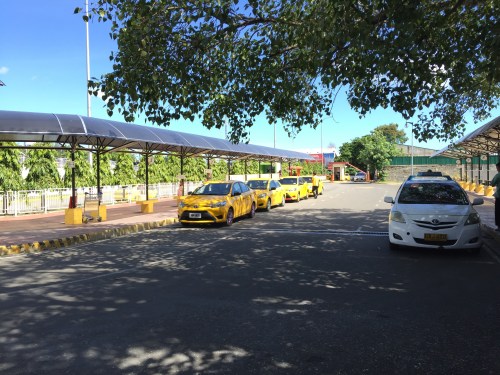 If the queue for the white taxis is proceeding at an acceptable pace, few people take the yellow taxis. Vehicle-wise, yellow taxis are newer and better maintained models. My observation (based on limited experience) is that yellow taxi drivers are also less reckless than drivers of white taxis.
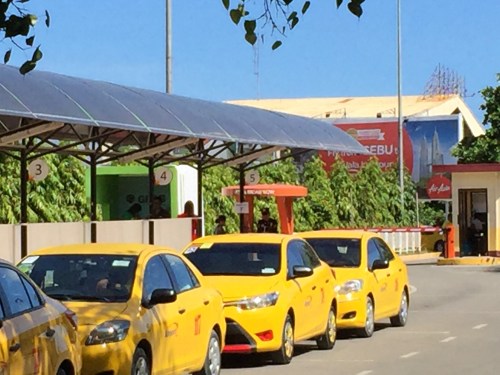 There are two booths for app-enabled taxis like Grab Taxi and Easy Taxi. Passengers for these may proceed to the area near the booths and board their taxis at the bays near them.
–
Here are a few photos from the second trip last December when we experienced long queues for taxis. I think we arrived during the morning peak at the airport when a couple of international flights using wide-bodied planes arrived.
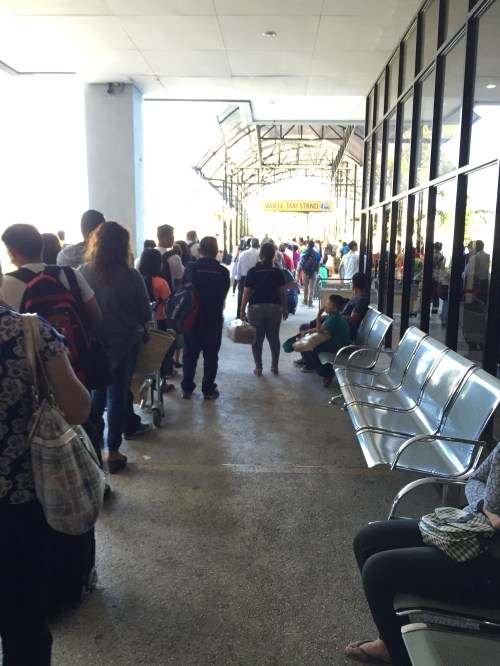 A very long queue for the white taxis greeted us when we got out of the airport terminal.
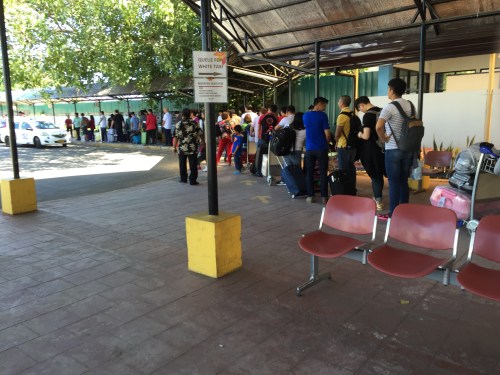 There was a constant arrival of taxis but the demand was just too high; resulting in the long queue.
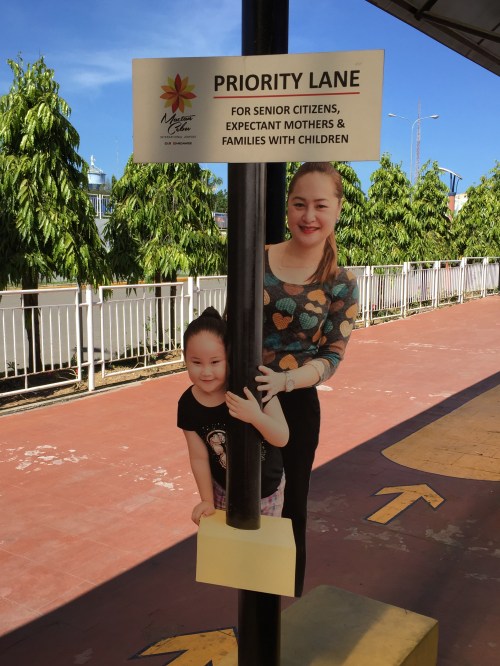 There is a priority lane for senior citizens, expectant mothers and families with children. Dispatchers make sure that these people get their taxis ahead of others.
–
Readings for the new year
I wrote late last year about how the Christmas and New Year holidays allow me to catch up on some readings. These are mostly contemporary articles on transport and other topics rather than whole books (though I just finished one by George RR Martin during the semester). That post with three articles may be found in this link:
Some interesting readings on traffic engineering
I open the year with another post with a couple of interesting articles. One article reports on the newly opened bicycle ‘autobahns’ in Germany. ‘Autobahns’ basically refer to expressways or freeways. The new facilities for cycling represents what many will term as a paradigm shift for a country well known for its excellent automobiles. The concept of an expressway for bicycles actually makes sense in terms of safety and as a way to eliminate many if not all the factors that tend to discourage people from using bicycles for longer distance commutes. These do have the potential to reduce car usage (and traffic congestion) and ultimately also reduce pollution and fuel consumption. I am interested about the designs of these structures as the designs are also key to the development of similar infrastructure elsewhere including, hopefully, the Philippines.
Germany opens first stretch of bicycle ‘autobahn’
Another article is more thought provoking in the sense that it delves into labor and legal issues surrounding Uber and other ride sharing companies. These issues are valid and need to be discussed thoroughly not just in the US but elsewhere where ride sharing services have proliferated and profited. Many of the points pertaining to labor and compensation are valid, and I would like to think that these extend to the franchising issues that have been raised against ride sharing, which ultimately have implications on their business model. The legalese may be a turn-off to many who would argue that companies like Uber and Grab provide them with a good quality of service. But then that begs the question of whether they would have the same view if taxis were better than what they are now.
Road warrior: Is Uber ripping off its drivers?
Happy New Year and happy readings!
–

Shopping at NAIA Terminal 3
Manila’s Ninoy Aquino International Airport’s (NAIA) has four passenger terminals. Of these, Terminal 3 is the largest and the building space has not been fully utilized. Due to the legal issues surrounding its construction, it took so much time for the terminal to be developed so it could be to its full potential. Last week, when I fetched my father who was flying in from Iloilo, I had more than enough time (his flight was delayed by more than 2 hours) to go around and see the new additions to the airport. These included new restaurants and shops at the south wing of the airport. Among the more conspicuous and perhaps newest addition is Kiss & Fly.


Kiss & Fly is found at the departure (3rd) levelof the terminal. The interior looks like a department store in a mall. There is a Starbucks at one of the entrances to the store. I think this is the 2nd Starbucks at NAIA with the first one at Terminal 1’s pre-departure area.
You can now practically do your shopping at Terminal 3. There are many stores selling clothing, shoes, bags, accessories, electronics and toys. The only thing lacking perhaps is a supermarket but then there are at least 3 convenience stores inside that could provide what the other shops couldn’t in terms of food and other items. Of course, there are duty free shops in the terminal, and if you are qualified, many shops offer duty free prices when you present your travel documents. Regular prices are similar to shops at malls but if your timing is right and there is a sale, you can get items for significantly less than the mall prices. So there is no excuse for not being able to get a souvenir for your loved ones or significant others, especially if you are arriving at Terminal 3.
–
Some interesting (and required) readings on traffic engineering
Christmas breaks allow me to catch up on a lot of reading. The previous months comprising our university’s semester were spent preparing for lectures though I had to do some readings related to researches I am involved in. Browsing the net and social media, I came across 2 articles shared by an acquaintance. He is a very progressive planner who has extensively studied and written about the most relevant issues in urban planning, focusing on transport. A third article I found while reading one of the two. These were very interesting for me in part because they are thought provoking in as far as traffic engineering is concerned.
- What traffic engineers can learn from doctors
- As traffic deaths rise, blame engineering dogma
- The new science of traffic engineering
The author seems to call out traffic engineers in general but these articles should also be contextualized properly. The situations mentioned in the articles are to be found in cities in the United States and may not be applicable in other cities in other countries. Traffic engineers in Europe, for example, have been working on exactly the solutions being mentioned in the articles that would make streets inclusive and safe especially for pedestrians and cyclists. The same with Asian cities like Singapore and Tokyo.
In the Philippines, however, there is so much that we can learn from the articles. The mere mention of the design guidelines being used in the US betrays the flaws of highway and traffic engineering in the Philippines. The Philippines’ highway planning manual and other guidelines used by the Department of Public Works and Highways (DPWH) are heavily drawn from US references. Most highway and traffic engineers in the country are educated using curricula that use US textbooks and references. There are even civil engineering programs that use licensure exam review materials as their references! These exam materials are also known to be based on DPWH guidelines and manuals aside from problems “outsourced” or patterned after the Professional Engineer (PE) exams in the US. Few schools have progressive curricula that look to best practices that take into account the complexities of roads especially in the urban setting. Such ‘copying’ of American standards and practices in many cases do not consider Philippine (local) conditions and blind applications to our roads instead of proper adaptation often have lead to unsafe and inequitable roads.
–
Honest Iloilo taxi driver
As if on cue, I just read a news article reporting on a taxi driver who returned a big amount of money left by one of his passengers. The driver is of a Light of Glory taxi. Call it coincidence but then the article mentions that the driver also was in the news before for returning a notebook computer another passenger has left in his cab.
Taxi driver returns P300,000 left by passenger
So it’s the driver and not necessarily the company? Likely, and we do need more trustworthy drivers like him behind the wheel of our taxis.
–
On Iloilo’s taxis
The talk about Uber vs taxi is a hot topic in many cities around the world and also in Metro Manila where Uber has gained a foothold and a strong following among mostly ‘former’ taxi goers. Many have stated that Uber provides the service that taxis should have been providing. Uber vehicles are supposed to be of newer models and drivers are supposed to be screened carefully. Uber even has a feedback mechanism not just for drivers but for passengers as well. Basically, Uber provides the quality of service everyone wants to have on regular taxis. The irony of course is that regular taxis are supposed to provide a higher quality of service compared to other public transport modes considering it is basically a for hire car short of a limousine service. But then this begs the question: If you had good taxi services in your city, would you still consider Uber? Or perhaps would Uber have a lot of demand in a city with good taxi services? Perhaps there will still be a demand for Uber but the clamor will not be like that in Metro Manila. And there are few cities with ‘good enough’ taxi services that can compare with Uber in terms of quality of service.
A good example of where there are ‘good enough’ taxis and there is a healthy competition not between Uber and conventional taxis but among taxi operators themselves is in Iloilo City. We have discovered many years ago that Iloilo City had one Light of Glory taxi company that is very popular among Ilonggos and visitors as the drivers were generally more honest than others and they had an efficient dispatching system including desks at the airport and a major shopping mall.
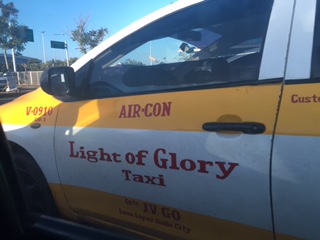 Light of Glory Taxi at the airport parking lot
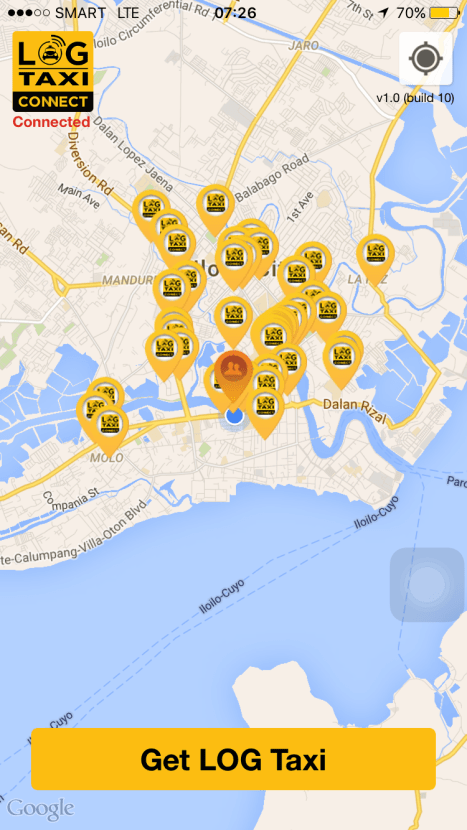 Light of Glory has its own app, which you can get for free and install on your smartphone. It is not as sophisticated as Uber’s or Grab’s apps in terms of features but it gets the job done (i.e., getting you a taxi).
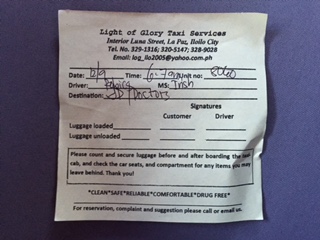 Dispatch sheet – note the attributes the company is trying to promote among its taxis: “Clean, Safe, Reliable, Comfortable, Drug Free” These are attributes we all want of our public utility vehicles whether these are taxis, jeepneys, buses or tricycles.
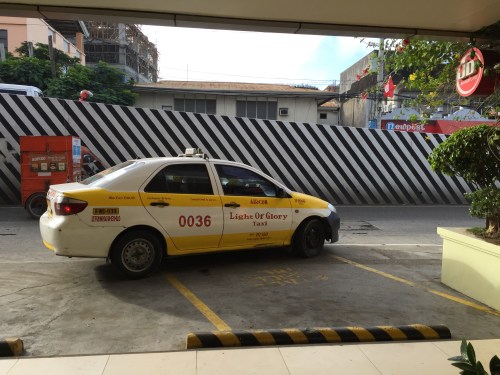 Light of Glory taxi that dropped us off at the venue of our meeting straight from the airport
The Light of Glory taxis is a well run company. Their drivers seem to be treated very well by the operator (drivers claim they have a better compensation system) and generally drive better than other taxis. Their vehicles are also seem to be better maintained compared to others except a few of the larger companies like GDR. Everyone knows about the best taxi company in Iloilo and would most likely prefer their taxis over others if the choice is given to the taxi-going commuter. To compare, I remember the Comfort taxis of Singapore and how many Singaporeans and foreigners living in SG prefer these taxis over others. Comfort taxis have a good dispatching system and you can make reservations for trips in advance. Of course, there are additional fees for on-demand services including arrangements for pick-ups and drop-offs (e.g., your residence to the airport).
–
Premium bus service schedule
For the benefit of commuters, here is the schedule of the premium express buses currently on experimental run along EDSA. The end points and routes are shown in the graphic below:
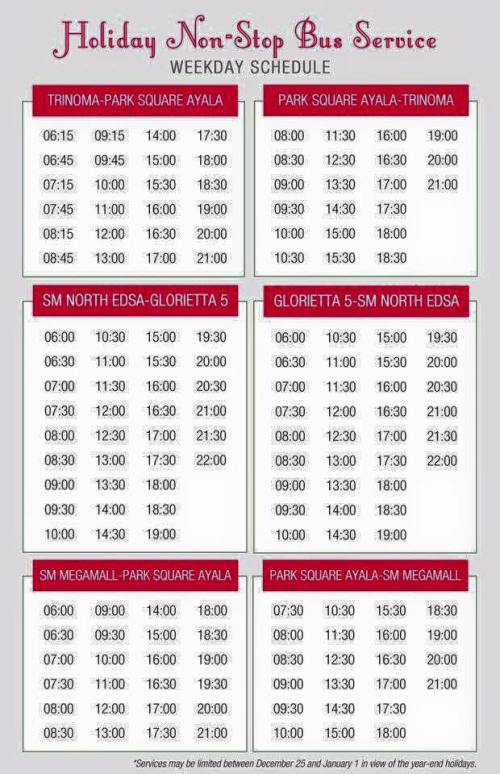
I suddenly remembered the slogan adopted by the defunct Metro Manila Transit Corporation (MMTC) for their Love Bus back on the 1970s and 1980s: “Save Gas, Ride Bus”. This is still very much applicable today and perhaps not only to consider saving gas but to save time and money by riding public transport. The express buses offer a higher quality of service than regular buses and should be promoted and perhaps expanded to include other corridors as well. I think many of us have forgotten about how good road public transport could be and should be (with the exceptions of those who have gone abroad to cities like Singapore and Hong Kong) that we fail to see a good initiative like the premium bus. It is also a proof of concept for the bus rapid transit (BRT) systems that can finally be implemented for Metro Manila and Cebu [crossing my fingers here].
–
 Caught (up) in traffic