
Enforcing bus lanes along Commonwealth Avenue
Commonwealth Avenue always seems to be the subject of road safety or traffic discipline initiatives every now and again. Quezon City together with partners in other government agencies like the Philippine National Police (PNP) and the Department of Transportation and Communications (DOTC) have embarked on another program aimed at reducing the occurrence of road crashes and other incidents along this busy corridor. It actually reminds me of the “traffic discipline zone” designation of Commonwealth not a decade ago and before public transport lanes were physically allocated along the highway.
They are failing miserably if I am to base success on observations of the behavior of drivers of public transport vehicles alone along this major highway. They get away with a lot of reckless driving including suddenly switching lanes, speeding, and tailgating. There are also cases where vehicles and pedestrians cross the wide highway at points that are prone to crashes. I am not aware of a lot of apprehensions being made of these reckless drivers along Commonwealth except perhaps at the foot of the Tandang Sora flyover where MMDA enforcers seem to be congregating on most days armed with one of two of the agency’s speed guns. But then it seems “business as usual” for the same drivers and riders along the rest of Commonwealth so the initiatives are not effective deterrents against irresponsible road use.
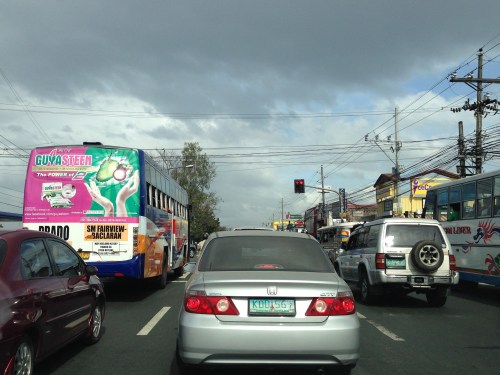 You can always see buses on the wrong side of the road along Commonwealth Avenue especially along the section between Fairview Market and Regalado. They do this to get ahead of other buses and then bully their way to make a stop or turn right at an intersection.
 This bus in particular was weaving in traffic, bullying smaller vehicles to give way as it raced other buses along Commonwealth Avenue. Such behavior among public transport drivers is one of the major ingredients for road crashes.
It’s been a year now since the tragic crash involving an out of line provincial bus in the Cordillera. That was partly the result of poor monitoring and enforcement by the LTFRB. While the major reason for the crash was reckless driving (i.e., the driver was allegedly speeding at a critical section of the highway), this could have been avoided if the bus wasn’t operating in the first place. The very same policies along Commonwealth apply to these provincial buses and fatal crashes could’ve been avoided or minimised if the LTFRB can just exercise its mandate effectively.
–
On jaywalking, overpasses and informal terminals
I had some errands last December and decided to take public transport instead of taking our car and wasting time parking the vehicle. There was significantly less traffic at that time of the year because schools already on Christmas break and everyone else seemed to be on the slow side of the holiday mode (read: not in shopping mode). I needed to cross the wide road that is Quezon Avenue and there was a sign where I usually crossed that it was now prohibited to cross there. I had to take the overpass to get to the other side and to the jeepney stop to board one to get back to the university.
The overpass at the Quezon Ave.-Araneta Ave. intersection is under-utilized. I base this on the several times I’ve used the overpass. Most people prefer to cross at road level, taking advantage of the traffic signal cycle that allows for gaps in the traffic for pedestrians to cross safely. Of course, there are those who cross any time and seem to tempt fate by their behaviour. They seem to tempt also the MMDA traffic enforcers assigned in the area but from what I have observed, enforcement of the “no jaywalking” policy is usually lax or non-existent. People regularly cross at ground level in plain view of traffic enforcers.
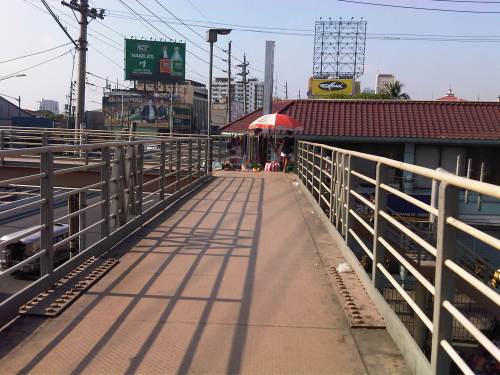 A vendor set-up at the corner of the pedestrian overpass at the Quezon Ave.-Araneta Ave. intersection. Obviously, there are few pedestrians using this overpass as most prefer to cross at ground level.
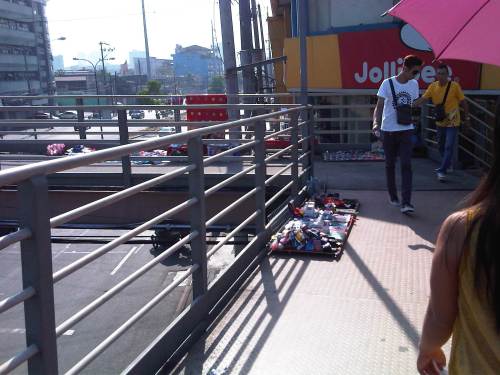 More vendors on the overpass – fortunately, there were few pedestrians using the overpass at the time. Its not the same for other overpasses that are crowded due in part to vendors occupying much of the facility.
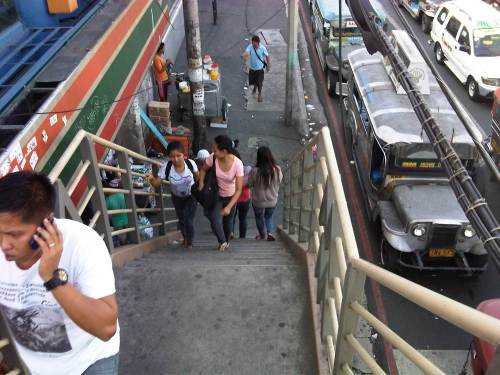 The stairs for many overpasses around Metro Manila are a bit on the steep side. That’s generally not okay with senior citizens, children or persons with disabilities.
There is an informal, on-street jeepney terminal right at the foot of the overpass. If you are in a hurry, its best to try to board a jeepney on the second lane as they are more likely to proceed when the approach is given a green light. From my experience, it takes about 2-3 cycles before the “queued” jeepneys finally cross the intersection. It takes that time to at least have several passengers for the jeepneys before it proceeds to cross the intersection. Most passengers here are transferring from jeepneys plying routes along Araneta Ave. There shouldn’t be an informal terminal here and jeepneys occupy 1-2 lanes of the road at a critical point – the intersection approach. This means intersection capacity is significantly affected and many vehicles could not proceed as they are blocked by the jeepneys. Special mention is made of vehicles wanting to make a right turn but have to go through this “gauntlet” of public utility vehicles. Again, there are MMDA enforcers in the area but it seems the jeepneys and the barkers hold sway and likely with the blessing of enforcers. Such situations are commonplace in Metro Manila and many other cities, and contribute to traffic congestion and other problems commuters regularly encounter.
–
Legit or kabit?
Traveling one morning from Antipolo, I spotted a bus with a familiar company name – EMBC. The last time I saw these buses operating as public transport was when I was in college, and I thought that the company folded up after losing money. However, I have seen some of their buses being used as shuttle services. It seems that the company has been revived but how is a bit unclear. EMBC stands for Eastern Metropolitan Bus Corporation, which was an old company that served the towns of Rizal along with the Antipolo Bus Co., G-Liner and CERT buses during the 1970’s and 1980’s. EMBC buses competed with the Antipolo Buses with their routes overlapping between Tikling Junction in Taytay, Rizal and Divisoria via Ortigas Avenue, E. Rodriguez Ave. (C-5), Pasig Blvd., Shaw Blvd., and Aurora Blvd. These two had overlapping routes with G-Liner and CERT, which plied the Taytay/Cainta to Quiapo route via the same Ortigas Ave. Extension.
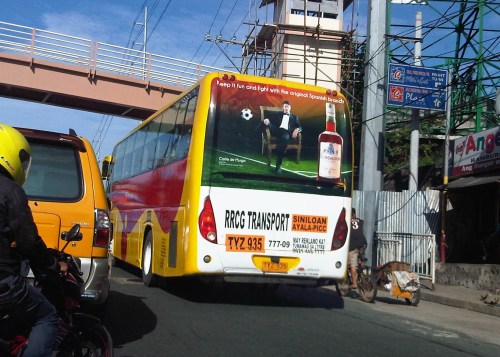 The back of the EMBC bus states that it is run by RRCG Transport with a route connecting Siniloan, Laguna and Ayala Avenue-PICC (it probably turns around at the PICC, where Gil Puyat/Buendia Ave. terminates).
 Closer inspection reveals that the bus is operated by Jasper Jean, another bus company that is better known for its Fairview-Alabang services.
EMBC is an old company and one that has been dormant if not extinct for quite some time. Was its franchise resurrected like what allegedly happened to another old bus company, BLTBCo. a few years ago? In this latter case, certain LTFRB officials were supposed to have been axed as they were allegedly behind the revival or “resurrection” of the franchise. I think it is not a “resurrection” case as I have also seen what looked like legitimate EMBC buses with information on the bus body showing EMBC as the operator of the bus unit. Unfortunately, I haven’t had the opportunity to take a photo of such examples. Thus, it is likely that the bus in the photo above is a case of “kabit.”
The concept of “kabit” (literally “connect” in English) in public transportation is not a new one. It has been used (and abused) in many cases) where the existing franchise holder(s) along a specific route could not deploy the number of vehicles necessary to address the demand for transport. In such cases, the franchisee (an operator) enlists other entities to provide the vehicles. And so there is an agreement among the formal franchise holder/operator and the “kabit” entities outside the contract between the government and the franchisee.
This is one reason why it is not necessarily the main company (franchise holder) that can be the guilty party in an incident involving one bus. However, the penalties (e.g., suspension and fines) are imposed on the franchisee and not necessarily to the “kabit” operators. The latter’s vehicles in turn continue to operate despite the suspension being technically applicable to ALL vehicles bearing the company’s name. Such are among the many issues concerning “kabit” and perhaps also among the strongest arguments to put a stop to this practice that is detrimental to the interests of people taking these buses.
–
Mactan Cebu airport departure
The trip to Cebu would not be complete without taking new photos of Mactan Airport’s departure lounge. This was already expanded and improved a few years ago to accommodate the steady increase in the number of visitors to Cebu. It will soon be part of a major project to expand and upgrade the airport so perhaps this year will see the start of a transformation of sorts for the airport. Following are a few photos describing the departure area.
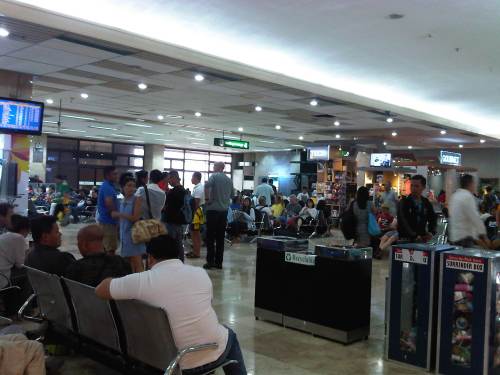 A crowded departure lounge greets travelers upon completing the final security check. The boxes at the right and near the garbage bins are containers for items prohibited from being hand carried to the aircraft.
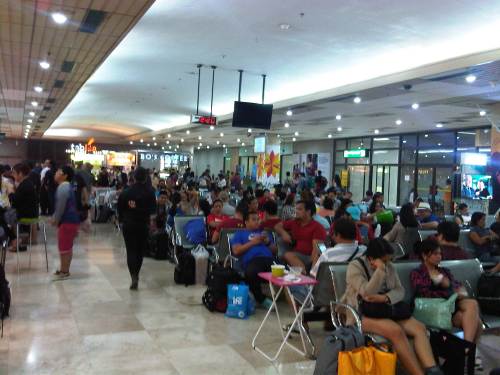 Passengers tend to congregate near the eateries and shops even if their gates were a few minutes walk away.
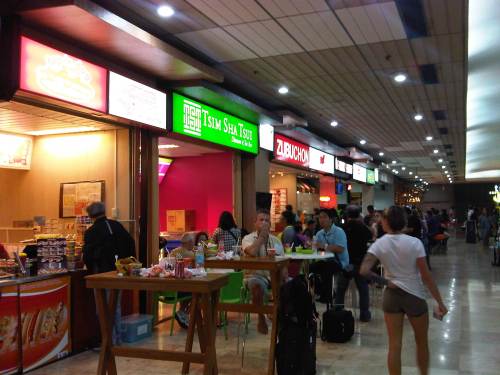 Eateries and other concessionaires at the airport departure lounge include those offering Cebu lechon, dimsum, donuts, sandwiches and others.
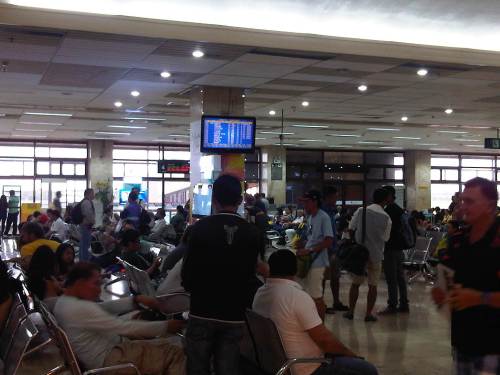 There’s a small screen showing the status of flights. I think the airport should eventually have a bigger screen for such useful information.
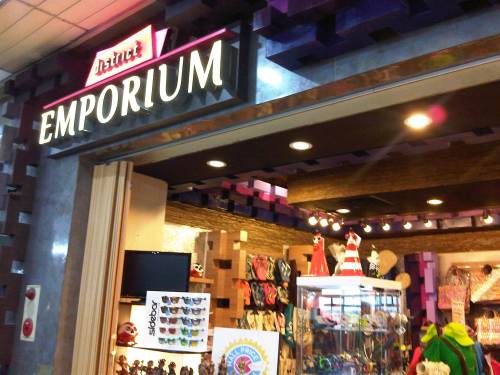 The District Emporium specializes on locally made stuff including bags, accessories, crafts, footwear and other interesting items travelers can take home as souvenirs.
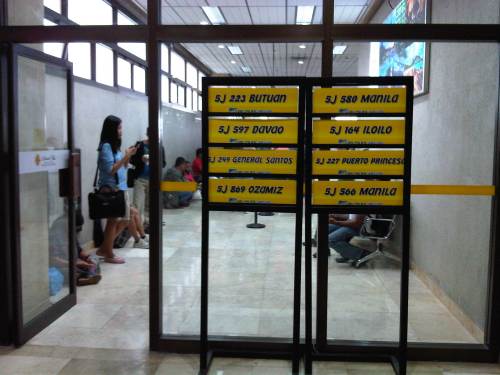 List of Cebu Pacific flights boarding at our gate and the one near it. These many flights meant a very crowded waiting area. You can see from the photo passengers standing and seated on the floor as they wait for their planes to arrive and be called for boarding.
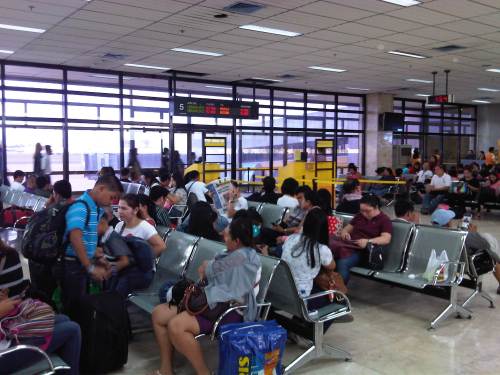 Inside the departure area that was apparently all for CebPac flights, many seats are actually unoccupied by people. Many seats have bags or other stuff on them care of passengers who tend to hog seats for themselves.
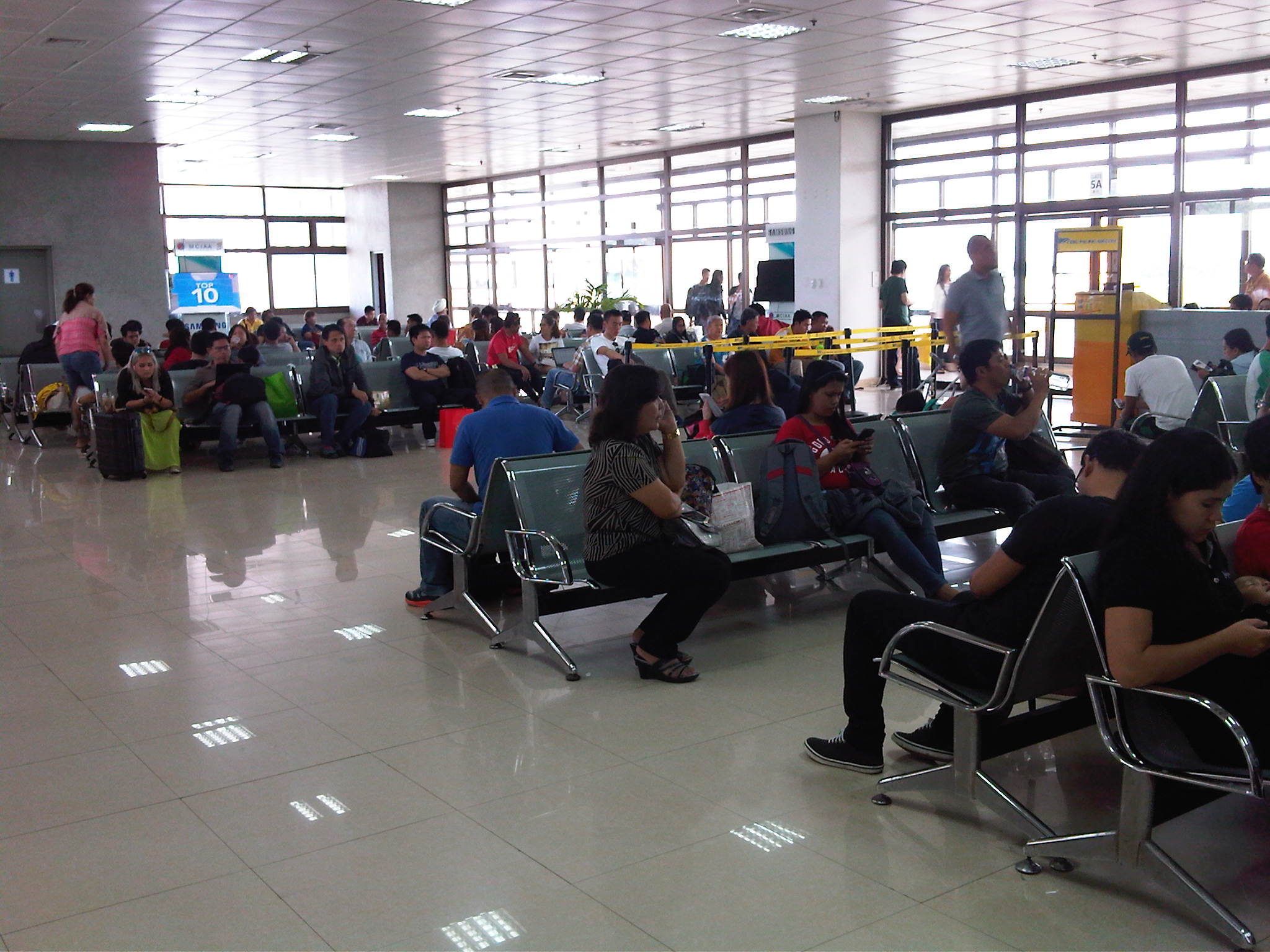 Another look at the area for departing passengers.
I expect to be in Cebu at least one more time this year. We have a big conference coming up in September for the Eastern Asia Society for Transportation Studies. This is a biannual international conference that is hosted by different Asian cities and which the Philippines will be hosting for a second time (The first conference was held in Manila in 1995.). We’ll see if there is a drastic change by then as the airport project is one that is tentatively listed as part of the technical tours for the conference.
–
Getting a taxi at Mactan Cebu International Airport
It is easy to get a taxi in many airports in the Philippines not named NAIA. The list includes, of course, Mactan Cebu International Airport. There is a regular taxi stand just a few meters walk from the arrival area. You have to cross the driveway and there are directional signs to guide travelers towards the taxi stand that is just a short flight of stairs from the corridor across the arrival area.
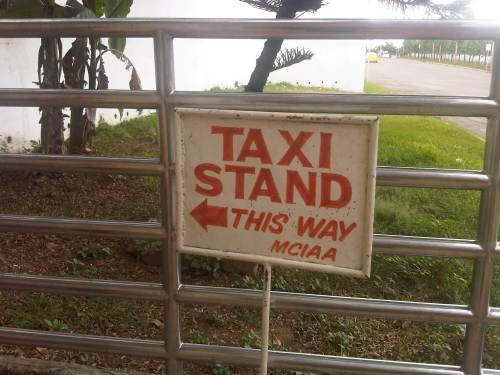 Directional sign to the taxi stand – definitely not international standard but is clear and sufficient for its purpose.
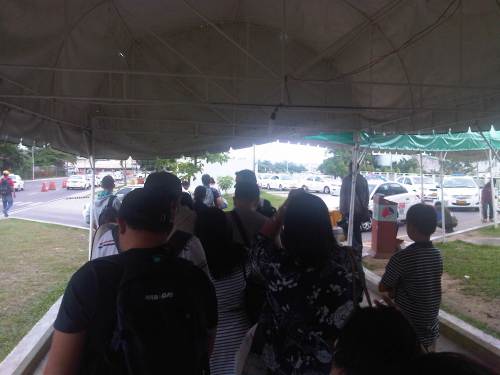 Queue for taxis – there has been an improvement here as there is now a tent for passengers’ shelter and a driveway for taxis. It used to be an open area along the MCIA driveway where taxis are lined up.
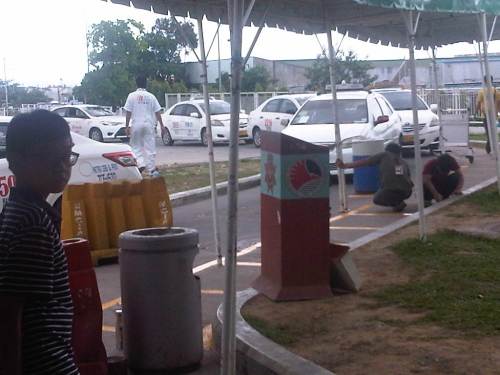 The stand is manned by airport security and staff who also issue information on the taxi on a piece of paper containing a phone number of the MCIA for complaints. I don’t know if they get a lot of complaints and if the airport acts on these if and when there are complaints from passengers.
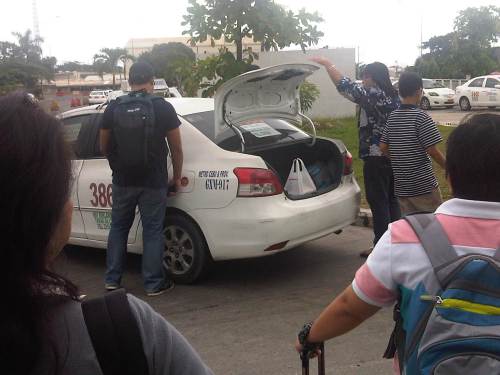 Passengers loading luggage in the trunk of a taxi – there are many LPG-fueled taxis in Cebu and if you have many pieces or large luggage it would be better to select a taxi with more trunk space. LPG taxis have their tanks inside the trunk, limiting space for luggage.
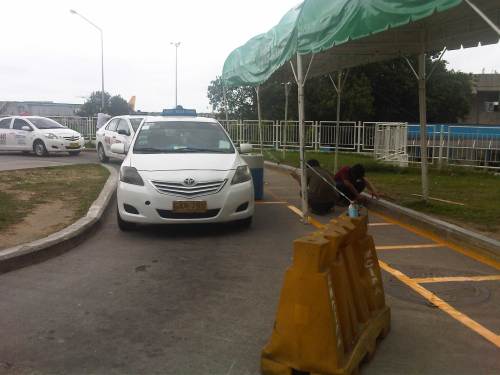 Some workers are busy doing the lane markings for the driveway. We thought that these probably being undertaken in preparation for the APEC meetings that several Philippine cities will be hosting.
–
Mactan Cebu airport arrival
Arriving in Mactan, Cebu for our vacation, I wanted to get a few photos of the airport to have an updated post on the airport. It’s been a while since I had been to Cebu and I noticed my previous posts on the airport did not feature any photos upon arrival. I also wanted to take photos before major work is undertaken for the airport. Mactan Airport is already scheduled for expansion and upgrading under a PPP project with a consortium including local contractor Megawide and the company behind Indira Gandhi Airport in India. (This was the same project where other consortia that included companies behind Changi and Incheon Airports, top airports in the world, lost in the bidding.) Here are a few photos of the arrival area as well as some tips for getting a taxi to your hotel, resort or wherever you’re going from the airport.
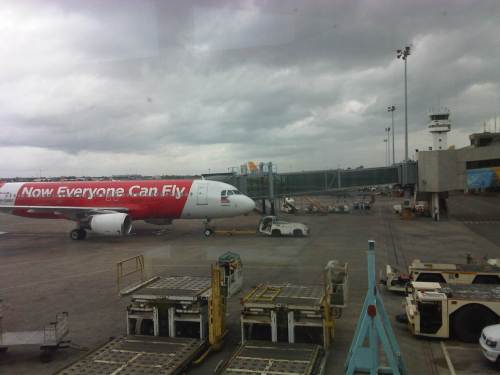 An Air Asia plane on the tarmac of Mactan Cebu International Airport
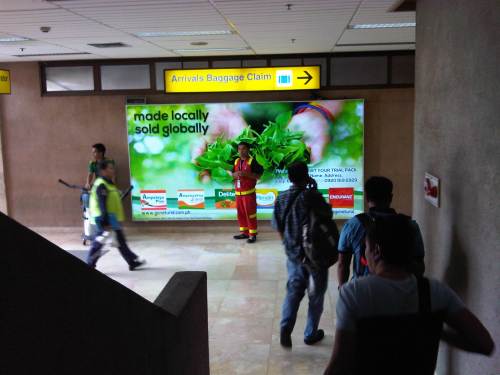 We got to use the tube as we deplaned (unlike in Manila) and walked towards the baggage claim area.
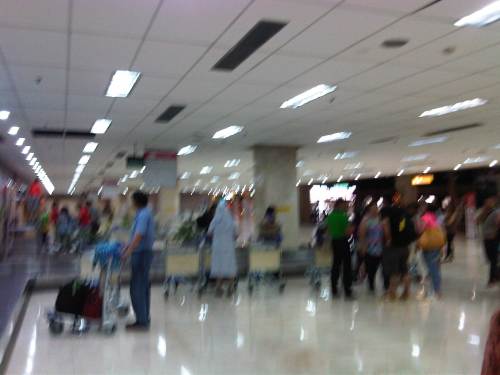 Passengers taking their positions to pick up their luggage from the carousel.
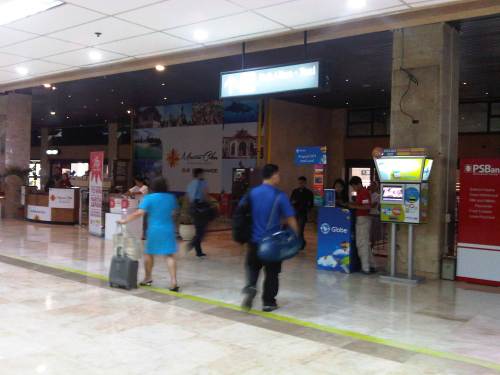 Tourist information, hotels and other counters and booths greet arriving passengers at the airport.
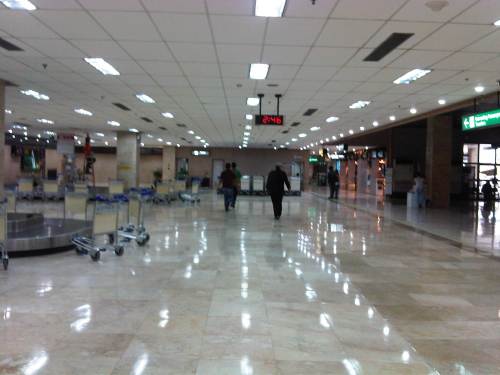 Spacious marble-floored baggage claim area
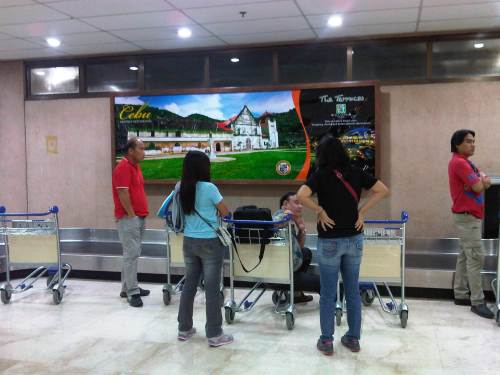 Passengers waiting for their bags to come out of the carousel.
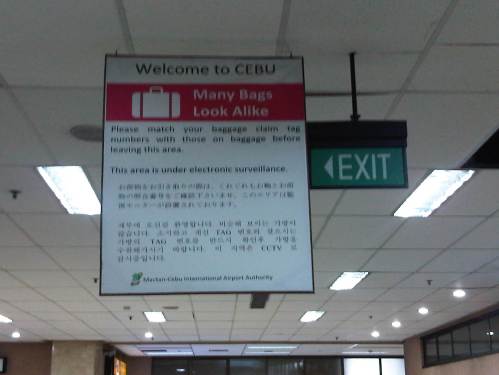 A friendly reminder to people claiming their baggage. The sign is in English, Japanese and Korean, indicative of the languages used by most travelers to and from Cebu. Similar to other airports in the Philippines, no one actually checks whether the baggage tags match the claim stubs with the passengers. Fortunately, people are honest and there have been none or minimal incidents of mistaken luggage.
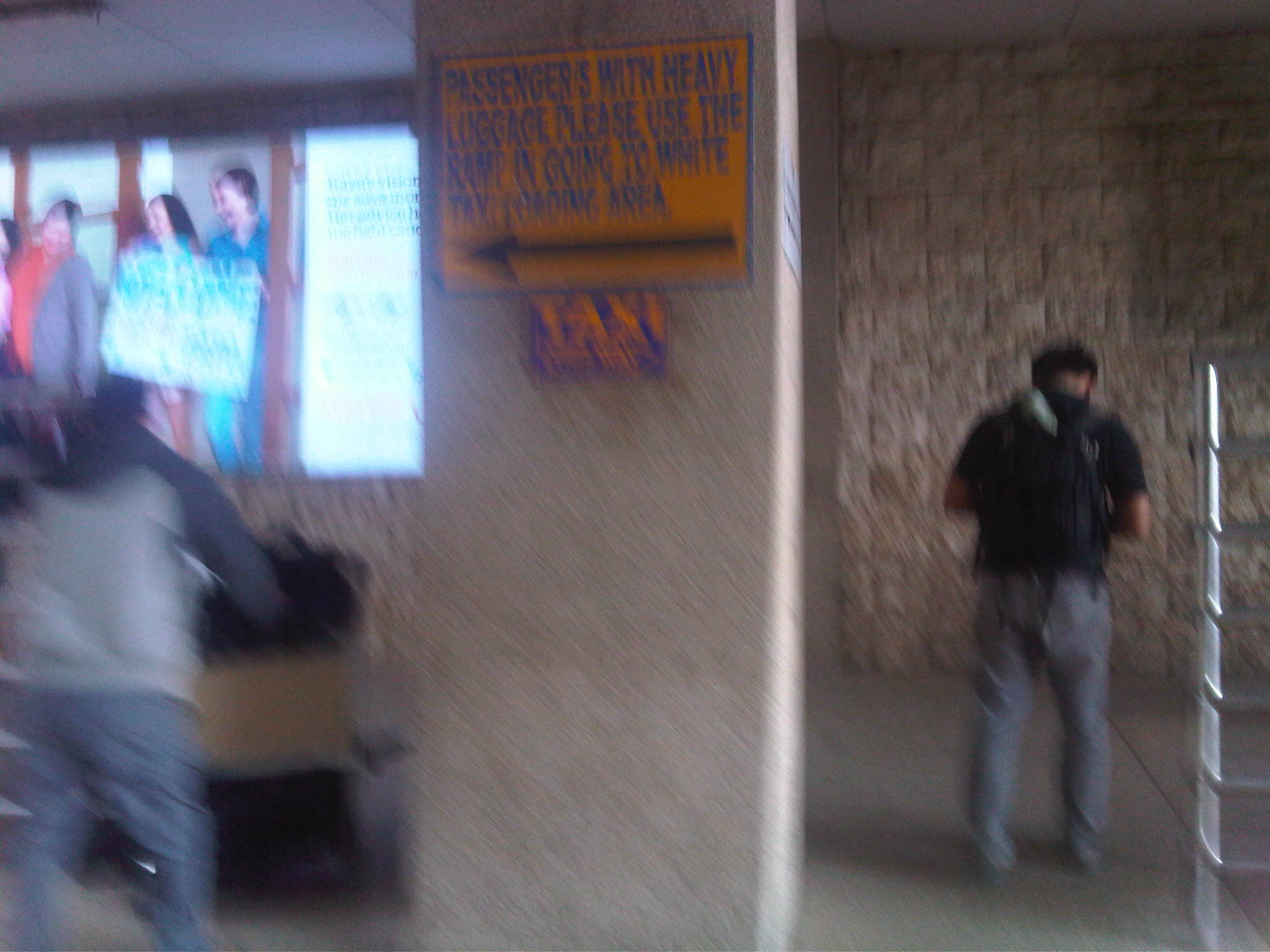 To get to the taxi stand, you have to cross the driveway as you get out of the arrival area. There are signs to guide you to the taxi stand where airport security provides assistance to passengers as they board the taxis. I took this photo in a hurry so its blurry. The taxis stand is to the right and up a short flight of stairs. The arrow on the large sign in the photo show the way to a ramp to the taxi stand for travelers with heavy or a lot of luggage.
In the next posts: Getting a taxi at Mactan Airport and Mactan Airport departure.
–
Comet – rare sightings
A colleague was saying that he has not seen the Comet, a jitney-type vehicle currently plying the SM North – Katipunan route via Mindanao Avenue and Commonwealth Avenue, for quite some time. I shared the same observation and this is based on my regular commute that includes travel along Katipunan Avenue. The Comet is becoming, if it is not yet, a rare sighting even considering its relatively long and apparently convenient route. The route passes through residential and commercial areas and would be a direct, single ride for students in particular of three major schools in the Katipunan area – UP, Ateneo and Miriam. It also connects to 2 large malls, SM North and Trinoma, and 2 rail stations, LRT 2 Katipunan Sta. and MRT 3 North EDSA Sta. Despite these traffic generators along its route, it seems that the Comet still has less than the desired ridership. I say ‘seems’ because I currently don’t have the hard statistics on ridership but only observations from those who have seen the vehicle along its route.
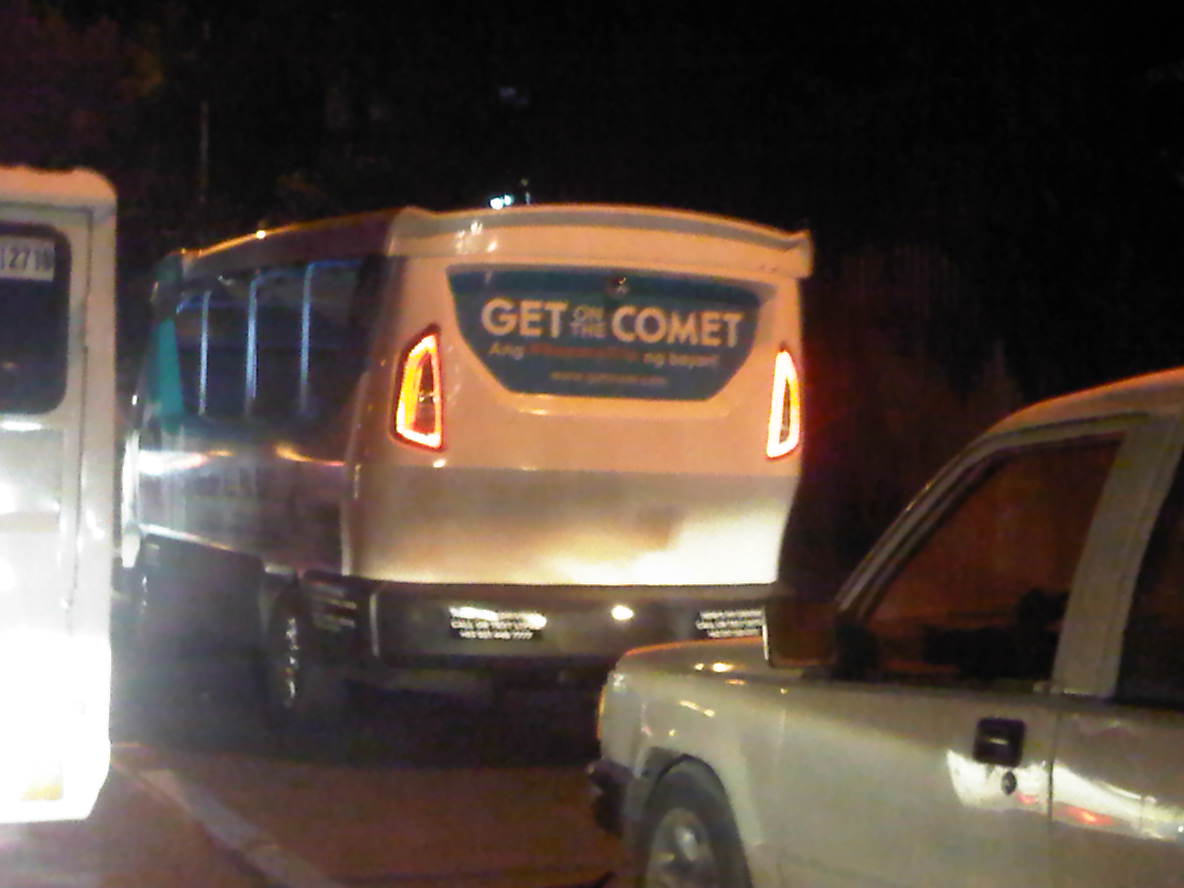 I saw this one on my way home last December in heavy traffic as our jeepney approached the Katipunan – C.P. Garcia intersection. It had few passengers considering its long route from SM North EDSA to Aurora Boulevard via Katipunan Ave.
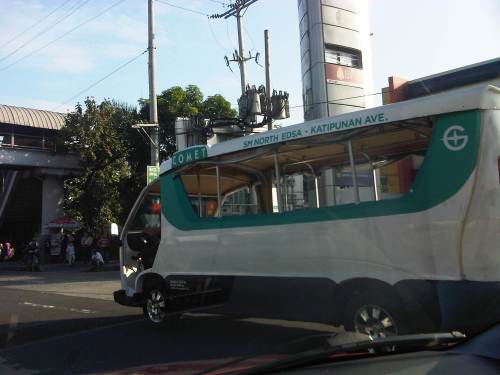 An almost empty Comet spotted one morning this January along Katipunan
What is the future for the Comet? It is unclear so far despite the hype and claims that this is supposed to be the vehicle to replace the conventional jeepney. (To be fair, this is what was also said of the e-jeepney that precluded the Comet.) The DOTC does not have a clear and firm policy or commitment to making this work. Its pronouncements have so far been towards deploying the Comet along new routes instead of replacing existing jeepneys on existing routes with this low emission vehicle. I believe that the only way for the Comet to work is for it to be mainstreamed as a replacement for the jeepney and along suitable routes, of course. The DOTC could and should review jeepney franchises to determine how the Comet and other similar low emission vehicles can be phased in over a realistic period in order to modernize public transportation currently being supplied by conventional jeepneys.
I recently noticed that there are jeepneys along Katipunan bearing tarps on their sides stating “No to additional jeepneys.” Underneath are the names of three jeepney groups supporting this call but with the exception of a major jeepney group that’s supposed to be supportive (even owning several units) of the Comet. Are the signs a form of resistance to change? Do the groups know or understand what they are saying and what they stand for? Or are these indicative of disagreements among jeepney groups, operators and drivers regarding the future of their operations using conventional jeepneys?
There will surely be resistance from these sectors if there are changes to be made that will affect their sources of income. It is a very daunting and sensitive task to decouple transport and livelihood in the Philippines. However, the issues coming out of such changes to improve public transport services should be met head on rather than skirt them, particularly in the case of the agencies responsible for these services – the DOTC and the LTFRB. Only then can we have the transformation we need for road-based public transport in this country.
–
Overnight parking at the NAIA T3 multi-level parking facility
Many have been asking about the overnight parking rates at the Ninoy Aquino International Airport (NAIA) Terminal 3 and I had wanted to write on this but just didn’t have the material to share with readers of this blog. I had wanted to verify for myself the overnight parking rates at Terminal 3 but had not used the Terminal for my flights last year, which had me using all except Terminal 3 for my travels. Last weekend, I finally had the chance to check the parking rates as I left my vehicle at the airport for a weekend getaway before school (and work) starts for the second semester at the university.
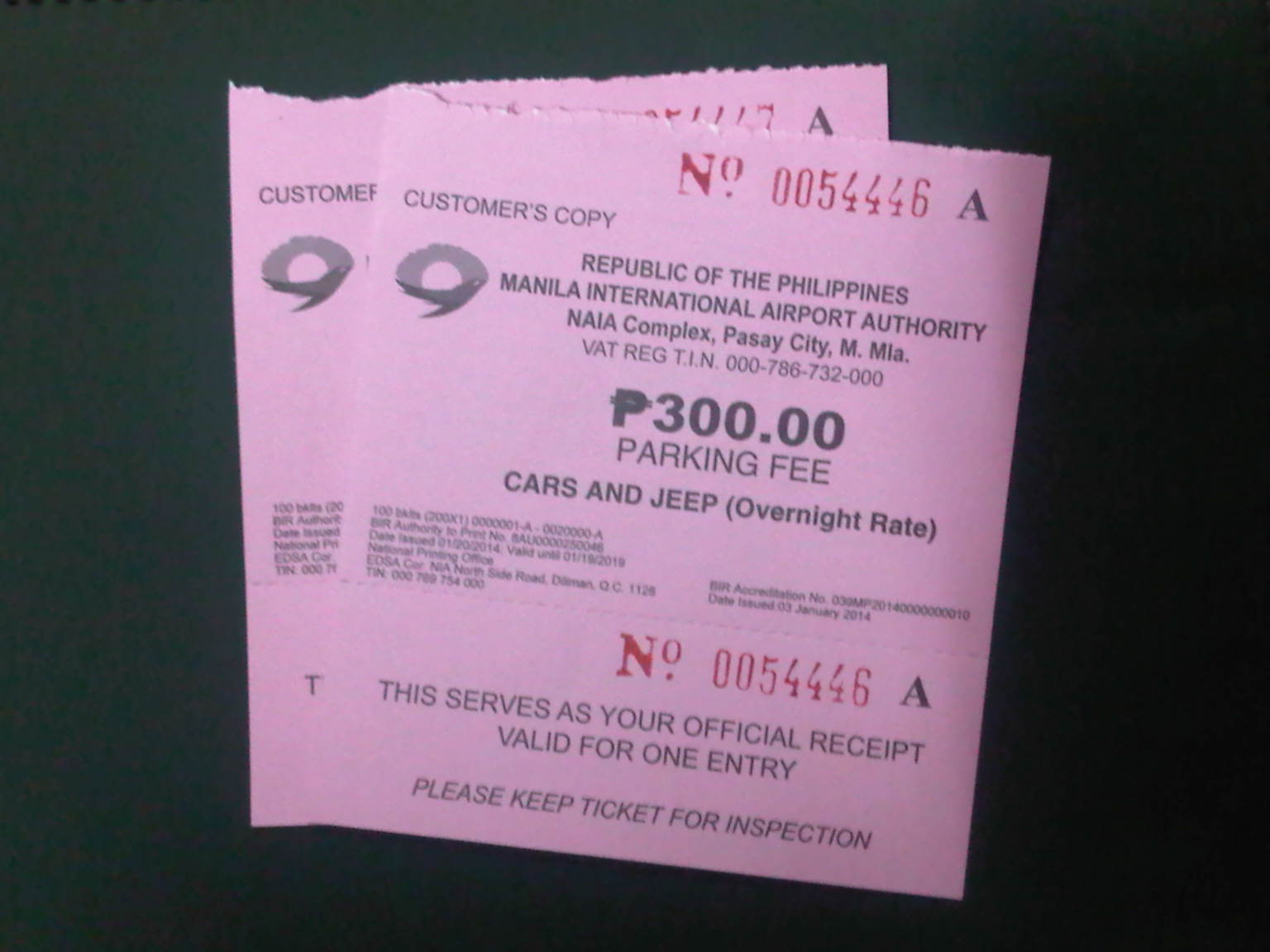 Parking tickets issued at NAIA Terminal 3’s multi-level facility.
The parking fee is 300 pesos per night. This is a fixed rate and you don’t have to pay additional fees for when you exceeded the hour when you parked your vehicle. That is, even if you parked your vehicle at 7:00 AM the previous day and took it out at 5:00 PM the following day, you still get charged 300 pesos and NOT 300 pesos plus a charge for exceeding 24 hours parking.
For those parking at the multi-level facility, one just has to drive through the arrival level (ground) of NAIA T3 and turn right near the end of the driveway to enter the facility. I haven’t checked if the access at the departure level is open (perhaps a reader can verify this?) but they do have security checks between the parking facility and the terminal itself so people can go directly to the parking area without dropping off their companions and luggage at the terminal. You don’t have to drop-off your companions and luggage at the departure level and then go around the airport road again just so you can park your vehicle at the multi-level facility.
–
The Metro Manila Transportation Planning Study II (JUMSUT II)
Similar to the previous JUMSUT Phase I, the recommendations of Phase II focused on route structure planning and improvement for road public transport to avoid unnecessary competition between LRT, bus and jeepney. Recommendations for route structure planning included the modification of route schemes for the central eastern sector of Metro Manila mainly to alleviate traffic congestion and improve schedules. The study reiterated the recommendations of Phase I.

Following are more photos showing the recommendations of JUMSUT II:

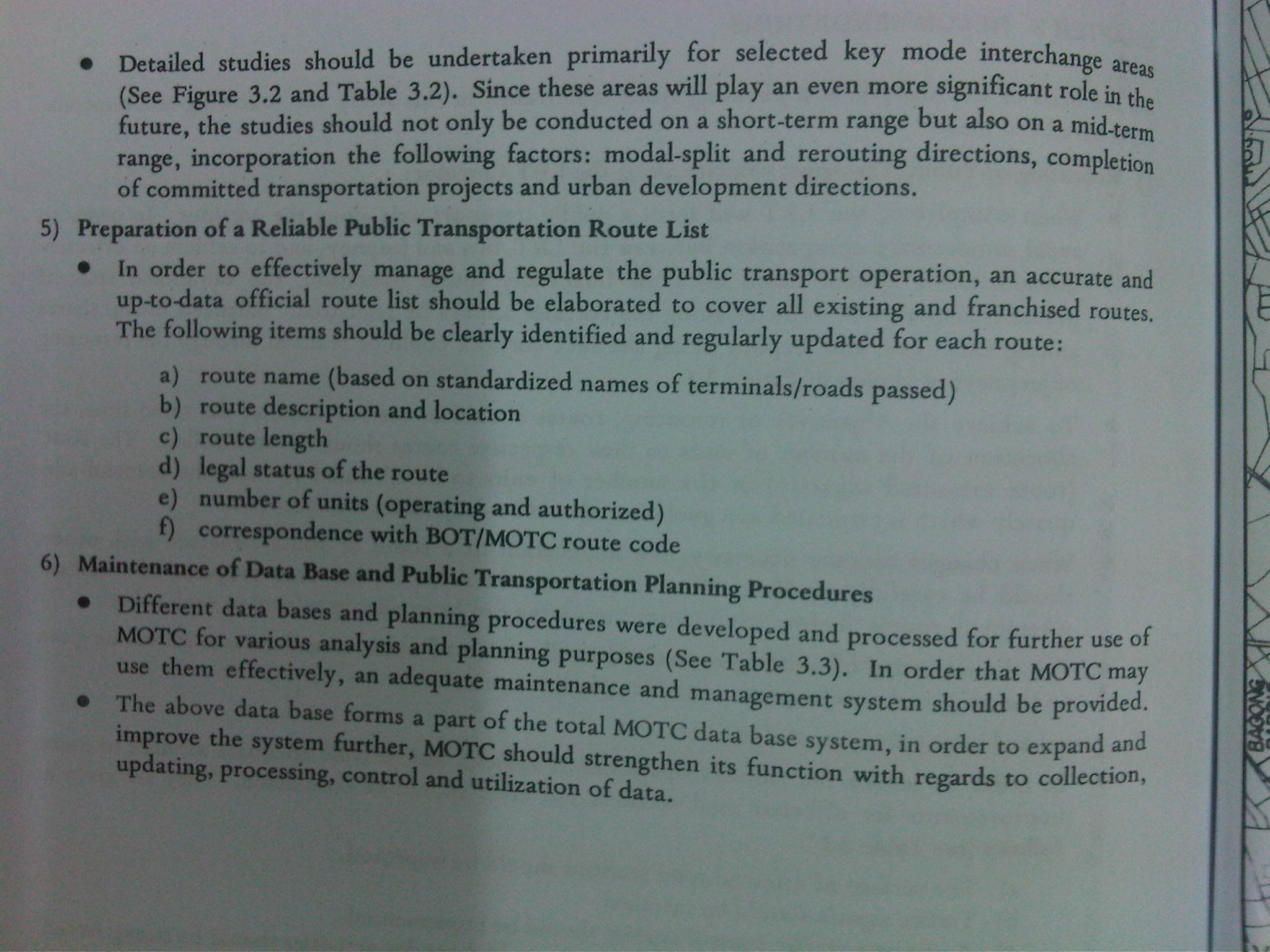
[Reference: JUMSUT II Final Report, NCTS Library, University of the Philippines Diliman]
–
The Metro Manila Transportation Planning Study I (JUMSUT I)
I continue with the series of posts I had started last year on past studies conducted for Metro Manila. It is important to review these studies in order for us to understand how transport in the metropolis came to be how it is now. I believe there are many lessons to be learned and history does not need to repeat itself (although as we can see, it has in as far as transport in Metro Manila is concerned).
The Metro Manila Transportation Planning Study better known as the JICA Update on Manila Study on Urban Transport (JUMSUT) was conducted in two phases, the first one from November 1982 – March 1984 and the second from June 1984 – March 1985, respectively, as a follow-up to MMUTSTRAP. JUMSUT focused on studies to support the implementation of the LRT Line 1 project along Rizal and Taft Avenues.

Recommendations of the first phase are mostly on the rerouting of public transport vehicles along LRT corridor and the traffic management required for the construction and eventual operation of the LRT Line 1. The rerouting is presented as a necessity to avoid unnecessary competition between LRT, bus and jeepney as well as to achieve balanced mode share among LRT, bus and jeepney along the corridor. Following are photos showing a summary of recommendations for JUMSUT I.

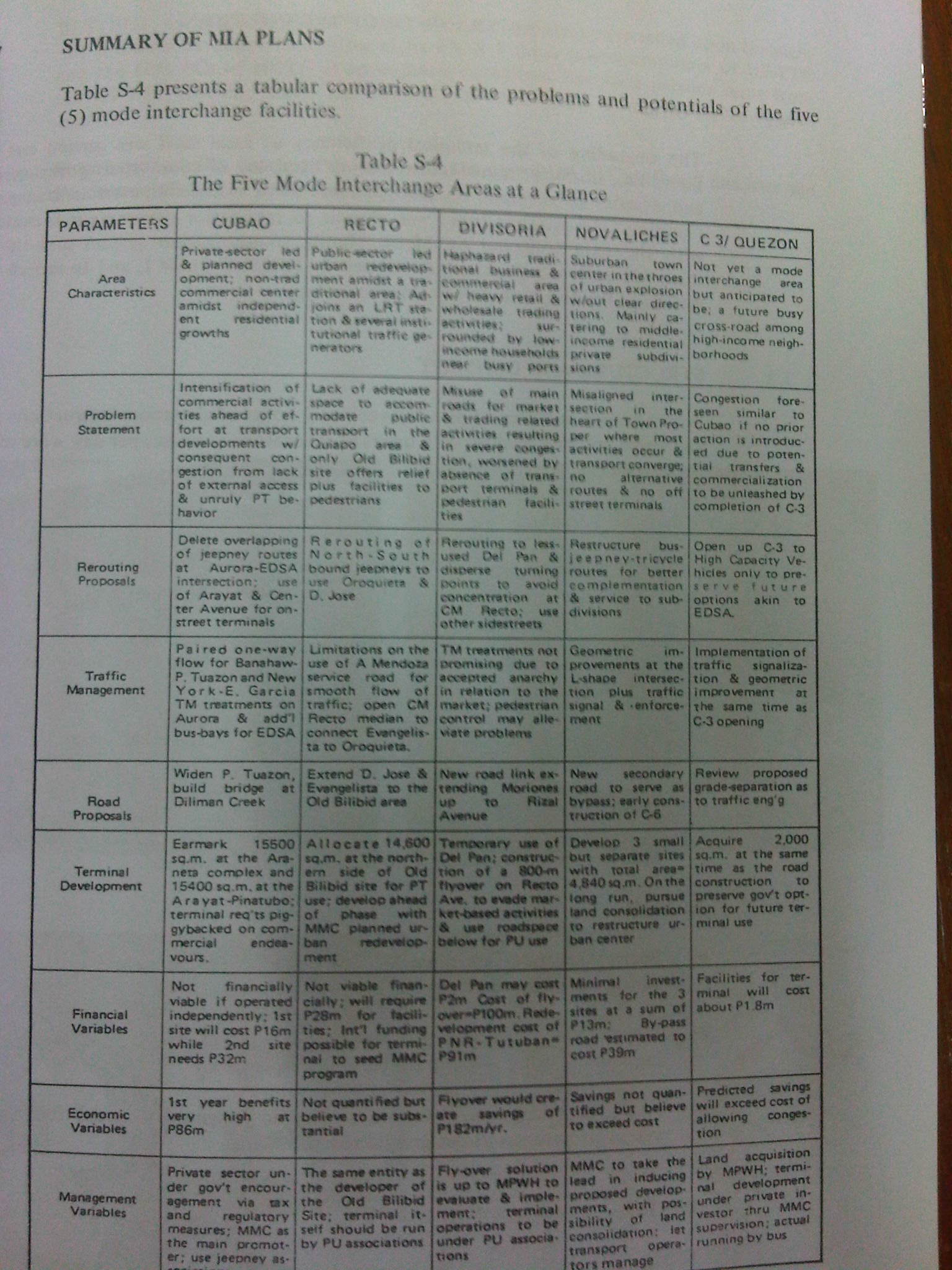
[Reference: JUMSUT I Final Report, NCTS Library, University of the Philippines Diliman]
Next: JUMSUT II
–
 Caught (up) in traffic