
On the new vehicle plates in the Philippines
A lot has been written about the new license plates being issued by the Land Transportation Office (LTO) for vehicles. I have read and heard many opinions or explanations from officials, experts and pundits about how the current license plates were better than the old ones due to its security features. As well, I have heard the opposite – criticisms by similar officials, experts and pundits usually focusing on the flaws of the new plates compared to the previous ones. They do agree on one thing, that the 4 numbers now appearing on the new vehicle plates issued to vehicles registered from January 2014 (5 numbers for the new motorcycles) are a necessity due in part to the rapidly increasing number of registered vehicles in the Philippines. Of course, the delays in the actual issuance of the plates themselves for new vehicles is another story.
Green plates are for private vehicles (not for hire). Red plates are for government vehicles. Blue plates (with only numbers and no letters) are diplomatic plates. Orange plates are the newest type of plates and were issued to electric vehicles. These solid orange plates and not of similar design to those bearing the Rizal Monument. Yellow plates are for “for hire” vehicles including public utility vehicles like buses, jeepneys, taxis and vans-for-hire. Recently, there were actually two types of yellow plates. One type used the design with the Rizal monument in the middle and these were issued to limousines such as those operated by hotels and tour companies. The other is the solid yellow plates (no Rizal Monument) that were issued to PUVs.
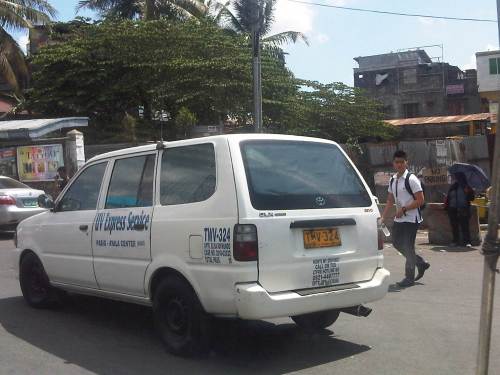 UV Express vehicle with the solid yellow plate.
The new plates issued by the LTO are black and white – basically black lettering on white plates. Recently, friends have been telling me about their seeing the new black and white plates on taxis. I had thought that this shouldn’t be the case since PUVs like taxis are supposed to have distinctive color (yellow) plates in order for illegally (so-called colorum) operating vehicles to be spotted easily by authorities. It turned out that the LTO under the previous head of the agency did away with the yellow plates in favor of what they claimed to be more sophisticated new plates. My reaction was that this was absurd and visual identification (i.e., seeing the color of the vehicle’s plate) is still the easiest was to spot colorum vehicles. I had wondered, too, how the LTO came up with that obviously flawed decision and if they consulted among law enforcement agencies like the PNP who would be tasked to apprehend illegally operating road transport.
 Such incidence of green plates on public utility vehicles were a no-no (illegal) in previous administrations. I assume that this one is “temporary” in the absence of what were phased out yellow plates.
Fortunately, the LTO led by its current chief has decided to bring back the yellow plates. These will probably follow the new plate design but with yellow instead of a white background. Hopefully, all legitimate PUVs will have these yellow plates instead of the “temporary” private plates many have been issued. These will aid in the enforcement of regulations pertaining to PUVs and will help weed out colorum vehicles.
–
A tale of two consultants
I attended a seminar last November where there were two foreign consultants who gave talks about public transport and the reforms required for Metro Manila. One consultant had extensive experience in public transport, having worked in Hong Kong and Singapore, and is currently a consultant in Jakarta. The other appeared to have the more limited experience but claimed credit (I think partial at best) for public transport reforms in a major Asian city. I was impressed by the first in part because he was very honest with his statements especially as he explained a list of prerequisites for fixing public transport in Metro Manila (and other large cities). The bottomline from his presentation was that it was not possible to have a quick fix and there are no easy paths towards solving public transport problems in Metro Manila and elsewhere in the Philippines.
The second consultant was more on the patronizing side – promising a lot and a little too optimistic to be realistic or practical in his presentation on how to solve Metro Manila’s public transport woes. His material was hodge-podge at best with lots of visuals but not really getting to the point in terms of concrete solutions. It only betrayed his very limited if not unfamiliarity with transport and traffic in the metropolis despite his being a consultant with the office of the highest official of the transport department. There is a saying that if something seems to good to be true, it probably is. I think the same applies to what the second consultant presented to us that morning.
We need more of the first type of consultants who will tell us how it really is with regards to the “challenges” we face in solving transport and traffic problems in this country. The second type just lets us into a false sense of confidence or a feeling that the problems are not so big or complicated and that we are not in a big, deep hole that we need to climb out of. Its one thing to throw caution to the wind and another to have oneself firmly grounded in terms of the understanding of the problem at hand. Understanding the problem is the first step in the formulation of suitable alternatives and allows for the elimination or at least the minimisation of non-practical and non-realistic options.
–
Challenges concerning pedestrian overpasses
A photo went viral over social media last year about power lines jutting out of a pedestrian overpass in Metro Manila that also happened to be a steel structure. There are others like it that were constructed with the implementors not paying attention to the details, that is referring to the power and communication lines or cables that are practically everywhere in Metro Manila and other cities. I give the designers the benefit of the doubt as they likely did the designs assuming there were no constraints such as the overhead cables and wires.
Over the holidays, we observed some very crowded overpasses along Commonwealth Avenue particularly those at the Fairview and Litex market areas. Here’s a photo of one very crowded overpass where pedestrians seem to be walking single file in two directions:

It is clear in the photo that the main reason for the very crowded overpass is the presence of vendors on the overpass itself. This seems to be the case in many other overpasses in other commercial areas (e.g., Quiapo, Ortigas, Cubao, etc.) where vendors practically occupy half of the area along the overpass thereby constricting the space people can use to cross the road beneath it.
Who is in-charge of these overpasses? Do local governments or the MMDA tolerate such practices by vendors? I already answered the first question – the MMDA and local government units are in-charge and are responsible for keeping these facilities clear of other activities other than pedestrians using the overpass to cross the road. I recall that there are actually ordinances with the MMDA and the respective LGUs pertaining to the proper use of overpasses and there are actually penalties for vendors and others setting up shop on these facilities. Judging from the scenes atop the overpasses that we see every day (e.g., the photo above), it is clear that the people in-charge are neglecting their work (surrender na?) and this is clearly an inconvenience to pedestrians, many of whom can also be seen crossing the wide Commonwealth Avenue and risking their lives and limbs as they evade motor vehicles including zooming buses along the highway.
These are examples of challenges that pedestrians face everyday and something authorities should be urged to act on and immediately and decisively. Such action should not only be for the case of overpasses but to sidewalks and other pedestrian facilities as well. These have significant implications to road safety as well as the efficient use of transport facilities and improvements will surely enhance quality of life as well. We cannot claim to promote walkable communities if we fail to deliver on the spaces that are supposed to be for walking. And we cannot promote healthy cities without having such spaces for people to be encouraged to walk.
–
Transport wish list for 2015
Last year, I opened with a very hopeful post on opportunities with certain mass transit projects that were hyped to be starting construction in 2014. The year 2014 went by and practically nothing really concrete happened (Yes, there were soil tests conducted for the LRT 2 extension but after that nothing else happened with the project.) with respect to these very critical mass transit projects that were already much delayed. It’s the same thing again this year so that same blog post from Jan. 1, 2014 applies this year.
I will not write down a list of New Year’s resolutions for the transport-related government agencies to adopt this 2015 though that stuff is quite tempting to do. Instead, I will just rattle of a wish list that includes very general and very specific programs and projects I would like to see realized or implemented (e.g., start construction) within the year; preferably from the first quarter and not the last. For brevity, I came up only with a list of 10 items. It is not necessarily a Top Ten list as it was difficult for me to rank these projects.
1. LRT Line 2 Extension from Santolan to Masinag
2. LRT Line 1 Extension to Cavite
3. MRT Line 7 from Quezon City to San Jose del Monte, Bulacan
4. Cebu BRT
5. People-friendly road designs
6. Integrated fare collection system for Metro Manila trains
7. Bikeways in major cities
8. Any mass transit project for Davao City or any other major city outside of Metro Manila or Cebu
9. Northrail or whatever it is that will connect Metro Manila with Clark
10. Protection of heritage homes and sites along highways and streets
The reader is free to agree or disagree with the list or to add to the list. I’m sure there are a lot of other projects out there that are also quite urgent that are not on my list but are likely to be equally important.
–
On delayed flights in the Philippines
I participated in a conference held in Puerto Princesa, Palawan last November and both my flights to and from Puerto Princesa were delayed. The first one was delayed by 1 hour. We boarded on time and there were no announcements of delays. However, we sat inside the plane for about an hour including taxiing towards the runway and then waiting in queue before we were cleared for take-off. The pilot was constantly on the PA system though, informing passengers about the cause of the delay, which was airport congestion. This was a reference to the many take-offs and landings (departing and arriving aircraft) being handled by the airport at the time. It seems air traffic control could not cope with the number of aircraft departing and arriving at NAIA even considering the airport had two runways that were operational (We took off using the secondary runway.).
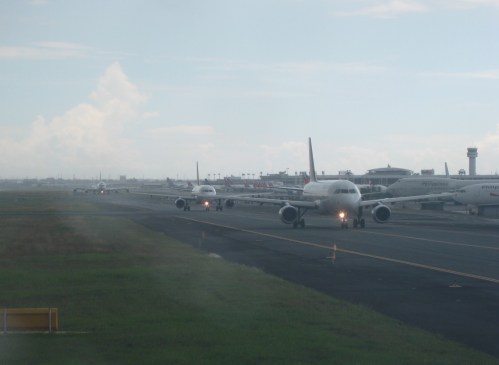 Aircraft taxiing towards NAIA’s main runway in preparation for take-off
I won’t mention specific airlines as I think domestic flights by all airlines have been incurring significant delays and not just recently but among the main possible reasons for delays that can be charged to the airline are the following:
1. Airport congestion – This can refer to either the runway or the passenger terminal. However, for the latter case you can have examples of very congested or crowded terminals of airports that have planes taking off and landing on time. Tagbilaran and Roxas Airports are like that, and Mactan (Cebu) and Bacolod-Silay have passenger terminals that are becoming if not already congested. Thus, airport congestion as a reason for delays must be due to runway operations. A single runway airport will handle fewer flights compared to those with multiple runways. Airport runway design and configuration are influenced by many factors but given any single runway in a major airport like NAIA it is already assumed that these factors are already considered in operation and on a typical day under normal or even favorable conditions, the only other significant factor for runway operations is air traffic control. Air traffic controllers would be responsible for guiding arriving flights and clearing planes for take-off. The number of take-offs and landings will also be significantly affected by how air traffic control “queues” planes in the air and on the ground.
2. Too many flights – Airlines tend to maximize the use of their aircraft and seem to be scheduling more flights that they can handle. This results in the very common “late arrival of turnaround aircraft” reason that airlines announce as the reason for delayed flights. Granted, in many cases this is ultimately due to reason #1, it seems that other airlines that have lesser flights also have less problems of this kind. In fact, I have observed that in many if not most instances, international carriers do not incur as much delays as local carriers and among local carriers there seem to be a unanimous observation on which “planes are always late” these days.
It seems at first that the main issue is not necessarily airlines overbooking their flights since air traffic control and the number of runways can be major factors influencing the number of aircraft that can take-off and land during a particular period. However, one particular airline has a knack for offering a lot of flights that they obviously cannot handle with all the delays and cancellations they have been incurring to the consternation of a lot of travelers. Though I myself use the airline often due to the convenience of their schedules and frequencies, I too have been victimized many times of these delays including one flight to Singapore a couple of years ago when, instead of arriving in time for dinner I ended up arriving home just after midnight.
Recently, there have been calls for the airline and others performing like it to be penalized in order for them to realize how much inconvenience they have brought on to their passengers. I think this is right in order to send a clear message to airlines that safety and service come first before profit. Too many flights, no matter how convenient to the passengers in terms of schedule, is not a substitute for good quality service. Being a budget airline also does not excuse it from what a lot of people have branded as crappy service. This mentality of airlines reminds me only of similar mentality among bus and jeepney operators (land transport) but that’s another story.
–
Updates on the DOST’s AGT project
It’s been a while since I’ve written about the Automated Guideway Transit (AGT) system being developed by the Department of Science and Technology (DOST) through its Metals Industry Research and Development Center (MIRDC). Instead of “reinventing the wheel” in writing an update article, I will just point my readers to the “official” item from the DOST’s Philippine Council for Industry, Energy and Emerging Technology Research and Development (PCIEERD). The following link provides a very detailed update on the AGT project including the pre-feasibility studies being undertaken for where the system might be deployed:
Filipino-made Automated Guide-way Transit System (AGT) Eyes to Curb Air Pollution and Traffic
Unfortunately, there is no information on the locally-developed AGT undergoing rigorous testing towards certifying its being safe for public use (i.e., as public transport). There are few testing facilities for such vehicles including those in the US, Japan, Korea and Europe. The DOST needs to collaborate or engage a legitimate testing center that will objectively conduct the strict tests required to ensure the AGT is technically sound and therefore safe for use. Leap-frogging for these technologies does not mean one also can bypass certain requirements for standards and the DOST owes it to the people who will ride this transit system to have it certified – validating its motto “proudly Philippine-made.”
–
Travel the Philippines 2015: 20 Photos that will make you pack your bags and go – @Just1WayTicket
I saw this article being shared around social media about tourism spots in the Philippines. Given the push for more visitors, local and foreign, the government and its partners in the private sector have exerted a lot of effort and allocated much resources to improving the tourism in the country. This includes improvements to infrastructure as well as to the tourism industry itself. There are many nice places around the country including those off the beaten track. I think the following article does a great job of featuring a lot of the more popular spots as well as many that are not usually in the typical itinerary of travel agencies:
Travel the Philippines 2015: 20 Photos that will make you pack your bags and go – @Just1WayTicket.
Some thoughts on transportation heritage in the Philippines
There have been a lot of buzz about heritage conservation and especially the past few weeks about certain buildings in Manila. A lot has been written about this in newspaper columns and blogs, and there have been features on television about heritage conservation focused on buildings, mostly houses, in Negros, Cebu and Panay. Of course, the most prominent heritage project has just been recognized as a wonder of the world in the city of Vigan, Ilocos Sur. I think another area for consideration in heritage discussions is transportation. We do have a lot of historical routes consisting of roads, railways and even trails that could be preserved or enhanced and not just for commercial purposes but more importantly for the current and coming generations to remember and learn about history and heritage.
The availability and accessibility of such tools like GIS, GPS and aerial photography using drones make it possible to do studies and documentation of transport routes such as the old rail line to Antipolo, the PNR’s Main Line North, the Bataan Death March, and even Aguinaldo’s retreat to Palanan, Isabela. There are also pilgrimage routes linked to the most popular shrines in the country like those in Baclaran, Quiapo, Antipolo, Cebu, Penafrancia and Manaoag.
The PNR and Panay Railway lines are good starting topics for transport heritage studies that may lead to some form of conservation. Following are a few photos taken back in 2006 when we surveyed the alignment for what was supposed to be Phase 1 of the Northrail project. The activities were preparatory for transport surveys that would have provided data that were to be used as inputs to estimating passenger demand for the railway line.
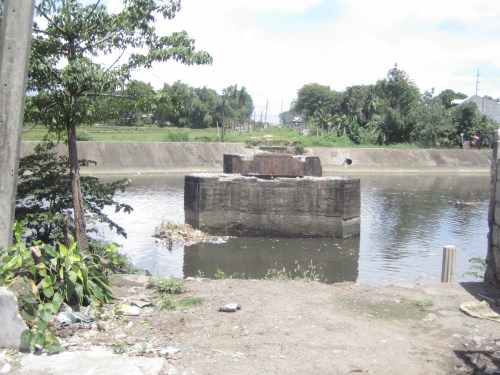 Remaining structures of an old PNR bridge in Bulacan.
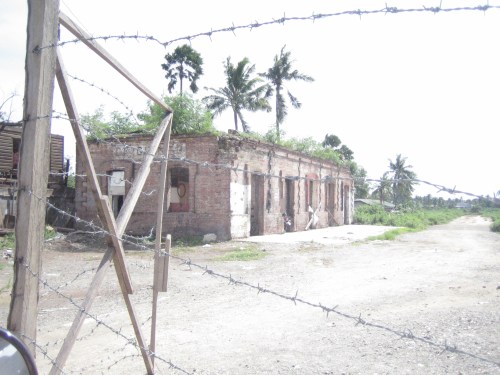 Old PNR station in Bulacan – I can’t recall if this were in Marilao or Bocaue but the red brick building reminded me of similar rebuilt and preserved buildings in Japan such as Tokyo Station and the warehouses at Aka Renga in Yokohama.
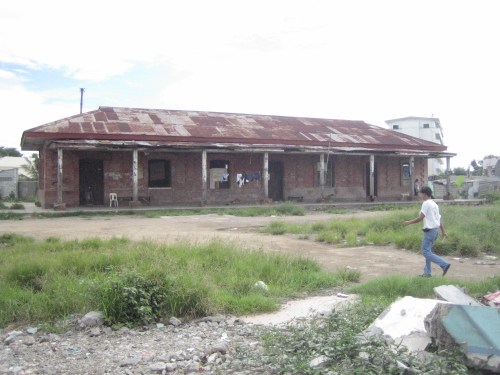 PNR Malolos Station back in 2006 – the building was occupied by informal settlers at the time.
A good reference for those interested in railway heritage and its conservation is a book entitled “The Colonial Iron Horse” by Arturo Corpuz and published by the University of the Philippines Press. There’s a lot of material in that book to get one started about rail history in the Philippines particularly for the island of Luzon and the two main lines of the PNR – the Main Line North and the Main Line South, which I have written about in previous posts. These could be good topics for interdisciplinary studies involving historians, sociologists, anthropologists, architects, engineers and specialist in other disciplines.
–
Conditioning
Was traffic really bad yesterday, Dec. 21, or was it typical Friday traffic? A lot of people have been talking or posting about how traffic last Friday was expected to be the worst of the year. Apparently, it was not.
Based on posts on my social media accounts yesterday, it seems that traffic was not at all that bad in many parts of Metro Manila, especially along roads that were expected to be hellish in terms of congestion. One post stated that it him only an hour to travel from Ayala to Trinoma by bus. People usually post about really bad experiences about traffic congestion and this crowd-sourcing approach is usually very reliable. I went home early yesterday and it didn’t take me long to travel between stops for errands I had to do along the way home. Media also would have reported about terrible congestion along major roads including EDSA, C5 and the expressways.
Statements like what the MMDA made prior to Dec. 21 are typical of a psychological approach that some agencies seem to have been resorting to in order to manage people’s expectations and perceptions. Conditioning people’s minds is not a new strategy or tactic. The MMDA has been doing this a lot for as long as I can remember, including during the stint of its former chair Bayani Fernando. Many if not most of these “conditioning” activities are done through media with the agency making statements through its officials about issues such as traffic, garbage and flooding. This is no different to the perception of one agency making frequent “power point presentations” (a reference to projects involving the private sector) to announce much delayed projects supposedly for immediate implementation.
One opinion is that this is a form of damage control. People will usually have strong opinions about what government is doing to address issues like congestion. For people not react too strongly against agencies that are supposed to be responsible for the problem, the same agencies have anticipated and preempted the manifestation of their ineptness by stating the obvious ahead of its occurrence. This would not have been necessary if the agencies did what they were supposed to do in the first place. Hopefully, in the near future such conditioning and other psychological tactics will indeed not be necessary once programs and projects are finally implemented and help alleviate or solve problems.
–
The worst traffic of the year on Dec. 19?
The Metropolitan Manila Development Authority (MMDA) issued a statement a couple of days ago in reaction to comments online and offline about how transport and traffic have gone from bad to worse in December and especially in the past week. The agency warned people about the worst traffic congestion of the year happening today, December 19, and media immediately branded it as traffic armageddon. Reactions on social media varied from the hostile, desperate, to resignation about their plight for their commute today.
The worsening congestion this time of year is actually part of a pattern, a cycle of ups and downs in terms of person, freight and vehicular traffic. In our case in the Philippines, we usually expect traffic to be bad during certain times of the year and in many cases along specific routes or roads. During the Undas period (All Saints and All Souls holidays), for example, we expect congestion along the expressways and other major roads connecting Metro Manila to the provinces to its north, east and south. During the first days of classes around June (for most schools), it is also expected that congestion will be severe along roads leading to and in the vicinity of schools, especially the big private schools that generate a lot of private vehicle traffic.
December is usually the worst month for traffic because of the increase in economic activity this time of year as people travel more like to earn a bit more income and for shopping. The end of the year also brings about a lot of culminating or concluding activities for offices and even schools so trip generation tends to increase for all types of trips. However, traffic has naturally increased every year and this refers to person, freight and, consequently, vehicle traffic. And so it is inevitable that transport and traffic becomes worse every year unless a major intervention is made in the form of a mass transit system along a specific corridor.
I am not sure if the MMDA or the DPWH keeps records of daily traffic so that we can have a quantitative basis for this. The LRTA and MRTC should have data on this based on ticket sales and the tollway operators would also have data on this based on their toll collections. Such information can provide a strong indication of which dates are the most likely for severe traffic congestion and perhaps allow for prediction and the provision of ample advice for commuters.
Will today be worse than the past few days and will it be the worst day of the year in terms of traffic? Or will Dec. 22, 23 or even 24 turn out to be worse than today’s traffic? Perhaps the statement from the MMDA is a way of psyching people about what could be the worst traffic of the year. This application of psychology may make people more aware of and therefore conscious about traveling today. This may actually lead to less traffic to the relief of many people. Or this may be a way for the MMDA to escape from blame considering they did make the statement ahead of today and this manner of “I told you so” basically excuses them from the public’s ire.
–
 Caught (up) in traffic