
DPWH and DOTC merger
I had posted on one of my social media accounts about the idea of a merger of the Department of Public Works and Highways (DPWH), Department of Transportation and Communication (DOTC) and Housing and Land Use Regulatory Board (HLURB) to become the Department of Land Use, Public Works, Transportation and Communication or DLUPWTC (that’s definintely a mouthful). While it was April Fool’s, I got a lot of comments agreeing with the idea. One friend even gave a short history review noting that DOTC used to be DPWTC and what is now DPWH used to be DPH.
The idea of a merger of agencies is not a new idea nor is it a novel one if you look at the potential more closely. In fact, the Japanese already did such mergers many years ago when they created “super ministries” in the Ministry of Economy, Trade and Industry (METI) and the Ministry of Land, Infrastructure, Transport and Tourism (MLIT) and the Ministry of Education, Culture, Sports, Science and Technology. These would be like merging the NEDA, DTI into one agency, the DPWH, DOTC, HUDCC, HLURB into another agency, the DepEd, CHED and DOST into a single entity. Such was undertaken in order to promote efficiency in government services in Japan by streamlining the bureaucracy among agencies that are supposed to have strong linkages if not overlapping responsibilities.
This idea makes sense for the DPWH and DOTC, and more so now that there seems to be a dearth in leadership over at the transport department while the public works and highways department is enjoying a resurgence, revitalized by a strong secretary. While these two agencies have cooperated for the longest time, much is still desired for a seamless collaboration where DOTC might serve as The Planning Agency while DPWH might be The Implementing Agency. They would probably work best under the guidance of a single strong leadership who would have a vision for a much improved future transport for the country and a knack for how to realize this vision.
Think about it and suddenly its not a joke worthy of April Fool’s Day.
–
“Sharing the road” – bandwagons and fads? Let’s hope not!
There seems to be a lot of talk about “sharing the road” and the initiatives to have more bikeways. I hope I am proven wrong but it seems to me as if these current programs and projects are more of a fad. A lot of people (and local governments) join the bandwagon with little understanding of what needs to be done. It’s usually because of the good PR they get out of these that they agree to coming up with the token carless street or the haphazardly implemented bicycle lanes. More than PR, some cities are aware of the opportunities that come with such initiatives as international agencies and groups are willing to spend money to support such programs and projects. The question really is on sustainability and doing the right thing not only on initiating things or coming up with programs but on the substance itself. And by substance I mean that programs should also go into the details of designs. Too often, the “pwede na yan” approach is taken and this just won’t do.
 The MMDA painted the sidewalks in White Plains and designated them as bikeways, in a way alienating pedestrians.
A vision for what people want to have is there but it is ultimately how the achieve the vision that needs a lot of work. For example, bills are being filed in congress to force the creation of bicycle lanes along major highways. (And mind you there are a lot of similar bills filed in congress that upon closer inspection actually have little substance.) The premise here seems to be that if you build them then people will start cycling. That was not the experience in Marikina, which boasts of the country’s only bikeways network that includes many off-street sections. These bikeways were built at a time when the perception and analysis pointed to a critical mass of cyclists in that city that was thought to be surely the tipping point in terms of non-motorised transport. Nowadays, the same bikeways are used by motorcycles and tricycles and most cyclists we see are not commuters (e.g., cycling between home and work/school) but recreational cyclists. It would take Marikina some effort to promote commuting by bicycles and much effort in enforcement to correct the misuse of the bikeways. The “new” bikeways in Quezon City appear to be poorly conceptualised as the MMDA decided to paint the sidewalks along EDSA northbound without addressing the obstacles like electric posts. Still, it is an effort to put NMT in the consciousness or awareness of the general public (thanks in part to media’s making these news worthy items).
Cities like Pasig and Taguig like to show-off Ortigas Center and Bonifacio Global City, respectively, as their faces when in fact the cities have not done much in their original cores. The running joke is that the real Taguig is not the areas to the west of C-5 but the old Taguig, which is to the east. This Taguig is the one plagued by narrow streets and the proliferation of tricycles. It was not so long ago that a former mayor imposed e-tricycles on BGC (where they were not suitable) while not doing much to lift a finger in the mayhem of tricycles in old Taguig (e.g., along Gen. Luna). As for Pasig, you just have go along the Pasig River and the Manggahan Floodway to see what it has accomplished so far in those areas.
There are no quick fixes to the transport and traffic problems our cities are facing. In the case of Metro Manila, much is at stake for the long-delayed mass transit projects. And the DOTC’s announcements of projects being formulated or proposed are no longer taken seriously as they have not delivered on any of these despite 4 years of this current administration. For other cities, it is important to learn the hard lessons from the experience of Metro Manila. There is also a need for a drastic change in transport and traffic policies in our cities. Iloilo, for example, has built an expensive bike lane along Ninoy Aquino Avenue (Diversion Road) and has marketed its Esplanade as a haven for pedestrians and cyclists. Yet the city has not acted on the clamour to revisit the overpasses along Gen. Luna (Infante and Jalandoni flyovers). The latest information I got from the city is that there are issues in the design of the bikeway along the Diversion Road as the surface (they used pavers) is not suitable for cycling. It seems, also, that the city and cyclists were not consulted by the DPWH when the bikeway was designed and constructed resulting in many cyclists using the Diversion Road itself for traveling. This last example is a lesson for our local governments and national agencies that they need to cooperate with each other and turfing has no place in transport and traffic if we are really serious about bringing solutions to problems we encounter everyday.
–
Public transport fare hikes
Bus and jeepney groups often demand for an increase in the fares every time there is an increase in the prices of fuel. The latest one is mentioned in this article via Rappler, where a jeepney group is to hold a protest caravan as they seek a discount on diesel for all public utility vehicles. The reaction from readers is an overwhelming “Annoyed.” And rightly so because while these protests appear to be noble and are often linked by jeepney groups to petitions for fare hike increases (i.e., asking for fare increases if they cannot be given fuel or petroleum product discounts), closer scrutiny of operating costs will reveal flaws in their arguments for fare hikes and discounts. These same flaws also reveal why government agencies charged with public transport franchising and regulation (i.e., DOTC and LTFRB) should have the data and tools for a fair assessment of fares (pun intended).
Data from field surveys conducted quite recently (NCTS, 2012) show us that jeepneys typically average around 3 to 4 km/L on diesel fuel. This is a very low value that is comparable to the income from passengers for one trip over a distance of say 4 km. A fully-loaded jeepney with an average of 20 passengers (9 on each bench plus 2 beside the driver) operating a 4-km route will 160 pesos. However, there are limited reliable information or data on other costs such as maintenance costs and other items including “boundary” and “dispatching.” The boundary is basically a rental fee for the use of the vehicle while jeepney groups charge a fee for dispatching vehicles from the terminal or stop. In a day’s operation, such costs could easily accumulate into a significant total that would eat up a day’s income, usually leaving the driver with just enough to bring home to his family.
This brings us back to the argument against transport being treated as livelihood rather than a service. Many operators or owners of public utility vehicles, whether they have one or more units, tend to scrimp on the maintenance of their vehicles. Poor maintenance manifests in the form of smoke-belching and frequent breakdowns. While smoke-belching contributes to the deterioration of the environment and health costs, breakdowns often lead to road crashes (e.g., tires flying off, problems with brakes, etc.) like the recent bus crash in the Mountain Province where faulty breaks were blamed for the crash.
Jeepney groups often raise issues on the plight of small operators who are usually the drivers of the jeepneys themselves. Many of these people should not even be operating or driving jeepneys in the first place because safe and efficient service is not their priority. Service is second only to the desire to generate income, to earn a living, which makes them drive the way they currently do (i.e., recklessly) and improperly and haphazardly maintain their vehicles. There is seldom serious talk and little done to protect the interests of people who take public transport. These are the same people who are often shortchanged with the poor quality of public transport in our cities and have long suffered for this. Let us hope that the LTFRB will be guided as they decide on this matter of fares and furthermore for the agency to study the state of road public transport franchising in order to weed out people and groups who do not deserve to be operators. I believe there is more than enough data or evidence against such operators if the LTFRB truly wants to reform the system.
–
Snippets of Manila streets and traffic
Coming from a forum held at a hotel in Manila, I took a few photos of scenes along our route back to the university. These are snippets of everyday scenes in the Philippines capital city, which now has for its mayor the former President of the country who was ousted back in 2001 for allegations of plunder. He has been on the news quite frequently as his administration has introduced traffic schemes intended to address traffic congestion in that city. These include going after buses without terminals in Manila last year and quite recently an expanded truck ban that renewed discussions about logistics and the Port of Manila (i.e., decongesting the port in favor of Subic and Batangas ports).
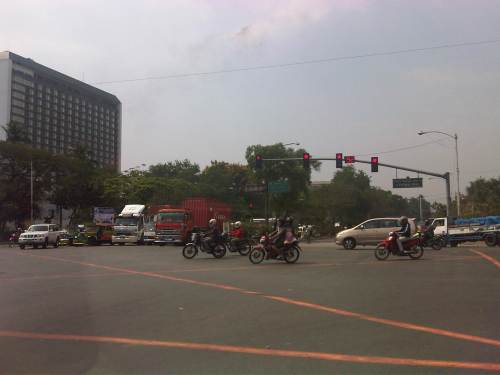 Traffic at the intersection of Bonifacio Drive, Roxas Boulevard and Padre Burgos Avenue. The trucks in the photo are coming from the Port of Manila and at the time this was taken, the window of the extended truck ban in Manila allowed these trucks to travel.
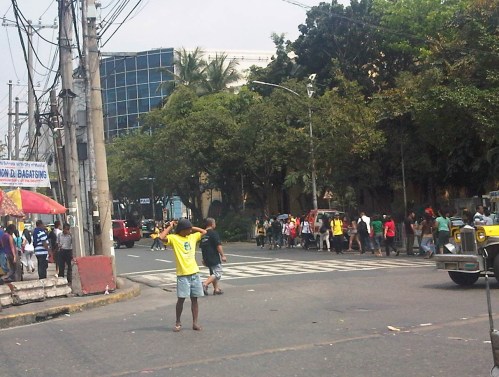 Barkers meet jeepneys head-on in the middle of the street just past Manila City Hall. A friend posted sometime ago that in Philippine streets, the uneducated dominate the educated and this seems so true in the case of public transport where barkers, paratransit drivers and their lot control how people should get a ride and how vehicles should operate.
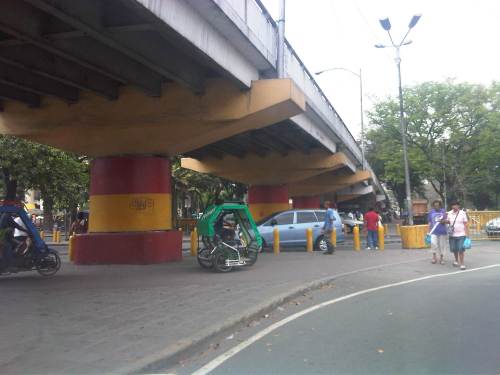 Organized mayhem – pedicabs run along most of Manila’s streets with many even traveling counter-flow. This photo was taken just across from the old, decrepit Metropolitan Theater just before the Quezon Bridge towards Quiapo.
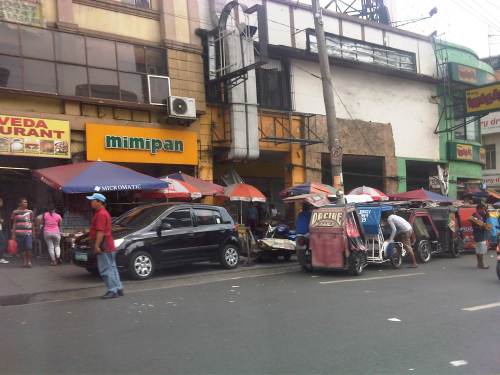 More pedicabs (also called padyak or trisikad), non-motorized 3-wheelers that notoriously violate traffic rules and regulations as they proliferate in many parts of the city.
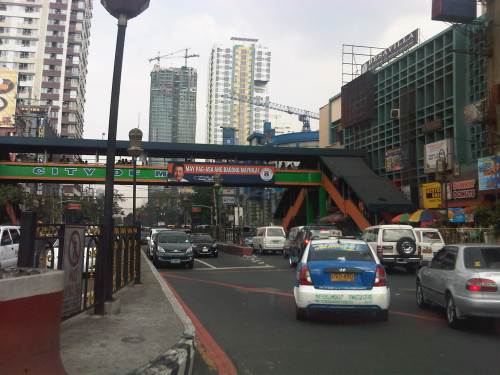 A sign stating “There’s hope for a new Manila.” with the face of former Philippines President Estrada, who was elected Manila Mayor last year.
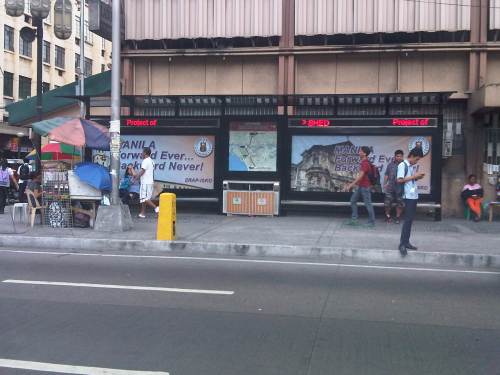 A modern public transport stop along the eastbound side of Espana Avenue shows a guide map and electronic message board that informs people who was responsible for the project.
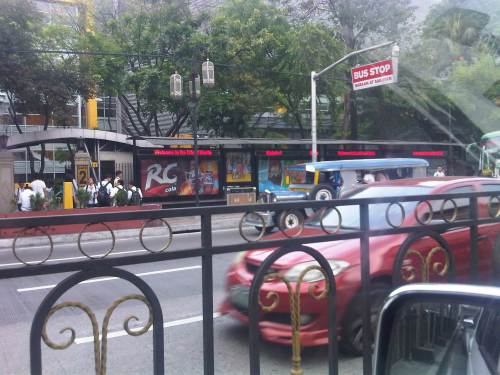 Another modern bus stop, this time just in front of the University of Sto. Tomas campus, which is along Espana Avenue.
 A side street to Espana Avenue reveals an on-street motorized tricycle terminal. There is a sign at the entrance to the street saying buses are not allowed along the road.
More on Manila in the next posts…
–
On sustainability and inclusiveness of pedicabs
“Sustainable transport is inclusive but inclusive transport is not necessarily sustainable.” Is this statement true? If yes, why and to what extent? This is not a philosophical take at transport. There seems to be some conflict in that statement but there should really be no confusion once you delve into the essence of sustainability and define the limits of inclusiveness. The statement is true to the extent that all sustainable forms of transport can be inclusive. These are transport modes that are friendly to all genders, all ages, all economic classes, and regardless of physical ability. However, there are transport modes that are inclusive in the same context stated but are unsustainable from the perspectives of suitability, efficiency and energy.
For example, non-motorized transport (NMT) in the form of pedicabs (also called trisikad or padyak) are sustainable from the perspective of energy. They are most suitable for operation along minor roads, especially those in residential areas. However, if the same pedicabs operate along national roads and mixed with motorized traffic, these become a nuisance and contribute to traffic congestion. Such operations also put passengers at risk, exposing to potential crashes as pedicab drivers tend to violate road traffic rules (e.g., moving against traffic).
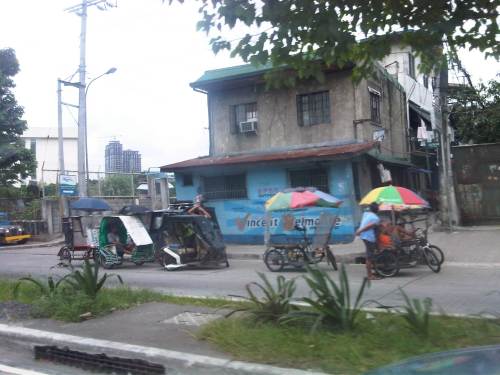 Pedicabs along the Quezon Avenue Service Road near Agham Road.
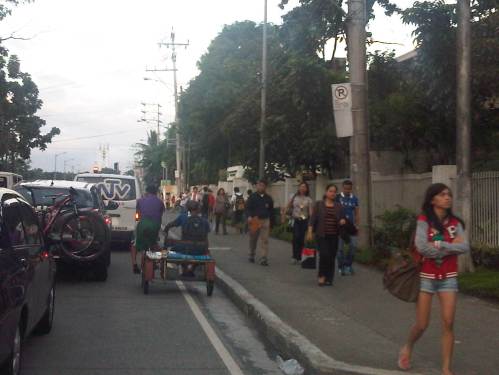 Pedicab ferrying passengers from the Quezon Ave. MRT-3 station to destinations along Agham Road.
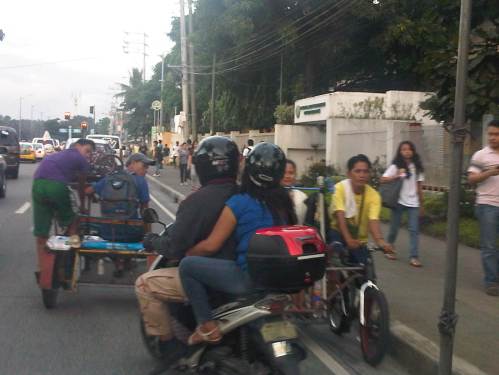 Counter-flowing pedicab along Quezon Ave. just outside the National Grid Corporation (formerly Napocor) office.
Pedicabs have another dimension, which is often cited as a reason for its very existence. It is a source of livelihood for many people. Whether this is something that needs to be encouraged is the subject of debates often involving discussions on poverty and governance. That is, pedicabs are often owned and/or operated by low income people and their numbers translate into votes for local officials who tolerate pedicabs and even encourage them as a form of livelihood. It is, after all, like the jeepneys and tricycles before it, supposed to be a simple investment that generates income for the owner/operator/driver. People have glorified or romanticized the pedicab as various designs have displayed the creativeness (or even artistry) of the Filipino. However, just like other modes of transport, the pedicab should function within a hierarchy based on its suitability with respect to other modes that are similarly appropriate for a certain range of conditions. Hopefully, such concepts are understood by stakeholders if only to effect the rationalization of transport services and correct certain notions pertaining to inclusiveness and sustainability for such modes.
–
Narita Terminal 2 Arrival
On our most recent trip to Japan, we took Philippine Airlines instead of the usual Delta in our previous trips. For one, PAL offered full service at a competitive price (Delta and JAL were more expensive) and the new schedules meant we could fly to Narita in the morning and arrive there early afternoon, and return to Manila in the evening. This was practically Delta’s schedule. It also helped that PAL was using NAIA Terminal 2 so that meant a better terminal for us compared to the congested and dilapidated NAIA Terminal 1. Of course, there were other choices including ANA, which I would have preferred if only it wasn’t so expensive even compared to JAL. Low cost carriers were also not on our list as we had the budget for full service and we didn’t like the schedules.
We arrived at Narita after a smooth flight and our plane proceeded to Terminal 2, which most Asian airlines use. I have not used this terminal for quite some time now as I usually planed in via Delta or its predecessor Northwest. The last time I was in Terminal 2 was in 1999 when I was returning home to Manila after 3 years in Yokohama, Japan. That time, I used JAL as part of my benefits of being a Monbusho scholar.
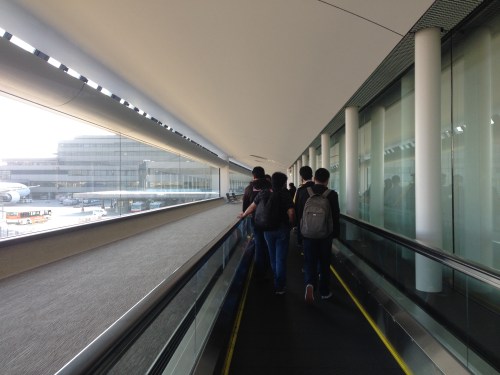 Moving walkway or “walkalator” to the arrivals area for immigration processing.
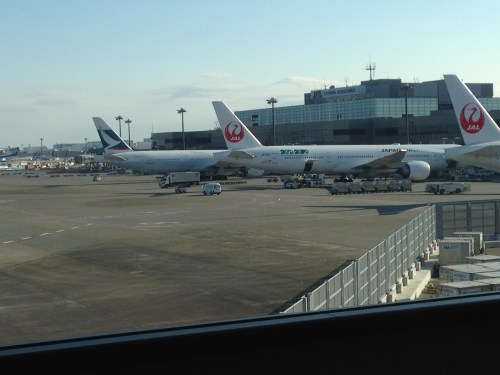 A view of aircraft docked at the airport shows a couple of JAL planes and one of Cathay Pacific. I like JAL’s old logo compared to its new one. This retro look gives you a feeling of nostalgia.
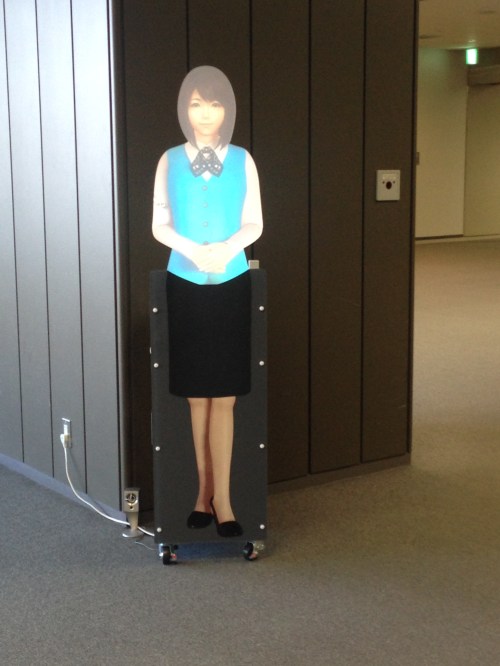 A computer-generated, anime image of an airport staff member greeting arriving passengers to Japan.
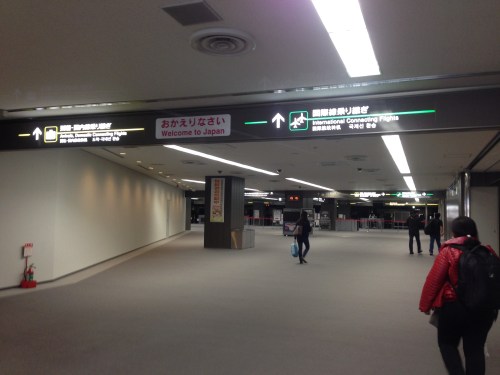 Entry towards the immigration counters
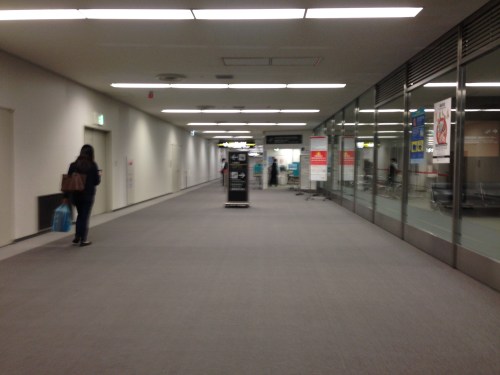 Past immigration and proceeding towards the baggage claim area.
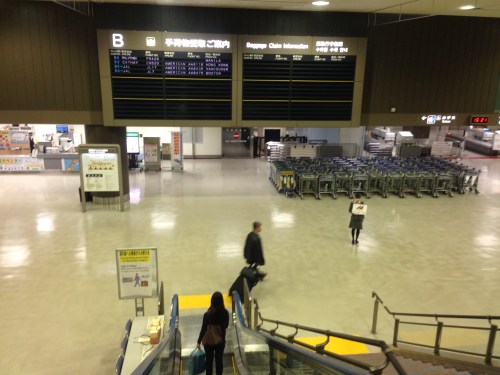 Descending to the baggage claim area, passengers are provided information on a huge board on which carousel their baggage will be coming out of. To be sure, ground staff hold a placard directing PAL passengers to the assigned carousel.
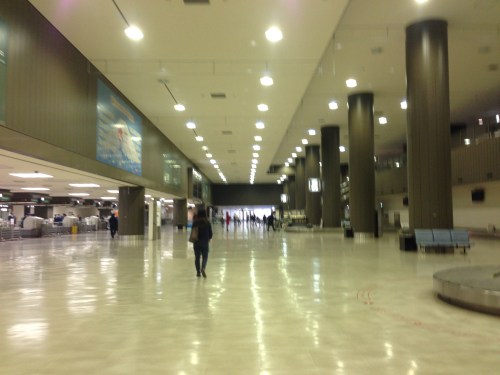 Narita’s expanse becomes more obvious at the baggage claim area.
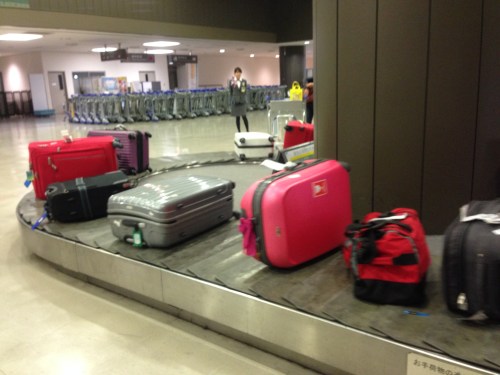 Luggage coming out for passengers to pick up from the carousel.
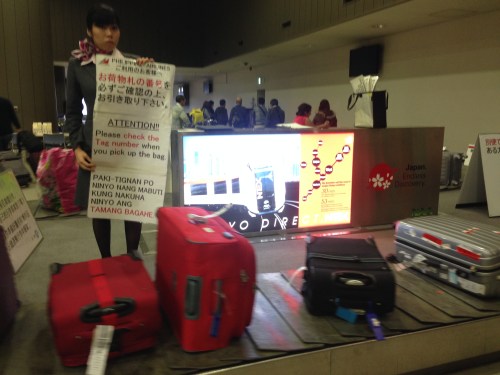 Ground staff remind passengers to check whether they got the correct luggage from the carousel. Many bags are identical so people should have a distinctive feature on their luggage whether its a tag, sticker, strap or others.
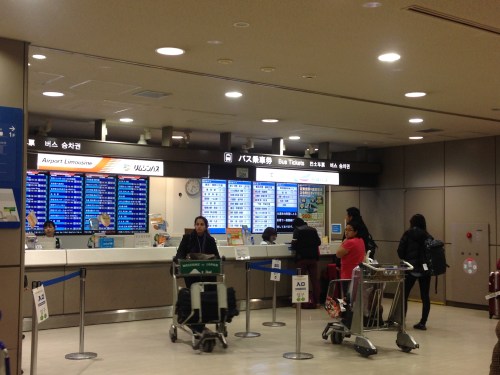 Airport limousine bus counters – there are limousine buses bound for many destinations in the Kanto area. I usually took the limousine bus to get back to Yokohama when I was a student in Japan in the 1990s.
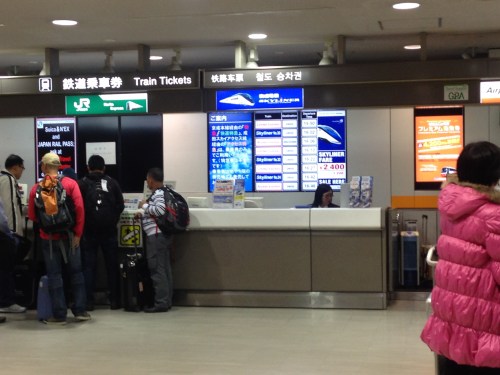 Keisei Skyliner train counter – the Skyliner is less expensive than the limousine buses and for those who travel light, it is a good option going to Tokyo. The last two stops are at Nippori and Ueno Stations where one can easily transfer to JR or subway lines. Other rail options are JR’s Narita Express (NEX) and JR Yokosuka-Sobu Line’s Airport Narita service. I usually take the latter from Yokohama Station.
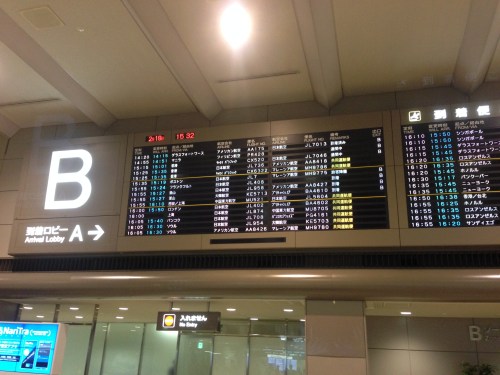 Giant electronic boards at the arrival lobby provide information on flights arriving and departing Narita Terminal 2.
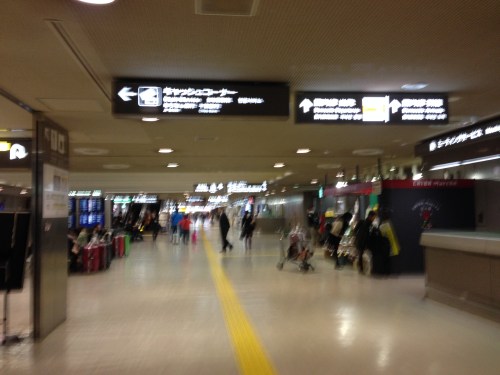 Our hosts gave instructions to take the limousine bus but part of our group were fetched by car. I was invited to join them because we were staying at the same hotel. The others stayed at another hotel. And so we walked to the upper level of the terminal to cross towards the parking building. The yellow line in the photo is a standard feature of many facilities in Japan that make them PWD-friendly. These are guides for blind people who can use their canes to “feel” the directions.
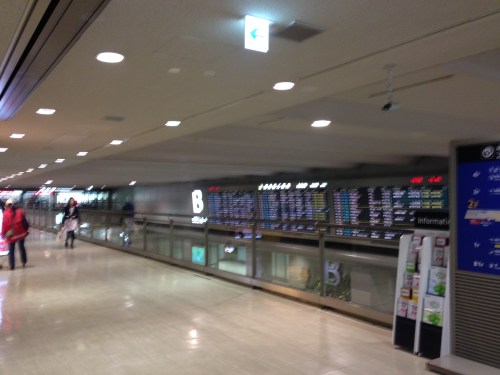 Another view of the information board from the upper level of the terminal.
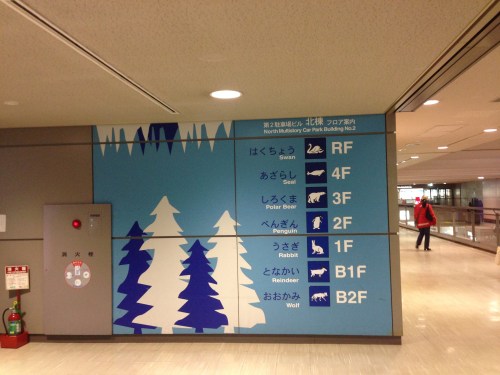 Quite an unusual description of the parking building levels, which we thought were signature Japanese.
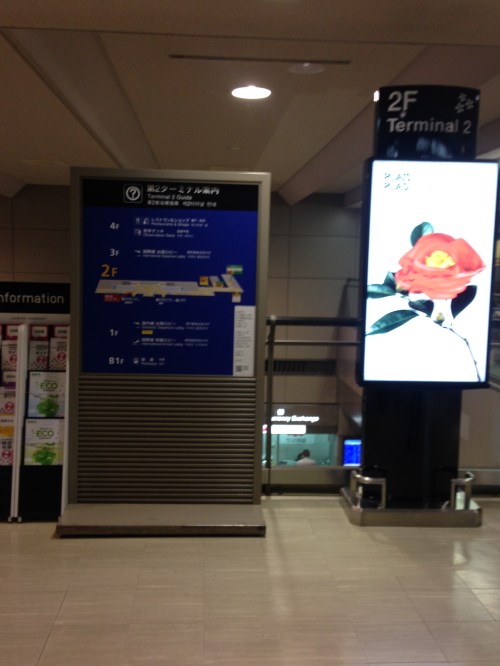 Floor information for Terminal 2
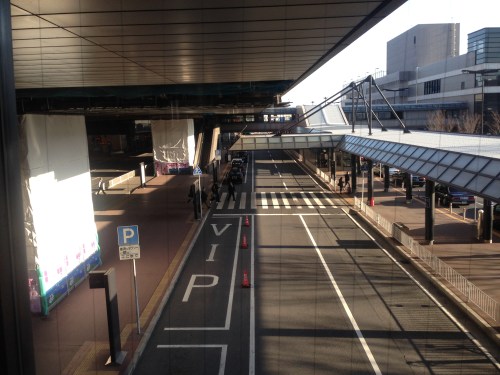 On the bridge from Terminal 2 to the parking building, we have a good view of the driveway and the slots for VIPs.
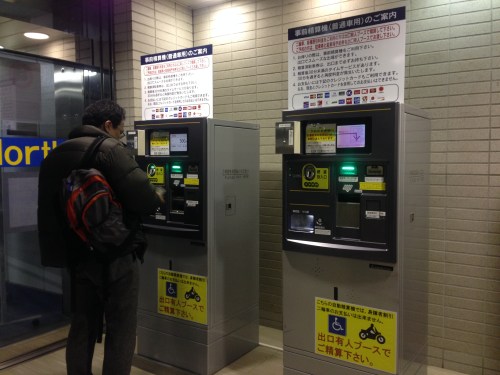 Paying for parking at one of the machines at the parking building.
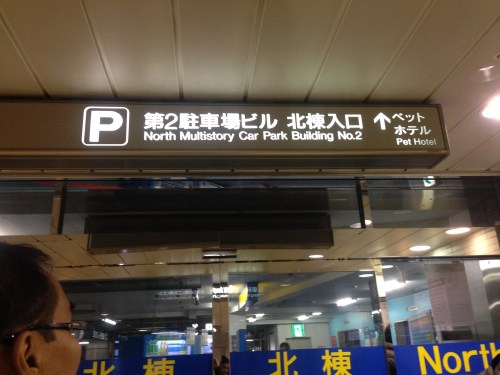 We were curious about the sign that also mentioned a pet hotel. I guess travelers who didn’t have anyone to leave their pets with at home can now have the convenience of checking in their pets at the hotel to take care of the animals while they were away.
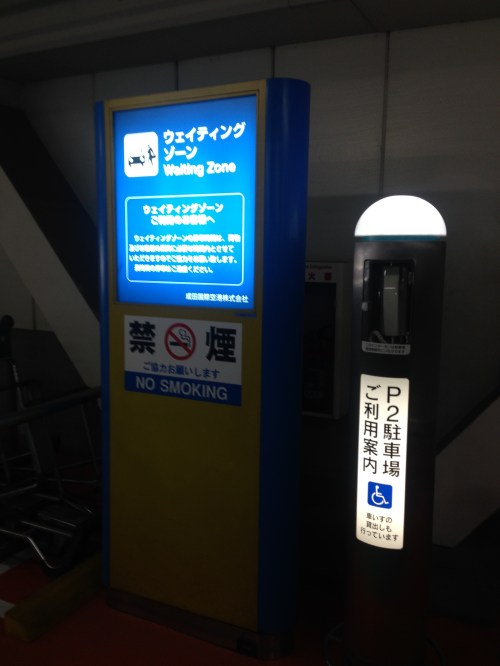 Waiting zone for vehicles – our host went to get our vehicle while we waited at the designated area.
I am already looking forward to a next trip to Japan. Perhaps I will take PAL again in a future flight? Actually, I was a bit disappointed that they used a smaller plane for our flight even if it was a new Airbus A321 Neo. I think I got used to the B747s that Delta and JAL used for their flights (I think JAL and ANA now uses the fuel efficient B777’s while Delta retained its B747s that eventually continue to the US). I think the smaller aircraft by PAL was the result of a combination of cost cutting (fuel-wise) and their increasing the frequency of flights. No matter, if you know that a nice airport like Narita is waiting on the other end of trip, it is a flight worth looking forward to.
–
Mobility for PWDs
Inclusive transport also covers persons with disabilities or PWDs as some people refer to them. Persons with disabilities include the blind, crippled, deaf, mute, and others who are physically challenged and therefore would have their movements limited or restricted. There are laws which provide for the needs of persons Republic Act 7277, which is the Magna Carta for Persons with Disabilities. Specifically, for accessibility, there is Batas Pambansa 344, “An Act that seeks to enhance the mobility of disabled persons” by requiring buildings, establishments and public utilities (e.g., transport) to install facilities or devices to enable use by PWDs. These include ramps at pedestrian sidewalks and at the entrance/exit of buildings. These should also include elevators and other devices to help “physically-challenged” or “differently-abled” persons up and down buildings including those elevated LRT/MRT stations. [Note: Quite frankly, I don’t really like all these supposedly politically correct terms but will nevertheless use them in this article.]
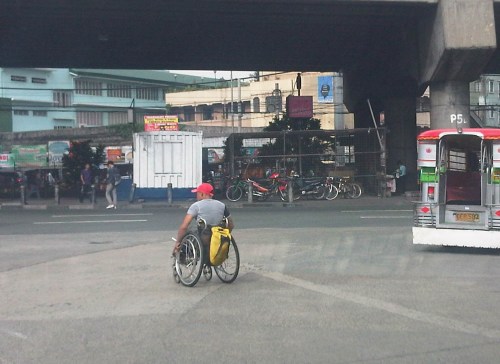 A man on a wheelchair crosses the intersection at Katipunan-Aurora.
Unfortunately, most public transport vehicles are not PWD-friendly. Most buses and jeepneys do not have provisions for PWDs and, on most occasions, do not even bother to stop to accommodate PWDs, especially those on crutches or wheelchairs. The LRT and MRT are now just too crowded even for able bodied people to endure (especially on a daily basis) but access to the elevated stations have always been an issue as there are limited escalators and elevators either seem to be frequently out of commission or there are none at certain stations. A high profile public official even suggested at one point during his stint with Metro Manila that PWDs and the senior citizens should just stay home rather than travel; hinting that these people would just be a burden to others when they travel.
This is not the case in other countries. I have seen in Japan, for example, that city bus designs can readily accommodate PWDs and this includes low-floor buses for easy access between the vehicle and the sidewalk. Bus drivers fulfill their responsibilities of stopping and assisting persons on wheelchairs to board and alight from their buses even if it means they would have to compensate for their scheduled stops. Then there are those I’ve seen riding the BART in San Francisco wheeling themselves in and out of the trains and stations with ease.
Addressing the transport needs of PWDs is definitely an area that needs proper attention especially as groups advocate for inclusive transport. Persons with disabilities are an integral part of our communities and enabling them to travel is a big factor towards encouraging them to be productive despite their physical limitations. They are not asking us to pity them but instead empower them to be the best they could become given the opportunity to be productive, to contribute to society. As such, they deserve the facilities and services that will enable accessibility and mobility that is at the same time safe for them and everyone else.
–
A study on a long-term transport action plan for ASEAN
The National Center for Transportation Studies of the University of the Philippines Diliman participated in the project “Study on the Long-Term Action Plan for Low Carbon Transport in ASEAN.” The study was funded by the Nippon Foundation and implemented by the Institution for Transport Policy Studies (ITPS) and Clean Air Asia with experts coming from ASEAN countries including Indonesia, Malaysia, the Philippines, Thailand and Vietnam, and Mizuho of Japan, which led the development of the Backcasting and Visioning Tools employed in the study. Detailed case studies were performed for Indonesia through the Universitas Gadjah Mada and for the Philippines through the University of the Philippines Diliman.
The Final Symposium for the study was held last February 20, 2014 at the Hotel Okura in Tokyo, Japan. A link containing information on the study, the symposium program, information on speakers, and presentation files are hosted by the Japan International Transport Institute, which is affiliated with ITPS.
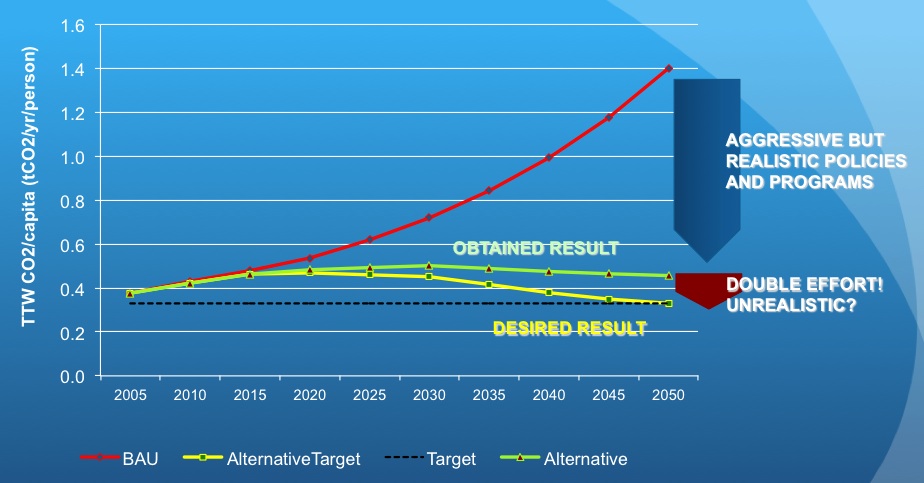 Graph of the result of backcasting for the Philippines using available transport data, policies and other information on various socio-economic and transport factors. (Image capture from the presentation by UP’s Dr. Regin Regidor)
–
Narita Terminal 2 Departure
On my previous two trips to Tokyo, I flew on Delta and this meant flying in and out via Narita’s Terminal 1. The last time around only this February, we decided to take Philippine Airlines, which uses Terminal 2 along with most other Asian airlines. Here’s a few photos I was able to take at the terminal.
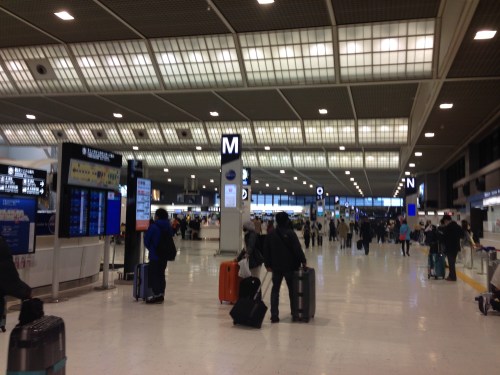 Terminal 2 is also a huge terminal and serves as the hub for Japan Airlines (JAL).
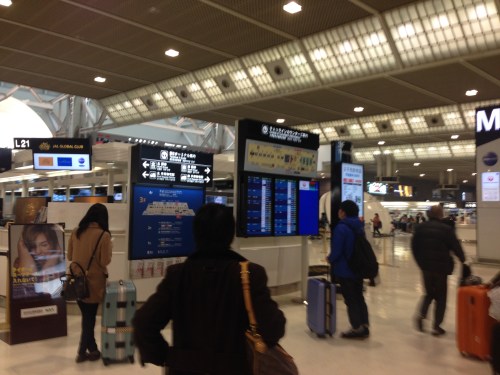 The many information boards provide up to date info on inbound and outbound flights out of Narita Terminal 2. Many refer to the boards for info on which counters to go to for checking-in for flights.
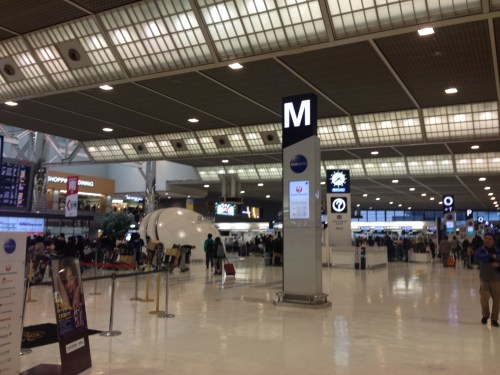 Another look at the spacious terminal.
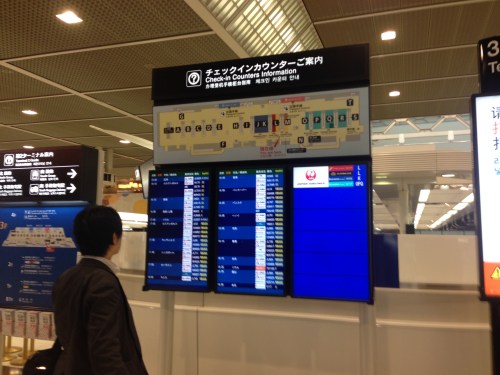 A passenger reading check-in counter information.
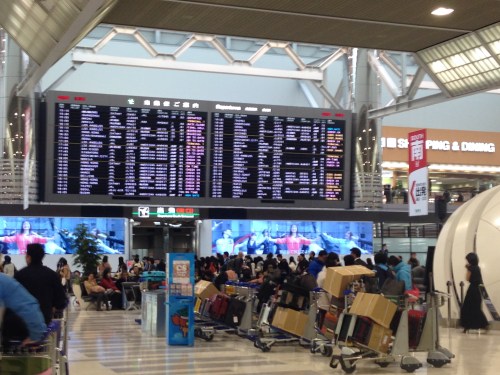 The giant board provides updates on flights as passengers wait seated in the middle of the terminal. Behind the board are shops and restaurants for the convenience of passengers and well-wishers.
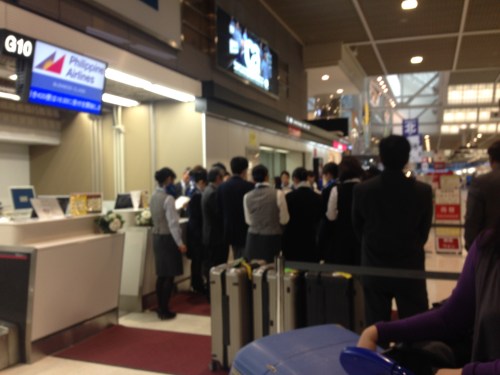 Airport staff on a huddle for orientation and final instructions from their team leader before checking-in passengers for Philippine Airlines. Meanwhile, a politician and embassy staff assisting him wait patiently among other passengers.
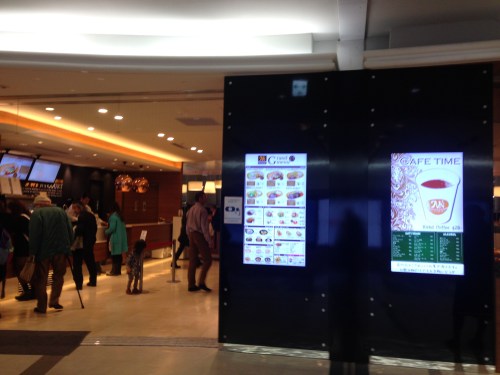 Info board on the various restaurants and cafes at Terminal 2.
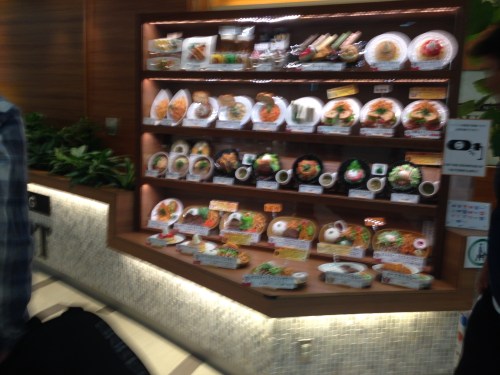 Display in front of one of the many restaurants at Terminal 2. These items on display are artificial but look good enough to eat.
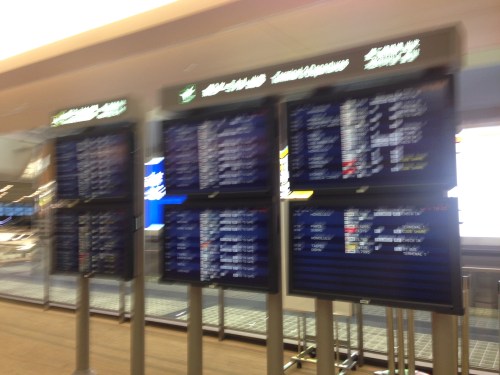 After going through immigration, passengers are greeted by more shops and cafes. Of course, there are always information boards to provide updates on flights. In many large airports, it is not uncommon for flight to change gates so passengers should always check if they are still boarding at the same gate provided to them upon check-in.
 Pre-departure area for our flight – our plane was actually parked somewhere in the wide tarmac of the airport and we were to be transported by bus from the terminal to our plane.
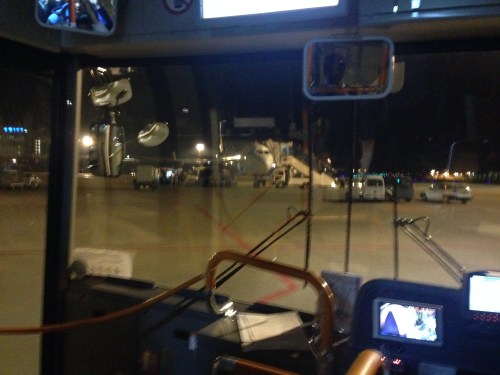 A bus transported us to our plane.
 This meant we would have to use the stairs to board the aircraft.
–
Some good reads on rural roads
A couple of articles came out recently on Rappler that focuses on rural roads:
Farm to market roads: a farmer’s journey, March 5, 2014
The future of rural roads, March 8, 2014
Both are solid articles and places our attention to rural roads and particularly farm to market roads (FMRs). There’s a wealth of information in the articles as well as the links embedded that allow us to see past and present efforts on rural roads. It is good that government with the help of international agencies are investing resources on these roads and we hope that this will be sustained in order to effect what has been touted as inclusive growth.
 Rural road connecting to a national highway in Palawan
Rural roads are an important and integral part of of our transportation system. Often, attention is placed on national roads, which are under the jurisdiction of the DPWH. Local roads, however, are under various entities including the Department of Agriculture and various levels of local government (e.g., provincial, city, municipal). Of course, there are roads that are rural but are national and therefore under the DPWH. But most roads are classified as local and therefore would not be directly under that national agency. In fact, 85% of our roads are considered local and those classified as rural comprise perhaps more than 70% of the total roads in the country (i.e., national roads can be urban or rural, and city roads include those in the rural parts of cities). Rural roads including FMRs are essential as they provide basic access to jobs, education, health services, markets and other services that could help alleviate poverty and promote development in rural areas.
–

