
Parking galore
I met Paul Barter not too long ago when he visited Manila to give a presentation on parking at the ADB. This was at the then annual ADB Transport Forum held around May every year at the ADB’s headquarters in Manila. He is a faculty member at the Lee Kuan Yew School of Public Policy of the National University of Singapore. I keep forgetting that he is a regular blogger and writes a lot about sustainable transport and particularly about parking. And so I share this awareness to my readers about Paul’s blog Reinventing Parking.
Reinventing Parking is an excellent resource for a lot of articles and references on parking. Paul has researched on parking in most Asian countries and has been to major cities in the region where he has collected first hand data on parking policies and behavior. I find his materials well researched and his discussions and opinions on parking quite interesting as many of the issues he has delved into in his posts are very much applicable to our experience in the Philippines. I have had the pleasure of sitting down with him to talk about parking policies and standards (?) in this country for his comparative research and a paper he was doing at the time. I’m sure there’s a lot our planners and developers will learn from Paul’s work. Perhaps, even decision-makers or government officials in-charge of parking standards (e.g., National Building Code) can pick up a thing or two from his body of work.
–
Iloilo’s Airport at Cabatuan and Sta. Barbara
The current Iloilo Airport located mainly in the towns of Cabatuan and Sta. Barbara is a significant upgrade to the old one located in the Mandurriao District of the city. Like the old Bacolod Airport, the Mandurriao airport could no longer be expanded considering the requirements for a larger terminal and a longer runway. Planners also had to take into account prospects for further expansion in the future. The location of the airport is quite a curiosity since only the main access road is located in Sta. Barbara town, which comes before Cabatuan when traveling from the city. The terminal and the runway are laid out at Barangay Tiring of Cabatuan town. Since the Bacolod and Iloilo airports were constructed almost at the same time in 2004 and completed one after the other. Iloilo’s was completed a few months ahead of Bacolod’s in 2007 but the former was opened that same year while the latter started operations early in 2008.
Transit time between the airport and Iloilo City is typically 30 to 45 minutes depending on the destination within the city. There is a service road connecting the airport terminal to the Sta. Barbara bypass road national highway. From the airport, taking a right from the access road will bring the traveler towards the city. A left will lead travelers towards Cabatuan and in the general direction of Passi City and Capiz Province in the north.
Following are a few photos of the airport passenger terminal from past trips to the province. There are few as I keep procrastinating about taking more photos given that our home in Cabatuan is a short 20-minute drive from the airport. There are many other photos of the airport as well as the Bacolod-Silay airport that can be found in the internet.
 The Iloilo and Bacolod airports are quite similar and the designs address many of the requirements of a modern airport. Both also take into account the typical Filipinos’ penchant for having many well-wishers accompanying the departing travelers to the airport or, for arrivals, fetching relatives and friends. As such, there is adequate space for people at the terminal (though again there seems to be a need for additional benches) and many parking spaces that can accommodate peak demands particularly during the holiday seasons of Holy Week and Christmas. It is easy to get a taxi or shuttle (usually AUVs or vans) from the airport.
 The departure area is spacious, with the high ceiling obviously helping out in making passengers comfortable. The terminal is well-lighted, taking advantage of natural lighting, and clean toilets, and, as required by law, smoking rooms.
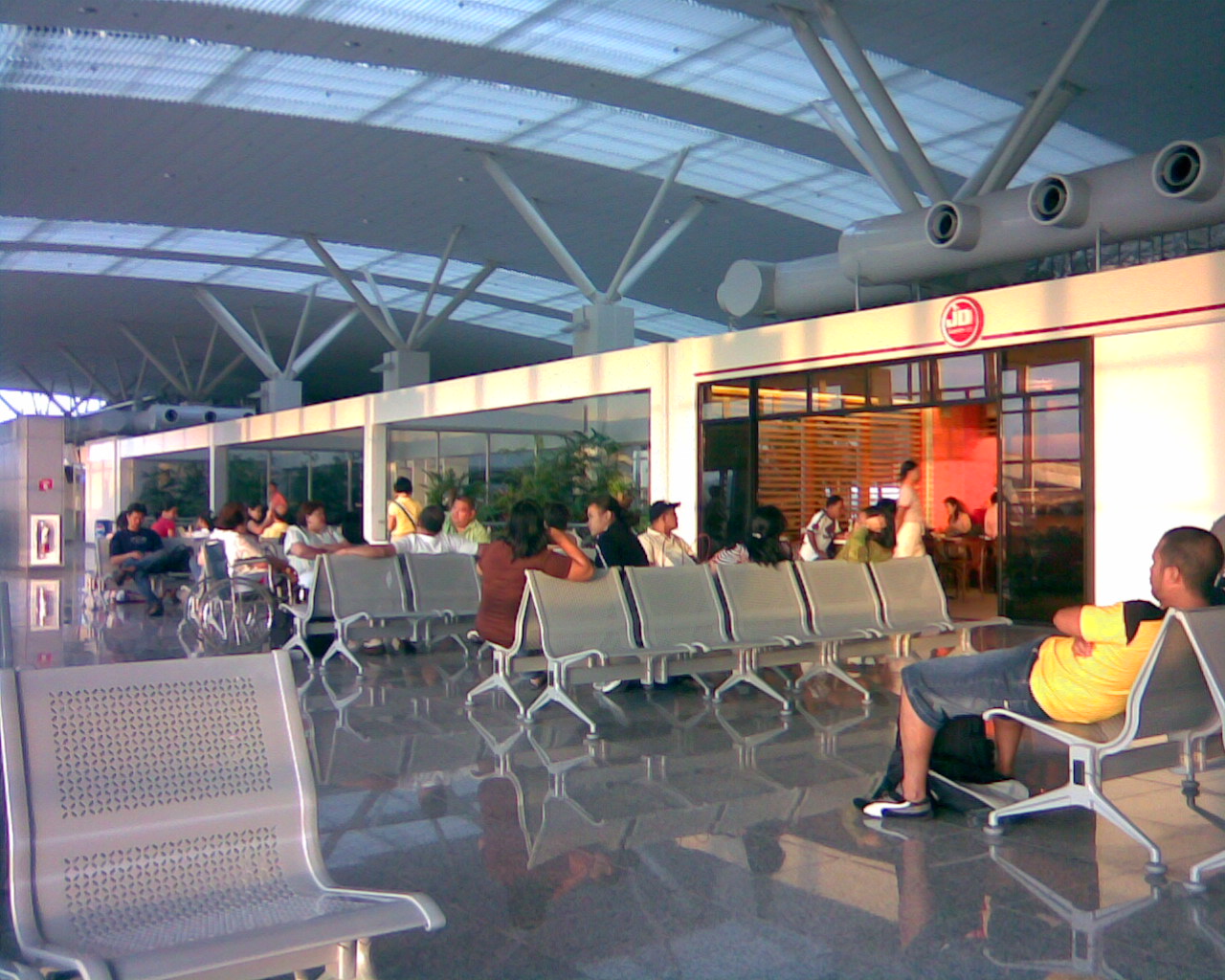 There are many concessionaires both inside and outside the airport. There are shops selling popular pasalubong like food items (try the pinasugbo, piaya, turrones and biscocho) and crafts (look for items made of hablon, an indigenous weave, or pineapple fiber). There are also eateries and cafes including one by the popular local bakeshop JD. It is never too late to try out a serving of Molo or Batchoy that may be ordered from the eateries.
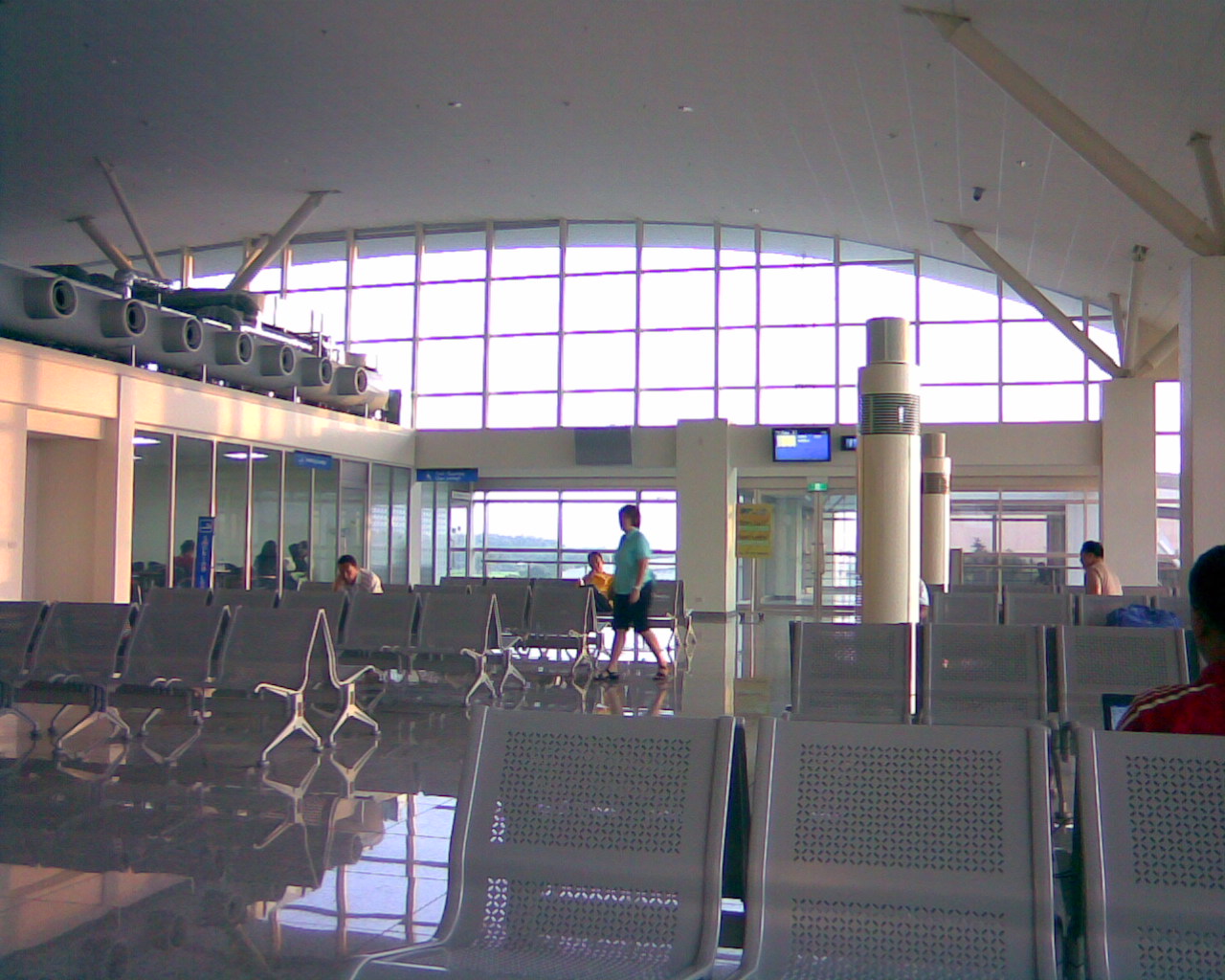 There are four gates at the departure area that are typically assigned to the airlines servicing the airport including PAL, Ceb Pac and Air Philippines. Passenger demand for the airport is quite high as it also serves as the air transport hub not only for the province but for the towns of neighboring Antique, Capiz and Guimaras provinces. Antique and the island of Guimaras off Iloilo City have no airports, while Roxas City in Capiz has fewer flights. Aklan province is already served by two airports in the capital of Kalibo and the newly upgraded Caticlan that is the gateway to the popular tourist destination of Boracay Island.
–
Davao’s international airport and some comments on Philippine airports
There are three other major international airports operating in the Philippines aside from the NAIA. These are the airports in Cebu (Mactan Cebu International Airport), Davao (Francisco Bangoy International Airport) and Clark (Diosdado Macapagal International Airport). There are two others that handle international flights, Laoag (Ilocos Norte) and Subic (Zambales), which mainly cater to chartered flights from Hongkong, Taipei or Macau. Subic, of course, is the former US naval base that also used to be the Asian hub of logistics giant Fedex.
Mactan is the gateway to the central Philippines and is second to Manila in terms of international flights. The number of domestic flights flying in and out of Cebu is comparable to Manila considering that Cebu connects to many destinations in Mindanao (southern Philippines) that does not have flights linking to Manila. Davao is the gateway to the south and handles international flights, mostly via budget airlines, from Indonesia, Malaysia and Singapore. Clark or DMIA is the former US airbase and has already overtaken Davao in terms of the number of international flights handled. It is always mentioned as a possible replacement for NAIA as the primary international airport for the country, with discussions comparing NAIA-DMIA to Haneda-Narita. Of course, DMIA will require a much larger terminal to be able to handle the number of passengers who are expected to use the airport should it become the main gateway. And, there should be a good transport system linking the National Capital Region with Clark, which also should be like the transport systems making Narita accessible (e.g., Narita Express trains, limousine bus services, etc.).
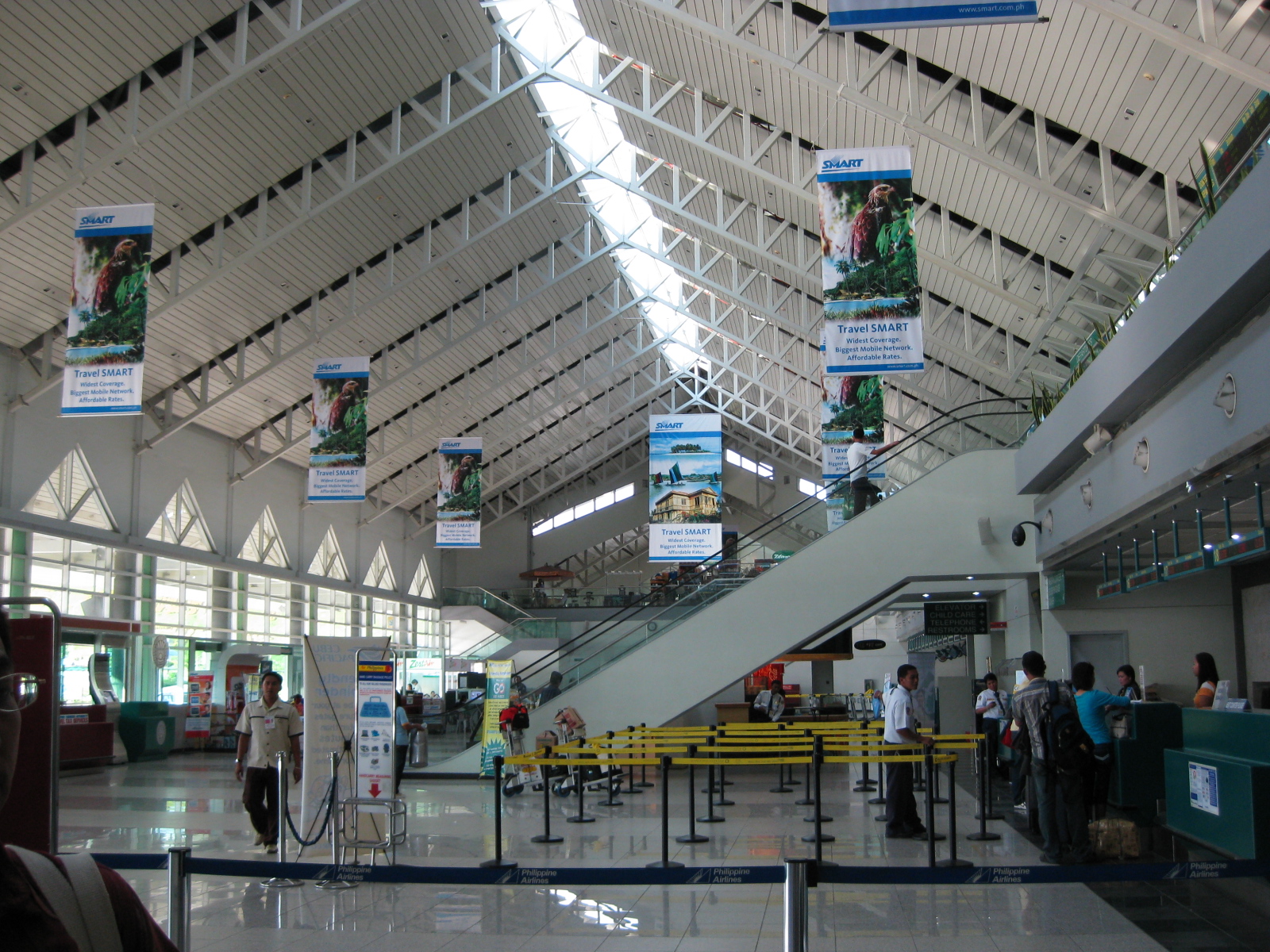 The pre-departure area of the airport is also spacious and should be sufficient for the projected demand for the airport. The area is squeaky clean, well-lighted and the staff are respectful and efficient.
 Check-in counters of the various local airlines are sufficient in number. All local airlines operate from Davao, which is the top destination in the southern Philippine island of Mindanao. Davao is actually the largest city in the Philippines in terms of land area.
 Up the stairs – the escalators are functioning and the so are the other facilities in the terminal. The comfort rooms are clean and larger than many other airports including NAIA T1 and T2.
 The spacious pre-departure area is sufficient for the number passengers typically handled by the airport particularly for domestic operations (There aren’t so many international flights.). Nevertheless, the area could use more benches considering the number of waiting passengers. The well-wishers’ area outside the terminal doesn’t have much furniture. Perhaps this is to discourage loitering or tambays in the airport terminal’s premises? These are understandably among the security concerns that the airport officials addressed with memories of the Davao airport (the old one) bombing a number of years ago.
 There are many concessionaires inside the airport but some of them appear more like tiangge or informal. There is a booth where people can purchase vacuum-packed seafoods that can be taken as carry-on (if not purchased in large quantities). All the other shops sell pasalubong with the typical food items and crafts Davao is known for. That includes fruits like suha (pomelo) and mangosteen. There is, of course, durian being sold and you can even buy them vacuum-packed so you can take them in the plane. Fresh durian is not allowed as carry-on for obvious reasons – the scent.
There are a couple of coffee shops inside the airport but they don’t seem to be as attractive as the ones in Bacolod, Cebu or Iloilo. Nevertheless, they are good enough for hungry stomachs or thirsty throats. I am not including photos taken at one coffee shop as they show some colleagues joking around.
 Departure area – the guy in the white barong is a distinguished gentleman from Mindanao who seem to prefer the spacious departure area from the VIP lounge usually reserved for people of his stature (good form sir!). Conferring with his staff, his being comfortable here seems to indicate that the area is good enough for everyone else including those who might think they deserve better.
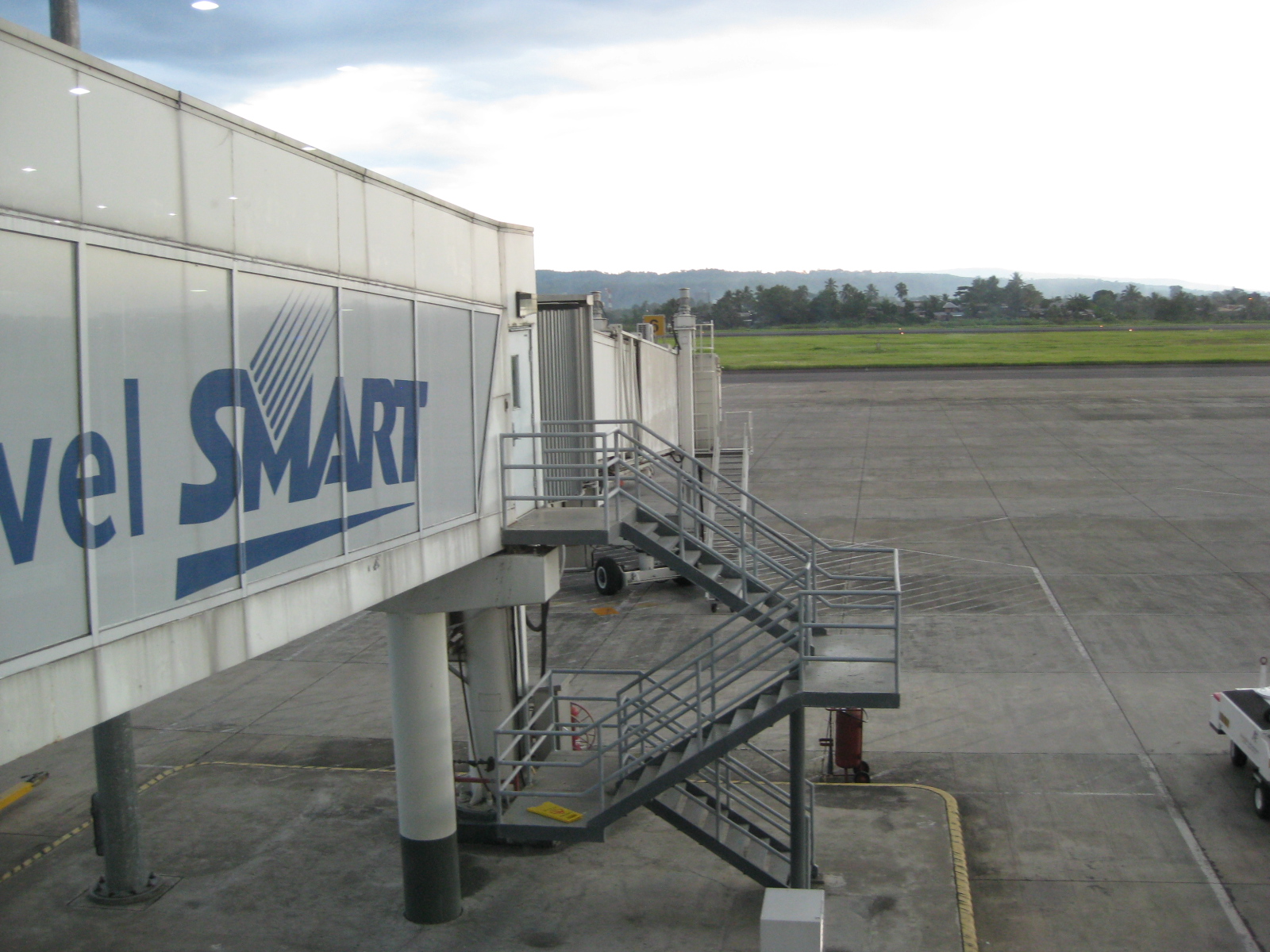 The airbridge is extendable and should be able to handle wide-bodied aircraft like the A330’s that PAL usually deploys to Davao. The city generates much air traffic passengers considering it is a major tourist and business destination in the country.
The scenes above of Davao’s international airport gives us hope that we can actually have decent terminal facilities. The floors of the terminal are so clean that I’m sure anyone blogging about this would agree they are worthy of “sleeping on.” The same goes with the Bacolod-Silay airport that I wrote about in the previous post and other airports that have been upgraded if not recently constructed or relocated. It’s not too late for NAIA’s terminals but the government should really pour some resources into it and perhaps take the cue from people who have offered their services pro bono in order to address the state of the terminals, especially T1. But then again, I would like to see the government finally make a firm stand, a commitment, regarding the futures of NAIA and DMIA. Alin ba talaga ang gusto nating maging premier gateway? And note that DMIA is indeed strategic and has enough space for expansion but will require a larger, modern passenger terminal to handle traffic that is currently flying in and out of NAIA, and more in the future.
–
Modern airports in the Philippines: The Bacolod-Silay Airport
After writing a lot about highways and streets and railways (particularly on the PNR, its history and a few what if’s) I think its high time that I also write something about other modes of transport. Much has been abuzz about the state of our main international airport, the Ninoy Aquino International Airport. Terminal 1 is already too crowded and with toilets already quite notorious for their being dirty and stinky. Terminal 2, despite being used only by one airline – Philippine Airlines, is also becoming too crowded already being unable to handle both domestic and international flights during the peak periods. It is also being dragged into the mess that PAL is currently wading through. Terminal 3 is predominantly being used by Cebu Pacific, already the country’s largest airline despite being a budget outfit. It is supposed to handle international flights for NAIA and yet because of the still unresolved issues surrounding its construction, most international flights are still serviced by Terminal 1. Perhaps the largest and the most friendly for passengers and well-wishers, it has a serious parking problem (covered parking anyone?) and many of its features are not operational (e.g., moving walkways, air bridges, baggage handling, etc.).
But rather than feature the older, less attractive airports for my first post on these facilities, I will start with what we should have more of. There are already several airports that have been constructed/ transferred and/or upgraded in the past few years around the country that are worth mentioning. Among these is the New Bacolod-Silay Airport that is located in Silay City, north-northeast of Bacolod City. The following photos were taken by colleagues at the Institute of Civil Engineering and the National Center for Transportation Studies of UP Diliman back in 2008 when the airport just began operations. It is a very significant upgrade from the old Bacolod Airport that was already too crowded and could not handle both passengers and aircraft projected for Bacolod and Negros Occidental.
 The airport terminal as viewed from the parking area – parking is spacious and sufficient for many years to come given the current and projected passenger demand. The airport is the second (after Iloilo) “airport of international standard” completed during the previous dispensation.
 Pre-departure area – provides a spacious area for passengers checking-in for their flights. The high ceiling definitely helps in providing a feeling of space.
 Another view of the airline check-in area – Bacolod is served by PAL, Ceb Pac, Air Philippines and Zest Air. Passenger demand requires frequent trips that allow for flexible scheduling of travel.
 Escalator to the departure lounge – departing passengers are handled on the ground floor but have to transfer to the upper floor for the departure area. They board the plane through the air bridges that provide the connection between the terminal and the planes. Arriving passengers also use the air bridges but descend to the ground level for departure procedures including baggage claims.

The departure lounge at the airport is spacious and clean. The comfort rooms, my colleagues say from more recent trips, are still sparkling clean and well-maintained.
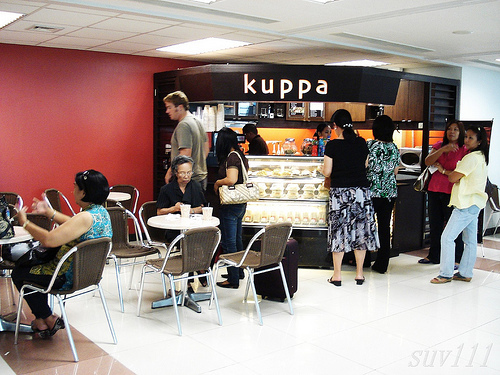 Concessionaires include this coffee shop for passengers wanting a cup of their preferred beverages or perhaps a serving or slice of a cake to satisfy the proverbial sweet tooth.
 Another concessionaire in the airport gives passengers an alternative to other shops offering snacks or full meals. The prices, I am told, are pretty reasonable considering they operate in the airport. Often, items sold in airports are criticized for being expensive (presyong turista), something that needs to be addressed, too, in the interest of travelers.
 Pasalubong center at the airport – Filipinos and travelers from other countries like to buy gifts or souvenirs to take home with them to give family and friends a taste of what they experienced in their trips. In Japan, this is called omiyage and is usually something that one can buy only from the place that you went to. There are many such items all around the country and for Bacolod/Negros Occidental, these include piaya, barquillos and napoleones.
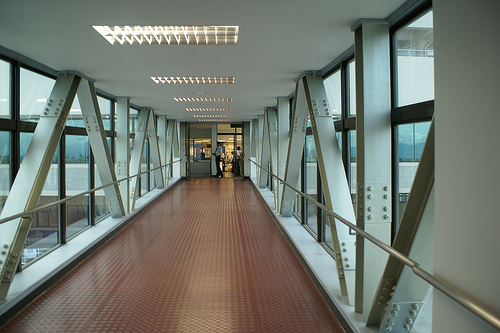 Air bridge – provides access to and from the terminal building to the plane on the tarmac. This is level with the aircraft’s doors and eliminates the need for ladders often employed in other airports (usually domestic).
 View from the departing plane – this is perhaps what the traveler will see first when his/her plane taxis towards to the terminal. It will also be what one would see as the plane taxis away to prepare for departure.
They say first impressions last and from the looks of the airport once you arrive in a certain place, you can already make some conclusions as to what the place might be in general terms. My colleagues are very impressed with Bacolod and its airport makes a statement to this effect. It is a very nice place to visit. It is clean and modern. Perhaps such simple observations or perceptions are what we should strive for in the case of NAIA’s terminals. It doesn’t really require so much to impress people. And clean toilets, and honest, efficient and reliable staff probably doesn’t require billions of pesos to realize.
Railways of old in Manila and Rizal
One of the great “what if’s” for public transportation in Metro Manila and its surrounding areas pertains to rail transport that were operated in the Cavite and Rizal provinces prior to the Second World War. The present-day developments along what were railway corridors attest to the viability of these areas for development and it can be argued that rail transport services here could have been a game-changer in as far as public transport is concerned and may have significantly influenced travel preferences and behavior in these areas. These would not be light-rail but heavy-rail services and would certainly have had higher passenger capacities.

Close-up for railway lines from the figure in a previous blog
An even better close-up is provided in the following figure that shows three lines that could have shaped developments to the east and southwest of Metro Manila. These are the Cavite Line, the Marikina Line and the Antipolo Line.
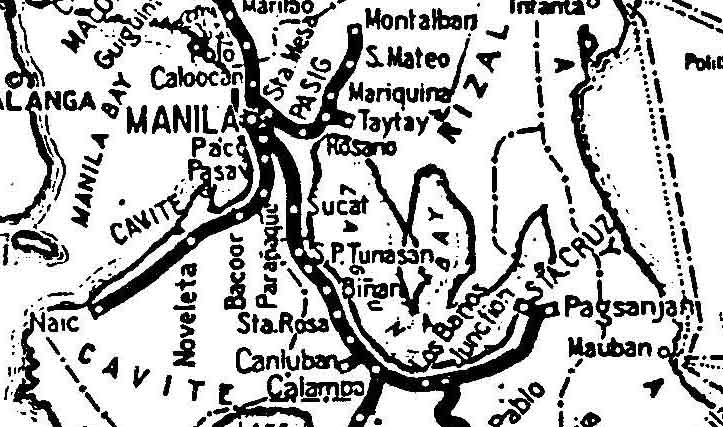
Close-up for Cavite, Marikina and Antipolo Lines of the Manila Railroad Company
Following are the breakdown of stations for the three lines:
- The Cavite Line stretched from Manila through Paco, Paranaque, Bacoord, Noveleta until Naic in Cavite Province for a total of 44 km. Completed in 1908, it was abandoned in 1936.
- The Marikina Line started from Rosario (presently in Pasig and along an area still called Tramo) to Montalban via Marikina (where there is still a Daang Bakal) and San Mateo for a total of 31 km. Completed in 1907 (until Marikina in 1906), the entire line was abandoned in 1936.
- The Antipolo Line started from Manila and passed through Sta. Mesa, Pasig (likely somewhere in what is presently Bagong Ilog), Rosario, Taytay (through present day Cainta) and until Antipolo (near Hinulugang Taktak where there is still a Daang Bakal). Completed in 1908, the line was abandoned in 1917. The alignment from Cainta and Taytay crossed what is now Ortigas Ave. Extension at the Valley Golf gate and stretched along an alignment that appears to have the gentlest slope for a climb to Antipolo.
Clearly, if these lines were not abandoned but instead retained and developed even after World War 2, commuting preferences and behavior in Metro Manila could have been quite different. In fact, people could have chosen to travel by train instead of being dependent on cars. For those residing or working in the south (i.e., Paranaque, Las Pinas, Muntinlupa, towns of Cavite, Laguna and Batangas) maybe people would have a viable alternative to the tollways in those areas. Note that the only operating rail transport in the area is the PNR Commuter Line that is currently experiencing a renaissance of sorts. Hopefully, its rehabilitation is completed and more passengers patronize the service.
Rizal is presently not served by any railway until perhaps LRT Line 2 is finally extended towards Antipolo via the Marcos Highway corridor. The Marikina-San Mateo- Rodriguez (formerly Montalban) areas are accessible via national roads that are often congested primarily due to paratransit traffic. The more progressive towns of Rizal (Cainta, Taytay, Binangonan and Angono) as well as its capital city of Antipolo is accessible mainly via either Ortigas Avenue or Marcos Highway. Both highways are already quite congested and road widening options are quite limited especially for the heavily traveled Ortigas Ave. One can only imagine now how a rail system could have addressed the travel demand along these corridors and perhaps enhanced the quality of living in these areas.
Roadworks along Angel Tuazon Avenue, Marikina
On my way to the dentist last weekend, I encountered more roadworks during my drive. This time, it was along Angel Tuazon Ave. stretching from Marcos Highway to Sumulong Highway. Due to the rains the past few days, work seems to have been suspended and I saw no one doing anything along the work site.
 Concrete pavement re-blocking site along A. Tuazon Ave. – this road frequently goes under water during intense rainfalls brought about by typhoons. Being a truck route also contributes to the road being damaged.
–
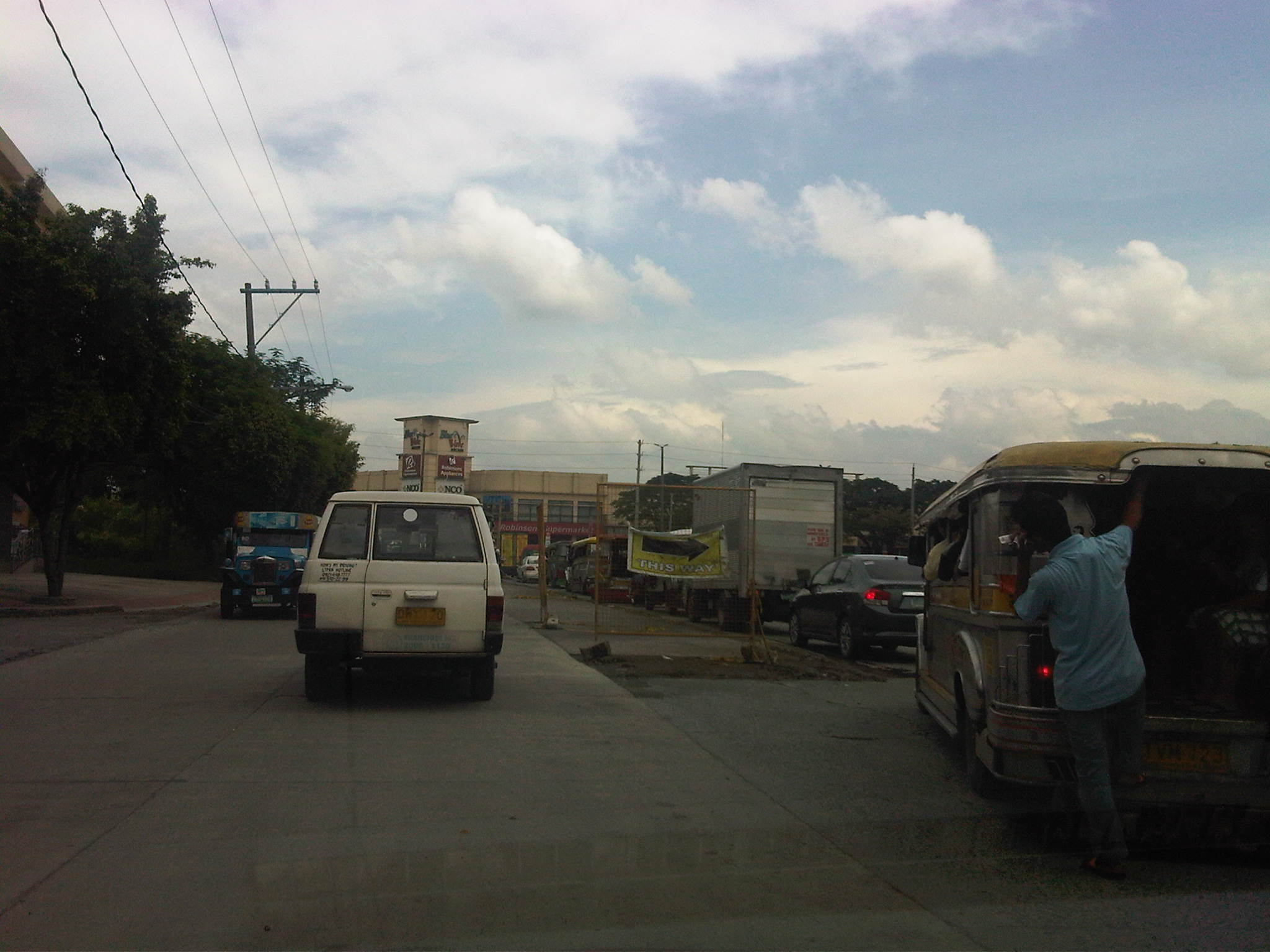 Roadworks along the approach to the junction with Sumulong Highway – one lane of the opposing direction is generally used by left-turning traffic along the northbound side under a countet-flow scheme. I can imagine this causes significant congestion along other legs of the intersection as only one lane is available for the southbound direction, limiting intersection capacity.
Good luck to people passing these areas this week. May you have more patience as you travel.
–
Road crashes along Katipunan Avenue
Katipunan Avenue in Quezon City has claimed a lot of lives and injured a many more people over the past years particularly due to aggressive and often reckless driving or riding by motorists using the road. Especially dangerous is the section stretching from the flyover to the U-turn slot just after Ateneo’s Gate 2 since many vehicles tend to (over)speed from the wide overpass and unto the section fronting Ateneo De Manila University. On the other side of the road, motorists also tend to speed up towards the overpass, unmindful of vehicles shifting from the outer lanes of the road towards the U-turn slot. In many cases, some vehicles cross from the establishments along Katipunan towards the U-turn slot. These conditions significantly increase the likelihood of occurrence of road crashes.
This morning, I noticed during my drive to UP that the concrete barriers of the U-turn slot along Katipunan northbound were again witnesses to another crash. The driver was most likely speeding if not flying from the overpass and miscalculated on his/her maneuver upon discovering the barriers along his/her path as he/she descended the overpass. It was more especially dangerous this morning as I can imagine the pavement conditions as well as the visibility given the heavy rains pouring around Metro Manila since last night. I took a quick photo of the damaged vehicle just when a truck was maneuvering in preparation to towing the vehicle.
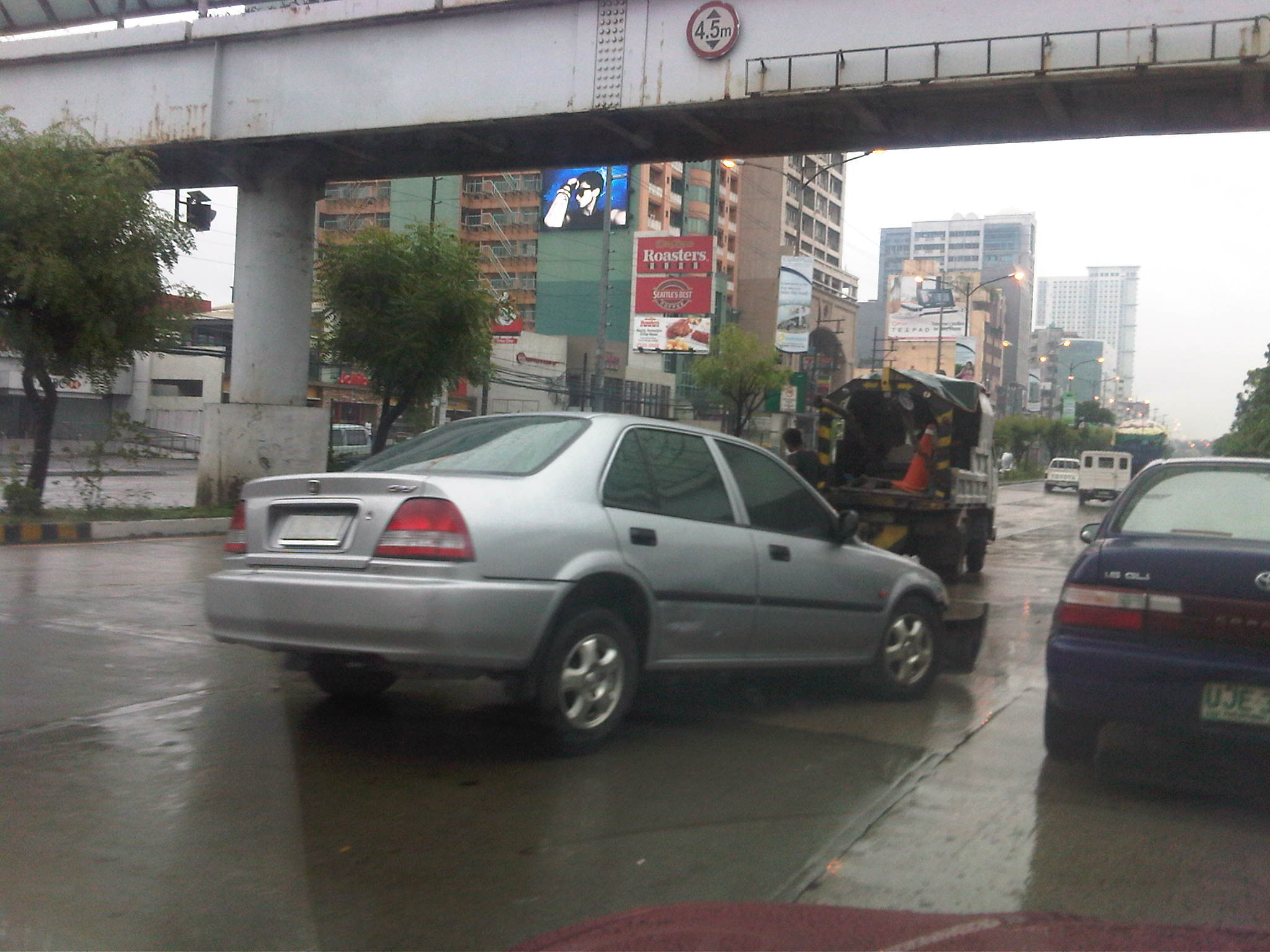 Honda City with damaged front bumper – the vehicle hit one of the concrete barriers of the U-turn slot with a trajectory indicating it apparently came from the direction of the overpass. After passing the vehicle, I saw that the left front wheel is already missing and apparently destroyed when the car hit the barrier. The damage to the car indicated tremendous impact and I just hope the driver and other occupants (if any) were wearing their seatbelts when the car hit the barrier. It would have helped also if the car had airbags. These safety devices are not standard issue in many if not most vehicles in the Philippines allowing dealers to make airbags optional and giving the buyer the false perception of getting the vehicle with a cheaper price.
When will motorists learn from such incidents? When and how will the MMDA or whoever is in-charge finally, effectively and decisively address this issue? Is it simply a case of speeding and something that can be addressed by enforcing speed limits? Or does the infrastructure and layout encourage such behavior among motorists? Perhaps we should rethink how we design and place U-turn slots and the barriers we use in the scheme. Otherwise, we will just see the same scene happening all over again at the cost of more lives and limbs.
–
SM Marikina-Santolan Station pedestrian walkway
A good example of providing for pedestrian access for development is the walkway connecting LRT Line 2’s Santolan Station with SM City Marikina. Of course there’s an even better example in Makati City where the walkways at the Ayala CBD connect office buildings and the commercial center comprising Greenbelt and Glorietta. That system of walkways is probably the first of its kind in the country and has not been replicated elsewhere, at least as far as I know. The significance of the walkway that practically connects to points in two cities (SM is in Marikina while the LRT station is in Pasig) is that it is a good example of a facility that provides access to a transit station. Not too long ago and before Typhoon Ketsana laid waste to the area beneath the bridge and overpass, there was even a proposal for a public transport terminal to be developed here. If this was realized, then the area would have been a very busy hub similar to Crossing or Market!Market! but maybe not at the level of Cubao.
 The elevated walkway across the bridge along Marcos Highway is wide and obviously designed to be able to handle the potential number of people generated by the mall.
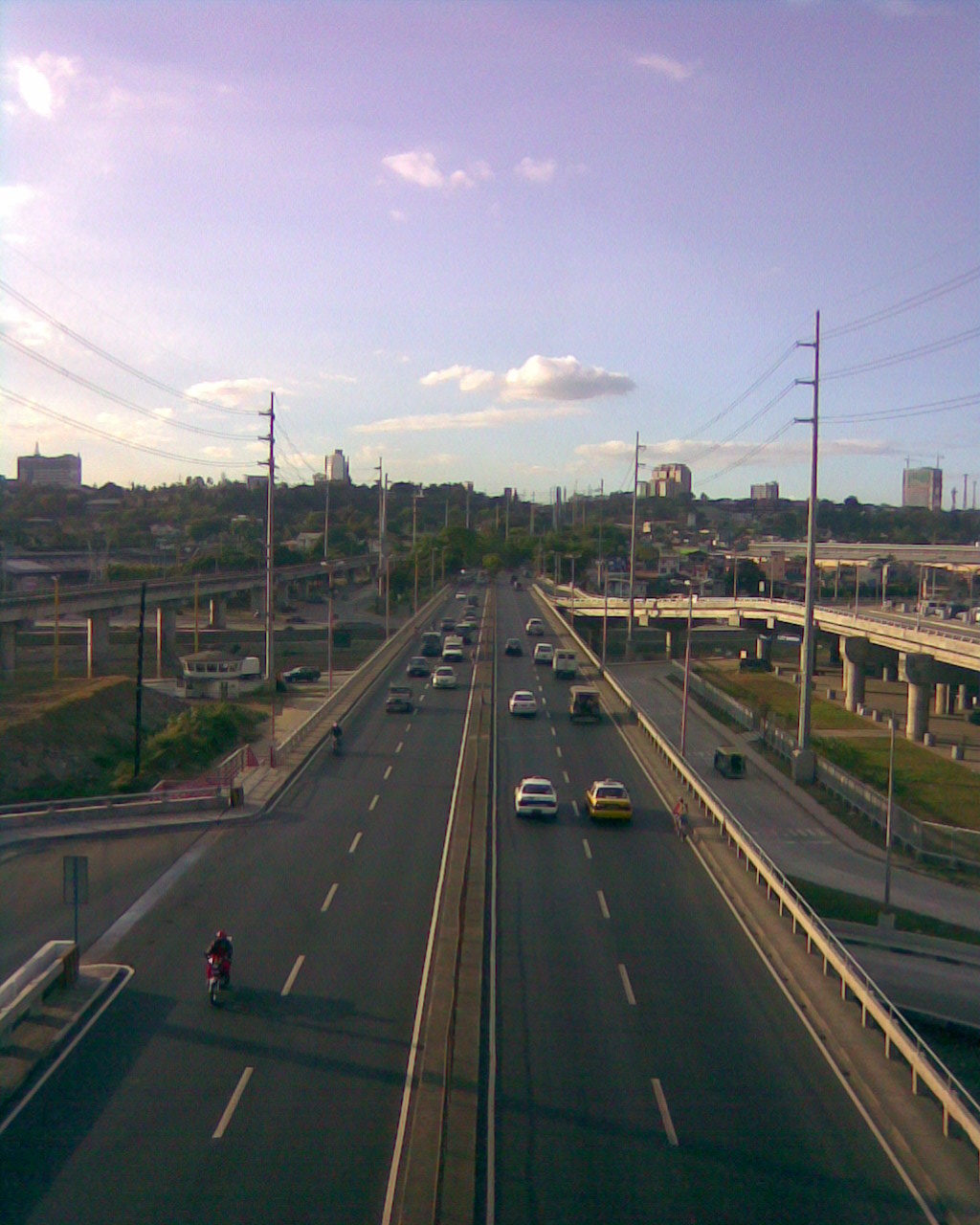 The walkway provides a perfect position for observing traffic along the bridge. This is probably an ideal location for a station for conducting screenline traffic counts for Metro Manila. The driveway on the left side of the photo is for public transport loading and unloading bays commonly used by jeepneys bound for the towns of Rizal Province.
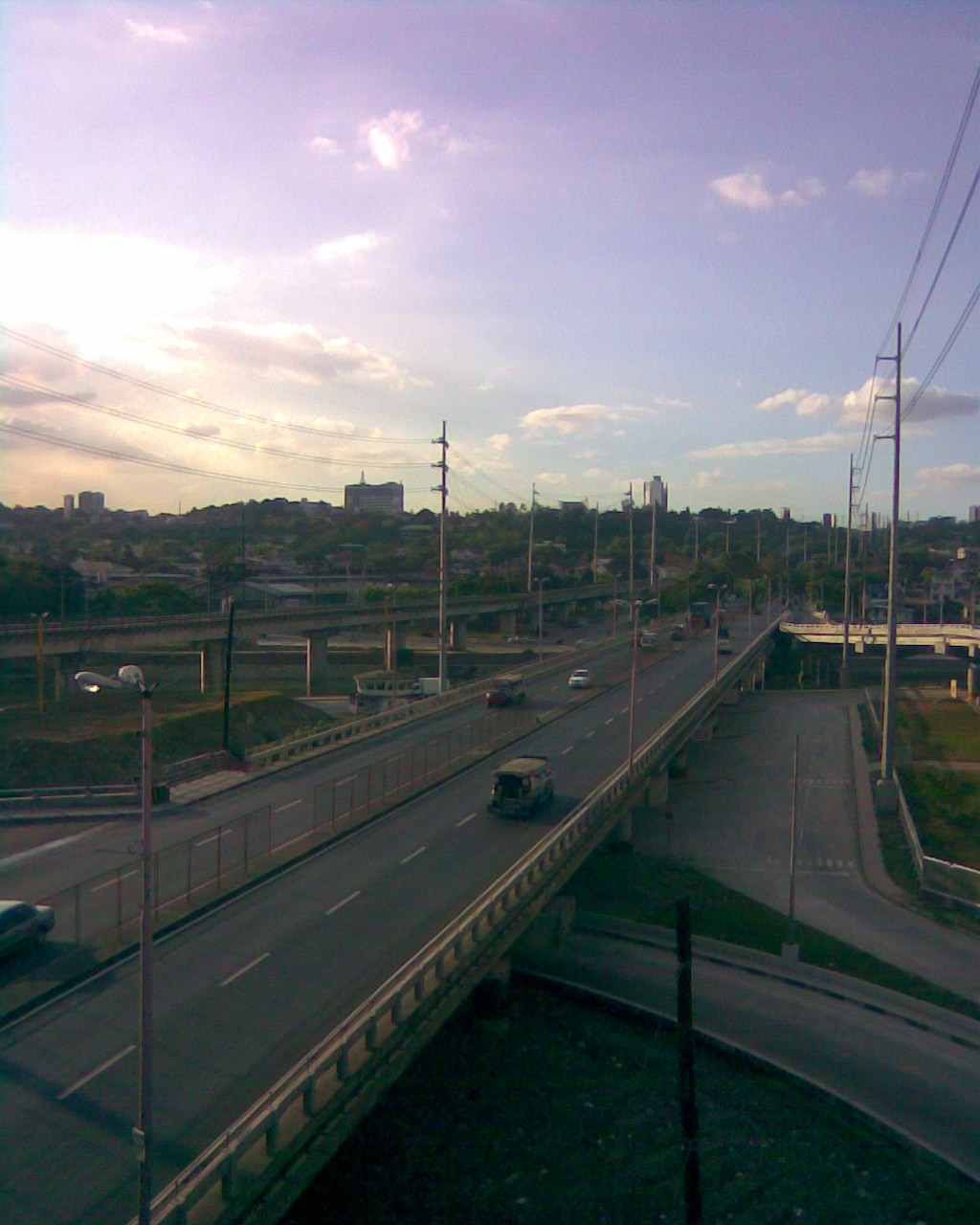 Another view from the walkway with a good perspective of the underpass connecting to a bridge to C5. Visible from this position is the area under the bridge that was proposed to be an eastern bus terminal during a previous dispensation at the MMDA.
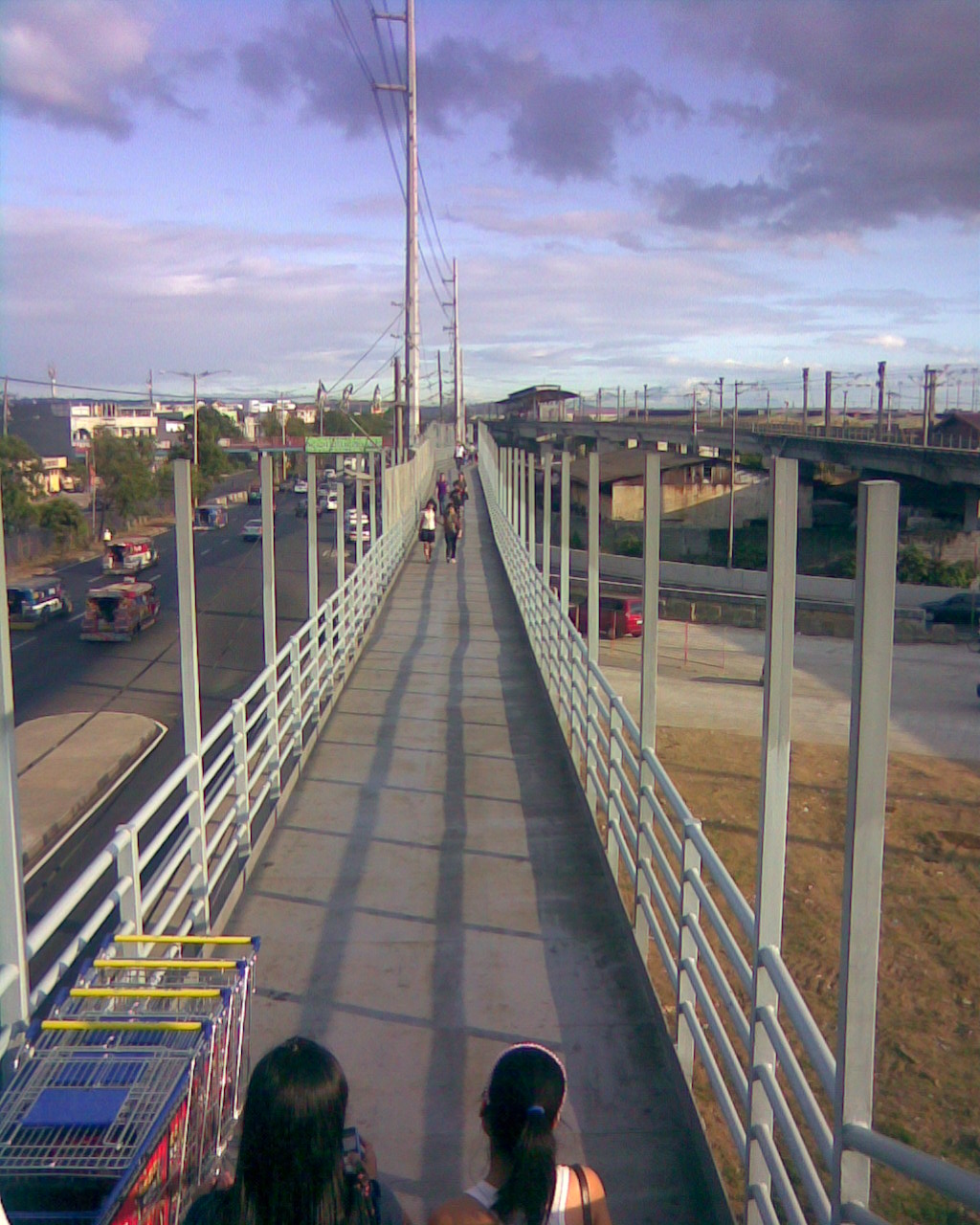 The long walk to the MRT station – from this perspective, it seems the walkway connects directly and almost level with the station platform. It is not at all connected directly with the station. Instead, one has to walk towards the end of this path and then down the stairs that end at the sidewalk near the PUV loading/unloading area. To get to the station, one has to walk some more. The posts appear to be provisions for the installation of a roof over the walkway to shield people from the elements.
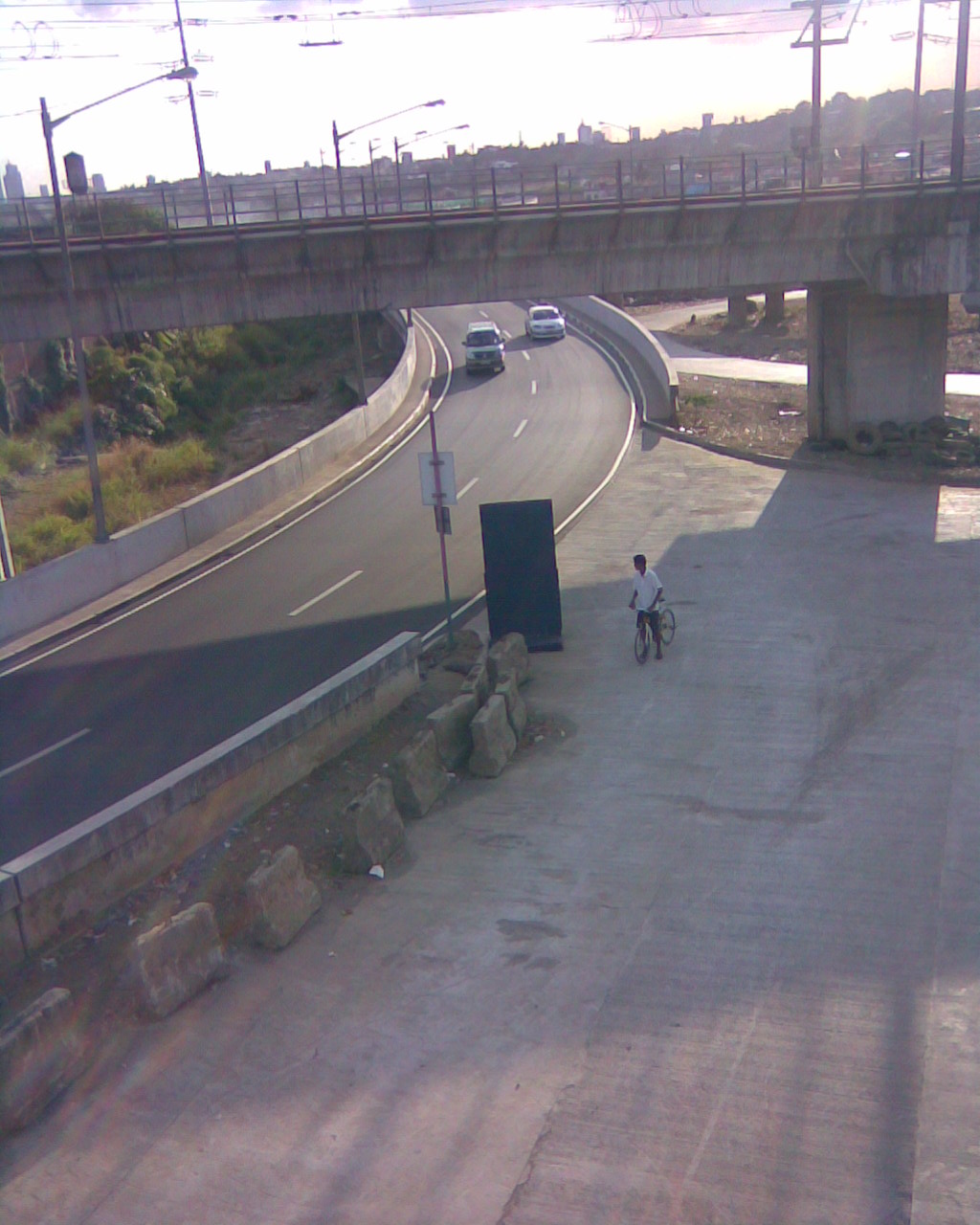 That’s the branch of the bridge emanating from C5 via the Riverbanks Road that was constructed on land expropriated from Camp Atienza, headquarters of the 51st Engineering Brigade of the Philippine Army. The curved section carries traffic from C5 that feeds into eastbound lanes of Marcos Highway.
–
Commonwealth extension
Quezon City’s Commonwealth Avenue extends from its junction with the Elliptical Road (Quezon Memorial Circle) up to gate of Jordan Plaines Subdivision in Novaliches. Often labeled as a killer highway due to the frequent road crashes that have resulted in many deaths, it is perhaps the widest road in all of the Philippines, having 10 lanes per direction at its widest sections in the Diliman area. The avenue is still far from completion as the stretch from Jordan Plaines to Quirino Highway has taken quite sometime for construction. I took the following photos of the area last weekend to illustrate the situation.
 Counterflow scheme a block away from the Jordan Plaines gate due to excavations and the civil works on a short bridge over a creek. Two weeks ago the counterflow scheme was implemented along the northbound side of the avenue.
 Only a few people were working on the Sunday I passed by the area.While there are signs and a few barriers, the work area presented a lot of hazards to both motorists and pedestrians. It was a bit dry last Sunday due to the sunny weather but I can imagine the mud from the work site should rains fall in the area.
Connecting Commonwealth Avenue with Quirino Avenue will surely improve circulation in the area and would probably ease congestion in the Novaliches bayan area. Maybe there will even be an adjustment of some public transport routes once Commonwealth and Quirino are connected. The extension of the avenue is long overdue and a much delayed project considering that there are already developments along the right of way including a residential project by the Quezon City government. The completion of the avenue will perhaps also have a significant impact on land values in Novaliches.
Fine-tuning the motorcycle lanes
I tried following the motorcycle lanes along Commonwealth Avenue one weekend to see if the MMDA has been able to mark the designated lane (4th lane from the roadside) throughout the entire stretch of the highway. I was optimistic considering all the hype about the lanes but still crossed my fingers given past experiences on such schemes’ implementation in Metro Manila and other Philippine cities. I wasn’t happy with what I saw while traveling along Commonwealth, particularly at points where public utility vehicles stop to drop-off or pick-up passengers. In a previous post, I already explained that where buses, jeepneys and AUVs tend to congregate, they occupy several lanes and effectively block through traffic. Among the lanes occupied are the ones designated for motorcycles. In all my observations, traffic enforcers seem always helpless and inutile against errant motorists occupying the motorcycle lane and posing danger through their maneuvers.
Following are a few photos I took along Commonwealth to “survey” the motorcycle lanes.
 Motorcycle lane along section past Toyota Commonwealth – note the “Motorsiklo” sign on the overpass indicating the lane designated for motorcycles
 Motorcycle lane along section in vicinity of Diliman Prep School – the lane is identifiable by the alternating blue and white lines, as well as the sign (“Motorsiklo”) on the overpass. While motorcycles are required to use only this lane while traversing the highway, other vehicles like the taxi shown in the photo are allowed use of the lane. I believe this is something that should be discouraged as they create situations where there is a high probability of crashes occurring.
The lane disappears after the St. Peter church and there are no markings or signs that would help guide motorcyclists to stay on the lane and perhaps also guide other motorists as well against using the lane. Many motorists, especially private vehicles, seem to respect the “blue lane,” usually and consciously leaving this lane for motorcyclists. We need more of that respect and much of courtesy in our streets and highways!
 Section past Sandiganbayan and approaching the Commonwealth and Fairview Markets – while some motorcycle riders can be observed as trying hard to follow the scheme, there are no markings to help guide them nor are there signs on the overpasses along the rest of the way. Perhaps the MMDA and the DPWH have not yet painted the markings or installed the signs along these sections? But then perhaps the implementation of the scheme is premature considering the lack of pertinent signs and markings?
 A bit of mayhem along Commonwealth and Fairview Markets – buses and jeepneys are practically everywhere here and occupy around 4 lanes as they load/unload passengers at this very crowded area. Motorcycle riders understandably veer away from the outer lanes of Commonwealth
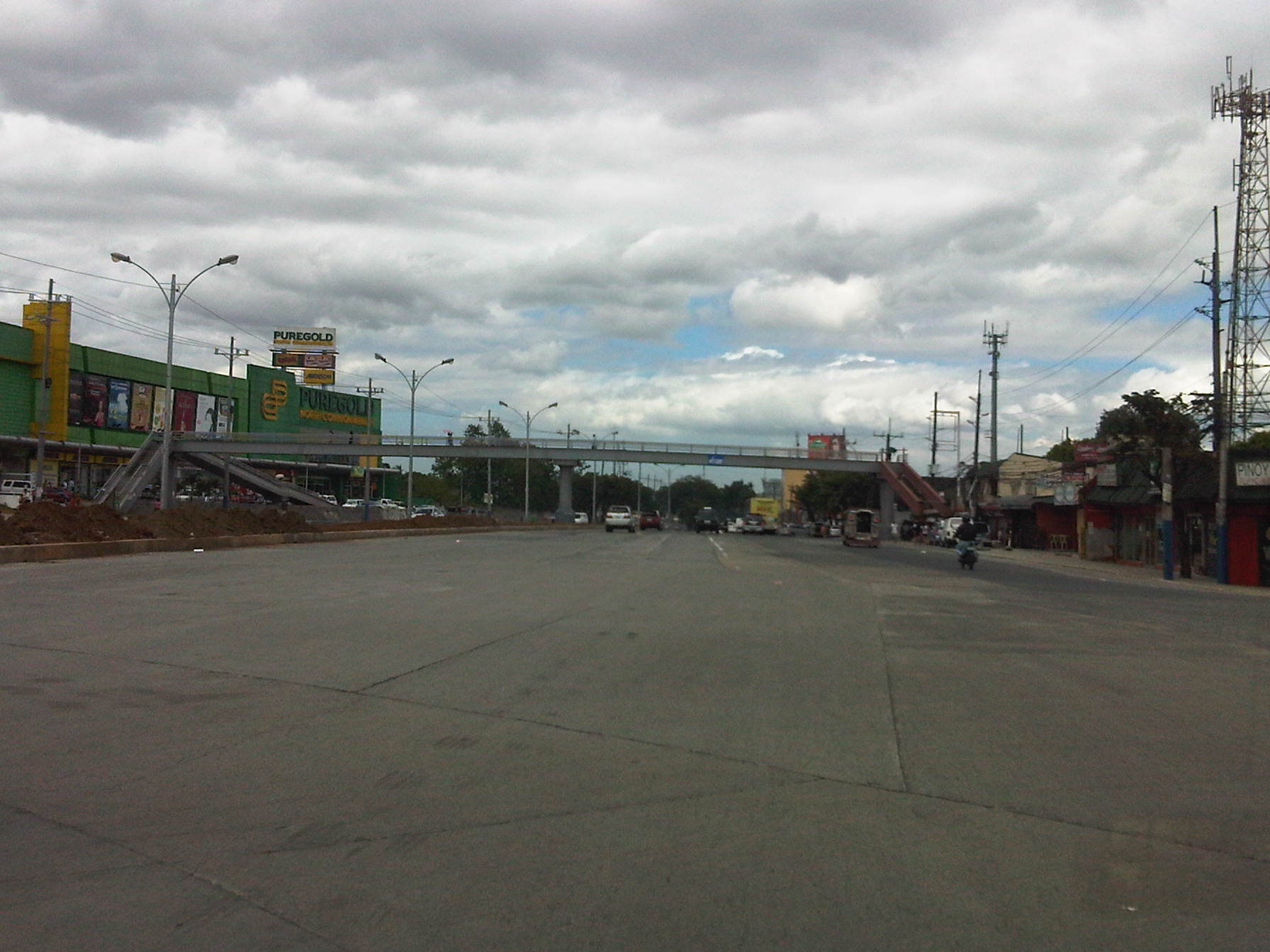 Section past the new rotonda along Commonwealth just before the overpass across the new Puregold branch – the highway was widened along this stretch and narrows to 3 lanes per direction after the overpass. There are no pavement markings yet for the newly added lanes and most of those for the previous lanes are already faded.
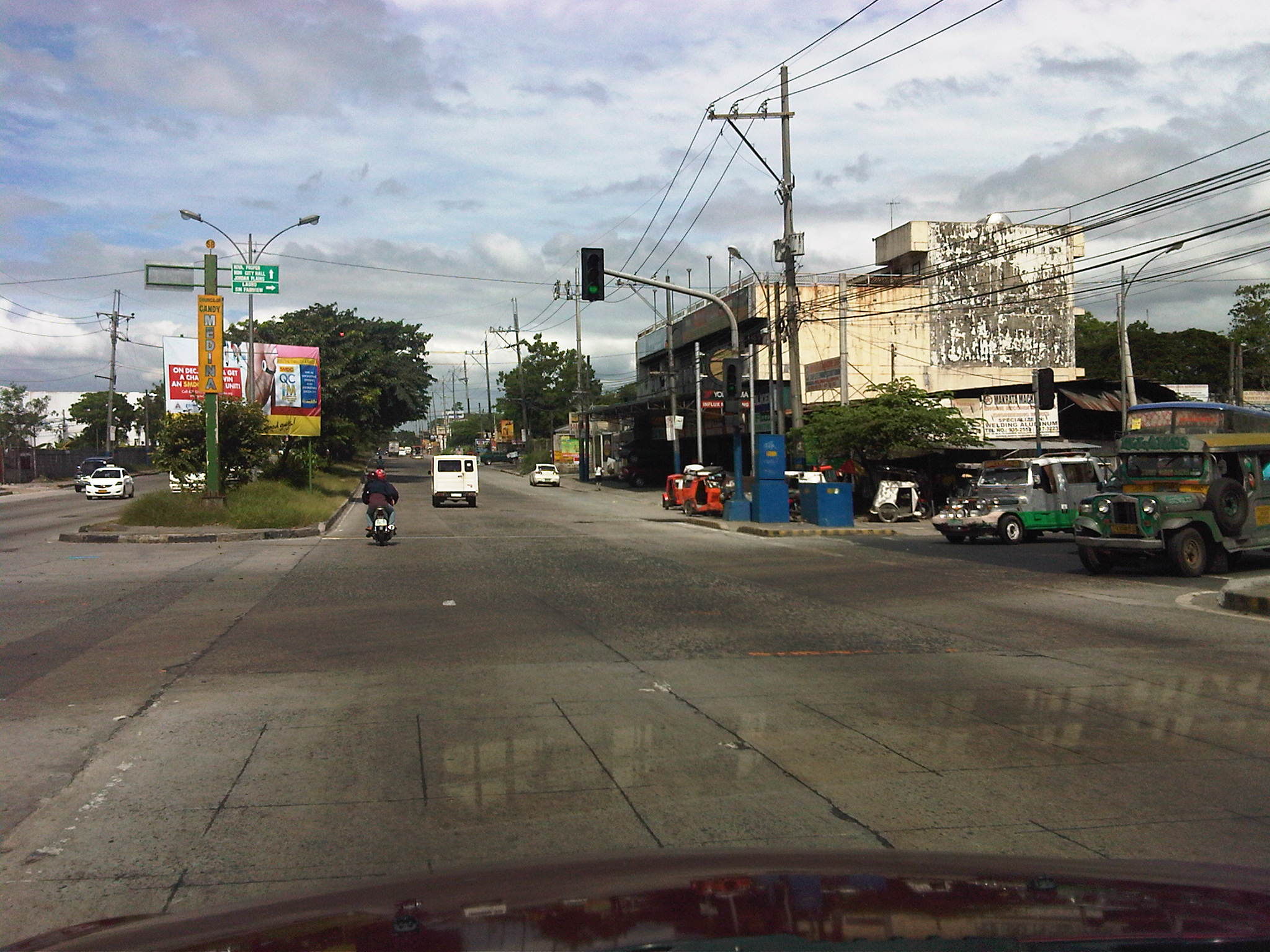 Junction of Commonwealth and Regalado – pavement markings are practically weathered and there are no indications of motorcycle lanes along these sections of Commonwealth
The formulation and implementation of motorcycle lanes along Commonwealth (and Macapagal Boulevard) are based on very good intentions (i.e., to reduce the incidence of road crashes involving motorcycles). However, the absence of pavement markings and signs to guide motorists and especially motorcyclists send the wrong signals in as far as enforcement is concerned. Add to this the serious matter of traffic management along PUV loading/unloading areas that is required to ensure that PUVs will not occupy motorcycle lanes and forcing riders to take to other lanes, thereby coming into conflict with private vehicle traveling along the inner lanes. These two issues clearly need to be addressed and fast so that the scheme can be effectively implemented throughout the entire length of Commonwealth Avenue.
The current situation pertaining to the implementation of motorcycle lanes in Metro Manila is perhaps another case where the agency implementing the scheme again “bit off more than it could chew.” As in the case of the 60 kph speed limit, effective enforcement throughout Commonwealth is limited by the availability and deployment of speed measurement equipment. As such, many vehicle still exceed 60 kph at sections where there obviously are no speed guns or radars. These situations and conditions are highly likely to lead ultimately to a ningas cogon outcome for such traffic management schemes. Such is undesirable since motorists will only become jaded (if they are not yet at this point) about traffic management in Metro Manila and elsewhere. And yet there are already indications that, like the PUV lanes, the MMDA would eventually slack on the enforcement side after realizing it needs to employ and deploy much more trained/skilled enforcers to implement all these schemes at the same time.

