
A quick look at the Puerto Princesa airport terminal – departure
I asked a good friend to take a few photos of the airports she used in her recent trip to Palawan. Here is the first batch consisting of pictures of the pre-departure area of Puerto Princesa airport. It’s been a while since my last travel to Palawan and that was through its old airport terminal.
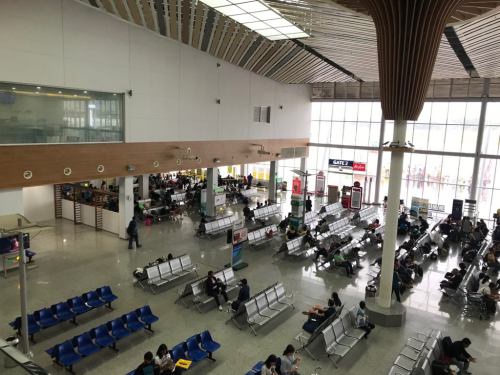 Here’s a look at the pre-departure area of the terminal. It is obviously a significant upgrade from the old terminal.
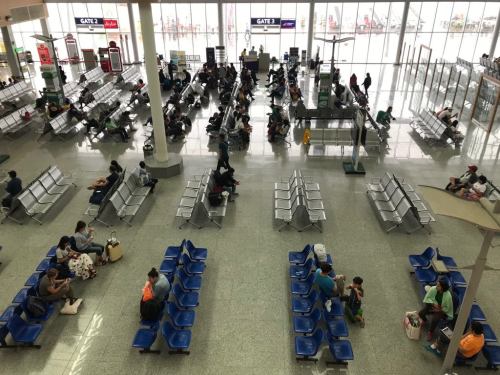 Here’s another look at the spacious are for passengers as they await their boarding calls.
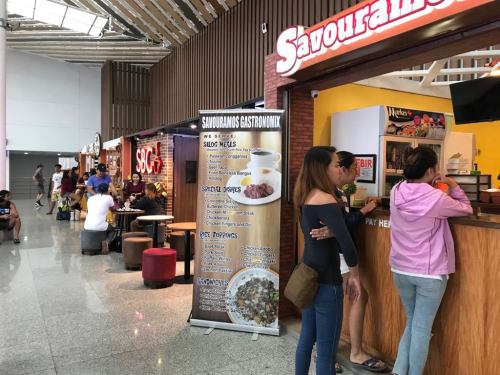 Here are some of the food concessionaires at the terminal.
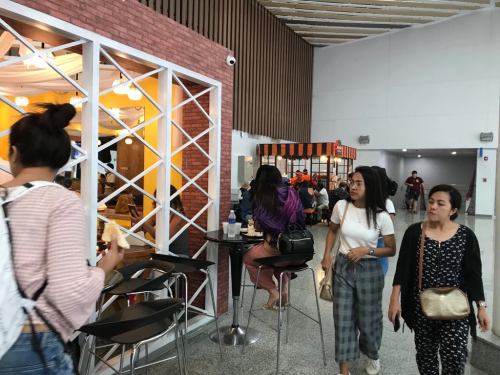 Passengers have a lot of choices for food and drinks as they wait for their flights.
I hope to be back in Palawan in the near future for some R&R and perhaps take more photos of this terminal for another article.
–
About the weather and other thoughts this weekend
We interrupt our regular posts with an article on the current state of the weather and some thoughts while a super typhoon (Mangkut) was devastating the northern and central Philippines. First the article from Wired:
Rogers, A. (2018) An Equator Full of Hurricanes Shows a Preview of End Times, http://www.wired.com, https://www.wired.com/story/an-equator-full-of-hurricanes-shows-a-preview-of-end-times/?CNDID=37243643&mbid=nl_091418_daily_list1_p4 [Last accessed: 9/15/2018]
I am not into doomsday articles and thinking but am always fascinated by it if has foundations in science and fact rather than of religion or the “prepper” type of thinking. This one is based on fact and should not be dismissed as “fake new” – an excuse many use if the information presented to them offers an inconvenient truth about our state of affairs or, in this case, state of the earth.
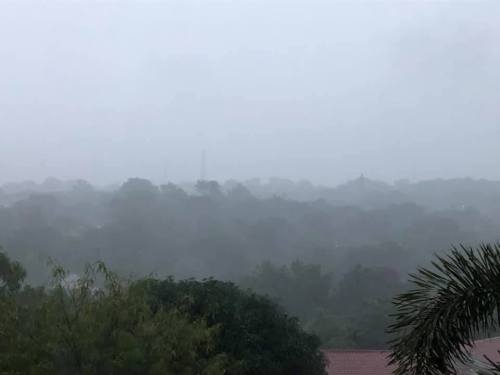 Gloomy weather brought about by Typhoon Mangkut
I was thinking about the bad weather and what previous strong typhoons have brought about early this morning as I was awaken by the sound of the strong winds and the heavy rains that followed. I easily come awake and cannot sleep whenever we have inclement weather. Its been like this since my childhood as our home was in a flood prone area.
The last times there were typhoons comparable in perceived and actual physical impacts, the socio-political impacts also eventually manifested. Typhoon Ketsana (Ondoy) in 2009 dumped record rainfall across a wide area that included Metro Manila, Central Luzon (Region 3) and Southern Luzon (Region 4A). The government’s response then and the issues that came about afterwards essentially contributed much to the doom for many of the administration’s candidates in the 2010 elections including its standard bearer who was Defense Secretary at the time. The follies of many politicians and government agencies were also exposed and most people judged them for that in the elections.
Come 2013, another typhoon, Haiyan (Yolanda), laid waste to much of the central Philippines. It was a super typhoon that again caught most, especially government, unprepared for the devastation that was its outcome. It spelled disaster, too, to many political aspirations with the then Interior Secretary becoming the poster boy somewhat for the government’s failures. Apparently, many of the lessons of Ondoy were not heeded despite gains here and there in weather forecasting and disaster preparedness. But then these were perceived to be more on the side of politicians. There were no lack in politicking, self promotion and grandstanding. And there was even more drama among rival sides in Philippine politics. There was enough material for fodder come 2016.
The current administration is much aware of the issues and the dangers of playing into the same script. After all, they created much of the political storm that led to an almost complete defeat of the previous admin’s ticket (the current VP survived that and hopefully gets to finish her term instead of being replaced by the ambitious son of a former dictator). But the present set of leaders and wannabees are not lacking for distasteful maneuvers as relief goods are being prepared by government agencies and local government units bearing the name (and sometimes even face) of aspirants for electoral posts in the 2019 elections. Among these are a Presidential “alalay” who is somewhat desperate for a senate post if only to protect himself from charges once his sponsor(s) bow down from power.
Will Mangkut/Ompong effect positive change in the country? Perhaps so and we can only hope it will be for the better. And that we, as a people, learn from mistakes we have made including electing certain people who are not fit or qualified to lead us.
–
On the need to increase NMT and public transport use
A recent report reinforces what many of us already probably know or are aware of – that we need to shift away from dependence on car use to more sustainable modes of transport in the form of non-motorised transport (NMT) and public transportation. Here is the article from the AASHTO Journal:
Global Climate Report Calls For Expansion Of ‘Non-Motorized’ Transport And Public Transit (2018)
There is a link to the report in the journal article. The report is conveniently available in PDF form and is very readable (i.e., not overly technical).
Incidentally, I was involved some time ago in a project led by the group Clean Air Asia (CAA), which involved several experts from across ASEAN as well as Japan that attempted to determine the necessary transport programs and projects in the region to stave off the projected increase in global temperatures. In all the scenarios evaluated, non-motorised transport (NMT) and a rationalised public transportation system By the term ‘rationalised’ I am referring to the use of higher capacity vehicles as against the taxis and tricycles that typically carry few if not one passenger. Here is a link to the final symposium for that study that has links to the materials presented:
The Final Symposium on the “Study on Long Term Transport Action Plan for ASEAN”
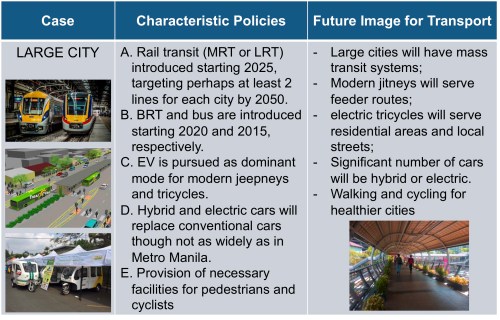
Here’s a slightly updated slide on the future image for a large city in the Philippines:
–
On the relationship between public transport use and enhanced traffic safety
I found this article while browsing the AASHTO Journal:
APTA Study Says Higher Transit Use Results In Fewer Traffic Deaths, https://aashtojournal.org/2018/08/31/apta-study-says-higher-transit-use-results-in-fewer-traffic-deaths/ [Last accessed: 9/5/2018]
The article contains a link to the report, which would be a good reference for those who want to show proof for the argument for public transportation development and use vs. dependence on cars. I think its possible to come up with our own version of the graphs shown in the report especially those that show less traffic fatalities per 10,000 residents vs. annual trips using transit per capita. However, this will require data collection and analysis for at least the highly urbanised cities (HUCs) in the country. I say at least because these cities would be the ones likely to have the resources to determine the stats necessary for such an assessment.
–
On unnecessary signages
Most of us who use roads whether as private motorists, public transport users, cyclists or pedestrians would notice a lot of signs along our roads. In fact, there seems to be too many signs along our roads including ads and information signs for commercial establishments. Electronic screens can be particularly distracting to drivers not just for their content but due to their brightness that can affect the eyesights.
However, there are also ads that are masquerading as traffic signs. These are designed as standard traffic signs providing directions to travellers using materials that are typically prescribed for signs produced and installed by the DPWH and LGUs according to the reference manuals.
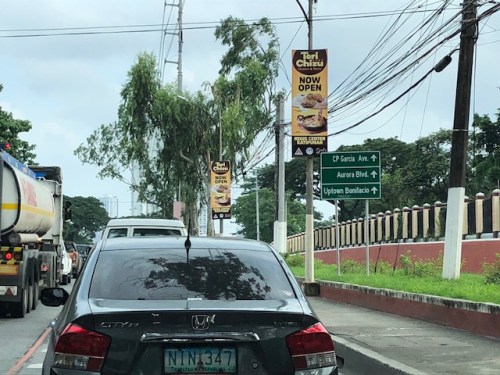 Ads and signs along Katipunan Road – the ads are obvious for their commercial purpose. The sign is actually a promotion for a commercial development that is a bit far from this area.
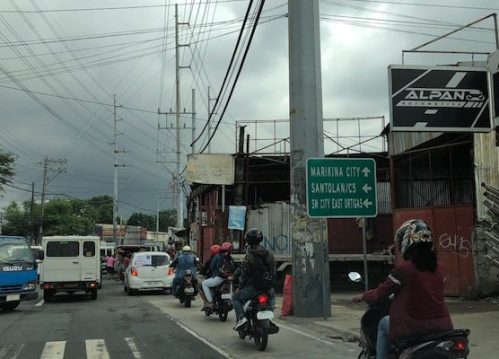 Here is another sign near the northbound approach to Masinag Junction along Sumulong Highway. The mall chain has a branch near the junction along Marcos Highway but the sign directs you to another along Ortigas Avenue Extension.
I believe the DPWH, MMDA and LGUs should be stricter about road signs. These add to the visual noise that is already present with all the ads (especially electronic ones) along our roads. These, too, have costs for their sponsors and we suspect that these are part of the recommendations made by traffic consultants who also have connections with the suppliers of these signs. If true, then these consultants are making the profession look bad through these questionable recommendations.
–
On bicycle helmet standards
Here is an interesting online article about helmet standards. One of the issues on child safety is whether children should be wearing helmets and if yes, then what helmets are safe for them to wear? Here is the link to the article:
A comparison of bicycle helmet standards
There was a lively discussion about which helmets are appropriate for children during a recent seminar I attended in Bangkok on safe journeys between the home and school. In Vietnam, for example, most children wear a child-sized helmets that are lighter than the ones adults use. In other countries, children wear bicycle helmets, which are even lighter but which some experts deem to be unsafe if used on motorcycles. In our case, most children don’t even wear helmets! That is definitely not safe even if the motorcycle speeds are low as children are more vulnerable than adults in these situations. We do have helmet standards in the Philippines (refer to Bureau of Product Standards) but these are for adult sizes and adult use rather than for children.
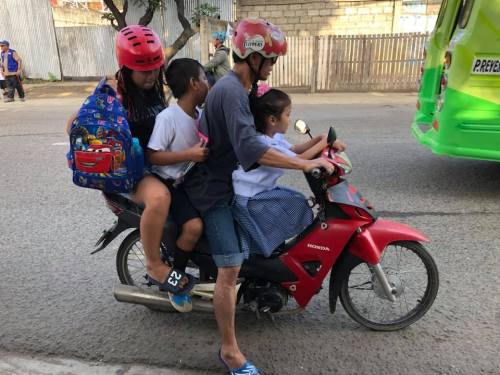 A common sight in the Philippines is parents taking their children to school on a motorcycle. Note that both children are not wearing any protective gear.
It would be nice to conduct a survey on helmet use for schoolchildren in the Philippines. We often make observations and provide anecdotal evidence on use/non-use but we don’t have the numbers to substantiate this issue. While, multiple passengers on motorcycles (e.g., a parent taking his/her child or children to school) is basically unsafe, it is widespread in the Philippines and surprisingly have not led to a high incidence of crashes involving them. Well, at least, not that we know of based on news reports and whatever available statistics are there. I guess that underlines the need to have better data collection and statistical analysis for this but that’s another story…
–
The ill-located terminal at Ligaya along Marcos Highway
There is a newly constructed public transport terminal in what is popularly known as the Ligaya area along Marcos Highway in Pasig City. The terminal is right across from the new Ayala Feliz Mall. The terminal is mostly unused or under-utilised. The jeepneys and UV Express vehicles that were supposed to use the terminal seldom go there as the natural stop for most coming from Pasig to Marikina would be closer to the junction of Marcos Highway with Amang Rodriguez Avenue. There is also the U-turn slot nearby where many passengers dare to cross to in order to catch a ride. Sinasalubong ng mga tao ang jeepney na lumiliko dito and the traffic enforcers in the area generally turn a blind eye to this.
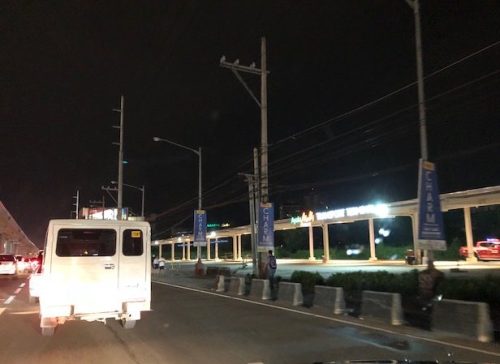 The practically empty terminal during evenings
Late at night, the terminal is dark with the lights turned off. Most times I pass by the area in the mornings and afternoons, there are few, if any, PUVs at the terminal and you don’t see a congregation of a lot of passengers there as with other terminals. Did Ayala make a mistake with this terminal? For one, it is known already that while this area is a transfer point for many passengers, the location of the terminal with respect to the established U-turn slots make it unsuitable and undesirable for most PUVs. Then there is the impending operations of the Line 2 Extension whose nearest station will be hundreds of meters away across Robinsons Metro East and Sta. Lucia Mall. I think Ayala needs to construct a physical connection to the terminal if only to increase the number of people going there and therefore attract PUVs. Finally, the area is not a terminus (or last stop) for PUVs so it doesn’t make sense for them to spend time there except perhaps during off-peak periods (i.e., for rest). However, it is not attractive even for the latter since there seems to be no amenities including stores or maintenance shops to support PUVs.
–
Another look at Suvarnabhumi Airport – departure, Part 3
Here are the rest of the photos for this series on Bangkok’s Suvarnabhumi Airport.
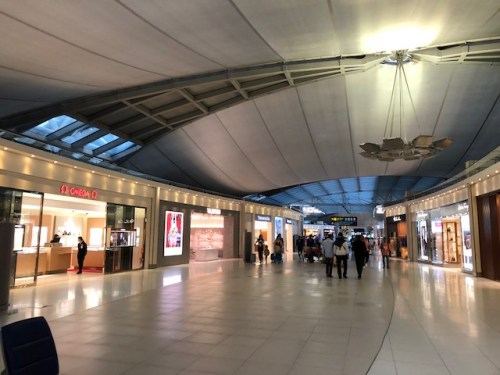 Here’s another look at some of the shops inside the terminal
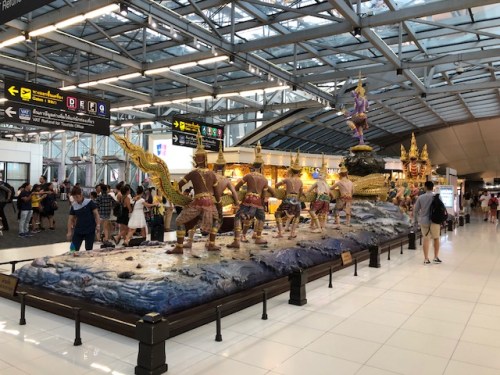 Here is a view of the grand display at the departure concourse after you clear immigration.
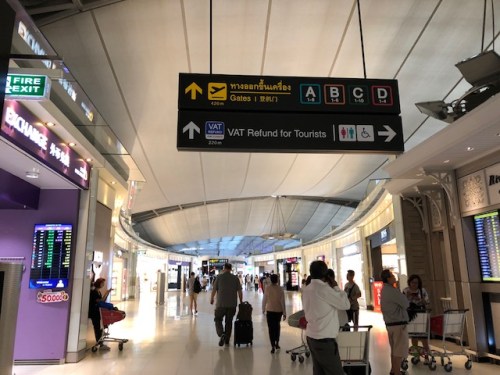 For those who did their shopping in Thailand, VAT refund is available at the airport. Just make sure you kept your receipts.
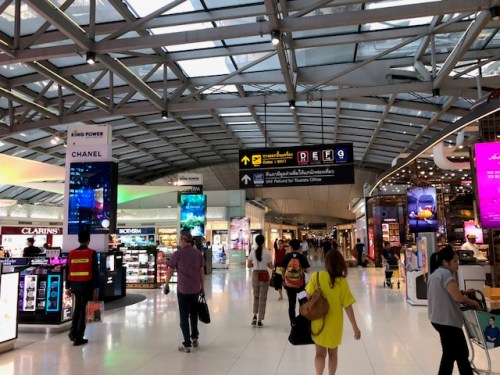 King Power duty free shops
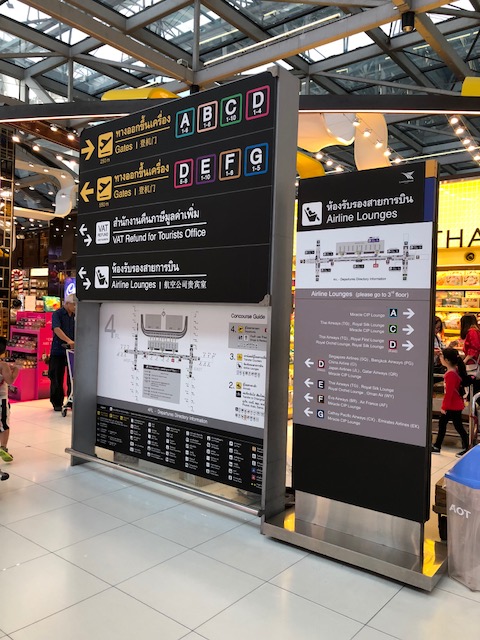 Information boards
 I like to say that a highlight of my recent travel to Bangkok was enjoying mango with sticky rice at the airport. Bangkok is famous for its street food and this is comfort food for me.
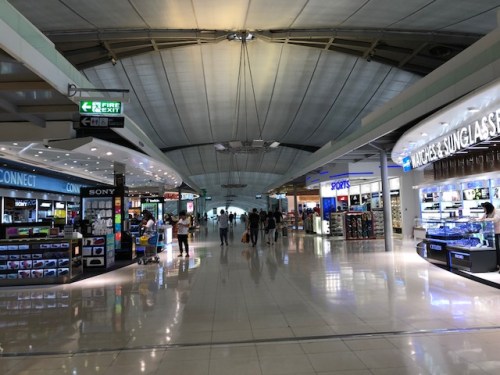 More shops greet you on the way to the boarding gates. These are actually the last ones prior to the boarding gates and present the last chance for some shopping.
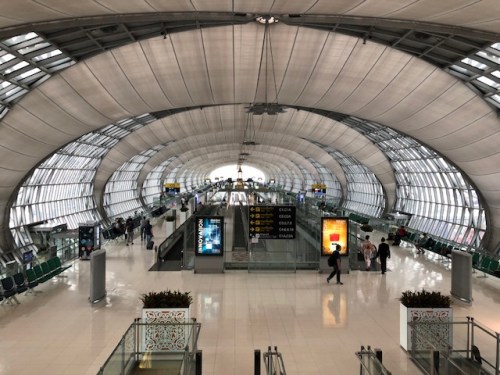 A view of one of the piers (there are 6) of the airport terminal.
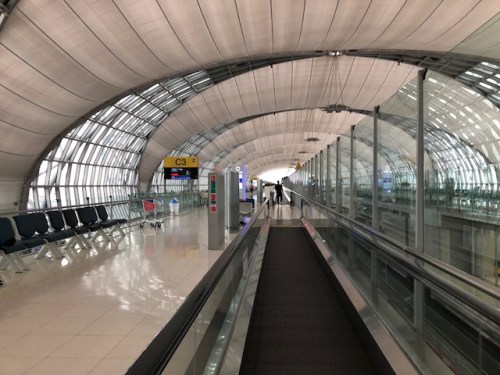 Moving walkways help passengers get to the boarding gates along the long piers emanating from the main terminal building. But if you want to have some exercise and increase your step count then you might opt to do some brisk or relaxed walking.
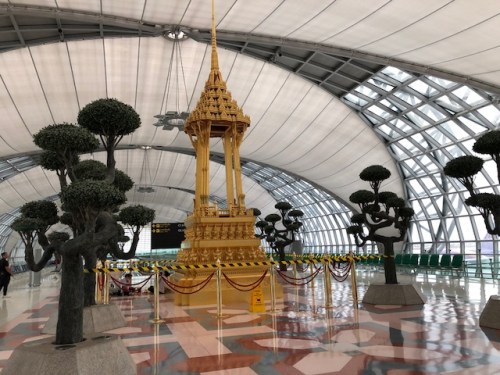 There is always these cultural-religious elements inside this modern terminal that remind you that you are in Thailand.
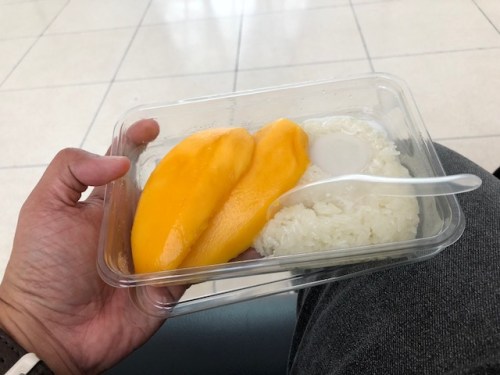 I enjoyed my mango with sticky rice while waiting for my boarding call.
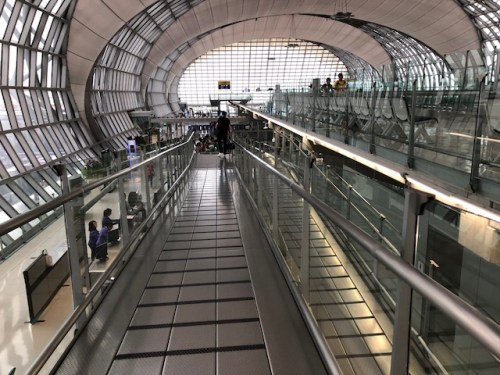 Ramp to the pre-boarding lounge before the gate
I’m looking forward to traveling to Cebu soon. Although the new terminal is for international flights, I hope to get some photos from the tarmac. And who knows if there is a chance to take a few opportunistic shots of the interior?
–
Another look at Suvarnabhumi Airport – departure, Part 2
Previously, I posted on my arrival at the airport prior to my return to Manila. Here’s a continuation with more photos of the terminal at the departure level of Suvarnabhumi Airport.
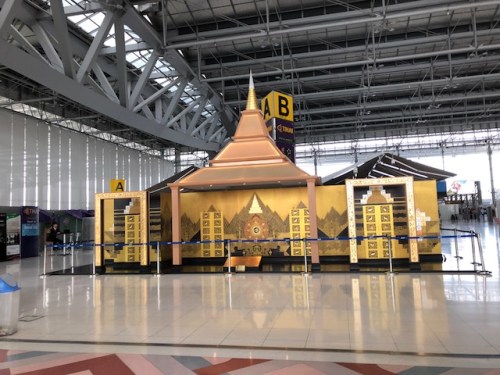 Display depicting a temple greeting people as they enter the terminal
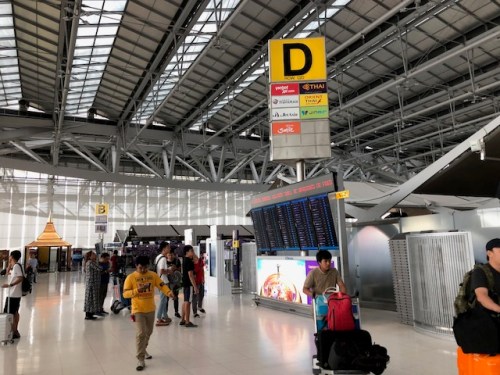 Travelers check the information board for their designated airline check-in counters
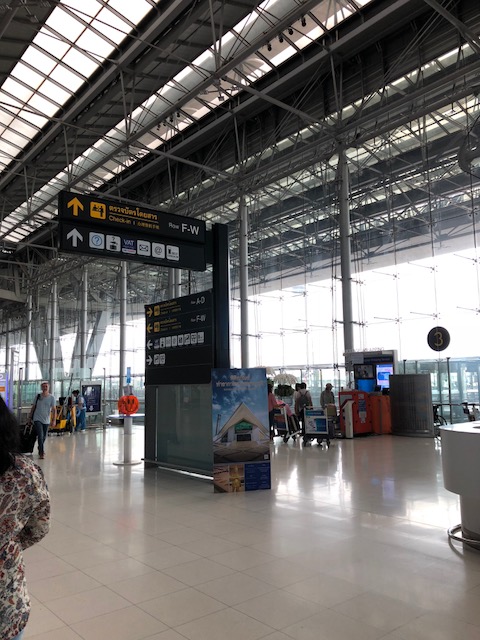 Direction signs and luggage wrapping services at the airport
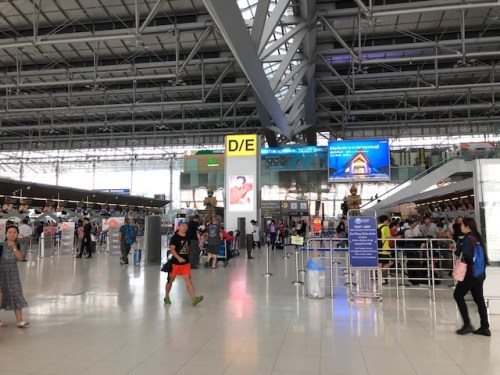 Somebody said it is easy to get lost in a terminal this spacious.
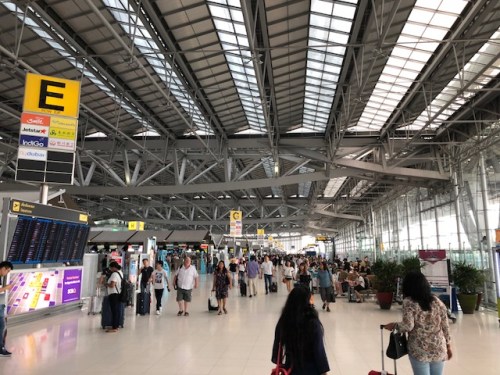 Just follow the signs and the information boards
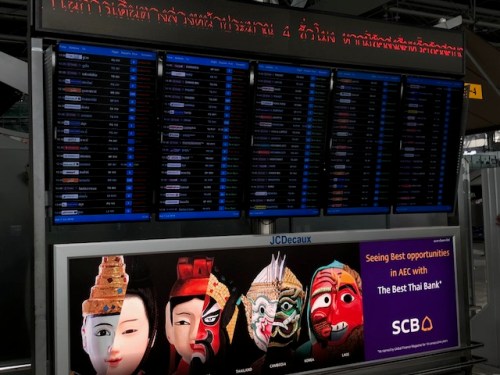 Here’s a closer look at one of the information boards showing departing flight information such as the status of outbound flights and the designated check-in counters.
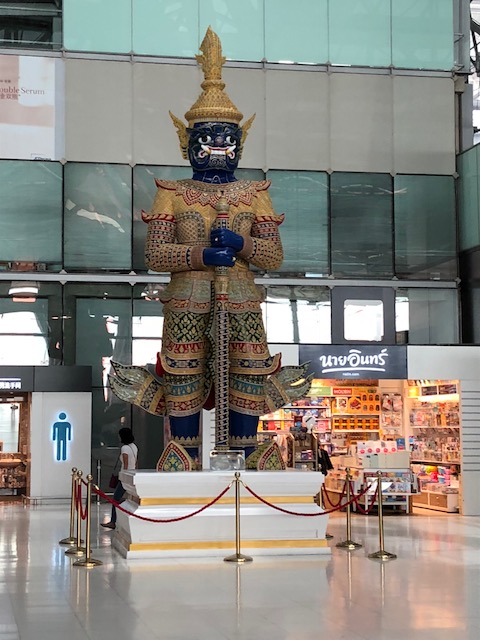 Among my favourites at Suvarnabhumi Airport are these sentinel-like figures “watching over” the busy airport.
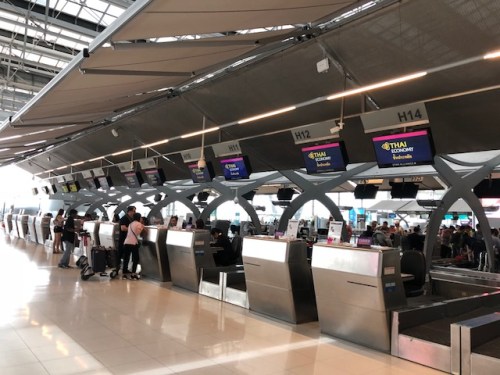 Thai Airways check-in counters designated for my flight back to Manila – there were no queues as there were more than enough counters and staff to handle passengers as of the time I checked-in. It helped that I checked-in online so I went directly to the bag-drop counters for my luggage and my boarding pass.
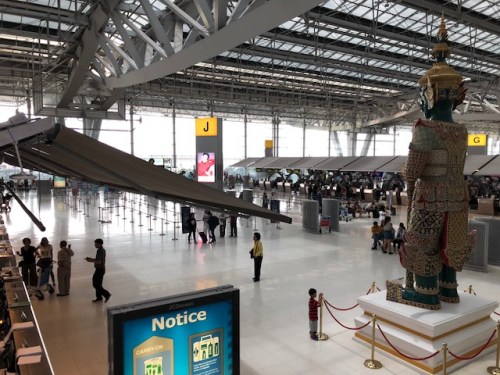 Going up the escalator for the final airport security check and the immigration counters, I took this photo of the spacious terminal.
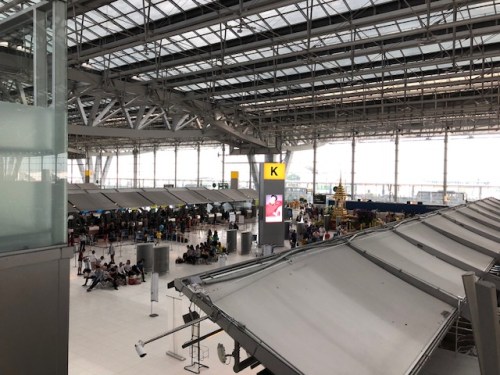 Here’s another shot just before I placed my phone in my backpack prior to the security check.
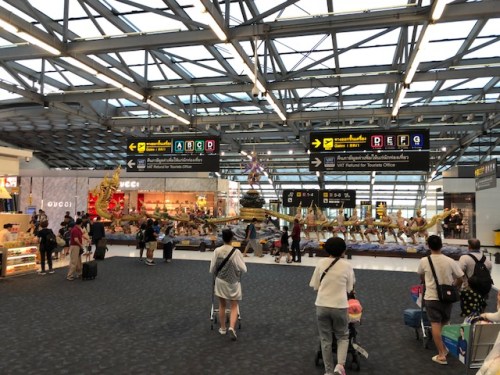 Upon clearing immigration, one is greeted by yet another display. I already featured this in previous (old) posts on the airport where I showed some close-ups.
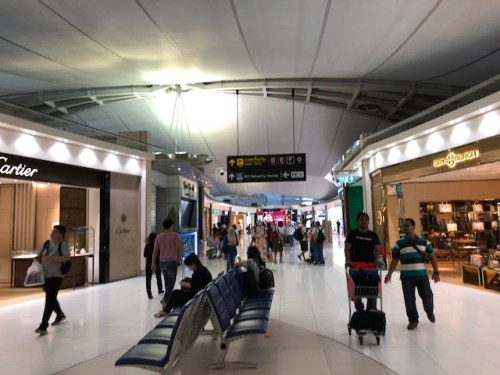 The ways to the boarding gates are lined up with shops.
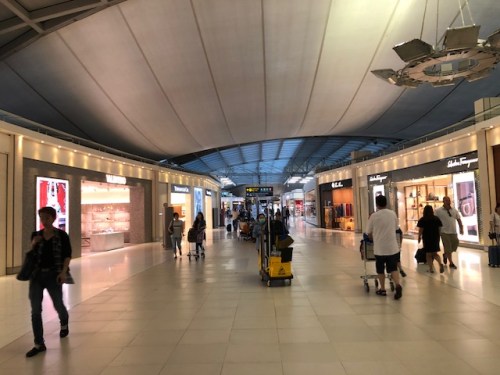 Here are more shops along the way.
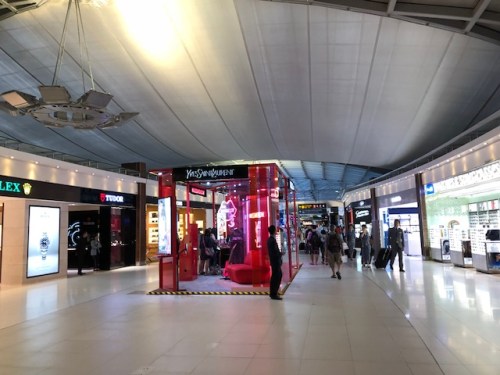 There are the usual souvenir shops, boutiques, and the cafes and restaurants for those who need refreshments.
More photos in the last instalment of this series!
–
Another look at Suvarnabhumi Airport – departure, Part 1
My recent trip to Bangkok allowed me to take more photos of Suvarnabhumi Airport. I already posted on my arrival at the airport and this time, I am posting on my departure. The following photos were taken as we approached the airport and upon my entry to the terminal.
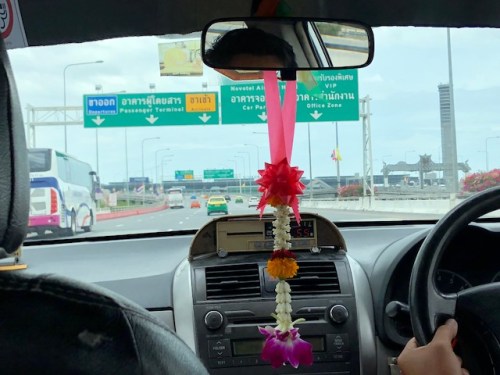 On the elevated expressway link to the international airport. The signs are obviously in Thai.
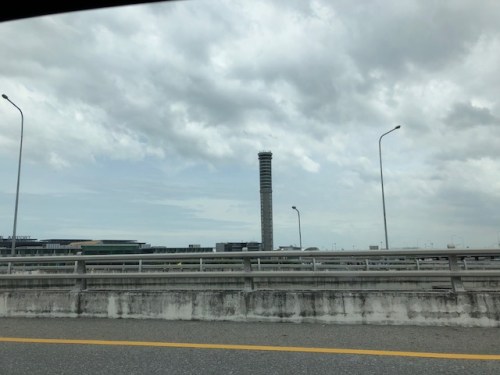 A view of the control tower
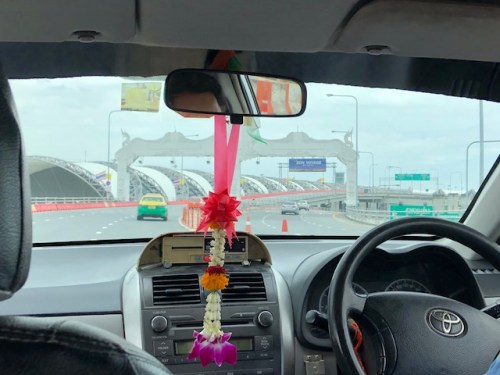 The taxi driver proceeds towards the departure level driveway to the left of the expressway link. The exit ramp to the right is for vehicles heading towards the arrival level driveway.
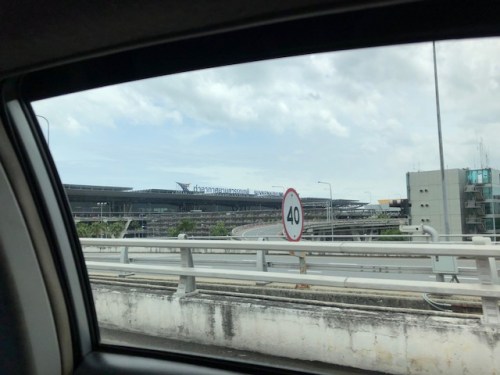 Speed limit for this section is 40 kph.
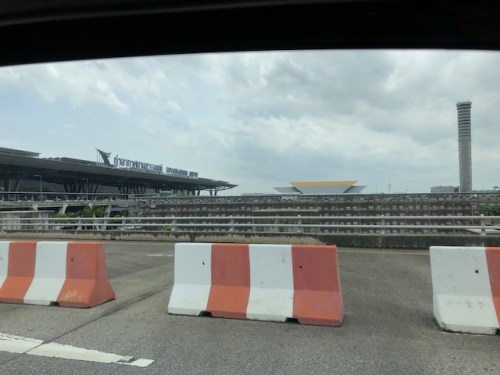 The airport terminal is at left and at the foreground is the multi-level parking facility
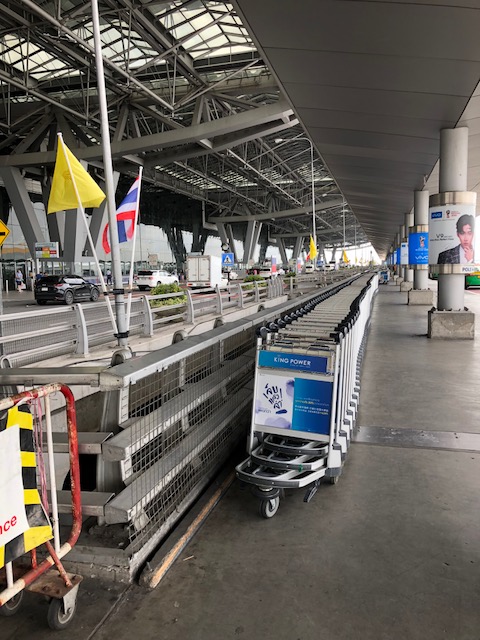 After alighting from the taxi, I took this photo of the luggage carts neatly filed and ready to be taken to the terminal.
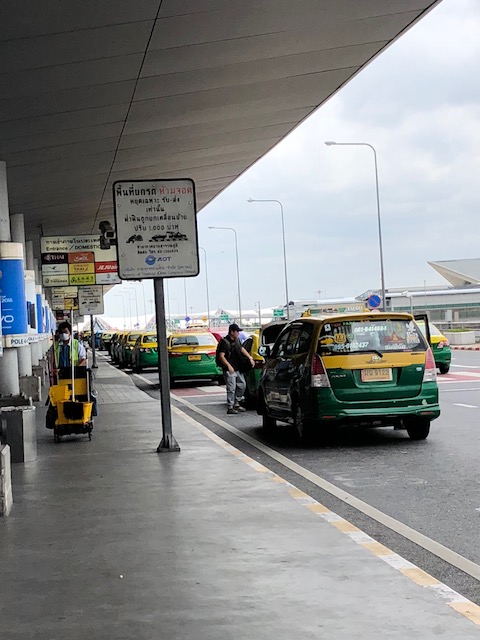 Taxis unloading passengers and their luggage along the driveway designated for public transport.
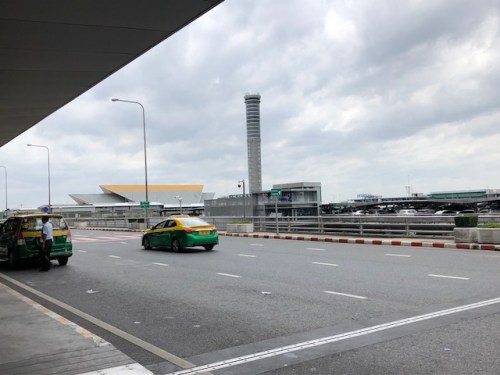 Airport departure level driveway with a view of the control tower and the multi-level parking building
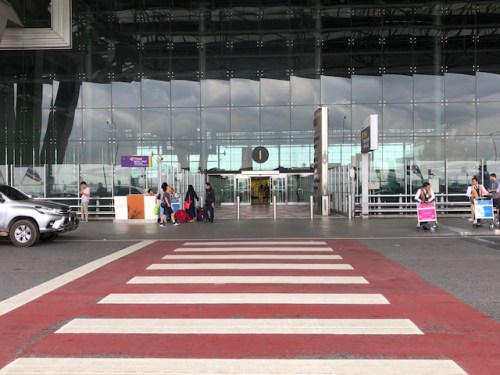 A properly and conspicuously marked pedestrian crossing at the airport
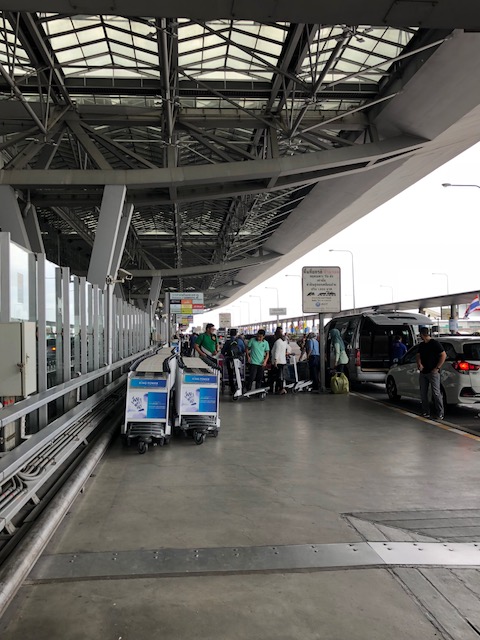 The driveway designated for private vehicles is more crowded
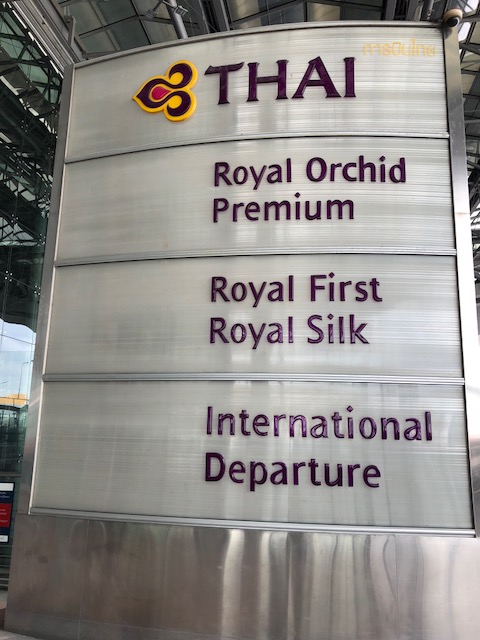 Sign for the national flag carrier whose hub airport is Suvarnabhumi.
More photos next time!
–
 Caught (up) in traffic