
Opinions on traffic – skeptical or objective?
There have been a lot of critics of the current administration for what is perceived as sins of omission in as far as major transport projects are concerned. There are those from the media including some columnists who have written scathing articles about the Department of Transportation and Communications (DOTC) and particularly agency officials who are perceived to be underachieving (to use a more diplomatic term). There are those from the general public who have written about their experiences (e.g., difficulties in commuting, traffic congestion, poor quality of public transport, etc.) and have been able to publish this in popular media. Then there are also netizens who seem to only find fault in everything about transport whether these are posts on solutions or simply observations or honest opinions.
A lot of people offer their take on solutions for transport and traffic problems in Metro Manila. You find these everywhere and especially on social media. Social media is a terrific platform for broadcasting your opinion to your friends and likely to the general public if your posts or tweets become popular and get shared by others. These opinions and assessments may be based on actual experiences (“may pinaghuhugutan” in today’s popular parlance). There are also all kinds of experts including some who have their own agenda or have vested interests. These include former officials of government who criticize the current regime and yet did little during their stints in government. Many overlook (or choose to do so) the importance to provide solutions or recommendations whenever one criticizes. Without such recommendations, the statements are basically rants or whining.
The academe’s role is to provide objective assessments of policies, programs, projects including their planning, design, implementation and even operations and maintenance. Granted that there have been many studies conducted at universities and other research institutions, many of these remain in the shelves of their libraries and offices. It is important for the academe to be active in engaging government agencies in seeking out solutions for transport and traffic problems. Local universities should engage the local governments in their areas for cooperative work. The assumption here is that they are in the best positions to help solve problems in their localities as they are most familiar with the causes of these problems. National agencies like the DOTC and DPWH should support this kind of cooperation at the local level by extending resources to make this work. This follows the model that they have in the US where federal and state government agencies support researches conducted by transport centers of excellence based in leading universities across the country.
–
Technology push?
An acquaintance announced that his company is planning to sponsor an event aiming to attract developers to come up with apps that could help alleviate transport problems in Metro Manila (and probably and potentially, elsewhere). This reminded me of a similar event a few years ago that was sponsored by an international institution that sought to have people come up with applications (apps) that would enhance transport using transport data they have compiled. While the event attracted a healthy number of app developers and arguably came up with some useful software, the impact of such apps on commuting is at best marginal. For one, some apps attempted to reinvent the wheel, so to speak, as one app developed was too similar to the well-established Waze but with an inferior interface. Then there were those which probably could be useful if only most people had smart phones and were dependent on them for their trips.
Metro Manila is at the point when most major arterials are already saturated. Stricter traffic management (as it should be) can only do so much to address congestion along thoroughfares such as EDSA and Circumferential Road 5. Apps that are aimed at enhancing commuting would ultimately be limited as the transport infrastructure is lacking and those proposed or under construction would take time to complete. Yes, carpooling can probably help and an app enabling people to find travel/commuting companions would probably help. But it does not assure participants (both drivers and passengers) of their safety or security and so isn’t for everyone. Apps and similar or related technology pushes are categorized along with other stop-gap or band aid solutions. It might have some positive impact but these are short lived and eventually will not be productive. It definitely though will satisfy a lot of geek or nerdy egos in terms of what they can create that they think can help improve transport or traffic. And I suddenly recall a term used by one of my friends chiding others one night we were engaging in some academic discourse about transportation theory as applied to traffic problems in Metro Manila – “intellectual masturbation” – which seems an apt description for this (app development, etc.) type of exercise. One colleague even made the observation that such efforts only provide an excuse for government not to act on the urgent matter of traffic. Innovation may be welcome but it seems such a waste of time and talent to be solving the unsolvable through apps. (Can someone develop an app to fix MRT trains? Or perhaps solve contract issues of the PPP kind? I think you get my point.)
The main reason why people buy and drive their own vehicles is because these cars and motorcycles enable them from being dependent of public transport, which is generally perceived as having low service quality. While there is a need to manage the demand for private vehicles, restraint without the suitable public transport alternatives (think Singapore or Hong Kong for best practice examples) will not make sense as these punish people for something the government is not able to deliver in terms of transport services. This is a message I have seen in many papers that are the outputs of many studies presented at the recently concluded 11th International Conference of the Eastern Asia Society for Transportation Studies. In fact, this has been a message in past conferences as well. You can find the technical papers in their searchable site at the following link: www.east.info
–
EASTS 2015 – Cebu City, September 11-13, 2015
The 11th International Conference of the Eastern Asia Society for Transportation Studies (EASTS 2015) will be held in Cebu City this September 11-13, 2015. For information on the conference and program, check out their website here:
You can also download a brochure about EASTS here:
The conference is hosted by the Transportation Science Society of the Philippines (TSSP), which is the local affiliate of the EASTS. More information on the TSSP are found below:
–
Misleading information on comparing modes of transport
A major media network sponsored an experiment pitting a bicycle, bus and rail in a race from Trinoma to De La Salle University along Taft Avenue. The bicycle won but under conditions that are favorable to the cyclist even considering Metro Manila’s road conditions that are not bike-friendly (and not pedestrian friendly, too, in many areas).
Would the bicycle have won against a motorcycle where both riders were of similar skills and experiences? Probably not considering the speed of a motorised vehicle even given congested roads.
Would a lot of people consider cycling between, say, Trinoma and DLSU? Most likely not, even if you provide the necessary infrastructure and facilities like bike racks, showers, etc., short of building exclusive bikeways (e.g., elevated).
I have nothing against bicycles and cycling. I have a bicycle myself and I have cycled between my home and the universities when I was studying and a visiting scientist in Japan. However, I have to caution people into thinking and oversimplifying that one mode is better than all others. If we pursue this line of thinking, then perhaps we should include walking in the discussion. I would like to think that there will also be a lot of people who would state that walking (and even running) is better than other modes including cycling. When comparing these two non-motorized modes, however, the advantages of one over the other become obvious – cycling is faster and requires less energy per person traveling using the mode. Such would extend to the motorized modes and comparisons should clearly show the suitability of certain modes of transport over others once distance and capacity are factored into the equation. Thus, we have rail systems as more appropriate over longer distances and are able to carry much more passengers per hour compared to, say, jeepneys. These are even more efficient in terms of energy on a per passenger basis. Further, we have to appreciate that we have to establish a clear hierarchy of transport systems and provide the necessary infrastructure to enable people to have all the options for traveling and especially for commuting.
–
Capability building for traffic management in Metro Manila
The Metropolitan Manila Development Authority (MMDA) has been on the news lately due to the perceived shortcomings of the agency on traffic management in the metropolis. The current administration has designated the Philippine National Police – Highway Patrol Group (PNP-HPG) to take charge of traffic management/enforcement at six identified choke points along EDSA. EDSA or Circumferential Road 4 has been a battleground of sorts for Metro Manila, representing the capital’s transport and traffic woes with just about all the conceivable problems including severe traffic congestion, high incidence of road crashes and a malfunctioning rail line (MRT Line 3) along the corridor.
The agency was criticized when its head went to Cebu City with a team of enforcement personnel in an apparent effort to augment that city’s traffic personnel. Cebu City has its own traffic management unit in the Cebu City Traffic Operations Management (CITOM), which has been managing traffic in that city for quite some time now. They have been actually ahead of Metro Manila with their own traffic engineering center already integrated with CITOM way back in the late 1980s. The traffic signals around the city were already under CITOM when Metro Manila’s Traffic Engineering Center (TEC) was still under the DPWH. It was only in the last decade that the TEC was formally transferred to MMDA and modernised to the current modern facility beside the MMDA headquarters at EDSA-Orense St. in Makati City. People observed that Cebu was already ahead of Metro Manila on this part and that the MMDA already had their hands full with Metro Manila’s traffic woes. The joke among major cities is that they were learning about traffic management and enforcement from Metro Manila by checking what the MMDA was doing. They will do the opposite. These cities in on the joke include Cebu, Davao and Iloilo, which are all highly urbanized cities looking to alleviate their own transport and traffic problems before these become the level of Metro Manila’s.
The MMDA has the capacity for traffic management as it has the resources including staff to manage traffic around Metro Manila. It even has people to spare that the agency can deploy to assist or supplement traffic personnel in adjacent local governments (e.g., in Rizal, Cavite, Laguna and Bulacan). However, capacity does not mean capability. And MMDA clearly has limited capabilities despite the resources at its disposal. In fact, their traffic management group should be integrated if not closely working with their planning group. Transport engineering, planning and enforcement should go together, working cooperatively in order to come up with comprehensive schemes and solutions that address problems that are progressive in nature.
The old Transport Training Center (TTC) of the University of the Philippines was established to build both capacity and capability for government agencies that included the then Constabulary Highway Patrol Group (CHPG) that was under the then Philippine Constabulary/Integrated National Police (PC/INP) headed by the then Gen. Fidel V. Ramos. The PC/INP became the PNP and the CHPG became the Traffic Management Group (TMG) (later becoming the current HPG) but they all trained under the TTC, which became the National Center for Transportation Studies (NCTS).
The MMDA trained under the NCTS since the 1990s but most of those who did so over the years are now out of the agency and working elsewhere (including those who have migrated to other countries). The remaining training graduates have limited capability and some have quite a bit of overconfidence (this probably is a by-product of the BF era when the agency and its staff were basically taught that they were better than their DPWH and DOTC counterparts and everything they did was right). Mix this with what seems to be confusion about what they need to do and the result is quite amusing.
The MMDA recently established an Institute for Traffic Management (ITM) with the intent of providing training for their own staff and those from local government units. This is apparently with the instigation of their consultants who include a few academics without transport planning and engineering expertise and experience yet dabble in it anyway. I think the ITM is not necessary at this point and it is actually not in the agency’s mandate to provide training programs other than to their own staff. MMDA should focus instead on capability building. If not under NCTS or other local entities they can probably get the knowledge and skills required to manage Metro Manila traffic elsewhere and abroad. In fact, I would recommend that they explore programs offered by the Land Transportation Authority Academy (LTA Academy) of Singapore. These are professional programs that have been developed in cooperation with leading institutions in Singapore like the National University of Singapore (NUS) that can provide a fresh infusion of knowledge to the MMDA. But attendance in such programs is not an assurance that the agency can be better afterwards. The key ingredient would still have to be an effective and progressive leadership that is not under the influence of politics and is committed to no-nonsense traffic management even without the media covering these activities.
–
Causes of congestion along Ortigas Ave. Extension
I have written about the common causes of congestion along Ortigas Avenue. The past articles mentioned the undisciplined loading and unloading along the entire stretch of the road and particularly at either ends of the Manggahan Floodway bridge in Pasig City. I have also written about the congestion caused by private vehicles generated by a private school just a stone’ throw away from DOTC headquarters. This time, I focus on Ortigas Avenue Extension, particularly the stretch from Cainta Junction to Valley Golf.
The current and more critical choke points along Ortigas Ave. Ext. are along the stretch of the road between Cainta Junction and Valley Golf. These are due to the road and drainage works along that section that effectively made the westbound side of Ortigas a single lane road between Brookside and Park Place. There are also road and drainage works along the eastbound side between Brookside and Valley Golf where the entire road section is being elevated. This section is flood prone and has been problematic during the wet season when heavy rains often result in flash floods.
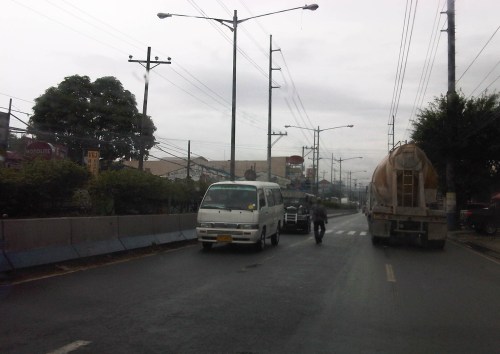 Counter flow along Ortigas Avenue Extension – this scheme has been the only option for the section between Valley Golf and Park Place Subdivision as the work proceeds one lane at a time. At the time, I took this photo, the counter flow lanes allowed for 2 lanes each for both the eastbound and westbound directions of this corridor. The past week, however, I noticed that during the afternoons and evenings, I noticed that two lanes were allocated for westbound traffic while only one was for the eastbound direction. This should not be the case as the peak direction in the afternoon to the evening is eastbound when people are home bound mainly from work and school.
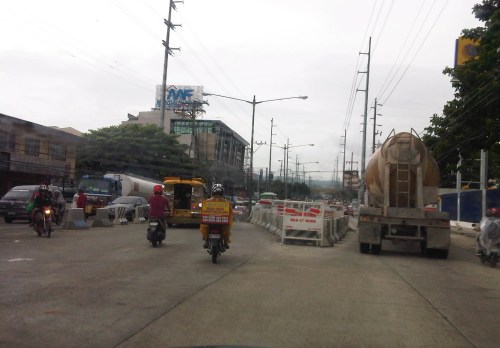 The section across from STI is another choke point as the area is one of the ends of the project raising the elevation of the avenue as well as improving the drainage along the road. The traffic along this area has improved much though vehicles still have to slow down to transition between the old pavement and new pavement sections, as well as vehicles turning towards Hunters ROTC Road.
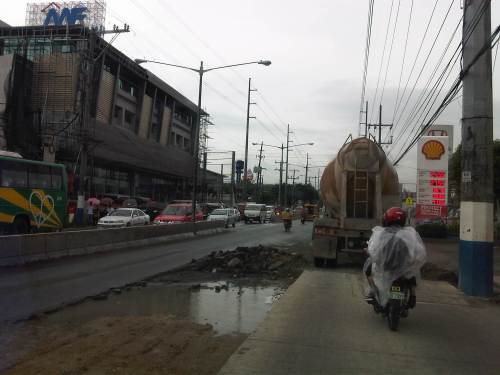 Unfinished sections – at the time this photo was taken, work along the site was intermittent. Commuters making the observation are often frustrated and much disappointed when they see none working along the construction site. The Mayor of Cainta did very well by talking to the contractor and apparently discussing with the latter how to improve traffic conditions as well as how to expedite the implementation of the project. My own observation was that conditions did indeed improve after that meeting (which was related by the Mayor in his Facebook page) and people could see workers busy with the project even at night time.
Traffic will continue to be bad along Ortigas Avenue Extension until this project is completed. While there should be some significant improvement in traffic flow after completion, congestion will again steadily worsen for this corridor whose private vehicle traffic continues to grow. Public transport is provided by buses, jeepneys and UV Express (whose numbers have ballooned during the last 5 years) and these have contributed a lot to congestion because of their drivers’ behavior particularly when they stop for passengers at areas like Valley Golf, Brookside, Cainta Junction, Ever, Countryside, Manggahan and Rosario.
There is hope though as news proclaim that the NEDA Board has approved the LRT 4 project along this corridor. A mass transit system is indeed necessary and this was required perhaps over a decade ago already. I do hope that this ‘LRT’ is more like the current Line 2 trains and stations than the Line 3 kind. Line 2 is a heavy rail system while Line 3 is light rail. The Ortigas corridor requires a heavy rail system considering the passenger demand in the areas that will be served by the transit system. I also hope that Line 4 is implemented like Line 2 with the government taking responsibility for constructing the system. I have maintained my view that the current administration is too fixated with Public Private Partnerships (PPP) that it had practically given up its responsibility to the general public to provide an efficient and equitable means of public transport for commuting. I just now wonder what became of the proposed BRT line along this same corridor. Perhaps the BRT option has already been abandoned by the DOTC in favor of rail?
–
The UP Bike Share project
Students of the University of the Philippines Diliman recently launched an initiative promoting bicycle use in the campus. The UP Bike Share initiative is a welcome initiative that has gotten the support of the community including the UP Diliman administration through the Office of the Vice Chancellor for Community Affairs. Here are some photos of pages of the packet/manual.


You can also check them out at their Facebook page: https://www.facebook.com/pages/UP-Bike-Share/882352095136994?fref=ts
This is an initiative that hopefully will expand especially towards Katipunan and the major schools (Ateneo and Miriam) along that corridor. Perhaps even Teachers’ Village and Sikatuna will be part of a bike share community. It would be nice to see safe bikeways and people on bicycles not just at UP Diliman but a larger area that can benefit from reduced motor vehicle traffic.
–
Some thoughts on Uber in Metro Manila
I had wanted to write something on Uber the past weeks but couldn’t because I wanted to have some visuals to go with the text. And so one time we decided to use Uber, I consciously took some screenshots for the photos that are shown in this post.
After opening your Uber app, you can indicate your pick-up point and you destination. You can see how many Uber drivers are nearby based on the map and the quick reference on screen. You can also check for a fare estimate as well as select the service you want. There are currently only two types of services available in Metro Manila – UberX and Uber Black. UberX is the default service and involves a regular car. Uber Black is a bigger and more ‘luxurious’ vehicle. Of course, you pay more for a better vehicle. Once you have inputted the necessary information for your itinerary, you can put in the request. Success in getting a ride is immediately shown on your phone.

The screen shows that the driver is en route to your pick-up point. Details on your ride are provided including the name of the driver, the vehicle make, model and plate number. The vehicles I have rode on so far are recent models and most have no license plates yet – an indication of how new these vehicles are. Uber is supposed to be screening both the drivers and vehicles being registered to provide their services. One criteria for vehicles is that these are supposed to be recent models and well maintained, what’s perceived to be the opposite of vehicles used as conventional taxis.
During the trip, you can get updates on your progress through the map onscreen. This includes the estimated time of travel until you reach your destination. Information on the driver is also shown including his average rating. Our driver in this example had a 4.6 star average rating. I guess this is good given the star rating scale of 1 to 5 with 5 being the highest rating.

At the end of the trip, you can receive a receipt on your email. The receipt includes details on your fare, the start and end times of your trip, the travel distance and the route taken in map form. Information on the driver and a note for rating your driver is at the bottom of the receipt. Of course, you can save this for future reference and perhaps print it out in case you will be reimbursing the cost of your trip.

After rating your driver, you will receive another message thanking you for rating your driver. Our driver that afternoon was good and drove safely. He wasn’t talkative but was polite and could strike up a conversation (My companion asked a few questions about his driving for Uber in an interview-like manner.).

What you don’t see is how your driver rated you. Uber also asks drivers to rate users and I would guess that this will have repercussions on passengers with bad attitudes. The ratings work both ways as Uber customers should be wary of their potential drivers as well as their own behavior. I suppose that drivers get information on whether a potential passengers is a rude one and may opt to avoid such passengers.
My take so far on Uber is that it is what conventional taxis are supposed to be. I find Uber drivers to be better in terms of politeness and safety in their driving habits. Fare-wise, Uber has been less expensive than Grab Taxi or conventional taxis as you don’t have to bid to get an Uber ride. The Grab Taxi app basically formalizes the bidding process as it asks you how much gratuity (tips) you are willing to give for a ride. I feel that this gratuity feature is a major determinant for taxi drivers choosing their fares and leads to more expensive fares. Of course, I haven’t experienced Uber’s surge pricing yet but friends who use Uber have informed me that this can be quite steep and can hurt your pocket or wallet. Still, I think Uber provides good service but it is not for everyone especially those on a budget or going to a place where roads are generally congested.
–
Running out of answers? How about congestion pricing?
A lot of people ask me about solutions to transport and traffic problems. Some are very general like the question “How do we solve traffic congestion in Metro Manila?” and others are more specific like “How do we solve congestion along EDSA?” These questions are becoming quite tricky because, for one, we are running out of answers of the ‘short term’ kind. All these ‘stop-gap’ or ‘band aid’ measures will only provide short-term relief and we have used many of them already including vehicle restraint measures we are very familiar with like the number coding and truck ban schemes currently implemented in the metropolis.
The general answer and likely an inconvenient truth is that we can’t solve congestion. It is here to stay and is a given considering the continued growth experienced throughout the country. Accepting this phenomenon of congestion, we can proceed towards managing it and work towards alleviating it. Denying that there is a problem or dismissing such as an issue requiring urgent action sets a dangerous course towards unsuitable responses or worse, inaction on the part of the government.
Like cholesterol, there is good congestion and bad congestion. Good traffic congestion is when it is predictable in occurrence and period. For example, the morning rush hour is termed so because it used to last only about an hour or so. Congestion occurring between 7:30 – 8:30 AM is okay but between 6:30 – 11:30 AM is undesirable. The cases between those two vary in acceptability based on the tolerance levels of commuters. In Metro Manila, for example, many people probably have been conditioned to think that 2-hour congestion is okay but more than that is severe. This is actually related to travel times or the time it takes to travel between, say, one’s home and workplace.
And so, are there better options other than a return to the “Odd-Even” scheme? There are actually many other options but they are more complicated to the point that many are unpalatable to people who are in a hurry to get a solution our traffic mess. Note that this is to get out of a hole that’s deep enough already but they still managed to dig deeper the last 5 years. Among these solutions would be congestion pricing.
Singapore offers a successful model for this where tolls vary according to the levels of congestion for these roads. There is a base rate for peak periods when congestion is most likely or expected. The government determines the desirable speed ranges along roads as a basis for congestion charges. Along urban streets, that range may be between 20 – 30 km/h. If speeds reduce to below 20 km/h (i.e., congested) then charges or tolls increase. If speeds increased to above 30 km/h, the rates decrease. The image below is screen capture from a presentation made by an official of Singapore’s Land Transportation Authority (LTA).

Note the item on the scheme being ‘equitable’ that is very essential in understanding how road space must be shared among users and that there is an option to use public transport instead. This scheme, of course, will require a lot of consultations but the technical part should not be worrisome given the wealth of talent at universities, private sector and government agencies who can be involved in the analysis and simulations. Important here also is to determine or institute where the money collected from congestion pricing will go. Logic tells us that this should go to public transportation infrastructure and services. In Singapore, a big part of the funds collected from ERP goes to mass transit including their SMRT trains and buses. Funds help build, operate and maintain their trains and buses. The city-state already has a good public transport system that is subsidized by congestion charges and this system is able to attract people from using their cars especially during the weekdays when transport is used for work and school trips. That way, people who don’t really need to own and use their cars are discouraged from doing so (Note: This works together with Singapore’s restrictive car ownership policies.).
Would it be possible to have congestion pricing for Metro Manila or other cities in the Philippines? Yes, it is and but entails a lot of serious effort for it to work the right way. We can probably start by identifying major roads whose volumes we want regulated, installing sensors for monitoring traffic conditions and tagging vehicles and requiring most if not all vehicles to have transponders for motorists to be charges accordingly. However, there should be an attractive and efficient public transport option for this program to work. Unfortunately, we don’t have such along most roads. Perhaps an experiment or simulation can be undertaken once the LRT 2 extension is completed and operational? That corridor of Marcos Highway and Aurora Boulevard, I believe is a good candidate for congestion pricing.
With the sophisticated software that are now available, it is possible to conduct studies that would employ modelling and simulation to determine the potential impacts of congestion pricing on traffic. It should have a significant impact on congestion reduction even without mass transit systems such as Singapore’s. However, without good public transport, it would be punishing for people who are currently using their own vehicles to avoid taking public transport. I used the term ‘punishing’ because congestion pricing will be a back breaker for people who purchased vehicles to improve their commutes (i.e., they likely were not satisfied with taking public transportation). These are the working people and part of the small middle class whose transport needs should be addressed with urgency.
–
Future of jeepneys?
I spotted a jeepney on my way home with a message (or tagline, depending on how you see it) printed on its side. It says BEEP, which was supposed to stand for Bagong Jeep (translated as New Jeep). From the looks of the vehicle, there was nothing new about it, except maybe this sign that was painted over an older design on the vehicle’s body. Apparently, the tagline does not refer to the vehicle itself but to the image of the jeepney. “Bago” or “New” here refers to a new image for jeepneys. Long regarded as the “King of the Road,” the jeepneys have become synonymous to reckless driving, uncomfortable rides and unreliable services. They have also come to represent unsustainable transport what with most jeepneys being fuel guzzlers and smoke belchers.
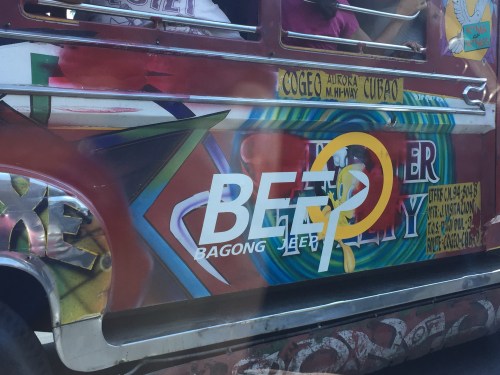 I already spotted several jeepneys plying the Cogeo-Cubao route sporting this sign that’s apparently a campaign to uplift the image of jeepneys. It seems really a stretch to call these ‘bago’ as the vehicles I’ve seen are the same customized bodies with second hand engines running them.
There is a campaign to rehabilitate the image of the jeepneys and perhaps it should start with driver behavior and not necessarily the vehicle. Many jeepney drivers (as well as drivers of other public utility vehicles) have attitudes leaning on the rude side. You see many of them driving recklessly along our roads and stopping just about anywhere (e.g., in the middle of the road). Such behaviour is due to many factors including the way these people learned to drive and their motivations for their means of earning a living. Much can also be said about their education both formal and regarding their driving.
There are also many vehicles vying to be the replacement for the jeepneys and among these are electric vehicles including the electric jitneys that I have featured in past articles on this blog. Incidentally, one of those electric jitneys is actually a more recent model of the electric jeepneys that’re currently in operation in Makati and Alabang, and it happens to be called the Beep. Operating in Filinvest City, the e-jeepneys there have been lauded as a viable option for replacing the conventional jeepneys. So far, so good and time will tell if indeed, conventional jeepneys will be phased out in favor of e-jeepneys. The jury is still out there in terms of the e-jeepney’s reliability and durability.
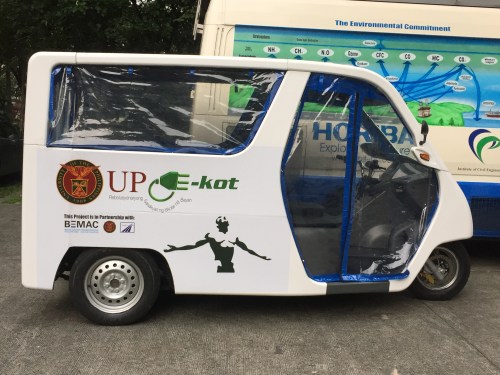 An electric tricycle currently undergoing experimental operations at the University of the Philippines Diliman campus is more a replacement for tricycles and multicabs than for jeepneys.
–
 Caught (up) in traffic