
On maximizing seating capacities of public transport
The restrictions for physical distancing for public transport seems to be easing. The reason for this statement is the observation that passengers of public utility vehicles are no longer one seat apart (less than the ideal 2m distance between people but deemed sufficient with physical barriers installed in the vehicles). If allowed to be seated next to each other (of course with some sort of physical barrier between them), the set-up will increase the allowed passenger capacities of PUVs to at least their seating capacities. Conventional jeepneys will be able to seat the 16 to 20 passengers their benches are designed for and buses, depending on their sizes and seating configurations may seat perhaps 40 to 60 passengers. That doubles or even triples the number of passengers that can be carried by each vehicle from the time these were allowed to resume operations after the lockdowns.
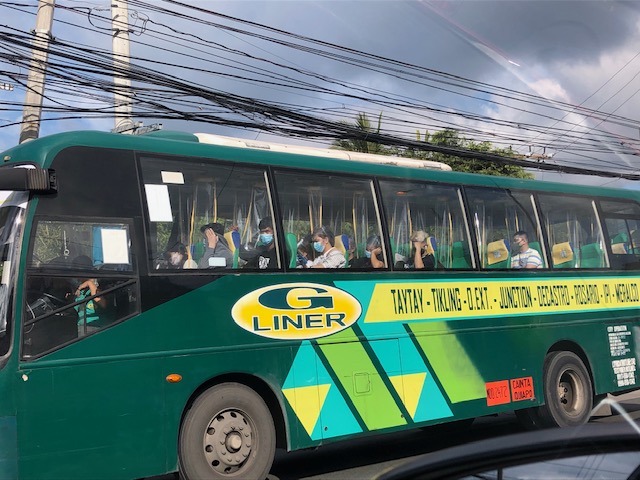
Plastic barriers separate passengers seated beside each other
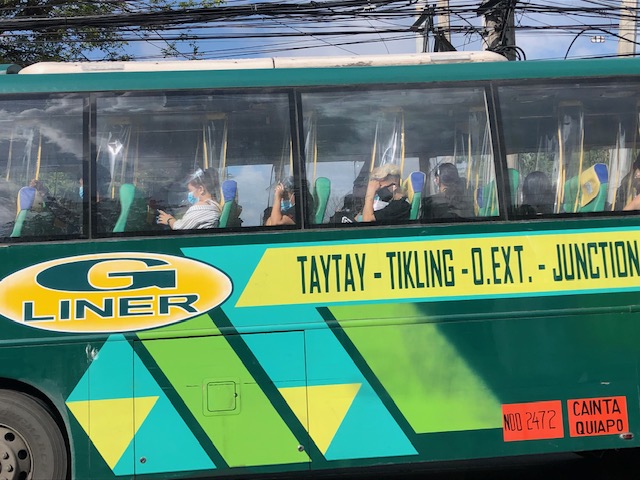
Not all physical barriers are designed and installed to provide whatever protection passengers can get from them. The photos above for a G-Liner bus seems to be the more desirable design as the barriers are practically like curtains. I have seen token plastic barriers installed in jeepneys. I wonder if these even went through some approval process of the DOTr, LTFRB or local government unit. Such inferior designs do not help the cause of promoting public transport use over private vehicles.
–
On the continued lack of public utility vehicle services – some observations
Traveling along Marikina roads en route to my office, I spotted not a few of the minibuses that are being promoted as modernized or modern jeepneys. These are definitely not jeepneys or jitneys but small (or mini) buses. They are airconditioned with seating capacities about the same as the typical conventional jeepneys but with space for standing passengers once these are allowed given the pandemic. There’s a lot near the end of the Gil Fernando Avenue Extension that serves as a depot or parking lot for vehicles that have not been deployed (or sold?). And here are a couple of photos showing these.
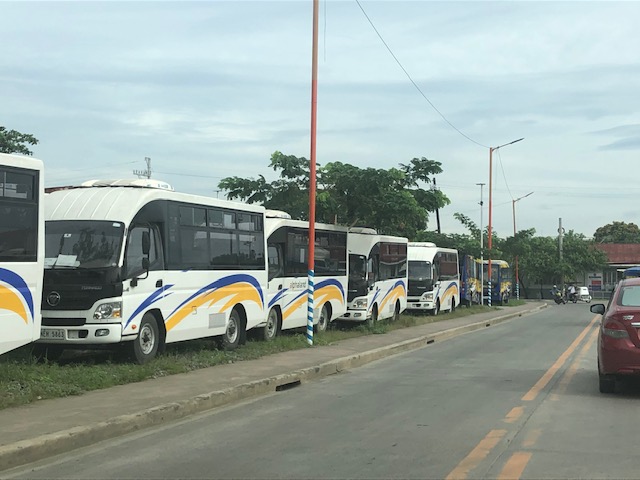
New mini-buses being touted as “modern or modernized jeepneys” parked along the Gil Fernando Avenue Extension connector road.
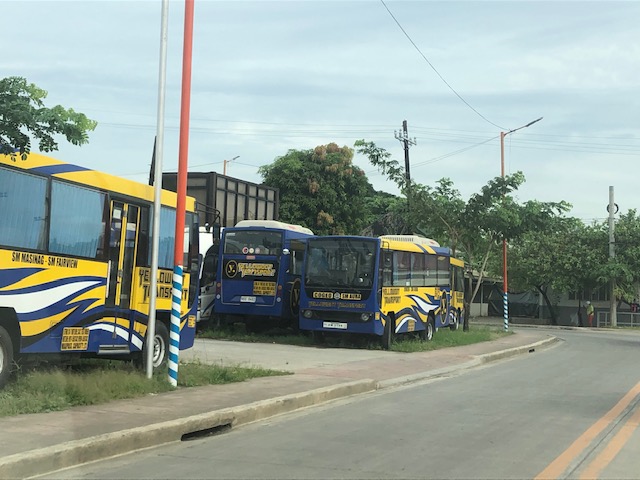
These mini-buses used to ply the SM Masinag – SM Fairview (via Marikina and Batasan) and Cogeo – SM Aura (via Marcos Highway and C-5) routes.
There is a perceived continued lack of public transport supply in Metropolitan Manila and its adjacent cities and municipalities. This is evidenced from the long lines at terminals and stations and the many people waiting for a ride along streets. With the DOTr and LTFRB slowly but surely adding buses, “modern jeepneys” and conventional jeepneys along many old routes and new ones, it may seem that there are enough vehicles. The situation may be summarized as follows:
- The DOTr and LTFRB are taking advantage of the situation to try to rationalize public transport routes under their rationalization program. Certain routes, for example, that were served by conventional jeepneys are now assigned to buses and ‘modern jeepneys’. You can’t exactly blame them for this as the lockdown presented the opportunity to sort of start from scratch in as far as rationalization is concerned. They won’t get another chance at this without stiff resistance from various stakeholder groups.
- PUVs are still limited in terms of allowed/permitted passenger loads due to physical distancing requirements. These are already being eased for both buses and jeepneys but standees are not yet allowed for buses.
- The observed lack of supply is not as widespread as perceived. Commuters along some routes are better off than others. Traffic congestion due to the preference and use of private vehicles by many who used to travel by public transport exacerbates the situation as PUVs are unable to make quick turnarounds thereby making it appear that there is not enough of them operating. Approving and deploying more public transport without exerting efforts to improve confidence in using them will only lead to more congestion and inefficiencies to their operations.
–
Micromobility policy atlas from the Shared-Use Mobility Center
Here’s a quick post sharing a policy atlas on micromobility from the Shared-Use Mobility Center. It looks like this will be something like a work in progress since there surely would be more policies and infrastructure in more cities and countries as micro mobility catches on with people. Already having many users prior to the pandemic, micro mobility, especially cycling, has gained even more during the lockdowns and afterwards when people opted for this mode over public transport (usually because of a lack of it), private cars (expensive), motorcycles (not their thing), and walking (too slow for their taste?).
Here is the link to the atlas: https://learn.sharedusemobilitycenter.org/atlas/?
–
Non-motorized logistics
The pandemic and the resulting lockdowns led to people rediscovering what is now termed as active transport modes – walking and cycling. Not that these modes were not being used for travel as usually they, especially walking, represent the last mile/kilometer mode for most people. With the absence or lack of public transportation or service vehicles (e.g., free shuttles for frontliners, office service vehicles, etc.), many people turned to cycling. Perhaps one area outside of commuting where bicycles have plenty of potential (and I use the word ‘potential’ here because it is not yet as widespread as motorcycle use) is for delivery services. It is the general perception that there has been a surge in deliveries for various items especially food from restaurants. Why not employ bicycles either to supplement or augment the usual motorcycles used for such purposes? I took the following photos showing an example of deliveries using bicycles.
 Jollibee delivery rider on a fat bike
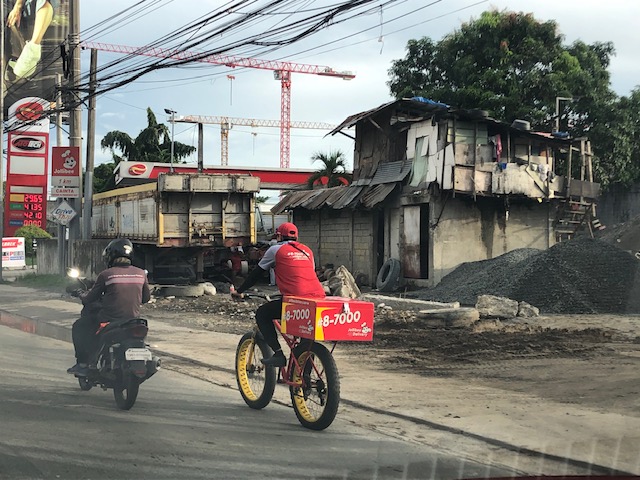 The bicycle rider compared to a motorcycle rider – the bike is just about the same size as the motorcycle, only higher/taller due to the large wheels on the bicycle. The carrier or box is also larger than the typical carrier as it is for transporting food that can be of a large quantity or even multiple orders if these are in close proximity to one another.
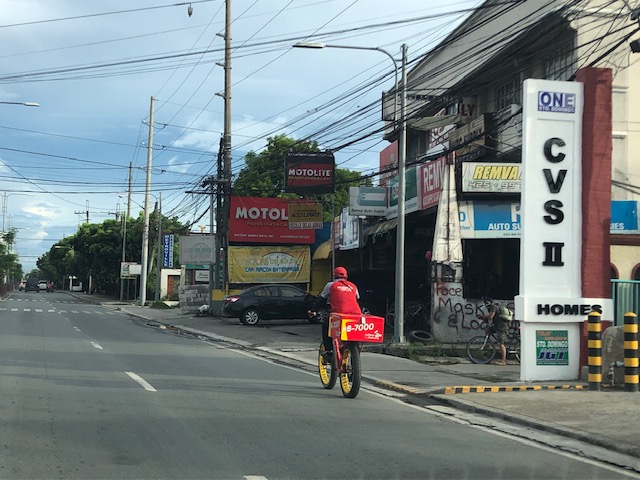 Fast-food delivery via bicycle along Felix Avenue in Cainta, Rizal
–
The FVR Road and Bridge after Typhoon Ulysses
This is a continuation of the feature on the aftermath of Typhoon Ulysses (Vamco). I am posting this here as part of my archives on the floods in the Marikina Valley.
There’s a road branching off from Marcos Highway that links to a bridge crossing the Marikina River and connects with the FVR Road along the Marikina Riverbanks. The following photos speak for themselves in as far as the mud and garbage that was left after the floods subsided.
 Descending from Marcos Highway, only one of two lanes are passable after heavy equipment moved tons of mud and garbage to the roadsides. The fences trapped a lot of garbage, too, as seen in the photo.
 Piles of mud and garbage at the service road leading to the east bank of the Marikina River and the SM Marikina access road.
 Under the Marcos Highway Bridge, garbage, mostly plastics, remain on the wire fences. This area was totally submerged during the height of the floods with water reaching the underside of the bridge. Fortunately, the bridge seems undamaged.
 Even lamp posts and electric poles caught a lot of garbage.
 The Olandes housing development was surely affected by the swelling of the river.
 The FVR Road leading to C-5 is already clear for 2-lane traffic but you can see the mud and garbage all around. The dried mud has turned into dust (alikabok) that blows away as vehicles pass through the road. There is also mud on the plants in the median planters as this area was also submerged during the height of the typhoon.
–
On transportation equity
Here’s another quick share of an article on transport equity:
McQuaid, H. (November 23, 2020) “Equitable Transportation Starts At Community Level,” CT News Junkie, https://www.ctnewsjunkie.com/archives/entry/20201123_equitable_transportation_starts_at_community_level/
How many times have I heard and read about people talking about the concept of “dignity of travel” or “dignity of transportation” referring to the quality of our commutes in terms of the quality of transport services available to us. The article also talks about societal exclusions and biases that sometimes we only attribute to America but in reality are also applicable here based on how we regard people from the rural areas or our being regionalistic.
–
More parks and trees = longer lives
Here is an article about a topic that seems unrelated to transportation but is actually strongly related to it. We already know about the benefits of tree-lined boulevards and parks as lungs of a town or city. The following article discusses the benefits and advantages of having more parks and trees.
Yanez, E. (November 19, 2020) “More Parks, Longer Lives,” Parks and Recreation, https://www.nrpa.org/parks-recreation-magazine/2020/december/more-parks-longer-lives/
I suddenly recall what were tree-lined national highways across the country. Many of these trees were cut down to give way to road-widening projects of the national government through the Department of Public Works and Highways (DPWH)., Nevermind that the widening was not really required in many if not most cases, and that the trees were never replaced or was there ever an effort to do so. The results have been disastrous in terms of the environments along these roads. Transport systems can also be developed with parks and trees in mind; especially if active transport were the focus of the development. Surely parks and trees will enhance the environment and encourage more people to walk or cycle. This should translate into better overall health and wellness for people.
–
Tumana during and after the flood
I was heading to the office the Monday after Typhoon Ulysses had devastated wide areas in Luzon. I was aware of the congestion along my usual routes so I used Waze to guide my trip. Waze took me to Tumana instead of Marcos Highway, which I assumed would have been less congested. I took the following photos in the Tumana area:
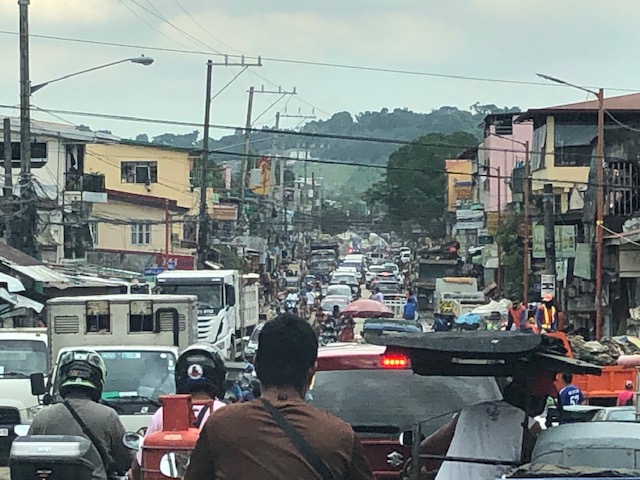 Congested main road due to heavy equipment like bulldozers, backhoes and dump trucks clearing the mud and trash in the area. There were also lots of parked vehicles along each side of the road including Marikina service and emergency vehicles.
 There was trash all around that included what looked like the belongings of people residing in the area. Many people were busy clearing their homes of items destroyed or damaged by the floodwaters.
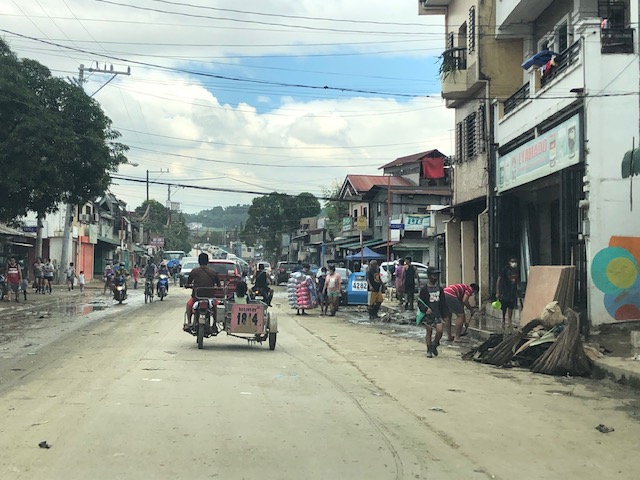 Despite being cleared for traffic, you can see the mud and water still in the area and signs of how deep the flood waters were by markings on the buildings.
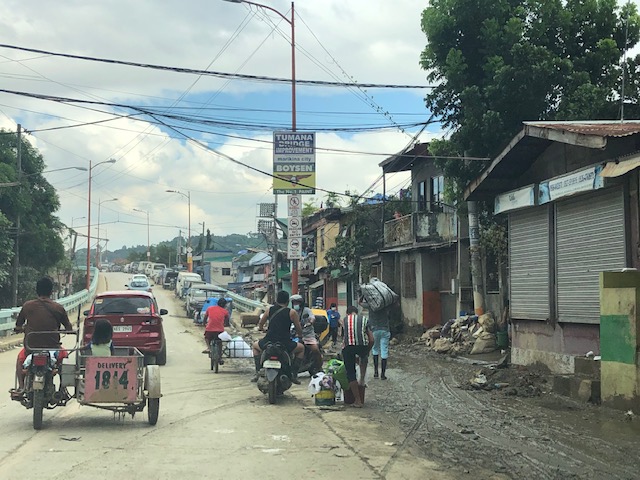 At the foot of the bridge connecting to Quezon City, you can see that there is still so much mud in many areas especially those closest to the river. Sidestreets were so narrow that the heavy equipment cannot enter them and cleaning the mud had to be done entirely manually.
 Here are what looks like the vehicles that survived the floods. I thought people must have rushed to get their vehicles on the best positions atop the bridge when they realized the waters were rising fast. It was likely few if anyone left their vehicles there during the height of the typhoon. That’s because the winds were so strong that perhaps people though it would be unsafe to leave their vehicles exposed to the winds.
The following photos from Facebook shows the extent of the flooding that reached the other side of the river – Loyola Grand Villas and another subdivision that’s directly along the banks of the Marikina River. The first photo shows the submerged end of the bridge from the LGV side in the foreground and Tumana in the background at the other end of the Tumana Bridge. The second photo is atop LGV and shows many submerged homes and cars.
 Only the cars on the bridge likely survived the floods.
 This was definitely at the level of the floods of Typhoon Andy (Ketsana) given the spread and depth of the floods.
One wonders what is now the return period for these typhoons. Ondoy was 11 years ago and the monsoon (Habagat) rains that also brought heavy rains and floods were in 2012 (8 years ago). Such floods cannot be solved by improving drainage systems alone but have to go to the root cause of flooding while also addressing how people could cope with these phenomena. Infrastructure alone cannot solve this and certainly will cost a lot for any initiative to provide some relief from such.
–
Walk, walk, walk
When I was living in Japan in the late 1990s and again in the early 2000s, I recall walking a lot every day. I felt healthy then not just because I thought I ate well but I had a lot of exercise, too. I consciously walked and jogged in the mornings and/or afternoons depending on the weather. And my commute included walks between my train station and the university. The following article seems to support what should be a healthy lifestyle without gym time.
Okumura, K. (November 6, 2020) “How Japanese People Stay Fit for Life, Without Ever Visiting a Gym,” Medium.com, https://kokumura.medium.com/how-the-japanese-exercise-to-stay-youthful-be2d6105e6e6.
I tried to estimate the number of steps I took on average each day. It seems I could easily make more than 10,000 steps everyday as I usually walk more than 6,000 steps for my commute and the typical walks in and around campus (including lunch time strolls with friends). My morning and afternoon walks can match this 6,000 steps. These can even be more during weekends when I’m out in the city or in Tokyo to be with friends. These steps seem nothing then and I loved to walk around partly to keep my sanity while studying there.
When I was visiting researcher later at another university, my step count was about the same if not higher. The only difference perhaps between Yokohama and Saitama was that I had a bicycle when I was in Saitama. The bicycle increased my range and I took the bicycle lent to me by friends to dome groceries or explore the nearby wards. Those were the days, I guess, that I wished I still have now in terms of more active transportation.
–
On super-spreaders
This seems like a non-transport post but it is, actually. Since the start of the pandemic, one of the biggest concerns have been the so-called super-spreaders. These are people who are usually asymptomatic of the COVID-19 virus and as such have been going around seemingly oblivious to their impacts on other people who may not be as resistant (somehow) as they are. These people might not be aware of their being carriers of COVID-19 and yet exercise little or no restraint or care in their movements.
Cox, C. [November 10, 2020] “The Vulnerable Can Wait. Vaccinate the Super-Spreaders First,” Wired. https://www.wired.com/story/covid-19-vaccine-super-spreaders/?bxid=5bd6761b3f92a41245dde413&cndid=37243643&esrc=AUTO_OTHER&source=EDT_WIR_NEWSLETTER_0_DAILY_SPECIAL_EDITION_COVER_ZZ&utm_brand=wired&utm_campaign=aud-dev&utm_mailing=WIR_Daily_111020_Special_Cover&utm_medium=email&utm_source=nl&utm_term=WIR_Daily_EXCLUDE_PaywallSubs
One wonders how many super-spreaders are there among us in the Philippines considering many people have practically disregarded other people’s safety vs. COVID-19 by moving about without necessity and application of best practices like distancing and the use of masks and shields.
–
 Caught (up) in traffic